Chapter 1: Ms. Marlowe's Perfect Morning
Ms. Marlowe liked mornings the way she liked pencils: neatly lined up and ready to work. She arrived before the hallway lights stopped yawning. Her classroom smelled faintly of paper and soap, like a clean notebook.
First, she straightened the reading rug so its stars pointed north. Then she placed the day's schedule on the board in tidy handwriting:
Morning Meeting. Math. Recess. Debate Practice. Science. Story Time.
On each table she set a small tray: sharpened pencils, an eraser that looked like a tiny marshmallow, and a stack of “thinking cards” with words like Breathe, Pause, Try Again.
“Good morning, room,” she whispered, as if the chairs and desks were her sleepy pets. The class plant, a brave little fern named Fred, got a drop of water. The class fish, Captain Bloop, got two flakes and a serious nod.
When the students arrived, the room filled up with backpack zippers and shoe squeaks and the warm buzz of new ideas.
“Morning, Ms. Marlowe!” called Jada.
“Morning!” said Amir, waving so hard his sleeve tried to fly away.
Ms. Marlowe smiled. “Welcome, Team Room 12. Let's park our backpacks, check the schedule, and start with our calmest voices. Today we'll practice a debate.”
“A debate?” Leo asked, eyes bright. “Like… arguing?”
“Like thinking out loud with manners,” Ms. Marlowe said. “It's not about winning. It's about listening and learning.”
The children groaned a little and grinned a lot. That was a good sign. It meant they cared.
Chapter 2: The Mystery of the Missing Markers
During Morning Meeting, Ms. Marlowe opened the “question jar.” Inside were paper slips with curiosities like Why do cats purr? and How do clouds not fall?
Today's slip said: How does a teacher plan a whole day?
Amir read it aloud. “How do you remember everything?”
Ms. Marlowe tapped the schedule with her marker. “Organization,” she said. “I plan like I'm packing for a trip. You don't want to forget your toothbrush—or your math lesson.”
Jada pointed at the board. “So you have a list.”
“A list, a timer, and a few surprises,” Ms. Marlowe said. She held up a small notebook covered in stickers. “This is my teacher planner. It tells me what we're learning, what you might need help with, and when we should stretch our brains.”
Leo leaned closer. “Do you plan recess?”
“I plan to let you run like joyful wind,” Ms. Marlowe said. “That counts.”
Then came the first surprise—only it wasn't the fun kind.
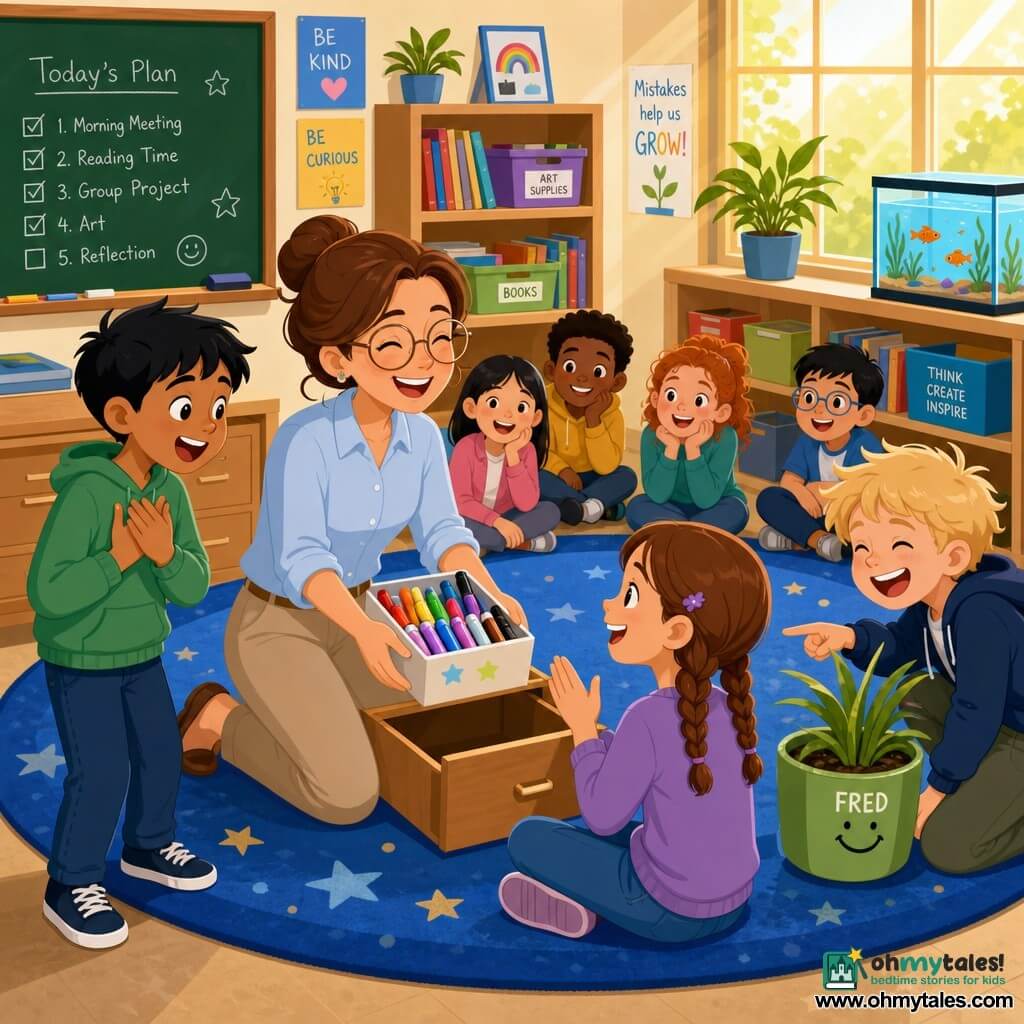
When it was time to make debate posters, Ms. Marlowe opened the marker box. It was empty.
Empty like a cookie jar after Dad “just tastes one.”
She blinked once. Then twice. Her classroom was organized. Markers didn't simply vanish. Markers were not allowed to have adventures without permission.
“Okay,” she said, voice steady. “We have a small mystery.”
“A marker thief!” Leo whispered dramatically.
“A marker ghost!” Jada whispered back, equally dramatic.
Ms. Marlowe lifted a hand. “We can solve this calmly. Teachers solve many problems: missing supplies, tricky math, hurt feelings, and sometimes… loose glitter.”
Amir raised his hand. “Could we use the thinking cards?”
“We could,” Ms. Marlowe agreed, pleased. She placed three cards on the rug: Pause, Breathe, Look Again.
The class paused. They breathed. The room got quieter, like a pond after someone stops skipping stones.
“Now,” Ms. Marlowe said, “let's look for clues. Where do we keep markers?”
“In the art shelf!” several voices answered.
They searched the art shelf—only crayons and a dried-up glue stick sat there like they had no idea what the fuss was about.
They checked the supply cabinet. They checked the reading corner. Leo even peeked under Fred the fern's pot.
Amir opened a drawer and gasped. “Ms. Marlowe! I found them!”
Inside the drawer were the missing markers, stacked neatly beside a stack of blank paper.
Ms. Marlowe's cheeks warmed. “Ah,” she said softly. “It seems the marker ghost is… me.”
The class laughed, but it was a friendly laugh, like a blanket being shaken out.
Ms. Marlowe chuckled too. “Teachers make mistakes,” she said. “And when we do, we fix them and keep going.”
She clicked the cap onto a red marker. “All right. Debate posters, here we come.”
Chapter 3: The Great Debate Practice
After recess, cheeks pink and hair full of playground air, the class gathered for debate practice.
Ms. Marlowe wrote the topic on the board:
Should homework be shorter?
A cheer rose like popcorn.
“Remember,” Ms. Marlowe said, “a debate has rules. We take turns. We use calm voices. We listen, even when we disagree. And we respond to ideas, not to people.”
She set a small sand timer on her desk. “This timer is the talking turn. When the sand runs out, we switch.”
Jada was on the “Yes, shorter” team. Leo was on the “No, keep it” team—mostly because he liked being dramatic.
Amir was the “moderator,” which meant he would say things like “Please begin” and “Thank you for your point” with a very serious face.
Ms. Marlowe handed out sentence starters on cards:
I agree because…
I disagree because…
Can you explain more about…?
One example is…
“Teachers use tools,” she explained, tapping the cards. “Not just rulers and pencils. We use words to help us be kind and clear.”
The debate began.
Jada stood. “I think homework should be shorter because kids need time to rest and help at home.”
Leo stood next, holding his card. “I disagree because practice helps your brain get stronger, like lifting small weights. Also, my grandma says reading every day is good.”
A few students murmured. One whispered, “He said weights,” like that was hilarious.
Ms. Marlowe noticed the noise starting to grow, like a radio turning itself up.
She raised her hand. The class knew the signal. Hands rose, voices fell.
“Strong start,” Ms. Marlowe said. “Let's remember: calm bodies help calm brains.”
The timer flipped again. Sand slipped down like tiny minutes.
Amir cleared his throat. “Next speaker.”
As the debate continued, opinions bounced around the room like rubber balls—fun, but sometimes a little wild. One student interrupted. Another rolled their eyes. Someone sighed loudly enough to be heard in the next town.
Ms. Marlowe walked to the “calm corner,” where a small poster showed a traffic light.
Red: Stop.
Yellow: Breathe.
Green: Speak kindly.
She pointed to yellow. “Class,” she said gently, “our feelings are getting loud. That happens in debates because we care. Let's take three slow breaths together.”
They did. Inhale… like smelling hot cocoa. Exhale… like blowing on it so it doesn't burn.
The room softened.
“Now,” Ms. Marlowe said, “we try again. If you feel like interrupting, press your lips together and squeeze your hands under the desk. That's a ‘wait muscle.' We can train it.”
Leo grinned. “My wait muscle is tiny.”
“We all start somewhere,” Ms. Marlowe said.
The next round went smoother. Students used the sentence starters. They asked questions. They nodded when someone made sense.
When the debate ended, Ms. Marlowe clapped once. “I'm proud of you,” she said. “Debating is hard. You practiced self-control, and you used respectful words.”
She looked around the circle, making sure everyone felt seen.
“And I especially want to thank you for your calm efforts during the debate,” she added. “I saw you pause before speaking. I saw you breathe. I saw you listen, even when you disagreed. That is real strength.”
The students sat a little taller, as if someone had filled them with a warm, invisible balloon.
Chapter 4: A Teacher's Quiet Superpowers
Later, during science, Ms. Marlowe showed them how to build simple paper bridges. She didn't just hand out instructions—she watched faces.
Teachers, she often thought, were part planner, part coach, and part feeling-detective.
When Leo's bridge collapsed, he frowned so hard his eyebrows tried to touch.
Ms. Marlowe crouched beside him. “What's your feeling right now?” she asked.
“Angry,” he said. “It keeps failing.”
“That makes sense,” she said. “Anger is your brain saying, ‘I wanted this to work.' Let's use it as fuel, not fire. What's one thing you could change?”
Leo stared at the paper. “Maybe… make the legs wider.”
“Great idea,” Ms. Marlowe said. “Try that.”
Across the room, Jada helped Amir fold his bridge. “Like this,” she whispered. “Gently.”
Ms. Marlowe made a note in her planner: Jada—great teamwork today.
This was another teacher job: noticing. Not just test scores, but tiny brave moments. A shy hand raised. A kind word. A student taking a breath instead of shouting.
When the bridges were tested, some held pennies like champions. Some drooped like sleepy dogs. But every student learned something.
“That,” Ms. Marlowe said, “is what I love about teaching. We don't need perfect. We need progress.”
The final bell crept closer. The classroom began to gather itself: papers stacked, chairs tucked in, pencils returned to their trays like little soldiers.
Ms. Marlowe stood at the door as students lined up. “Before you go,” she said, “tell me one thing you did today to manage a big feeling.”
Amir said, “I breathed when I wanted to yell.”
Jada said, “I listened even when I disagreed.”
Leo said, “I used my wait muscle. It grew… one millimeter.”
Ms. Marlowe laughed softly. “That's a fine millimeter.”
Chapter 5: The Last Light and Tomorrow's Laughter
When the room finally emptied, it was quiet again, but not lonely. It was the good quiet, like a book waiting to be opened.
Ms. Marlowe erased the board carefully, leaving a faint cloud of chalk dust. She set out tomorrow's math cards. She refilled the marker box—this time, she placed it in the correct spot and gave it a firm, friendly pat.
“No more secret drawer vacations,” she told it.
Fred the fern stood proudly in the window. Captain Bloop floated in gentle circles, as if drawing invisible spirals of calm.
Ms. Marlowe sat at her desk and opened her planner. She wrote:
Debate practice: improved calm voices.
Emotion tools used well.
Remember: move marker box back after posters (again!).
She paused and listened to the building settle. Somewhere far down the hall, a custodian's mop squeaked like a shy mouse.
Ms. Marlowe turned off the lamp, leaving only the hallway light spilling in, soft as moon milk.
She thought about the day: the missing markers, the bouncy opinions, the breaths taken together, the bridges that fell and rose again.
Teaching wasn't just explaining things. It was guiding a whole roomful of hearts and minds, helping them learn how to learn—and how to be with each other when feelings got big.
At the door, she looked back once more at the empty desks. She imagined tomorrow: new questions, new mistakes, new chances.
And, most of all, she imagined the laughter that would arrive with the morning—bright, bubbling, and ready to learn.