Morning Circle and a Little Plan
The classroom smelled of paper and lemon cleaner. A sunbeam lay across the carpet like a warm bookmark. He opened the door with a calm smile that had become a small rule: smile, breathe, listen. The children came in, shoes in a neat parade, coats hung like tiny flags. He gathered them in the circle—every morning was the same, and every morning felt new.
“Good morning,” he said. His voice was steady like a safe boat. “What would you like to learn today?”
Hands popped up like daisies. Some children tugged the sleeve of the class delegate, Sam, who sat upright as if he wore a little crown of responsibility. Sam loved to know the schedule. He liked to say, “We start with stories, then we do maths,” as if the days were trains arriving on time.
The young teacher—Mr. Ellis, though he preferred simply “teacher” when they were together—listened. He listened when Mei wanted to learn more about stars, when Luca asked if they could paint without lines, and when Fatima suggested building a tiny museum for lost pencil toppers. He listened slowly and then nodded, because listening was his favorite kind of planning.
“We'll do something special this week,” he announced finally. He had promised to make the school feel like a garden where ideas could grow. “We'll have workshops in small groups. Each group will explore something you love. And on Friday, we'll invite parents to see and join.”
Sam nearly bounced off his chair. “Can I be the leader?” he asked, proud and precise.
“You can be the delegate who helps organize,” Mr. Ellis said. “You'll be the ears of the class. You'll listen and tell us what they need.”
Sam puffed with pride, as if someone had gifted him a medal made of words. The children cheered softly—this was an ordinary enchantment: the promise of making something together.
They began to make a plan. Each child whispered into a small paper boat—a folded piece of notebook paper—and they sailed those ideas into a glass jar on the windowsill. “Art,” wrote Mei. “Science experiments,” Luca. “Story theatre,” Fatima. Mr. Ellis listened to each idea and gently suggested ways to create groups where everyone could help.
That afternoon, the classroom felt like a beehive. Names were pinned under headings: Paints and Brushes, Little Scientists, Story Garden, and Tidy Helpers. Sam looked at the list and announced, “We'll meet every morning and check with our parents before Friday.”
“Good,” Mr. Ellis said. “And remember, listening comes first. We will listen to each other when we have an idea, and we will listen to our parents on Friday.”
They practiced a little ritual: fingers on the chest, whispering the word “listen,” and then a small clap that sounded like a tiny drum. The ritual made them feel like guardians of a secret: kindness.
The Parents' Evening with Cakes and Questions
When Friday arrived, the classroom had turned into a honey-sweet open house. Little projects were pinned on strings across the room like bunting. Parents arrived with warm faces and warm jars of jam. There were cups that chimed and a big bowl of cookies that smelled like holidays. Mr. Ellis put out name tags and a board with the workshop schedule written in careful, looping handwriting.
“You did all this?” a parent asked, amazement soft in her voice.
“We planned it together,” Mr. Ellis said, and he listened as she spoke about how her child loved colours at home but was shy at school. He wrote notes, not to judge but to remember.
The parents started to circulate. They sat at small tables where children explained their ideas. Sam stood tall and practiced his proud announcement: “Welcome to our workshops. You can join us or just watch.” His voice wobbled once, and a father in the corner smiled and clapped.
There were quiet conversations too. A mother asked, “How do you split the groups so everyone feels included?”
Mr. Ellis had expected that question. He explained simply, “We listen first. Then we ask the children what they enjoy and where they think they can help. Sometimes children surprise us by wanting to try things they thought they couldn't.”
“Like my niece who couldn't sing last year and now plays the recorder,” one parent said, and the room filled with small, gentle laughter.
As the parents nodded, a few offered to stay and help. One parent, who knew how to bake, offered to help with the final snack. Another, who loved gardening, said she could bring herbs for the science table. Mr. Ellis accepted each offer with gratitude, and he listened as Sam took notes on a little clipboard as if he were a tiny secretary of ceremonies.
The meeting warmed into a convivial hum. Parents moved between tables tasting small biscuits, listening to their children explain a project. Mr. Ellis listened closely to each suggestion and adjusted the plan: story theatre would have a parent reader, the science group would get extra magnifying glasses, and the art group could use the cafeteria's extra poster boards.
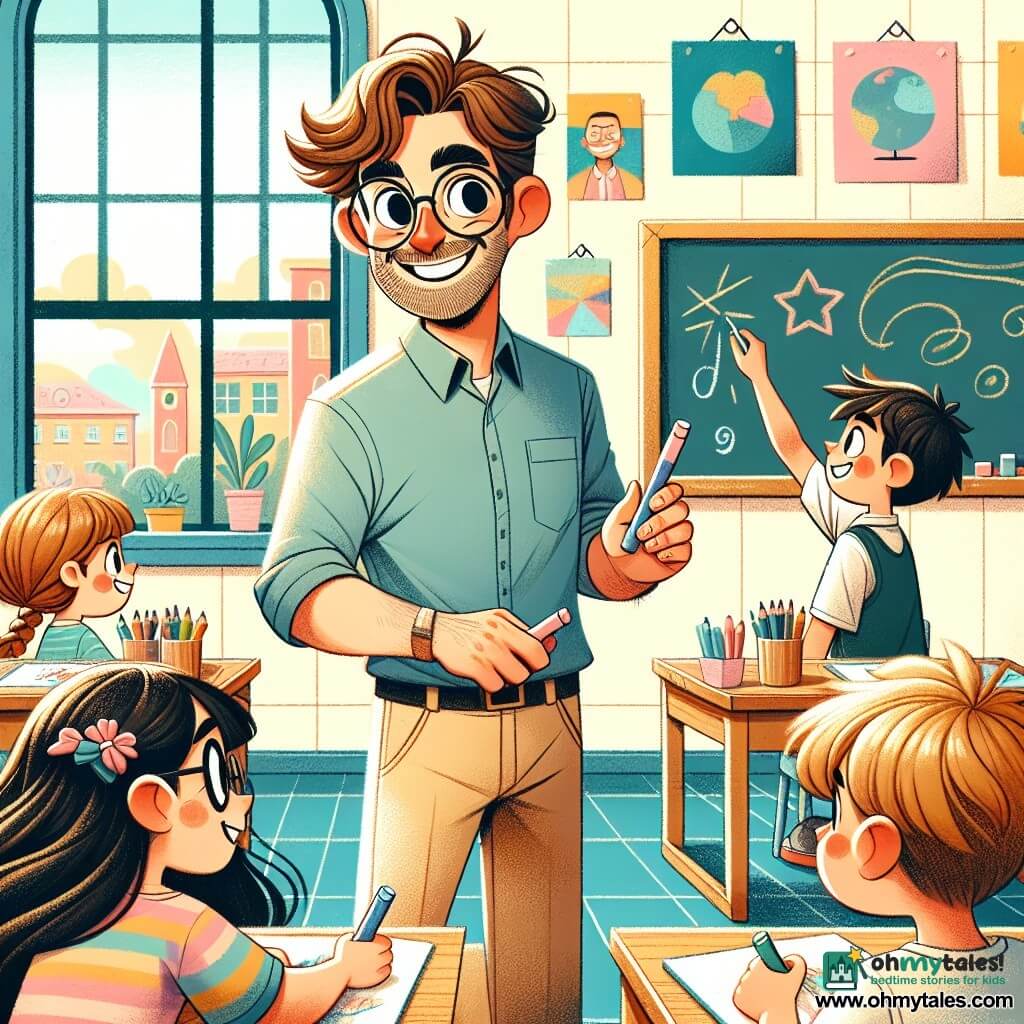
Then the bell rang softly in the distance. It was time to return the children to their seats for a short demonstration. Mr. Ellis wanted to show how a tiny lesson could be a doorway to a big idea. He picked up a piece of chalk.
The Chalk Breaks and a New Idea Blooms
He walked to the blackboard and tapped the chalk to make a loud little start. “When we write together—” he began, and then, with a small, ordinary snap, the chalk broke clean in half. A pin-drop of white dust fluttered down like a slow snowflake.
A hush settled for a heartbeat. The room could have turned awkward, but Mr. Ellis smiled and held the two pieces like treasure. “Well,” he said, “the chalk has a story too.”
Sam blurted, “We need a new piece!”
“We could borrow one,” someone suggested.
Mr. Ellis set the broken pieces on the table and asked, “What else could we do? How could this change our plan?”
The children thought. They had been taught that broken meant ruined. But Mr. Ellis had taught them to listen to the question first. Hands rose. Mei suggested using the small pieces to draw tiny details, like freckles on a ladybug. Luca said the broken piece could make thin lines for maps. Fatima imagined the chalk pieces as wands for a story about a mountain that split to let a river through.
Listening to them, Mr. Ellis realized the accident might be the very key to their workshops. “What if each small piece of chalk becomes a station?” he asked. “We'll make tiny groups using tiny tools. Small pieces for small tasks. We'll see how different shapes help us create different things.”
Parents leaned in, intrigued. “That's clever,” a mother said. “It teaches resourcefulness.”
He rearranged the room on the spot. The big art table split into two: one for broad strokes with paintbrushes and paper, another for delicate chalk drawings with the little broken pieces. The science station traded a big beaker for careful measuring tubes. The story theatre traded a long script for small cards with single lines so every child could hold a piece. Sam helped tape signs and assign helpers, his face shining with the glow of doing something important.
Throughout, Mr. Ellis listened to murmurs and objections. “But what if someone's piece is too small?” a child worried.
“We will share,” Mr. Ellis replied. “And Sam will check everyone's needs at the start of each session. Listening will be our rule.”
The change felt like rearranging furniture in a room to let sunlight reach a plant. It was simple, but it made possibilities bloom. The parents clapped quietly. They liked seeing a teacher adapt and children lead.
Workshops, Little Miracles, and a Snack to Finish
The workshops began as the clock chimed. Small groups drifted between stations like little flocks of curious birds. At the chalk table, Mei traced a pattern of tiny stars with the short piece, and a parent leaned in to say, “Look how careful she is.” The science group watched a vinegar and baking-soda volcano fizz not in one great roar but in gentle, careful bursts, each child measuring different amounts. They learned that some reactions are like whispering conversations, not shouts.
Sam moved between groups with his clipboard. He asked, “Do you need another tool?” and listened to the replies, scribbling down names and needs. He beamed when a shy pair found joy in mixing colours because a parent had joined to guide their hands. “Thank you for listening,” the child whispered to the parent, and the parent's eyes filled with a soft kind of pride.
At the story theatre, Fatima read a single line and then handed the next line to a parent who read in a voice like warm bread. The theatre was small and friendly; parents and children laughed over invented voices. In each space, Mr. Ellis sat back and watched, ready to step in but choosing to listen first. When a disagreement bubbled—whose drawing should go on the wall?—he asked each child to explain their idea. Listening transformed the argument into a negotiation. They decided to make a “gallery of many hands,” where every hand left a mark.
The day moved through soft cycles: work, rest, share. They had small rituals to hold them steady. Before each workshop, someone would say, “Listen with your heart,” and the group would clap three times. At the end, they would tidy together to a tidy-up song Mr. Ellis hummed. His voice was not loud, but it was a thread that stitched the day together.
When the final bell neared, the class gathered on the carpet. Parents looked on, some tired, some glowing. Mr. Ellis thanked them for their help and asked the children to share one thing they had learned.
“I learned we can make big things with small pieces,” Mei announced.
“I learned that listening helps us fix surprises,” Luca added.
Sam stood, chest straight, and said, “And I learned that being the delegate is about asking and listening, not just telling.” He held up his clipboard like a small flag.
To honor their work, the baking parent had set out a spread of sweet breads, jam, and fruit—an afternoon snack, a gouter to celebrate. They called it the Closing Taste. Everyone took a small plate. They ate together, passing jars, trading spoonfuls as if they were sharing secrets.
As they munched, Mr. Ellis looked at the room—at hands sticky with jam, at chalk dust on elbows, at parents whispering about homework and gardens, at Sam explaining to a younger child how to fold a paper boat. He felt a quiet warmth, like a kettle sighing after a long boil. He had listened, and then he had acted, but he had acted because the listening told him what to do.
“Today we grew a little garden,” he said softly, not as a teacher lecturing but as someone who had watched a seed sprout. “We listened to each other, and that is how we learned.”
The room hummed in agreement. There were a few tidy up tasks left, but the important things were done. They had worked together, experimented, shared, and learned that sometimes a broken chalk is not a problem but an invitation.
As parents left, a mother squeezed Mr. Ellis's hand. “You taught them how to listen,” she said.
“No,” he corrected gently, smiling at his class. “They taught each other. I just sat and listened too.”
Sam waved a small goodbye and marched home with his head high. He had been proud and helpful and had learned that being proud meant helping others be proud too.
Night came soft as a blanket, and the classroom's lights twinkled like stars in a small sky. The ritual at the end—hands to chest, whisper “listen,” a single clap—closed the day. The tiny chairs were stacked; paper boats slept on the windowsill. The jar of ideas was full and glittered in the last light. Mr. Ellis turned the sign on the door to CLOSED and walked out, feeling like a gardener who had watered his plants and now leaves them to grow.
He knew that next week would bring new surprises: a missing glue stick, a rainy day, a child's sudden question about the moon. He knew he would listen before acting, because listening had turned a broken piece of chalk into a festival of small, brilliant creations.
Outside, the street lamps blinked awake like friendly eyes. He walked home with his teacher bag light and his heart full. Tomorrow he would return, and the circle would open again—smiles, breath, listening—ready to make more small things into something grand.