Chapter 1
Tom woke up with a plan. He was seven and knew how to solve small mysteries. Today, his mystery was missing: the town theatre's bright blue banner had gone from the workshop wall. Nobody had told him. Tom liked to know things.
He put on his detective hat — a knitted cap with a small hole. He packed his pocket notebook, a pencil, and Mrs. Lee's chewy mint gum (for thinking). Down the lane he ran, feet quick on the cobbles, ears open for clues.
At the theatre workshop, curtains hung like sleepy clouds. Old paint cans sat like quiet soldiers. The smell of glue and warm wood made Tom grin. Mrs. Lee, who ran the workshop, waved from a table of buttons.
“Morning, Detective Tom!” she said. “We woke up to a bare wall. The banner is gone, and no note.”
Tom knelt close to the empty spot. He felt the paint under his fingers. A tiny pin lay on the floor. It was round and made of metal. Three letters were stamped on it: T A P. Around the letters someone had drawn a small mask and a tiny paintbrush.
Tom stood up. “I'll find the banner,” he promised. “Can I look around?”
Mrs. Lee smiled. “Of course. But be gentle. This place is full of stories.”
Tom nodded. He asked a few quick questions. He listened to the answers like a sponge. Mr. Niko, who fixed lights, had seen two children playing by the back gate yesterday. A sleepy cat had watched them. The gate had squeaked then stopped. No one saw the banner leave.
Tom put the pin into his notebook. He drew the mask and the brush. He drew the letters big and dark. He had one small clue: T A P. What did it mean?
He whispered to the reader (because readers help): “What could T A P stand for?” Then he zipped his note closed and went to the next clue.
Chapter 2
Tom's feet took him to the workshop's craft table. Here the actors painted faces and glued feathers. He sniffed the air. A new smell sat under the glue — lemon soap. He noticed tiny blue threads tangled in a paint tray. Blue like the missing banner.
“Hello, Tom!” called Mina, a girl from the school choir. She was sewing a sleeve. Mina liked neat stitches and quiet jokes. Tom liked her smile.
“Did you see the banner?” Tom asked. He handed her the paper with the pin drawing.
Mina looked at the letters. “T A P? My aunt runs the Theatre and Puppet club. They call it The Art Project. But that's T A P too.” Her eyes twinkled. “Or maybe it's ‘Tap' like the dance. We could ask the dancers!”
Tom listened. He loved listening. It gave him new ideas. He thanked Mina and found two small footprints in dusty chalk. They were tiny and wearing sneakers. Chalk dust followed the prints to a pile of costumes.
Tom peeked under a starry cape. A piece of paper stuck to the fabric with a lump of glue. It was half-covered in paint. He blew gently. The letters left were P _ Y. Could the banner say “PLAY”? He circled the letters with his finger. Someone tried to wipe out a word.
“Maybe someone used TAP to hide PLAY?” Tom said aloud. He wrote both ideas in his notebook. He felt excitement in his stomach like when he ate jelly beans fast.
Near the paint shelf, he noticed tape with small letters on it. The letters were the same T A P, but they were on a box labelled “Props.” He opened the box carefully. Inside lay tiny carved animals, a paper crown, and a folded poster with blue smears. The poster had three letters left unpainted: T A P.
Tom held the poster to the light. The paint had been smeared but a faint line of pencil showed where the banner had been folded. The poster was part of the missing banner! He had a piece. He hummed a small happy tune.
Then he heard a voice. “You found a piece?” asked a deep voice. Tom turned. It was Mr. Niko, the light man. He had paint on his nose like a little moon.
“I think the banner had T A P on it,” Tom said. “Who would take it?”
Mr. Niko scratched his head. “Sometimes kids borrow things for shows. But no one would hide it. Unless…”
“I have to check the rehearsal room,” Tom said. He put the poster in his pocket and ran, like a wind-up toy.
Chapter 3
The rehearsal room smelled of wood polish and old shoes. The stage was small but brave. Costumes hung like soft trees. A blackboard listed the week's plan. Tom read the board: Monday — Voices, Tuesday — Dance, Wednesday — Masks. Under Masks someone had scribbled T A P in chalk and then circled it.
Tom's heart beat fast. He looked at the chalk circle. A smudge of a paw print touched the circle edge. Not a human shoe, but a soft paw. He remembered Mr. Niko's sleepy cat. Tom smiled. Cats were curious like detectives.
“Hello?” called a tiny voice.
Tom turned. A boy sat on a crate, pulling a mask over his eyes. His name was Sam. Sam loved hiding behind masks. He looked guilty and bright at the same time.
“Were you playing with the banner, Sam?” Tom asked gently.
Sam's eyes dropped. “I found a corner of it in the garden,” he mumbled. “I thought it looked lonely. I wanted to make a small sign for our hideout. I only took a bit.”
Tom listened to all of Sam's words. He asked, “Did you take more than a bit?”
Sam nodded and tugged his sleeve. “It wasn't me who took the whole thing. I only had a piece. I swear. But I saw someone with a small badge last night. They had a pin. They said ‘Keep it safe. TAP knows.' I didn't ask more.”
Tom put a hand to his chin. TAP kept popping up. He flipped through his notebook. He listed all things TAP could mean: Theatre Art Project, The Art Players, Tiny Actor Patrol, or Tap like dance. Each idea made a small rhyming bell in his head.
He crouched and noticed a small wooden stool. On one leg, someone had carved letters—T A P—tiny and careful. Under the stool sat a thin envelope with no stamp. Inside the envelope was a tiny map of the theatre. The map had a red dot: the stage wings. Someone had marked a route from the back gate to the wings.
Tom looked at Sam. “Do you know who owns this stool?”
Sam shook his head. “It's from the old club. Everyone uses it. But the carving looks new.”
Tom's detective mind liked new things. He thanked Sam for being honest and listened as Sam described the night noises. Tom now had footprints, a pin, a folded poster, a map, and a carved stool. He decided to follow the map's route. He looked to the reader: “Can you see where that route leads?”
Tom moved like a careful mouse. He tiptoed from the back gate, past the paint cans, and toward the stage wings. He listened at the door. Inside, he heard voices whispering like wind in leaves.
He knocked softly. The whisper stopped. A small voice said, “Come in.”
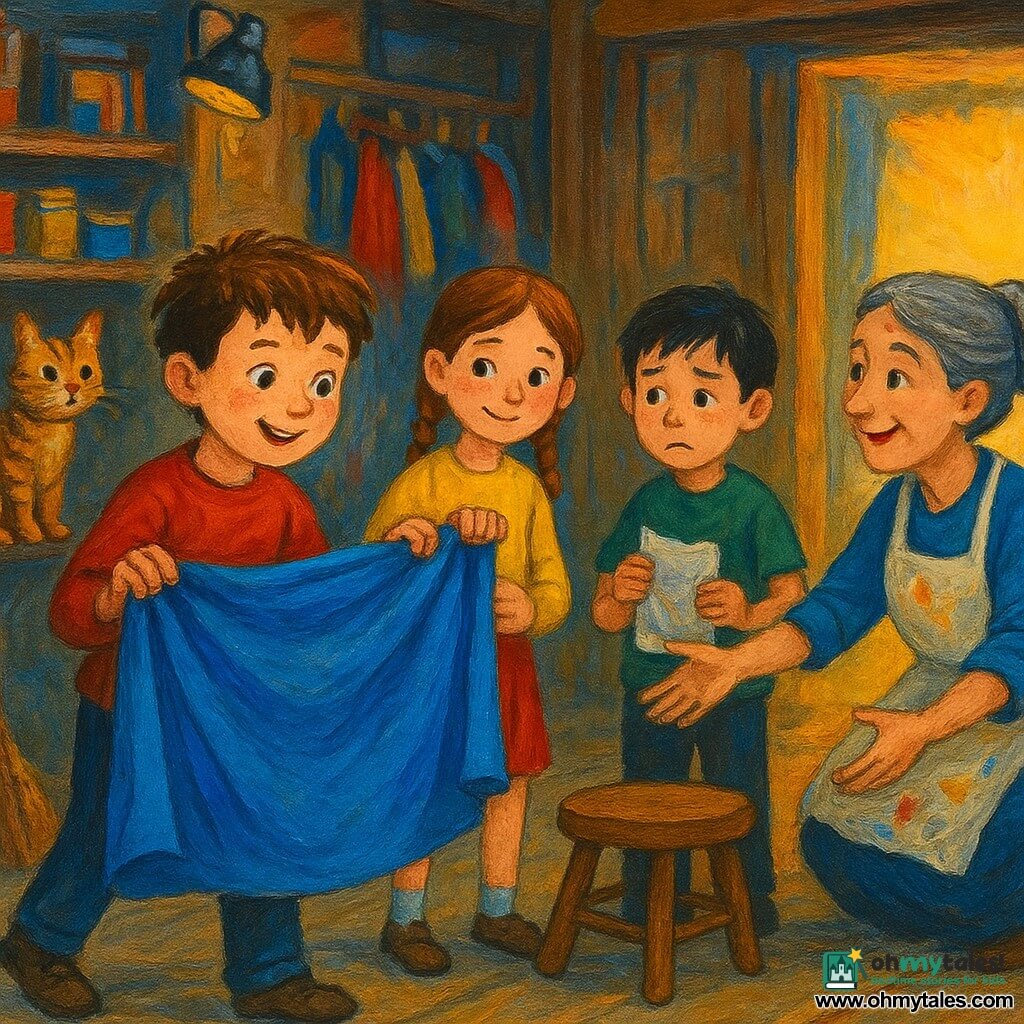
Inside were three children and the theatre cat. They held the banner. It hung folded on a broom. One child wore the pin Tom had found. The child's name was Lila. Her cheeks were bright, and her hands shook a little.
“We were making a surprise,” Lila said. “For the festival tomorrow. We were going to hide it and then show everyone. But when we saw Tom, we panicked and forgot to tell anyone.”
Tom listened to the whole story. They had carved TAP on the stool because they loved the letters. TAP was their secret, meaning ‘Theatre Art Project' — a club they made to help the theatre. They had borrowed the banner to make sure it was perfect and safe. They had meant to bring it back by dawn.
Tom felt a warm, soft thing in his chest. He nodded. “Secrets can be nice,” he said, “but telling someone helps. Mrs. Lee was worried.” He looked at them with kind eyes. The children's shoulders relaxed.
Lila's voice was quiet. “We were afraid they'd say no. We wanted to help and make it pretty.” She handed Tom a small folded note. On it, in careful letters, was the sigil T A P, and under it one word: listen.
Tom read the word out loud. “Listen.” He smiled. “That's the best secret code.”
The theatre bell jingled like a small laugh. Tom and the children carried the banner back. They walked together, with the cat trotting like a slow drum.
Chapter 4
Back in the workshop, Mrs. Lee hugged the banner like a friend. The blue color was bright again. The children explained. Tom gave her the carved stool map and the pin. Mrs. Lee listened to each child. She did not scold. She thanked them for caring about the theatre. Then she tucked the pin into a special box labelled “Helpers.”
Tom opened the little envelope from Sam again. Inside was a folded letter. He had not seen it before. He unfolded it carefully. The letter was soft and a little wrinkled. The handwriting was small and round.
Dear Theatre Friends,
I wanted to tell you a thank you. When I came here, I was shy and scared. Your theatre made me brave. I want to help. I will sew. I will paint. I will listen. Please keep me in TAP.
From,
Your Quiet Friend
Mrs. Lee wiped a small tear. “That must be from the new girl who arrives early,” she said. “She told me she liked to watch but never spoke. She left this letter to ask if she could join. She was too afraid to say it aloud.”
Tom folded the letter back with care. He looked at the children. Lila's eyes shone. Mina put her arm around the quiet new girl who stood a little to the side and smiled shyly.
Tom felt proud. They had found the banner, they had learned about TAP, and they had discovered a kind letter. The mystery had a gentle end. Everyone listened. Everyone helped.
Before leaving, Tom pinned the little metal badge into his notebook. He wrote TAP in big letters and underlined it. He drew the mask and the brush again, and then he added one small word: listen.
Mrs. Lee gave Tom a peppermint for his thinking. “You solved it well,” she said.
Tom chewed and grinned. Outside, the sun painted gold over the theatre roof. Tom thought of the letter and the quiet brave girl. He learned that mysteries are not only puzzles — they are chances to listen, to help, and to make room for others.
He waved goodbye and walked home. In his pocket, his notebook felt like a small, warm book of secrets. He hummed a little tune and thought of the next mystery. He knew he would listen first. He knew that was the best way to begin.