Chapter 1 — The Morning Run
The sky is still sleepy when Mara ties her laces. Mist curls around the park like a cat. She checks her watch, tucks a stray curl into her headband, and jogs into the pale light.
Her breath makes little clouds. Her steps make a steady drum. Her mind makes pictures: a green pitch, white lines, her teammate racing ahead, the ball sliding between defenders at just the right second. An assist. The kind that lifts a whole stadium.
A dog trots beside her for a few meters, sniffs her shoe, then dashes off. Mara laughs. “Even you're ready, huh?”
On match days, everything begins early. That's part of the job. People see the goals. They don't always see the morning. They don't see the quiet work.
Back home, she whips up breakfast. Oats with berries. A scrambled egg. A tall glass of cold water. Fuel for muscles. Fuel for focus. She sits at the small kitchen table and opens a notebook. She writes three lines:
Be brave.
Find space.
Play for the team.
Her phone buzzes. A message from Coach Rafi: Remember: timing is kindness. The pass matters.
Mara smiles. She massages her calves with a foam roller, counts to thirty, then switches legs. Stretching isn't glamorous. But it keeps you on the field. She checks her bag: boots, shin guards, two jerseys, tape, a banana, a lucky hairband. She taps each item like a pilot.
As she zips the bag, she glances at a photo on the fridge: a little girl, muddy and grinning, holding a torn shoelace like a prize. That was her. The girl who loved the ball more than clean socks.
“Hurry up,” she tells herself. “There's a whole day waiting.”
She grabs her bag and heads out into the humming city.
Chapter 2 — Boots and Questions
The clubhouse smells like grass and coffee. Teammates drift in, yawning, joking, nudging each other with elbows and smiles. The kit manager, Bea, sits on a stool, polishing studs until they sparkle.
“You could eat your lunch off those boots,” Mara says.
Bea grins. “Don't you dare.”
Mara pulls her boots on and wiggles her toes. They feel like a handshake. Firm. Familiar. She tapes her left ankle—two strips, not too tight. She knows where it needs a hug. That's the job, too: knowing your own body like a best friend.
“Hey, Mara!” a voice calls.
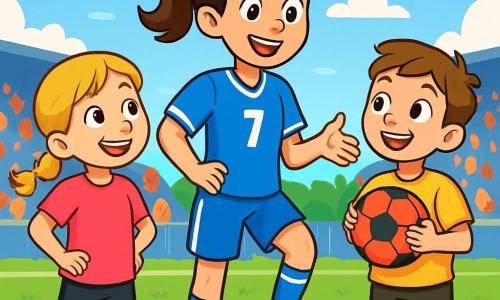
It's Sam from next door, carrying a notebook and wearing a cap with the team's crest. He waves, shy but shining. “Coach Rafi said I can watch training for a bit. I wanted to ask... what do you actually do all day? I mean, besides, you know, the match.”
Mara laughs softly. “It's a lot of little things. Training, sure. But also cooking decent food. Sleeping well. Watching clips. Learning how other teams move. Being on time. Being kind. Every bit helps.”
“Do you score lots?” Sam asks.
“Sometimes,” she says. “But today my goal is a pass. A good one, when it matters.”
“An assist?”
“Exactly. Like building a bridge so someone else can cross.”
They walk out to the field. The grass is trimmed and proud. Cones line up like soldiers. The ball sits in the center, patient and perfectly round.
“You play midfield, right?” Sam asks.
“Mostly,” Mara says. “In the middle you do a little of everything. You help defend. You help attack. You see the whole picture. It's like being an air-traffic controller with muddy knees.”
Sam scribbles. “And do you ever get scared?”
Mara glances at the empty stands. “Everyone gets nervous. Courage isn't about never feeling it. Courage is choosing the right thing anyway. Even if everyone's watching.”
Sam nods, eyes wide. “I hope you choose right today.”
“So do I,” Mara says. “Now watch. Warm-up time.”
Chapter 3 — Practice with Shadows
They start with circles. Calf raises. Hip turns. Ankles singing small circles in the air. Joints wake up, one by one, like a row of windows opening.
“Find your breath,” Coach Rafi says. “In through the nose. Out through the mouth. Calm is a skill.”
The passing drill begins. Two touches. Move into space. Receive with the inside foot. Pass with the other. The ball zips. Thuds. Whispers over the grass.
“Eyes up, Mara,” calls Taya, the striker. “I'll be there.”
Mara flicks a glance. Left shoulder. Right shoulder. That's something else in the job: looking before you have the ball. Seeing the future as if it's already happened.
She tries a threaded pass. It hits the cone. “Oops,” she says.
“Try again,” Coach Rafi says. “Mistakes are maps.”
She tries again. This time the ball sails between two markers and bends into Taya's path. Taya taps it back with a wink. “Like butter,” she says.
They practice quick turns. Change of speed. Shields with the body. Dribbles in tight boxes. Mara's thighs burn. Her heart thumps a steady song. Work now, joy later.
They huddle around a whiteboard. Arrows snake across the drawn pitch. “They're fast on the wings,” Coach Rafi says. He moves a magnet. “So our full-backs tuck in when needed. The midfield stays brave in the middle. And, Mara? If you see it, trust it. The gap will be a blink. Blink well.”
“Yes, Coach.”
Sam watches, writing furiously. “Do you have to remember it all?”
Mara grins. “We don't memorize. We understand. It's like a story we tell together. If someone changes a line, we listen and help them find their way back.”
After training, they cool down. Big breaths. Slow steps. The sun climbs higher, but the air feels kinder.
Sam waves as he leaves. “Good luck, Mara!”
“Thanks,” she calls back. “I'll try to build a bridge.”
Chapter 4 — The Stadium Sings
Afternoon leans toward the match. The bus rolls through the city. Faces press to windows at stoplights. People wave. Some hold up signs. The players wave back. This is part of the job too: being a small spark of joy in someone's day.
The locker room hums with a low buzz. Tape snaps. Boots clack on tile. Someone laughs at a joke about socks. The captain, Imani, stands and raises her voice. “We play together. We play fair. We leave our egos at the door and bring our hearts to the field.”
Mara closes her eyes and breathes. The stadium is a creature, curious and hungry. She listens to its heartbeat—drums, chants, the swirl of many voices. Her chest tightens, just a little, then loosens. “Okay,” she whispers. “Okay.”
Bea hands her a fresh jersey. “Go paint the grass,” Bea says.
On the pitch, the referee smiles and checks their boots. “Shin guards, please.”
Mara taps hers. “All good.”
They line up. They shake hands with the other team. Faces up. Eyes clear. No growling. Just respect.
Taya nudges Mara. “Remember your bridge.”
“Remember your running,” Mara says.
The whistle is a bright bird. It takes flight. The game begins.
Chapter 5 — The First-Half Storm
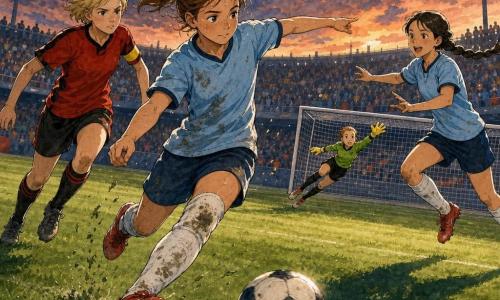
The ball skips. Passes hiss through legs. Cleats bite. The other team presses hard. They swarm like bees around a spilled drink.
Mara keeps calm. She lifts her head. She points, she shouts. “Left! Switch!” She drops back to help the defenders, then pushes forward when the way opens. This is the rhythm of her work. Back and forth. Heavy, light. Tight, free.
She gets the ball in the center circle. A rush of footsteps. A flash of blue shirts. Her first thought is a pass to Taya, who's peeling wide. Her second thought is a dribble into space.
She picks the dribble. A blue foot pokes the ball away. “Ugh,” she mutters. The other team pounces, shoots, and clips the post. The crowd gasps like one big mouth.
Imani claps her hands. “Heads up! Next play.”
Mara nods. Her cheeks sting. Not from the cold. From the lesson. Timing is kindness. The pass matters.
She gets the ball again. A defender charges. This time she shields, glances, and slips a neat pass out to the wing. The crowd's noise softens into a purr. Better.
Halfway through the half, she steals a ball with a clean toe-poke. She sees Imani bursting down the middle. The gap is tiny. A blink. She hesitates for one heartbeat—and the gap closes. The pass hits a heel and dies.
“Almost,” Imani says, jogging back. Her voice is warm, not sharp.
“Sorry,” Mara says.
“Don't be sorry,” Imani says. “Be ready. It'll come.”
At halftime the air in the locker room feels thick and sweet like warm bread. The score is still tied. Sweat sparkles on foreheads. Water bottles clack. A trainer rubs a calf. Someone hums to quiet the nerves.
Coach Rafi draws quick arrows. “They're biting on your first touch, Mara. So take one touch to show them, and the next to surprise them. Bait them. Lead them. Then pass. You don't have to be the hero. You have to be yourself.”
Mara nods. Her chest eases. Courage doesn't always roar. Sometimes it listens.
Chapter 6 — Courage Finds Space
The second half begins with a burst. The sun slides lower, warm gold spilling over the stands. Shadows lengthen, the way they do when a day has told most of its story and saved the best part for last.
The ball comes to Mara with a spin. She cushions it, soft as catching a bird. A blue shirt rushes in. She turns her shoulder, keeps her balance, and hears Taya's voice. “Now!”
A lane opens. Blink small. Blink fast. Be brave.
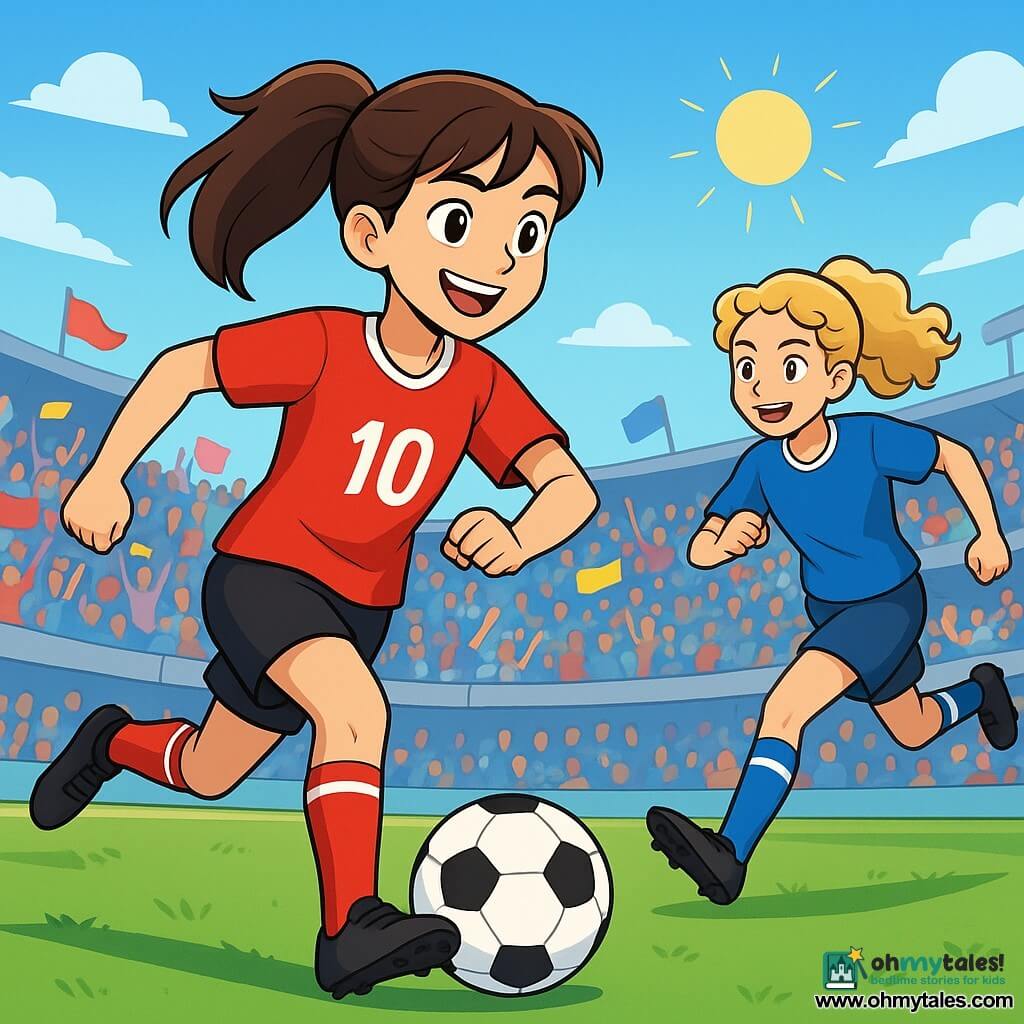
Mara sells a fake with her hips. The defender bites. The lane grows. She taps the ball with the inside of her foot, threading it like a needle through fabric. The pass slides past one shoe, past another, and kisses the grass in front of Taya.
Taya doesn't slow. She meets the ball like it's an old friend. One touch. Then a low shot, quick as a fox. It skims inside the post.
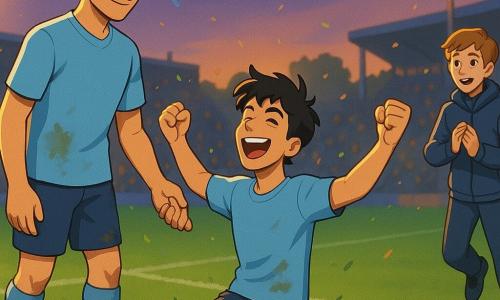
The stadium explodes. A thousand hands clap. Flags leap. The air shakes with joy. Taya sprints to Mara and wraps her in a hug. “Bridge built!” she laughs.
Mara laughs, breathless. “Run crossed!”
They jog back for the restart, hearts thumping, eyes bright. The scoreboard changes. The job isn't finished. It's never finished until the final whistle.
Minutes creep and tumble. The other team pushes. They try long balls. They try quick one-twos. Mara tracks back. She steals one, clears another. She helps a teammate up after a tangle. “Are you okay?” she asks.
“Fine,” the player says, grinning through her hair.
“Fair play,” the referee says, giving Mara a nod.
Time melts thin. On the sideline, Coach Rafi turns his palms down. Calm. Calm. Breathe.
A blue winger breaks free. Speed like lightning. Imani slides in, clean and crisp, and taps the ball out. No anger. No shouting. Just perfect timing and respect. The crowd applauds the tackle the way they'd applaud a song.
Mara gets the ball one last time with seconds left. She could dribble. She could try to dance. But a teammate is open on the right, hugging the line. The safe pass is the smart pass. She gives it and moves, ready to receive again if needed.
The whistle arrives like a bird returning home. The game ends. The field exhales.
Chapter 7 — After the Whistle
They line up again to shake hands. Sweat, smiles, and tired legs. The other team's captain bumps fists with Imani. “Good game,” she says. And she means it.
On the sideline, a reporter lifts a microphone. “Mara, that assist was a beauty. What were you thinking?”
Mara wipes her face with her sleeve. “I was thinking about trust. I knew Taya would be there. My job was to make her job easier. That's what an assist is.”
She signs a program for a kid with bright braces. She answers a question about training. “It's every day,” she says. “Even on days when you don't feel shiny. Especially then.”
Back in the locker room, Bea collects jerseys like seashells. “Ice bath?” she asks, handing Mara a towel.
“Five minutes,” Mara says, making a face. “Then hot chocolate?”
“Deal.”
She slides into the cold water. It bites. She grits her teeth and counts. Recovery is part of the job. So is rest. So is listening when your body whispers, and before it ever has to shout.
Later, in the quiet corner, Coach Rafi sits beside her. “Proud of you,” he says. “Not just for the pass. For the patience.”
She nods. “I almost messed it up in the first half.”
“Almosts are teachers,” he says. “They show you the door. Courage walks you through it.”
On the way out, she spots Sam waiting by the gate, holding his notebook like a treasure. He bounces on his toes. “Did you do it?”
Mara smiles. “We did it.”
“Can I ask one more thing?” he says. “What's the hardest part of your job?”
Mara thinks. The stadium lights blink, one by one, like sleepy eyes. “The hardest part,” she says slowly, “is choosing right when your heart is loud and the moment is small. It's being brave enough to share the ball. It's being steady in storms and gentle with yourself. And sometimes it's laundry.”
Sam giggles. “Laundry?”
“Trust me,” Mara says. “Grass stains are fierce.”
They walk toward the bus. The night air smells like rain and popcorn. Fans drift away, humming old songs. Mara lifts her face to the sky and lets the cool breeze settle over her like a blanket.
At home, she builds a simple dinner. Rice, grilled chicken, a salad that crunches like new snow. She drinks water. She stretches on the living room rug while the kettle sings. She texts Taya: Your run was perfect. Taya replies with a laughing emoji and a picture of two boots propped on a coffee table.
Mara opens her notebook again. She writes:
Be brave.
Find space.
Play for the team.
And today, build the bridge.
She slides the notebook shut and turns off the lamp. The city whispers outside her window. Somewhere, someone is kicking a ball against a wall. Tap. Tap. Tap.
Mara smiles in the dark. Tomorrow she'll run again. She'll stretch, and tape, and study arrows on a board. She'll wave to buses and answer small questions with big care. She'll work on timing, and kindness, and passes that feel like stories told at the perfect moment.
Because that's the life she chose. A life of green fields and noisy hearts. A life where courage doesn't always shout. Sometimes, it simply says, “Look up. Give the ball. Trust your friend.” And that, too, is how you win.