Chapter One: Boots by the Door
My boots wait by the door like two patient dogs. I touch the laces, just to feel the roughness that means game day is close. The sun hasn't climbed far yet. Birds chatter on the balcony. The city is quiet, held in soft morning light.
I breathe in. Out. My stomach is awake before my head, so I make breakfast that fills me without weighing me down. Oatmeal with slices of banana. One scrambled egg. A glass of water. Not too much. Not too little. A footballer learns to listen to his body the way a captain listens to the sea.
I stretch on the rug. Ankles, hips, shoulders. The floor smells faintly like orange cleaner. My leg muscles hum the way a cat hums when it's happy. I roll a tennis ball under my foot to wake up the small muscles. “Morning, Milo,” I tell myself in the mirror. “Feet ready. Heart steady.”
My phone buzzes. A text from Zed, our striker. “Bring extra socks. Lost mine. Again.” I laugh and stick an extra pair in my bag. Zed can score from twenty yards but can't keep track of socks. That's football.
I pack my kit. Shin guards. Shirt. Warm-up jacket. A small journal with a dog-eared page that says: Remember—play brave, play kind. I tuck in a granola bar and my lucky coin. It's just a coin, but it feels like a promise.
Outside, the air is crisp. On the walk to the car, I pass Mrs. Alvarez watering her plants. “Big match today?” she asks.
“Big as a mountain,” I say.
“Then step steady,” she smiles, spraying the roses until they sparkle. I smile back because that's what today will be. Step steady. Drink water. Share the ball. Run when my legs say stop. This is the job. It's more than ninety minutes. It's all the minutes that lead to the ninety.
I lock the door and lift my bag. The boots nudge against each other in the dark like they're whispering. They know. We all know.
Chapter Two: The Pitch That Smells Like Grass
Training smells like grass and cut oranges. Coach Rey stands by the cones like a general made of patience. He has a whistle he almost never needs. His voice carries without shouting. We circle him, boots tapping, breath making small clouds.
“Warm-up,” he says. “Wake the lines of your bodies. Ankles to shoulders.”
We move. High knees. Side steps. Gentle sprints. Joke sprints. Serious sprints. When we finish the first round, I feel sweat bead on my neck like tiny rain. It feels good. It feels like my engine humming.
I'm a midfielder. In the middle, you are a bridge. The ball travels through you like a story. You have to read the game, close spaces, open spaces, choose quickly. Coach says, “See three passes ahead. Think like a chess player with muddy socks.”
We work passing triangles. Two touches. Then one. The ball ticks between us like a metronome. “Head up, Milo,” says Coach. “Know before you receive.” I call out. “Left! Back! Turn!” My voice threads through the shouts and thumps.
Zed arrives late from the changing room, wearing one purple sock and one blue. He winks at me. “Thanks for the rescue, Captain Socks.” I toss him the extra pair. “You owe me a goal,” I say. He taps his chest. “Two.”
We practice set pieces. Corners. Free kicks. Rehearsed runs that look like dancing if you don't know the plan. Coach points to the whiteboard. “We attack the near post. Milo, you hang back for the second ball.”
We talk about recovery. Ice baths. Stretching. Sleep. Being a footballer means moving fast, but it also means resting slow. “Your muscles are workers,” says our physio, Mia. “Let them clock out. Let them come back fresh.”
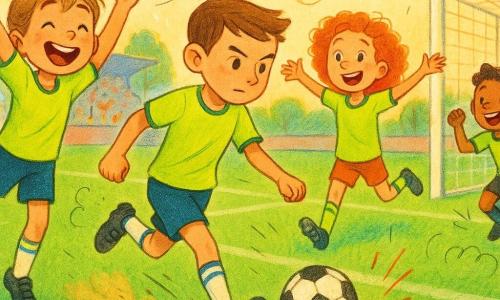
We finish with a small-sided game. Five versus five. The pitch feels smaller, decisions quicker. Eli steals the ball from me with a grin. “Wakey wakey, maestro.” I steal it back. “Always awake.”
When Coach blows the whistle, there's a quiet moment. Just breath and birds. He says, “Good. Now the brain work. Ten minutes in the video room.”
In the dark room, we watch ourselves on the screen. We see spaces we missed, passes we rushed, moments we can win before they even start. It's like traveling back in time to set the table better. Coach pauses a frame with my face in it, eyes wide. “Here,” he says. “Patience, Milo. Wait for Zed's run. Two more beats.” I nod. Two beats can be everything.
Chapter Three: The Questions That Matter
On the way out, the team bus stops at a school. We're early, but the hall is full. Kids wear our colors and wave signs. I swallow my nerves. Playing in front of thousands is one thing. Sitting on a stage in front of a hundred sharp eyes and curious minds is another.
A teacher with a bright scarf smiles. “This is Class 6. They have questions about your job.”
We sit on tall chairs. Zed shakes his leg so fast the chair vibrates. A boy in the front row raises his hand, then forgets and blurts: “Do you score every day?”
I grin. “Not even close. Scoring is rare, like finding a coin in a fountain. My job is also to pass, to defend, to help others score. On some days, the bravest thing is saying, ‘Not today, but I'll try again tomorrow.'”
A girl with glittery glasses asks, “What do you eat? My brother says footballers eat only pasta.”
“We eat for work,” I say. “Carbs for energy, protein to rebuild, rainbow vegetables for health. And water. Always water. Pasta sometimes, yes. But also fish, chicken, rice, salads. And treats on birthdays.”
A taller boy leans forward. “What do you do if you lose?”
“Learn,” I say. “We watch, we talk, we fix small things. We don't hide. The important part is respect. We shake hands. We say, ‘Well played.' We remember to be human first.”
“Is it scary?” asks someone from the back. “All the people. All the cameras.”
“Sometimes,” I say. “Pressure is like a backpack. You feel it more if you carry it alone. We share it. We talk. We have a team psychologist. Breathing helps. Laughing helps. Remembering that the pitch is still grass helps too.”
Zed points to his socks. “Also it helps to wear matching socks. I'm still working on that.”
The hall laughs. I take my shin guard from my bag and hold it up. “We wear these to protect our bones. We tie our boots tight so our feet listen to our brains. We train every day, even when it rains. We rest. We read. We call our families. That's part of the job too.”
Before we leave, a boy with a sign that says Play Fair, Milo! hands it to me. “I made this,” he says, shy as a new moon.
I bend to his height. “Thank you,” I say. “I'll try.”
He taps the word fair. “Try every day,” he whispers.
I promise with my right hand over my heart. The promise sits warm in my pocket with the lucky coin.
Chapter Four: Tunnel Heartbeats
The stadium rises from the street like a ship. Lights blink. Vendors shout. Fans sing with arms wide like wings. My chest drums a little faster. The tunnel is cool and smells like rubber and grass and the faint metal of the railings. The other team, Riverton FC, waits across from us. They're tall. So are we.
Coach walks down the line, touching shoulders. “Play brave. Play kind,” he says, almost like a song. “We do it together.”
We warm up on the pitch. The ground is firm, not too soft. I check the wind by watching the corner flag. It flaps a little. I take three shots. Two go wide, one curls in. A whistle peeps somewhere. Kids in team shirts give us thumbs up. I see the Play Fair sign again, waving like a small flag in a big world. It makes me smile.
Back inside, we put on our kits. Zed turns to me. “You good?” His eyes are bright. Mine are too.
“I'm ready,” I say.
The captain, Tarek, speaks. “We sprint back. We help each other. We talk. If you lose the ball, we'll find it together.” His voice is steady. I feel taller just hearing it.
Then the anthem, low and strong, and the walk out. The grass blazes under lights. It's greener than any green. The ball is white like the moon. We shake hands. I look into the keeper's eyes. He nods. I nod. Enemies for ninety minutes. Friends after.
The whistle. We begin.
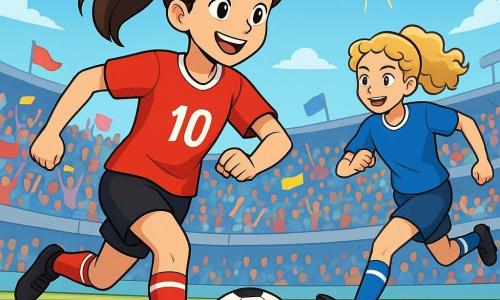
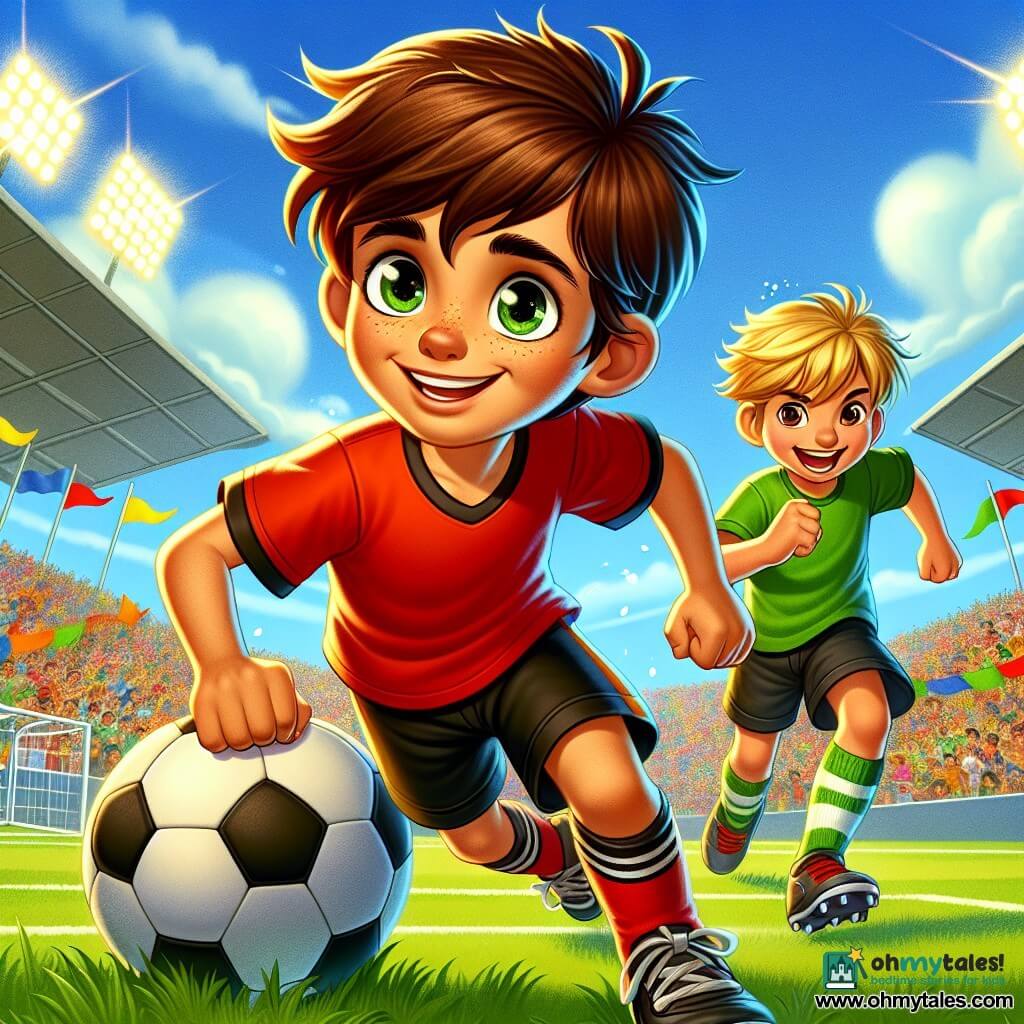
The ball moves so fast the game becomes a river. They attack down our left. I slide across, a door closing softly. I win the ball, look up, see Zed spin away from his marker. I pass. He shoots. The keeper saves with fingertips. The crowd oohs, a sound like wind in trees.
Minutes stack like dominoes. We work. We call. We cover. I chase back, lungs burning. I lift my head, find calm, spread the play. It's a dance with boots and breath.
Near the thirty-minute mark, they score. A cross. A header. Net shakes like a trapped bird. For a heartbeat, the noise in my ears is a storm. Coach claps his hands. “Heads up! We're fine. We're building.”
I catch Zed's eye. “Still owe me two,” I say.
He grins, shaky but strong. “On my tab.”
Before halftime, their winger goes down hard. He stays on the ground, clutching his ankle. The referee stops play. A teammate picks up the ball. I jog over and ask, “You okay?” He nods, wincing. When the whistle goes to restart, we pass the ball back to them. The crowd applauds. The boy's sign flashes again in the stands. Play fair. It is not a rule written in chalk. It is a rule written in the chest.
We jog in at halftime trailing by one. We jog in together.
Chapter Five: The Chalk Talk
The locker room buzzes like a hive. Some breath hard, some sit quiet. A fan in the corner spins lazily. Coach draws a line of magnets on the board. “We're close,” he says. “They press high. We don't have to rush. Two touches, then movement. Strings in defense. Waves in attack.”
He points to me. “Milo—delay their counters. Don't dive in. Guide them wide.” He points to Zed. “Time your run. Don't drift offside. Trust the pass.” He points to all of us. “Talk.”
Mia hands us water. “Sip, don't gulp,” she reminds us. My shirt sticks to my back. I peel it away and laugh. “Feels like a jellyfish,” I say. Eli groans. “Why would you say that? Now I can't un-feel it.”
I sit, towel over my head, and think of the dusty pitch where I played as a kid. The touchlines were made with chalk that blew into clouds when we ran. We didn't have nets. We had two stones. We played until the sky turned purple. I remember my father saying, “Be a good man first. Then be a good player.” The words sit in my chest like a steady drum.
Zed bumps my shoulder. “You okay, Captain Socks?” he asks.
“Born ready,” I grin. “Also, your socks still don't match.”
He looks down, horrified. “How? I had them right.” He laughs, shakes his head. “I'll score with mismatched socks. It'll be my thing.”
Coach claps once. “Eyes here.” He draws a new line on the board. “A set piece we worked on. They put two on the post. Milo, hang back for the second ball. If it falls, hit it hard or feed the edge.”
I nod. I can see it. The move is a picture in a book I've read a hundred times. All we have to do is turn the page.
We stand. We tap the doorway on the way out, a habit that feels like a promise. Tarek's voice is low and strong. “Together,” he says.
“Together,” we answer, and the word floats behind us like a banner we can't see but always feel.
Chapter Six: The Second Half Heart
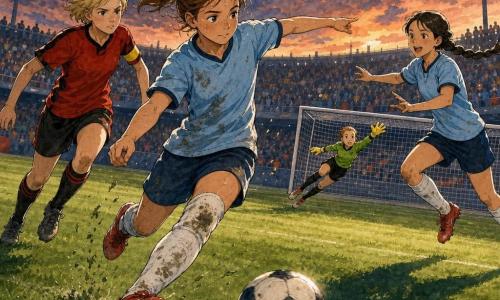
The second half starts like a drum solo. Fast. Loud. Full of beats that make your feet move before your brain tells them to. I intercept a pass and turn. Someone slides in. I hop over, heart in my throat, and keep going. The crowd whirls like a sea.
They crowd our box. Tarek clears. The ball drops to me like a gift. I control with my thigh, then my foot. I look up. I see Zed making that curved run we practice again and again in the soft light of morning. I send the pass like a thread. It pulls him through. He shoots.
Off the post.
He covers his face with his hands for a heartbeat, then points to me. “More,” he calls. I give him a thumbs-up. “Always.”
The minutes tick. Sweat cuts across my back like tiny rivers. I tell my legs to run, and they do. I tell my lungs to breathe, and they thank me by burning.
Then it happens. A corner for us. The set piece. The one from the board. I jog to the edge of the box, heartbeat like a horse. The ball swings in, a white comet. Bodies crash. The ball bounces, sky to grass, right to me. Time slows, not like a movie, but like a breath before a note.
I could shoot. The net is a green mouth. But in the corner of my eye I see Eli at the edge, free, and Zed between two trees. I remember Coach. Two beats. One. Two. I slide it to Eli. He strikes clean. The net jumps. The stadium explodes.
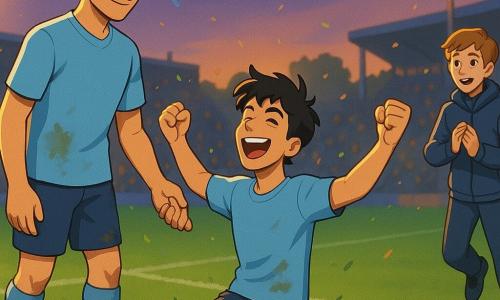
We jump together. Hug. Laugh. Shout nonsense. It's 1–1. The noise tastes like sweet rain.
The game opens like a book with pages turning faster. Riverton attacks. I recover, sliding, standing, guiding. A player clips me in the box. I stumble but don't fall. I could go down. Maybe we get a penalty. But my legs know truth. I push on. I shoot. The keeper saves. I hear a voice, small in a big stadium, the memory of the boy in the hall. Try every day. Try fair.
The referee runs over. “You okay, number eight?” he asks.
“All good,” I say, and he nods, already running.
Later, a long ball drops out of the sky. I control it with my chest, but the ball skids and brushes my hand. I bring it down and curl it into the net. The crowd roars. I feel the roar in my bones. Then I feel the brush of the ball on my skin again, as if my hand is telling me a secret. I turn to the referee.
“Handball,” I say, raising my palm. “Touched my hand.”
He blows his whistle. No goal.
For a heartbeat, the world is a soft, stunned hush. Then I hear clapping. My teammates pat my back. The captain of the other team nods. The stadium fills with something warmer than noise. It fills with respect. It fills with the sound of a choice we all made together.
Coach meets my eyes and touches his heart. A small tap. Good.
We play on. The ball is tireless. So are we.
In the eighty-seventh minute, we win a free kick. Perfect distance. Coach whistles and calls the routine. Not the direct shot. The trick we built on Tuesday when the rain made the ball skip.
I stand over the ball with Eli. “Ready?” I whisper.
“Ready,” he whispers back.
I run past the ball. He taps it softly into the space. I turn quick, the world leaning into the move. The defenders step. Zed hesitates, then explodes into the gap we made. I slide the pass. He meets it first time.
Net. Boom. Wild joy. 2–1.
Zed runs straight to me, grinning like a kid who found a treasure chest. “Paid my debt,” he shouts. “And a tip!”
We huddle in a circle, arms around shoulders. The world is bright and loud and perfect for a second. Then back to work. We defend like a string pulled tight. We talk. We time our jumps. We smell the grass. We hear the whistle blow, and it sounds like a doorway opening.
Chapter Seven: Lights Down, Heart Steady
After the final whistle, I shake hands. Riverton's winger, the one who fell earlier, smiles. “Nice game,” he says. “Nice honesty.”
“Nice footwork,” I say. “And I hope your ankle is okay.”
He nods. “Better when we eat ice cream.” We both laugh because we are tired and because it's true.
Reporters wait by the tunnel. Microphones like small birds. A woman asks, “Milo, why tell the referee about the handball? You gave up a goal.”
“Football is a game we share,” I say. “You can't love the game and lie to it. Some days the ball loves you back. Some days it doesn't. But the game is bigger than goals.”
Zed leans into the camera, waggles his mismatched socks, and says, “Teamwork!” The reporter laughs. Tarek pulls us into a photo. We look like a row of trees after a storm: bent in places, but rooted.
In the locker room, Mia brings the ice. “Five minutes,” she says. “Don't try to be heroes.” We squeal like penguins as our legs slide into the cold. The ice bites, then soothes. Eli shivers. “Next time, warm chocolate bath,” he suggests.
Coach stops by, hands in pockets. “Proud,” he says, simple as that. “Tomorrow, recovery. Stretch, sleep, light jog. Send me your wellness check by eight. Eat well. Call your mums.” He leaves us to our laughter.
On the team bus, the city drifts by. Streetlights blink like eyes getting sleepy. I open my journal and write:
Today I remembered the boy with the sign. I remembered Dad's words. I remembered to wait two beats. I made a choice about a handball. We won with a move we built in the rain. My legs are tired. My heart is calm. This job is running and resting, speaking and listening, choosing kindness even when it's hard. It is sharing the ball and sharing the load.
My phone buzzes. A photo from the school. The boy with the sign is holding it up at home, smiling. His mom wrote: “He says thank you for trying.”
I hold the phone and whisper, “Thank you for asking.”
When I get home, the socks by the door are waiting like old friends. I set my boots beside them. I pour a glass of water and watch it catch the kitchen light. I stretch, slow and easy. The city hums. Somewhere, a night game plays on TV with the sound turned low, a lullaby of distant cheers.
I turn off the lights. My legs ache in a way that means they worked hard. I close my eyes. Tomorrow will be a new page: training cones like tiny mountains, passes like threads, laughter in the hall. The job is the journey. The story is the team. And the dream is simple as grass under a wide, kind sky.