Chapter 1: The Quiet Clues
Mira Bright stepped out onto the rooftop and smiled at the city. Her coat shimmered like blue glass in the morning sun. She was brave, quick, and careful, and people in the city called her Echo-Glow because she listened to things no one else could hear and she left a soft light wherever she walked.
“Morning, Mira,” said Mr. Patel, watering his rooftop tomatoes below. He waved a small green hand.
“Morning, Mr. Patel!” Mira waved back. Then she froze and leaned closer to the breeze. She didn't have super hearing or loud powers. Her power was quieter and cleverer: she could notice the little details that were invisible to others—things like a ribbon of paint that didn't belong, a tiny crack in a brick, or a whisper of a worry carried on the wind.
“Do you hear that?” she whispered to herself.
“What?” asked Lena, her friend and inventor, who poked her head up through the skylight. Her goggles sat crooked on her forehead. “You look like a detective.”
“I heard a pattern in the breeze,” Mira said. “Not a sound. A rhythm. Like something was moving through the city, testing things. It wants the old pedestrian bridge reopened.” She tapped her chin.
Lena blinked. “The Arts Walk bridge has been closed for months. That's where painters and musicians meet.”
“That's where we'll go,” Mira said, grinning. “We better be ready. Want to come?”
Lena shrugged on her backpack filled with useful gadgets. “I've got glue, lights, and some jokes. Let's go, Echo-Glow.”
They slid down a rope from the rooftop like two bright comets and landed neatly on the street. People turned to smile. When Mira walked, small motes of light skipped from the soles of her boots. Children giggled and chased the lights like tiny fireflies.
“Keep your eyes open,” Mira told Lena. “The city talks in small things.”
They hurried toward the Arts District, where murals glowed on old brick walls, and music spilled from open windows. Mira sniffed the air and watched the way the pigeons fluttered. A tiny paper kite bobbed against a lamppost, attached by a single frayed string. Mira noticed the string's shadow was wrong; it fell one way while the kite sat another.
“Tricky wind,” Mira said softly. “Someone's been moving things to test the town.”
Lena tapped a little screen. “Sensors show the bridge is fine but the gate bolts are twisted. It's like someone practiced locking and unlocking it.”
Mira smiled. “Then we'll let the bridge practice opening again.”
They hurried on, voices bright and determined. Children waved. A musician in the square played a brave trumpet fanfare. The city felt warm and safe, even as the mystery began to hum at the edges.
Chapter 2: The Arts Quarter Clue
The Arts Quarter was a ribbon of colors and sounds. Paint dripped like rainbows on steps. Sculptures tipped their heads to listen. Mira loved the way artists put feelings into small things—tiny painted birds hidden inside doorways, secret poems tucked in benches.
“Look,” said Mira, pointing to a mural of a giant blue cat. The cat's painted whiskers looked real, but one whisker had a knot of yarn looped through it.
“Who would do that?” Lena asked.
“A prank? A pattern?” Mira crouched down and looked carefully. The knot's yarn had tiny flecks of silver in it. She touched it gently. The yarn hummed under her fingers, like the memory of a footstep.
“That's the test-step,” Mira said. “Whoever left this wanted someone to notice.”
They followed a trail of tiny clues—an umbrella with a missing button, a sequence of chalk stars on a sidewalk, a painting of a bridge with one plank painted in bright red. It felt playful and purposeful, like a scavenger hunt from a friend who wanted help.
They passed the small gallery where Mrs. Cortez taught kids to mold clay into boats. She paused her lesson and smiled at Mira and Lena. “Everything alright, dears?”
“We're tracing a pattern,” Mira said. “We think someone wants the bridge opened. They left things that speak.”
Mrs. Cortez nodded. “The bridge matters. My students cross it to show their work. It connects us.”
“Then we'll connect it back,” Mira said.
They climbed narrow stairs and listened at a tiny café where poets recited short lines that glowed like sparklers. A young poet read, “Bridges are feathers and feet.” Mira tapped the poet's cup. Inside, someone had drawn a tiny map. The map pointed toward the bridge. Mira's eyes brightened.
“Someone wants us to follow,” she said. “But why test the bridge?”
Lena peeked at her gadgets. “Maybe it keeps trying to close. Or maybe it's lonely and needs help opening cleanly.”
“Bridges aren't lonely,” Mira said with a grin. “But sometimes they're tired.”
They followed the map through a parade of murals, each one offering a small riddle. At one door, a little brass key was taped beneath the handle. Mira lifted it and felt the key hum like a small bell. She listened and heard nearly forgotten laughter—children who once ran across the bridge and older people who told stories.
“This bridge remembers joy,” Mira said. “We have to remind everyone.”
“Okay, Echo-Glow,” Lena said, patting the backpack where she kept a portable lamp and a bundle of rope that smelled faintly of cinnamon, “I'll set up lights and help secure the bolts. You do the listening.”
Mira nodded. She closed her eyes and let the tiny world speak to her. The wind brought memories: the creak of boards, the scuff of sneakers, the flap of a dog's ears. Small things. Invisible threads. She followed them like a map only she could see.
Chapter 3: The Night of Little Lights
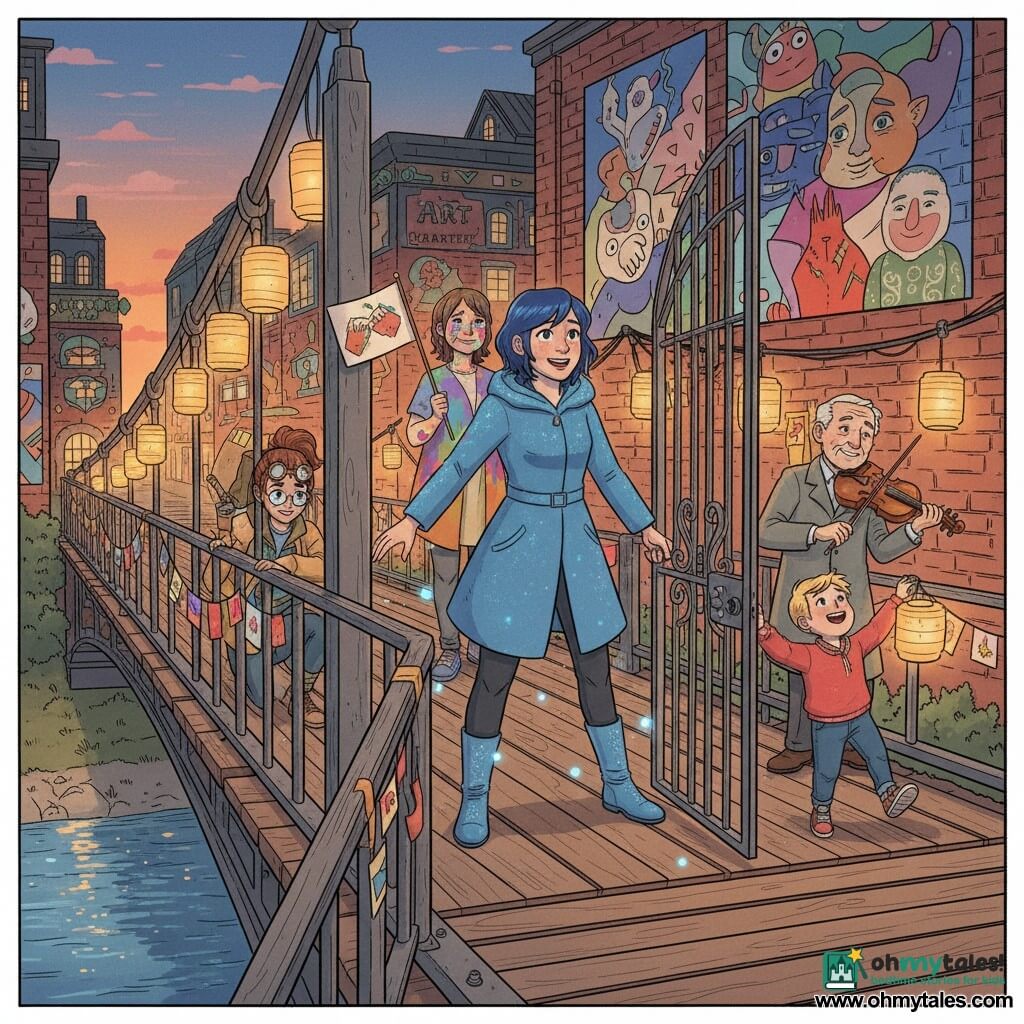
As evening fell, the Arts Quarter shimmered with soft glows. Artists lit paper lanterns shaped like tiny moons. Children ran with painted faces. The city hummed in a happy chorus. But the bridge remained closed, a shadowed line over the river.
Mira stood at the bridge gate and watched the bolts. They had been wound tight by careful hands. Someone wanted the gate to stay shut. Mira touched the metal. It was cool and smooth and full of small imprints—handprints, tiny paw prints from a curious dog, a nick from a painter's brush. The bridge had been used and loved.
“Why would someone lock a bridge they loved?” Lena whispered.
“Maybe they were trying to protect something,” Mira said. “Or maybe they wanted to see who would care enough to open it.”
Lena flicked on a tiny lamp and held it up. The lamp's light spilled across the bolts and made a shadow map. “Look! The shadows show where the bolts were gently loosened earlier. Someone practiced opening a little and then stopped.”
Mira smiled. “A test of courage. We'll finish their test.”
They worked together. Lena climbed onto the railing and threaded a rope through a bolt. Mira sang softly, a little tune she used when she wanted the city to calm down. Her light shimmered in waves.
“Can you feel it?” Lena asked.
Mira nodded. “Not loud things. Quiet ones. I can feel them remembering how to move.”
Slowly, carefully, the bolts turned. The gate sighed open like a mouth after a long nap. Nothing dangerous popped out. No scary clatter happened. Just the honest smell of river water and paint and autumn leaves.
“Open!” shouted a small boy who had hidden behind a pillar. His mother laughed and hugged him.
Mira stepped onto the bridge and looked out over the river. Lights from the Arts Quarter reflected like scattered stars. The bridge groaned happily, as if stretching after a long rest.
“Thank you,” said an old violinist who had been waiting with his case. “It's been silent for too long.”
Mira smiled. “Bridges like to be used. Let's make sure it stays strong.”
They walked across, and as they did, little lights sparked under Mira's boots, weaving a bright path. People joined them, carrying lanterns and singing. The bridge seemed to remember how to hold footsteps and jokes and small promises.
At the center, a young painter named Tori stepped forward, her cheeks flushed. “I left the clues,” she said. “I wanted to see if anyone still cared. I wanted someone who would listen to the tiny things.”
Mira put a hand on Tori's shoulder. “You were brave,” she said. “You made a test that needed kindness.”
Tori blinked. “I was scared to ask for help.”
“You don't need to be,” Mira said. “We all need help sometimes. That's what makes a city a team.”
People clapped and shared cookies. The violinist played a cheerful tune. Mira looked at Lena, who was grinning so wide her goggles nearly fell off.
“We reopened the bridge,” Lena whispered.
“We reopened more than that,” Mira said softly. “We reopened the street that holds people's stories.”
Chapter 4: A Bridge of Hands
After the bridge opened, the Arts Quarter turned into a parade of friendliness. Painters hung small flags with tiny painted hands. Children glued paper boats along the rails. A bakery made a special loaf called the Bridge Loaf, shaped like a tiny footpath and covered in seeds.
Tori stood beside Mira and spoke to the crowd. “I was afraid the bridge was broken forever,” she said. “But you all came. You listened. You helped. That makes me brave.”
Mira felt her light warm. She liked being brave, but she liked the way courage multiplied when people stood together even more. Solidarity was not just a big word; it was warm coats shared on cold benches, a ladder passed hand-to-hand, a song hummed as you fixed a bolt.
“Let's make a promise,” Lena said, climbing onto a bench. “Whenever something small needs help, we help. Not because we have to, but because we want to.”
Everyone cheered. The poet read a short line about tiny bridges in big hearts. Children drew chalk bridges on the pavement and ran across them, pretending to be grown-up heroes. Mira watched a small dog carry a yellow ribbon across the bridge and drop it at the violinist's feet. The violinist tied it onto his bow and winked.
As the evening settled, Mira walked slowly across the bridge alone for a moment. She listened. The bridge hummed low and content. Under her feet, painted words glowed faintly where Tori had painted them: “Listen and you will see.”
Mira whispered to the bridge, “I see you.”
A wind brushed her hair, carrying the smell of paint and baked bread and wet stone. She thought of all the tiny things people had done—the yarn knot, the taped key, the chalk stars. None of them were huge on their own, but together they were a map.
“You did well,” said a small voice. Mira looked down. It was Mr. Patel, who had brought a tray of small tomato tarts. “You listen to tiny things and you help them be loud enough to matter.”
Mira laughed. “I couldn't have done it alone.”
“Who can?” he answered.
They closed the evening with a big group picture on the bridge—artists, children, the violinist, Lena with soot on her fingers, Tori with paint on her cheek. Mira stood in the middle, her light gentle, her smile steady.
“Echo-Glow!” shouted a child. “Can you make our picture sparkle?”
Mira bent down and brushed a tiny ribbon of light across the camera. The flash caught it and the photo twinkled like a tiny galaxy.
As people started to leave, the bridge's gates were left open, not locked, welcoming everyone. The city felt safer not because danger had vanished, but because people knew they could act together, notice small things, and fix them.
Mira and Lena walked back through the Arts Quarter, hands full of tarts and hearts full of songs. “What will you do tomorrow?” Lena asked.
“Listen,” Mira said simply. “To anything that needs help. To the city, to a friend, to a bridge. Small clues lead to big things.”
Lena grinned. “I like small clues.”
They stopped at the rooftop where their day had begun. Mira looked at the city lights twinkling like answers in the dark. Her light shone soft and steady, not to show how strong she was, but to remind everyone that the city glowed when people stood together.
“Good night, bridge,” she whispered.
“Good night, Echo-Glow,” a chorus seemed to say back—the city speaking in small, brave sounds.
And the bridge stayed open, a passerelle reopened, welcoming feet, laughter, and new stories for a very long time.