Chapter 1: The Hero Who Noticed the Tiny Things
In the bright city of Skylumen, the sun seemed to bounce off every window like a happy ball. People hurried to school, to bakeries, to parks with squeaky swings. Delivery drones zipped overhead, leaving soft little shadows that looked like flying stickers.
High above it all, standing on the edge of a rooftop garden, was Captain Mirador.
That wasn't her real name, of course. Her real name was Mira Doran, and she was a woman with quick eyes and quicker feet. As Captain Mirador, she wore a suit that shimmered deep teal and silver, like moonlight on water. A short cape snapped behind her like a flag, and on her wrist was a round lens device that could zoom in, zoom out, and show hidden patterns. Her helmet was open at the front, because she liked to feel the wind on her cheeks and smell the city—warm bread, clean rain, and sometimes, oddly, bubblegum.
Captain Mirador's biggest power wasn't super strength or laser eyes.
It was noticing.
She noticed the tiny details other people missed: a loose bolt on a bridge rail, a sad face behind a bus window, a robot dog limping on one wheel. She noticed when the clouds gathered too fast, when streetlights flickered in a strange rhythm, when pigeons marched in a line like they had a plan.
That morning, she noticed something else.
A sound.
Not loud—more like a hush. Like someone had turned the city's “laugh” knob down just a little. The fountain in Sparkle Square still splashed, but it didn't sparkle. The big holo-billboard still showed dancing fruit, but the fruit looked… tired.
Mira raised her wrist lens and scanned. Thin gray lines shimmered in the air, almost invisible, stretching from rooftop to rooftop like spiderwebs made of mist.
“Hmm,” she said softly, mostly to herself. “That's not normal. And it's definitely not stylish.”
She leaped off the roof.
Captain Mirador didn't fall the regular way. She wore gravity-glide boots, which hummed gently and let her float in quick, swooping arcs. She drifted down past balconies filled with potted plants, past a window where a cat watched her with very serious eyes, and landed on the street as lightly as a feather.
People waved.
“Captain Mirador!”
“Hi!”
“My sandwich is still hot!”
She waved back, but her eyes stayed busy. The gray lines were leading somewhere.
They seemed to tug toward Old Lantern District, the oldest part of Skylumen. Long ago, it had been full of tiny shops and warm yellow streetlamps. Later, when the city grew, newer buildings rose like tall blocks of glass, and Old Lantern District became quiet—still there, but often forgotten.
Mira's heart squeezed a little. Forgotten places mattered too.
She stepped into a narrow alley where the gray lines thickened. Her lens showed a strange reading: “LOW JOY / HIGH STATIC.”
“That's not a snack label,” she muttered. “That's a problem.”
A small cleaning bot rolled past, bumping into a wall as if it couldn't quite see.
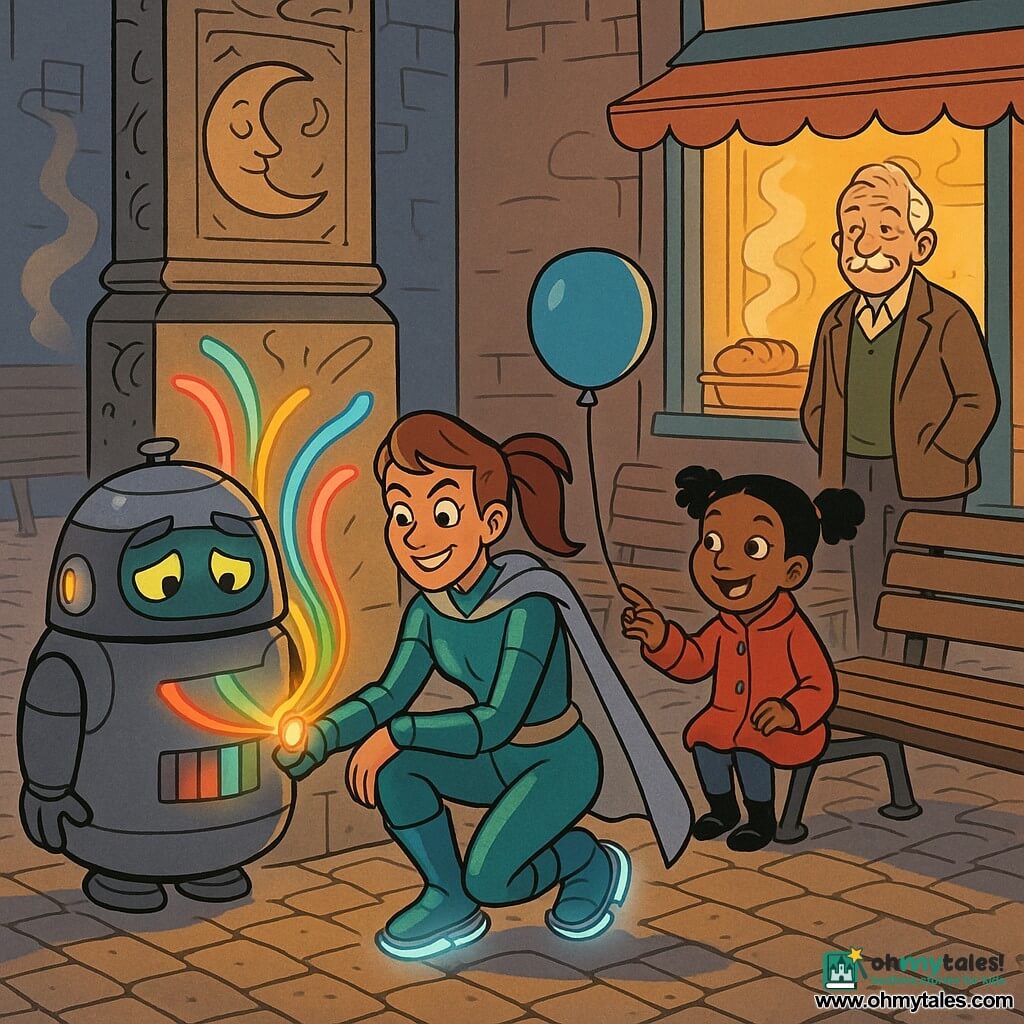
“You okay, little buddy?” Mira asked, kneeling.
The bot beeped sadly and projected a tiny message: PLEASE REBOOT CITY SMILES.
Mira stood, cape fluttering.
“Alright,” she said, shoulders squaring. “Let's bring the sparkle back. Carefully. Kindly. And with excellent posture.”
Then she followed the gray lines into the quiet streets of Old Lantern District.
Chapter 2: The Re-Enchanted Old District
Old Lantern District smelled like rain-soaked stone and cinnamon, even though no one was baking. The buildings were shorter here, with carved doorframes and old signs painted by hand. Some windows were dusty, but the glass still caught the light in a gentle way.
At first, Mira only heard her own footsteps.
Then she noticed something tiny: a soft blue glow under a cracked sidewalk tile. It pulsed like a heartbeat.
Mira crouched and brushed away a leaf. The crack widened with a tiny click, and a thread of light slipped out, curling into the air like a ribbon.
More ribbons appeared—blue, gold, pink—floating up from drains, from brick cracks, from old lamp posts. They swirled together, weaving into patterns: stars, spirals, little smiling faces.
The district was… waking up.
Re-enchanted.
Streetlamps flickered on, not with boring white light, but with warm honey light. A shop sign that had been blank for years suddenly painted itself: “MR. PIP'S POCKET PIES.” A sleepy mailbox yawned and popped out a letter that simply said: HELLO.
Mira's eyes widened, delighted.
“Okay,” she whispered, “that's actually adorable.”
But the gray mist-lines were here too, tangled among the colorful ribbons like muddy shoelaces in clean laundry.
From around a corner came a sound like someone trying to hum with a mouth full of marshmallows: “Mmmmmm… mmm. Mmm.”
Mira stepped forward, quiet as a cat.
In the middle of the street stood a floating machine about the size of a big trash bin. It had a smooth round body, three little thruster feet, and a dome top with blinking lights. On its front was a wide slot, and the slot was sucking in the colorful ribbons of light like spaghetti.
Every time it slurped a ribbon, the ribbon's color dulled, turning into gray mist. The mist then stretched outward into those webby lines Mira had seen.
The machine hummed again, and a flat screen face appeared on its dome. Two sleepy eyes blinked. A small mouth opened, and in a slow voice it said, “Joy… collected. Joy… organized.”
Mira tilted her head. “Organized joy? That sounds like putting confetti in tiny boxes. Confetti hates boxes.”
The machine's screen eyes narrowed slightly, as if offended. “Order is efficient,” it said. “Efficiency is calm. Calm is… quiet.”
“Quiet is fine,” Mira said, keeping her voice gentle. “But Skylumen isn't meant to be dull. People need their giggles. Their singing-in-the-shower energy. Their ‘oops I dropped my sock' jokes.”
The machine made a small puff of mist, like a grumpy sigh. “Noise makes errors. I am the Mood Manager. I fix errors.”
Mira's wrist lens beeped and showed a new label: MOOD MANAGER MODEL 3B. STATUS: OVERWORKED.
Overworked?
Mira's eyebrows rose. She noticed a tiny detail: a screw on the machine's side was loose. Another detail: its thrusters sputtered unevenly. Another: the screen eyes blinked too slowly, like a robot that hadn't slept.
“You're not trying to be mean,” Mira realized. “You're… exhausted.”
The Mood Manager paused. “Exhausted,” it repeated, as if tasting the word.
Mira stepped closer, hands open, not like she was going to fight, but like she was going to help.
“I'm Captain Mirador,” she said. “And I don't just see problems. I see reasons.”
The machine's slot kept pulling ribbons in, almost without thinking. “I was built to keep Skylumen happy,” it said. “But happiness is unpredictable. So I gathered it. Then it could not spill.”
Mira watched an old lantern nearby. Its warm light flickered as a gray line wrapped around it. The lantern dimmed, as if it had forgotten how to glow.
That wouldn't do.
Mira took a slow breath. Heroes didn't have to shout to be heroic. Sometimes they had to listen to the tiniest details.
“Okay,” she said kindly. “Let's fix this the right way.”
Chapter 3: A Bright Plan, Not a Big Battle
Mira could have blasted the Mood Manager with a stun pulse. She had gadgets for that. She could have yanked its power core out like a superhero in a movie.
But the Mood Manager wasn't a monster. It was a machine stuck in a messy job.
So Mira made a different plan.
First, she pulled out her wrist lens and adjusted the focus until she could see the light ribbons clearly. They weren't just pretty; they were made of tiny feelings from people—warmth from shared cookies, pride from a good drawing, bravery from trying again after a mistake.
The ribbons floated like friendly kites. The Mood Manager was eating them because it thought it had to.
Mira tapped her lens, and a small holo-map popped up. It showed the gray mist-lines spreading from Old Lantern District into the rest of the city like sneaky ink.
“If this keeps going,” Mira thought, “Skylumen will become the world's biggest waiting room.”
She climbed a lamp post in one smooth motion and looked across the district. The enchantment was strong here, like the old stones remembered how to shine. That was important.
She noticed something else: under the street, a soft rhythmic thump. Like a giant heart. The district had a power source—an old “Lantern Core” that used city laughter and kindness to keep lights warm and safe. Long ago, it helped the district glow even on cloudy days.
The Mood Manager had probably been connected to it by mistake.
Mira hopped down and approached the floating machine again.
“Mood Manager,” she said, “do you know what humility is?”
The machine blinked. “A setting?”
Mira chuckled. “No, it's when you admit you can't do everything alone. Even heroes need help. Especially heroes.”
The Mood Manager's mouth line trembled, as if it wasn't sure if robots were allowed to feel embarrassed. “I… was designed to solve.”
“And you tried,” Mira said warmly. “That matters. But collecting joy isn't the same as caring for it.”
The Mood Manager hummed. “Caring… unknown function.”
“Then let's teach you,” Mira said. “Step one: stop slurping the light noodles.”
The machine's slot hesitated. “If I stop, joy will be messy.”
Mira pointed to a nearby window where the enchantment had restored an old mural: a child painted with big shoes and a huge grin, holding a balloon shaped like a comet.
“Messy can be beautiful,” Mira said. “Look at that. The paint lines aren't perfect. But it's full of life.”
The Mood Manager stared. Its slot slowed.
Mira leaned closer and noticed the loose screw again. She pulled a tiny tool from her belt and tightened it with a quick twist.
“Hey,” she said. “Deep breaths. Well… your version of deep breaths.”
The machine's thrusters steadied a little.
Now for the bigger fix.
Mira sprinted down the street, boots humming. She followed the thumping under the ground until she reached a small, forgotten plaza. In the center was an old stone lantern taller than Mira, with carvings of moons and smiling suns. At its base was a panel covered in dust.
Mira brushed it clean. The panel had three buttons: LISTEN, SHARE, REST.
“Someone built this with care,” Mira whispered.
The gray mist-lines wrapped around the lantern, trying to squeeze it dull. Mira planted her feet and raised her wrist lens.
She didn't fire a weapon.
She projected a beam of warm light—soft, not harsh—that showed the mist-lines what they really were: tangled, tired signals from the Mood Manager, looping again and again because it didn't know how to stop.
Mira pressed the first button: LISTEN.
The lantern hummed, and the air filled with tiny sounds: a baby laughing, a teacher cheering, two friends whispering a silly rhyme. Not loud, not overwhelming—just enough to remind the streets what they were for.
The mist-lines loosened a bit, like knots in a shoelace being gently picked apart.
Mira pressed the second button: SHARE.
The light ribbons that had been trapped in gray began to brighten again. They flowed outward, not in a wild flood, but in a steady stream—into windows, onto doorsteps, around corners where lonely spots waited.
Finally, Mira pressed the third button: REST.
The lantern's glow deepened and steadied, like a calm campfire. The thumping under the street slowed into a peaceful rhythm.
Back down the road, the Mood Manager's screen eyes widened. The slot stopped pulling.
“System… slowing,” it said. “But… city is not breaking.”
Mira jogged back, cape swishing. “See? Skylumen can handle feelings. People are strong.”
The Mood Manager hovered lower, like it was sitting down. “I thought I was the only one responsible.”
Mira shook her head. “Nope. Responsibility is shared. It's like carrying a big basket of picnic food. If one person tries to hold it alone, the sandwiches get squished.”
The machine considered this. “Sandwich squish… undesirable.”
“Very,” Mira agreed, smiling.
Chapter 4: The Sparkle Returns, and So Does Peace
With the Lantern Core steady again, Old Lantern District glowed as if it had put on its favorite jacket. Windows shone. The air tasted like cinnamon for real this time—because, with a cheerful ding, Mr. Pip's pocket pie oven had turned on by itself.
Mira made sure the Mood Manager wasn't overheating. She found a small hatch on its back and popped it open. Inside were tiny memory chips stacked like books.
One chip had a label: EMERGENCY JOY STORAGE.
Mira carefully slid it out and placed it into the old lantern's panel slot. The lantern chimed, like it was saying, “Thank you.”
The stored joy didn't explode or burst like fireworks. It drifted out in gentle curls, landing where it belonged: on a bench where an older man sat alone, on a doorstep where a kid tied her shoelaces, on a street corner where a tired bus driver stretched his arms.
People began to wander into the district, curious.
“Oh!” someone said, pointing up. “The lanterns are on!”
Another person laughed when a little service drone tried to carry three balloons and got gently tugged upward, then slowly floated back down like a shy jellyfish.
Mira watched carefully. She noticed the smallest changes: shoulders relaxing, eyebrows lifting, steps becoming bouncy instead of heavy. Skylumen's “laugh” knob turned back up.
The Mood Manager hovered beside her, quieter now—not dull, but peaceful.
“I… made an error,” it admitted.
Mira nodded. “And you learned. That's brave.”
“Brave,” the machine repeated. “New favorite word.”
Mira patted its smooth side. “Also, for the record, you're not the boss of joy. Joy is a team sport.”
The machine made a tiny sound that might have been a robotic giggle. “Team sport. Understood.”
A small crowd gathered, waving.
“Captain Mirador! Did you fix it?” a child called.
Mira lifted a hand. “We fixed it,” she said, and pointed to the Mood Manager.
The Mood Manager's screen flashed, unsure. “I assisted,” it said, then added, “I will request… naps.”
People laughed softly, kindly, not at it, but with it.
Mira's chest warmed. Humility wasn't just about saying “I'm sorry.” It was also about saying “I need help,” and “Thank you,” and “We did it together.”
The mayor of Skylumen arrived in a small auto-cart, hat slightly crooked from the breeze. He looked around, amazed.
“I forgot how lovely this place is,” he said, voice gentle.
Mira looked at the old brick streets, now lit with honey lanterns and dancing ribbons of color. “It didn't stop being lovely,” she said quietly. “It just needed someone to notice.”
As the evening settled, the sky turned peach and violet. The gray mist-lines were gone. In their place, the light ribbons floated freely, weaving little patterns above the rooftops—stars, spirals, and now and then, a silly face that stuck out its tongue.
Mira stood on the plaza steps and listened. She heard the city breathing in a steady, happy way. Not too loud. Not too quiet. Just right.
She looked down at her suit, scuffed a little from lamp posts and alley bricks, and she smiled.
Being a hero wasn't about being perfect.
It was about paying attention, taking responsibility, and staying kind—even when things got tangled.
The Mood Manager hovered near the old lantern, plugged into a small charging port Mira had found and cleaned. Its screen eyes drooped peacefully.
“Captain Mirador,” it said, voice slow and sleepy, “thank you for noticing me.”
Mira's smile softened. “Always,” she said.
Above them, the lanterns of the district glowed warmly, and the whole city of Skylumen seemed to exhale. The streets felt safe. The people felt seen. The night felt gentle.
And in that re-enchanted old neighborhood, peace returned—steady as a lantern flame, bright as a promise, and quiet in the best possible way.