Chapter 1: The Herb Hello
Morning light slid into Chef Milo's apartment like warm butter. It painted his modern kitchen in soft gold: smooth counters, shiny pots, a fridge that hummed a sleepy tune, and a little herb shelf by the window.
On that shelf lived his best friends.
There was Basil, bright and leafy, always smelling like summer.
Mint, cool and tickly, like a clean breeze.
Parsley, curly and cheerful.
And a small pot of chives, thin and brave, standing tall like green candles.
Chef Milo leaned close and whispered, “Good morning, my green team.”
The herbs answered the way herbs do—by smelling wonderful.
Chef Milo breathed in slowly. “Mmm. Basil, you smell like a hug. Mint, you smell like a giggle. Parsley, you smell like a happy dance. Chives… you smell like a tiny trumpet.”
He washed his hands with warm water and soap, rubbing his palms and between his fingers. “Clean hands, calm mind,” he said. It was one of his kitchen sayings.
Today was a special day. He had promised to make a lunch box for his neighbor's child, Lila, who was starting a new art club at school. Lila liked drawing cats in hats and rockets with smiles. She also liked food that was colorful and not too spicy.
Chef Milo opened his notebook. It had smudges of flour and little doodles of tomatoes wearing crowns.
He wrote at the top of the page: LUNCH BOX: TASTY + KIND.
Then he tapped his pencil and said, “Before we cook, we listen.”
His phone gave a small “ding.” A message from Lila's dad popped up:
“Hi Chef Milo. Lila is excited! She says she likes crunchy things, sweet fruit, and she's not a fan of onions. Thank you!”
Chef Milo nodded. “We heard you, Lila. No onion surprises.”
He looked at the chives. “Sorry, Chives. You can come, but very gently.”
Chives seemed to sway as if saying, “That's fair.”
Chef Milo opened the fridge. Cool air puffed out, fresh and clean. He gathered ingredients and lined them up like friendly guests: a chicken breast, a small tub of yogurt, a lemon, cucumbers, cherry tomatoes, a carrot, a little honey, bread for a small sandwich, and strawberries.
He placed a lunch box on the counter. It had neat compartments, like little rooms in a tiny house.
Chef Milo rubbed his hands together. “Okay, green team,” he said. “We have a mission. We will make a lunch box that tastes like comfort and looks like joy.”
He leaned down again and spoke softly, like bedtime words. “We'll go step by step. We'll smell, we'll taste, and we'll listen.”
And the modern kitchen, bright and tidy, felt ready. Even the spoon seemed to smile.
Chapter 2: The Modern Kitchen Symphony
Chef Milo started with the most important tool: his ears.
He turned on gentle music—soft and slow, like a lullaby made of piano notes. Then he listened to his kitchen.
The fridge hummed.
The sink dripped once, then stopped.
The cutting board waited with a quiet, wooden patience.
Chef Milo smiled. “A chef is like a team leader,” he said. “A chef cooks, but also plans, stays safe, and makes sure everyone feels heard.”
He took out a clean cutting board. Then he chose a knife that fit his hand just right. He held it carefully, like holding a pencil—steady and kind.
“Safety first,” he said. “Fingers curled like a sleepy cat paw.”
He sliced cucumbers into half-moons. Tap-tap-tap. The sound was gentle and steady.
Then he cut cherry tomatoes in half. They looked like tiny red boats with shiny seats.
He peeled a carrot. The peel curled into orange ribbons.
Chef Milo picked up the herbs. “Now, my friends, you'll help, but we'll be polite about it,” he said. “A little herb goes a long way.”
He pinched a few basil leaves and tore them softly. “Tearing is kinder than chopping for basil,” he explained, as if the herbs could feel it. “It keeps the smell bright.”
He chopped a little parsley. Snip-snip. It looked like green confetti.
For the chives, he snipped only two thin pieces. “Just a whisper,” he told them. “Not a shout.”
Then he prepared a simple chicken salad for a sandwich. He cooked the chicken earlier, so it was ready and cool. He pulled it into small pieces with a fork.
In a bowl, he stirred yogurt, a squeeze of lemon, a tiny drizzle of honey, and a pinch of salt.
He leaned in and sniffed. “Smell check,” he murmured. “Creamy, sunny, sweet. Like a bright day.”
He added parsley and one small basil leaf, torn into bits. Then, with great respect, he added the two chive pieces.
He stirred slowly. “We mix with patience,” he said. “No rushing. Rushing makes lumps. Patience makes smooth.”
Chef Milo took the tiniest taste. He closed his eyes.
“Mmm,” he said quietly. “Soft. Fresh. Not too strong. Chives, you are behaving.”
Chives, in their pot by the window, stood proud.
Chef Milo spoke to the lunch box as if it were a little classroom. “Here's what a chef does,” he said. “A chef thinks about balance.”
He held up a cucumber slice. “Crunch.”
He held up a spoon of chicken salad. “Soft.”
He held up a strawberry. “Sweet.”
He held up a small lemon wedge. “Tangy.”
“And color matters too,” he added. “Color makes food feel friendly.”
He laid everything out like an artist. Red tomatoes. Green cucumbers. Orange carrot ribbons. Pink strawberries. Pale, creamy chicken salad.
Then Chef Milo paused and listened again.
Not for danger. Not for trouble. Just for needs.
His phone buzzed with another message:
“Lila says she's nervous about art club. New kids. New room.”
Chef Milo's face softened. “Ah,” he said. “Then this lunch box must also be brave.”
He looked at Basil. “We need a brave smell,” he whispered.
Basil smelled warm and strong, like someone saying, “You can do it.”
Chef Milo nodded. “Perfect.”
Chapter 3: The Lunch Box Adventure
Chef Milo took a slice of bread and placed it on the board. “Let's build something cozy,” he said, voice low and calm.
He spread the chicken salad in a smooth layer. “Like spreading a blanket,” he said. He added cucumber slices, then a few tomato halves.
He tore two basil leaves and tucked them inside the sandwich.
Basil's smell floated up—soft, green, and comforting.
Chef Milo pressed the top slice of bread gently. “Not too tight,” he said. “A sandwich likes to breathe.”
He cut it into small triangles. The triangles looked like tiny sails, ready to travel.
“Now,” he said, “we pack with care.”
He opened the lunch box. Each compartment waited like a small stage.
In the first compartment, he placed the sandwich triangles. He lined them up neatly, like they were holding hands.
In the second compartment, he made a crunchy garden: cucumber half-moons and carrot ribbons. He added a little cup of yogurt dip on the side.
He sprinkled a tiny bit of parsley on top. “Parsley is a friendly sparkle,” he said.
In the third compartment, he placed strawberries, their tops trimmed. They smelled like summer and jam.
He added one small note, folded into a tiny square. On it he drew a cat in a chef hat holding a paintbrush. Under it he wrote:
“Listen with your eyes, listen with your heart. You belong.”
Chef Milo read it twice, checking if it sounded kind. “A chef feeds bodies,” he said, “but also feelings.”
He closed the lunch box halfway, then stopped.
Something was missing.
Not a big thing. Not a scary thing. Just a small detail that wanted attention.
He turned to the herb shelf. “Green team,” he said softly. “What do you think?”
The herbs did not talk with words, of course. But they had their own ways.
Mint smelled extra cool today, like it was waving a tiny flag.
Chef Milo chuckled. “Mint, you want to join the adventure?”
He thought for a moment. Mint could be too strong. But a little mint, used wisely, could be a sweet surprise.
He picked one small mint leaf and rubbed it between his fingers. The smell jumped up—fresh, bright, and gentle.
He sliced the mint leaf into thin ribbons and sprinkled them over the strawberries.
“Just a breeze,” he said. “Not a storm.”
He closed the lunch box properly. Click. The sound was satisfying, like a puzzle piece fitting.
Chef Milo washed the bowl and knife. “A chef cleans as they go,” he said. “A clean kitchen is a calm kitchen.”
Then he dried his hands and leaned on the counter for a moment.
He imagined Lila opening the lunch box. He imagined her smelling basil when she lifted a sandwich triangle. He imagined her dipping a cucumber into yogurt and thinking, Oh, that's nice.
He also imagined her sitting in the new art room. New faces. New tables. New noise.
Chef Milo took a slow breath. “Listening,” he reminded himself. “That's how we help.”
He picked up the lunch box and walked next door.
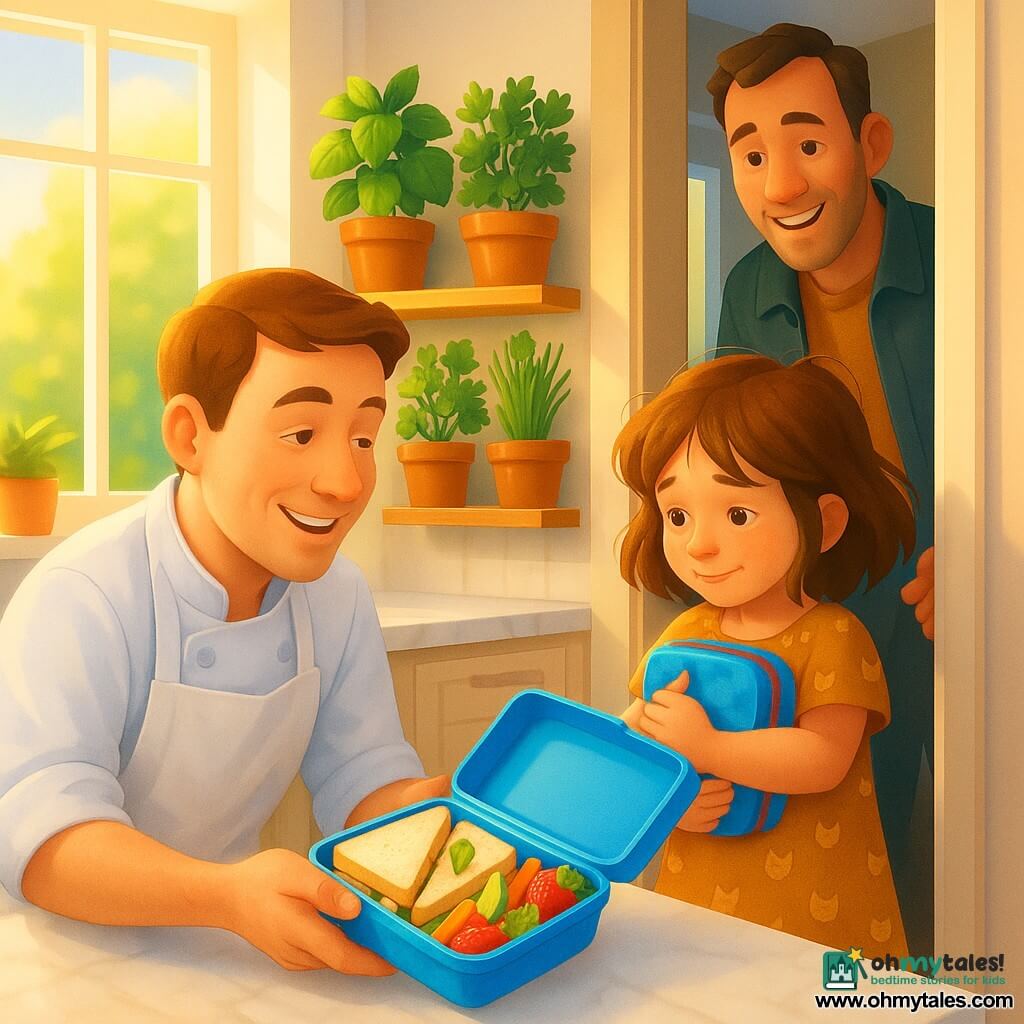
Lila's dad opened the door with a grateful smile. “Chef Milo! It smells amazing already.”
Chef Milo lowered his voice, as if the lunch box might be sleepy. “It's packed with comfort,” he said. “And it heard that Lila doesn't like onions.”
Lila peeked from behind her dad's leg. Her hair was a bit messy, like she had just been thinking hard.
Chef Milo crouched down to her level. “Hi, Lila. I made you a lunch box that is brave, but not loud.”
Lila blinked. “Brave food?”
Chef Milo nodded. “Brave food doesn't push you. It stays with you. It says, ‘Try if you want.'”
Lila smiled a small smile. “Okay.”
Chef Milo handed her the lunch box. “When you open it, smell first,” he said. “Smells can be like a friendly hand.”
Lila hugged the lunch box to her chest. “It's warm,” she whispered.
“It's not warm from heat,” Chef Milo said gently. “It's warm from care.”
Lila's dad laughed softly. “That's the most chef thing I've ever heard.”
Chef Milo grinned. “We chefs say silly things sometimes. But we mean them.”
As he walked back home, he felt the quiet happiness that comes after helping.
The hallway smelled like soap and someone's toast.
Back in his modern kitchen, Chef Milo looked at his herb shelf. “Good work, green team,” he said. “You listened.”
The herbs smelled proud.
Chapter 4: The Folded Towel Goodbye
Evening arrived with sleepy footsteps. Chef Milo made himself a simple bowl of soup and ate slowly. Then he cleaned the last dish and wiped the counter until it shone.
He turned the music down low. The kitchen lights became softer, like the room was putting on pajamas.
Chef Milo checked his phone. A message from Lila's dad:
“She ate everything. She said the basil sandwich tasted like ‘a calm forest.' She also said she talked to a new kid about cats in hats. Thank you.”
Chef Milo let out a long, happy breath. “That's the best review,” he whispered.
He looked at the herbs and spoke as if telling them a bedtime story. “Today we learned what a chef does,” he said. “A chef plans meals. A chef uses senses—smell, taste, touch, and sight. A chef keeps things safe and clean. And a chef listens to people.”
He paused. “Listening is not just with ears,” he added. “It's with attention. It's with kindness.”
Chef Milo went to the sink and rinsed one last spoon. The water ran warm over his fingers. He liked the feeling—smooth, steady, simple.
Then he reached for his kitchen towel.
It was soft cotton, pale blue, with tiny stitched lemons. It smelled like clean laundry and a hint of sunshine.
He held it up and said softly, “Every day in the kitchen ends the same way.”
He folded it carefully: once, then again, edges lining up like well-behaved pages in a book. He pressed the folds with his palms, feeling the neatness, the calm.
“A folded towel means the work is done,” he murmured. “The kitchen can rest. The chef can rest.”
He placed the folded towel on the counter, perfectly square.
He turned off the lights, leaving only the small glow from the herb shelf by the window.
Basil, mint, parsley, and chives stood quietly, breathing out their gentle smells into the night.
Chef Milo yawned. “Good night, green team,” he whispered.
The kitchen was peaceful. The towel was folded. And somewhere nearby, a child had a full belly, a calmer heart, and a little more courage for tomorrow.