Chapter One: The Map in the Teacup
Ten-year-old Milo loved two things more than pocket money: his battered green boots and maps. He kept maps folded like secret leaves under his pillow, tracing rivers with his finger until the paper softened. His village, Willowmere, was a place where chimneys smoked like friendly questions and the wind told small jokes in the hedges. One rainy Tuesday, Milo found a map in his grandmother's teacup.
Grandmother had laughed when Milo dropped the cup on the table. "It's been there since you asked where the stars keep their lost socks," she said, stirring the steam. Milo picked up the cup and inside, clinging to the porcelain like a tiny island, was a rolled scrap of paper. It smelled of lemon and adventure.
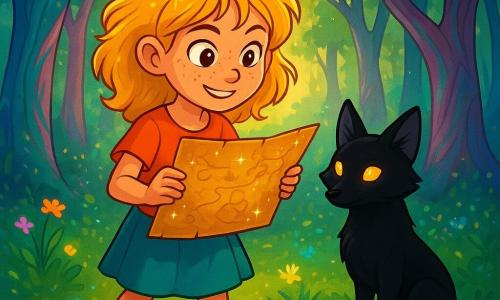
The map showed a path that began at Willowmere's crooked elm and wound past places that breathed like living things: the Whispering Marsh, the Clockwork Grove with trees that rang bells in the wind, and finally a jagged mark that read simply: Heartlight. Around the map's edge, in handwriting that looked like spider-silk, there was a note: "Find who you are under the blue moon. Bring back a memory."
Milo's heart did a quick hop. He wanted to be brave in the way knights were brave in fairy tales and also in the way a child dares to ask questions. He wanted to return changed, as if polish had been rubbed on a dull pebble. He stuffed the map into his coat and, before his grandmother could say any more, he slipped out the door, the rain playing a drumroll on the roof.
Chapter Two: The River That Sang
The path left Willowmere like a ribbon, and the ribbon unfurled into wildflowers and stories. Milo's boots made puddle-moons with each step. He met the Whispering Marsh at noon. It was neither ugly nor pretty; it was interesting. Reeds bowed like old librarians, and bubbles rose from the mud like tiny wonders.
The marsh whispered not secrets but questions. "Why do you hurry?" it asked, in voices that sounded like leaves. Milo answered aloud as if conversation could stitch courage into him. "Because I'm curious," he said. "Because I want to see everything."
A reed hummed, leading him to the River That Sang. The river's surface rippled in tune to invisible music, and fish leaped notes into the air. Milo knelt and put his hand into the water; his reflection looked back like a boy far away and also very near. The river pushed a small, shiny pebble toward him, as if passing on a secret. On the pebble was carved a tiny compass rose.
"Where are you going?" the river asked. Milo laughed; the river sounded like his uncle when he told jokes. "To the Heartlight," Milo said. The river bubbled agreement and rolled the pebble back to shore as if to say, "Take this. Remember where you came from."
Milo put the pebble into his pocket. It warmed like a loyal coin and seemed to hum softly against his hip. He felt braver, not because the pebble was magic, but because something outside him had noticed his smallness and had given him a token that said, You matter to the path.
Chapter Three: The Clockwork Grove
Next came the Clockwork Grove, where trees wore pendulums and birds nested in little brass cages. Each tree ticked like a grandfather clock, and the air smelled faintly of cinnamon and old books. Time here was not a ruler but a companion — it nodded and adjusted its hat to suit travelers.
Milo wandered between trunks that chimed his name in different accents. A squirrel with a waistcoat offered him a tiny cup of tea and a map of the stars. "People get lost when they think time is scarce," the squirrel said, polishing a nut. "Take a breath. Time is a river you can step into more than once."
As Milo walked deeper, he heard a sound like a heartbeat wrapped in wood. Under a lantern-tree, he found a boy about his age, blindfolded, trying to tune a clock with trembling hands. The boy's name was Arlo, and he had been trying to set the clock to ring a lullaby that would wake his village from a sleeping sadness. He had come from a place where the sun forgot to smile.
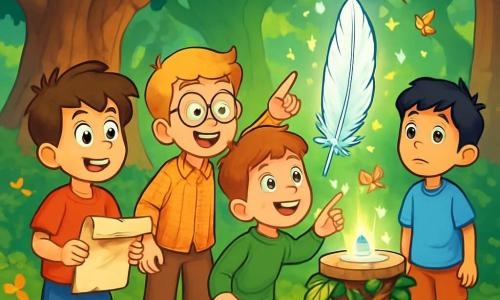
Milo could have hurried on, but he remembered the pebble's warmth and the river's kindness. He knelt and guided Arlo's hands, both of them listening to the tiny gears like birds learning their first songs. Together they coaxed the clock into harmony. When it chimed, the entire grove hummed with approval. A golden leaf floated down and settled onto Milo's shoulder like a promise.
Arlo could not see Milo very well, but he could feel steadiness in the other boy's breaths. "You help like someone who's practiced courage," Arlo said. Milo's chest swelled. He had been brave by choice, and the choice felt like a muscle getting stronger.
They walked out of the grove together, and Arlo offered Milo something. "Take my map to Heartlight," he said. "I must go home when the shadows lengthen." Milo accepted, surprised at how easy it was to hold another's hope.
Chapter Four: The Mirror of Caves
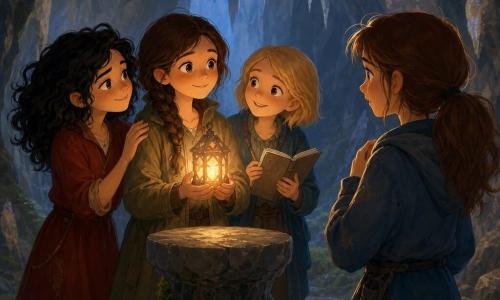
Beyond the grove, the path narrowed into a gorge that smelled like liverwort and lantern smoke. Milo followed a trail of cool stones into the Mirror Caves, where the walls were polished like truth and reflected more than faces. When light hit the crystals embedded in the rock, they flashed with memories: a woman baking bread, a lamb skidding on a hill, a grandfather's whistle. The cave murmured stories with every dripping footstep.
Milo remembered the note in the teacup: "Bring back a memory." The caves were full of them; most hung just out of reach like ripe fruit. He stepped under an arch where the air tasted like caramel and saw himself reflected not as he was but as he might be. In one mirror he was a captain of a silver ship; in another, a gardener coaxing stars into bloom. Each possibility shimmered and vanished.
At the cave's heart, a pool lay still as glass. Floating above it was a small lantern shaped like a heart: the Heartlight. It did not blaze; it pulsed like a moth's wing. The pool whispered, "To take a memory, give one."
Milo thought of the pebble in his pocket—how gently the river had nudged it to him. He imagined giving up a memory of Willowmere, of his grandmother's laugh, of the smell of hot porridge. It hurt to imagine losing those things, but he remembered too the map's promise: return transformed.
He closed his eyes and took from his pocket the compass pebble. He pressed it into the palm of his hand and let the pebble's warmth melt into the lantern's glow. The pool shimmered, and in exchange, a small bowl of light rose to hover above Milo's head. The bowl held a single memory: the first time Milo had been brave enough to speak up for a friend, small but shining like a coin. The memory wrapped itself around his heart like a ribbon. He did not lose his grandmother's laugh; instead, something new nested beside it—a memory that belonged only to this journey.
When he opened his eyes, the lantern's pulse had steadied. The pebble was no longer in his pocket, but its place felt full. The cave reflected Milo as someone who had chosen to give and thus received something truer.
Chapter Five: The Return Under the Blue Moon
The sky found him as he climbed from the caves: stitched with stars and a blue moon hanging like a spoon over the world. Heartlight lay behind him, small and steady, like a friend's breathing. The walk home felt different. The wind commented kindly on Milo's new stride and the trees waved as if greeting a traveler who had learned an elegant thing.
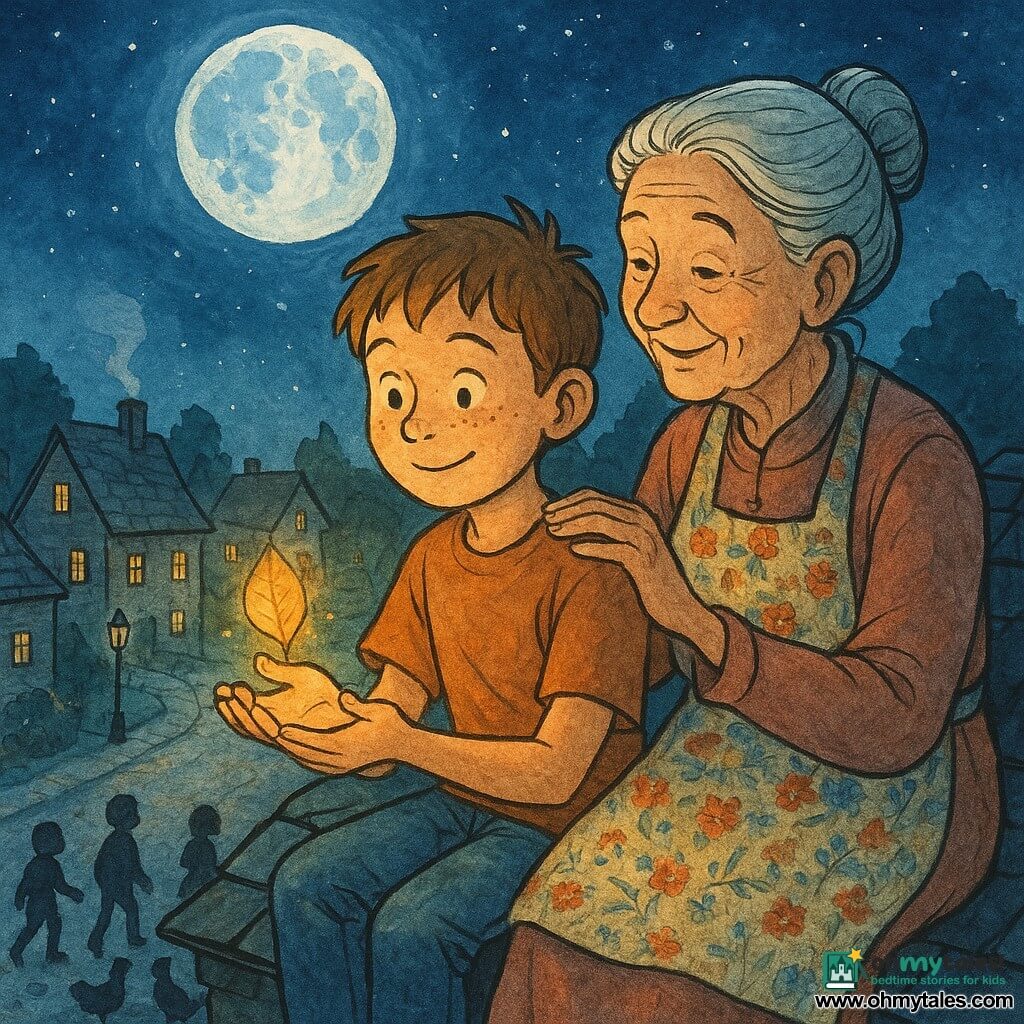
When Milo reached Willowmere, the crooked elm stood like a waiting grandfather. The villagers gathered, curious about the boy who smelled of river and pine and cave crystals. Grandmother, who had been waiting with a kettle and an apron that smelled of safety, wrapped Milo in a hug. He felt the bowl of light there, warm and present, and opened his hand. It was empty; the memory didn't sit in objects now but in him—woven into his laugh, in the way his eyes looked when he told a story.
That night the blue moon rose, full and soft as a promise. Milo climbed onto the roof to watch. He took from his pocket a single object he had kept: the golden leaf from the Clockwork Grove. He pressed it to his forehead, closed his eyes, and remembered the boy Arlo and the tune of the clocks, the River That Sang and its pebble, the Mirror of Caves where he had learned to trade a memory for a gift he could not find in Willowmere. The memory that arrived under the blue moon was gentle: the proud, surprised feeling of helping someone find their song.
Grandmother sat beside him. "Did you find what you were looking for?" she asked.
Milo looked up at the moon and felt his whole journey inside him like a tiny lantern, warm and honest. "I found parts of myself I didn't know were missing," he said. "And a memory to keep."
The villagers asked him about Heartlight and the maps and the river. Milo told them stories in a voice that had been stretched by travel like a well-used rope. Children listened with wide eyes, and even the hens seemed to cock their heads in interest. Arlo's lullaby came to them too, carried by a wind that liked to run errands. It softened faces and made small, stubborn flowers turn their heads toward the moon.
In the days that followed, Milo changed in simple ways. He still loved maps, but now he drew paths he had walked and added notes—small reminders of who helped him and how the world answered questions if one only asked. He walked more slowly sometimes, because the squirrel had been right: time could be a river you stepped into again. He helped other children find their own brave things, offering them tiny tokens—pebbles of listening, leaves of encouragement.
Years later, when Milo grew not so much older as fuller, he would take a child by the hand and point to the elm with a smile. He would tell of the Heartlight and the price of giving, of the River That Sang and the pebble that taught him to feel his roots. He would not keep the story like a trophy but like bread—something to share.
On clear nights, when the blue moon rose like a bowl of milk, Milo climbed the roof and closed his eyes. He could call back the lantern's pulse, the grove's bells, the river's laughter, and the warmth of Arlo's friendship. The memory he had brought back sat in his chest like a small lamp, never fading. It reminded him that curiosity is a mapmaker's tool and courage is what carries you across the map. And when he listened, he could still hear, like a far-off tune, the world asking, "Where will you go next?" and his own heart answering, steady and bright.