Chapter One: The Warning Winds
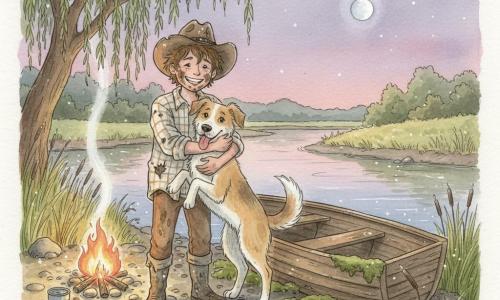
The wind smelled of rain and dust when Silas Reed rode into Sweetwater. He rode a lean chestnut horse named Bramble, and his hat was tilted back so he could see the town's wooden roofs glinting under a low, gray sky. Silas was twenty, with a quick grin and hands that knew how to mend a fence or steady a frightened steer. People in Sweetwater greeted him as if he belonged; after all, he had stopped in their street more than once to fix a loose plank or help haul in a stubborn wagon.
On the far edge of town the river—wide and slow during dry months—had swelled into a hungry ribbon of mud. The sheriff, old Mr. Pritchard, stood on the bank with his coat collar turned up, staring at the current. "This is no ordinary rise," he said when Silas dismounted. "Snow up in the mountains comes down in one great gulp. If that ferry's not secured, the Martha June won't stand a chance."
The Martha June was more than a boat; it was the town's link to the market, the school, and the mail. It creaked at its moorings, proud and weathered, waiting. Silas ran a hand along its railing and felt the tremor of the river beneath his boots. He smelled timbers and rope and rain. He thought of the folks who crossed each day—farmers hauling chickens, Mrs. Larkin with her basket, little Sam Hawkins who loved to count knots on the ferry's ropes.
A shout cut through the air. A boy waving a red handkerchief ran toward them—Sam, all freckles and knobby knees. "Silas! The river's moving fast! The men from up north saw ice breaking!" he panted. His eyes were wide as river stones. "It could sweep the Martha June away!"
Silas's jaw tightened. He felt the kind of worry that sits like a hard pebble in the chest. "Gather the men," he told Sam. "Tie the ferry to the bank. We'll need more than rope. Come on."
Chapter Two: Plans Under a Dark Sky
Inside the town hall, the lamps threw warm circles on the rough wooden floor where a dozen townspeople leaned over a map. Silas sketched lines with a stub of pencil: extra anchors, weighted logs, a brace of timbers across the ferry's side. "We can't just tie her to one post," he said. "The river will pull at every spot. We'll need counterweights upstream and a boom to block debris."
An old dockworker named June—after whom the ferry was named—nodded. His hands were knotted like roots. "We can lash felled trees from the west bend and drive them as a breakwater," he said. "But it's dangerous work. The current's a liar. It looks gentle until it bites."
Sam's small voice spoke. "I can help. I can pass rope. I can—" He stopped, shadowed by the crowd's worry. Silas looked at him. The boy's chin trembled, but his feet were planted as steady as a post.
"You're coming," Silas said. His answer was soft but certain. "Bring your courage, Sam. It's as useful as any hammer."
They set to work under the hiss of coming rain. Teams hauled logs, the blacksmith heated hooks, and women tied knots faster than you could say "anchor." Silas moved among them like a captain, giving quick orders, fixing a bad lash here, steadying a frail ladder there. When a rogue gust tried to tear a canvas tarp loose, he leaped and held it down with a strength that made the crowd laugh—nervousness breaking into brave noise.
As night fell, the river swelled further, silvering beneath the moon. The first great groan of the current sounded like a long, unhappy animal. They had built the boom and positioned the logs, but Silas knew the real test would be in the morning, when the river came with teeth.
Chapter Three: The Night the River Roared
Rain came hard, like thrown stones. It pounded the town's windows and sifted into the rafters. Silas and a handful of watchmen stayed by the ferry, their hats soaked, their faces pale in the lightning. Sam was there too, wrapped in a blanket, eyes reflecting the river's angry white strips.
At midnight a sound broke the storm: a great crash upriver. Trees tore free and spun like frightened animals. The boom trembled, and the Martha June shuddered under a sudden shove. Ropes sang as if a thousand birds were trapped inside them. One of the anchor lines snapped with a report that made the horses whinny.
Silas shouted orders over the noise. "Bail!" he cried. "Get the extra anchor in! Move upstream—fast!" Men leaped into waist-deep water, pulling against the current that felt like a living thing. Sam passed coils of rope from hand to hand, his fingers numb but his face set with iron.
A jagged chunk of ice the size of a table came hurtling toward the ferry. It struck the boom square and splintered. The river found a new path, pressing iron and timber. The Martha June tilted; water slashed across her deck.
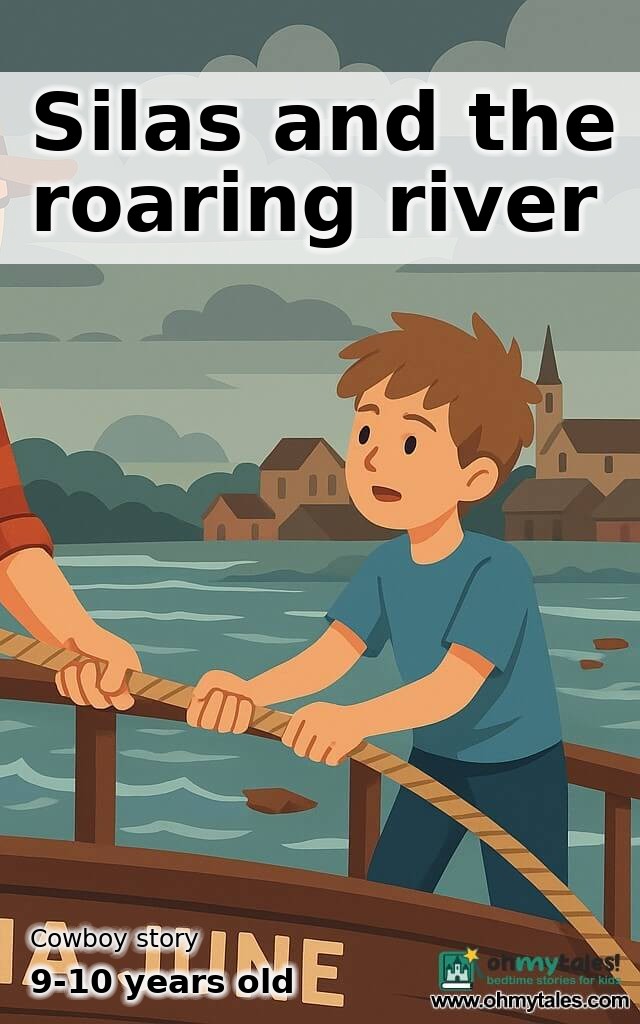
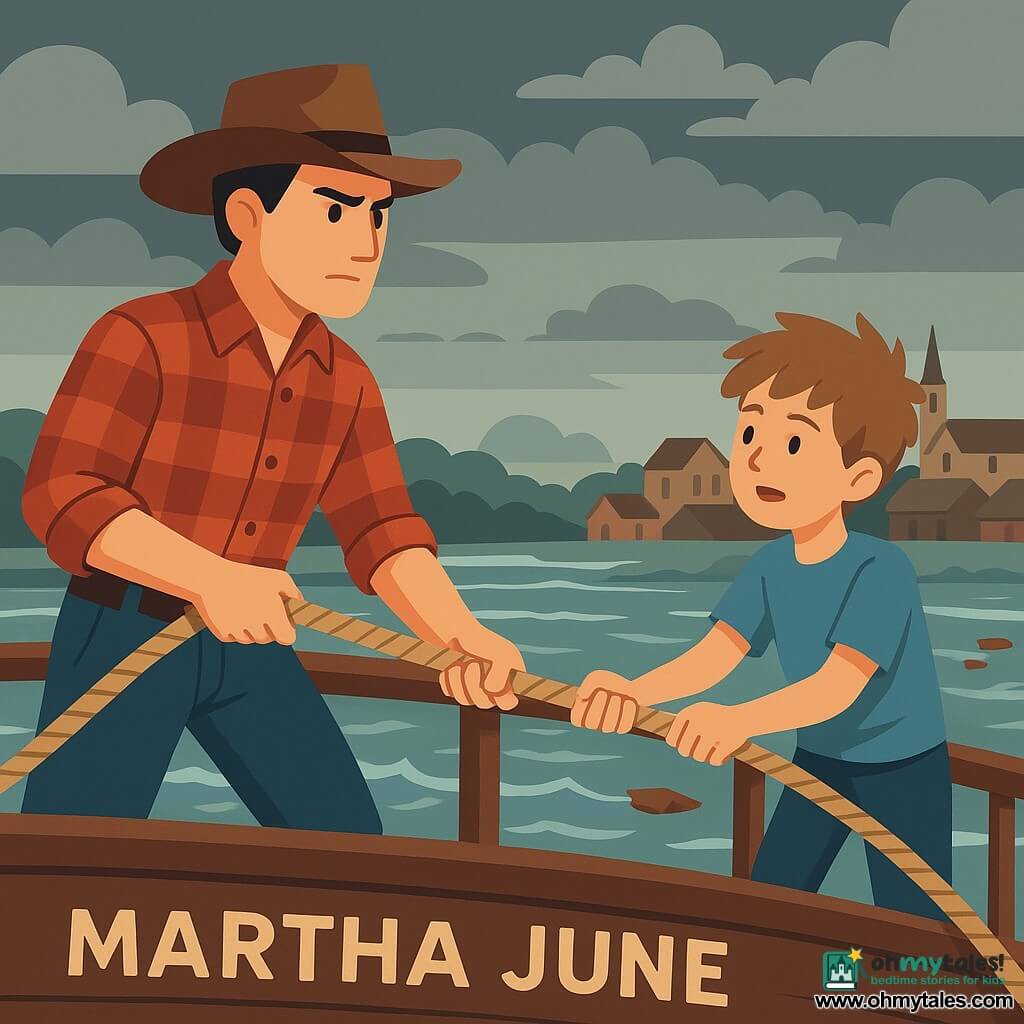
Silas did what had to be done. He clambered along the ferry's edge, heart hammering, and lashed a new line to a felled oak while balancing against the pull of the river. The rope cut into his palms. For a moment, fear showed through: he might be swept, caught under a plank and lost. He inhaled the storm's taste and steadied himself. He thought of Sweetwater's schoolhouse bell, Mrs. Larkin's laugh, Sam's small determined face. He tightened his grip and heaved.
With a groan that sounded like an old man freeing a stuck door, the ferry stopped drifting. The new anchor held. The townsfolk cheered, voices cracking but fierce. They were wet, shaken, and bright with relief. Sam's grin cut through the rain like a beam of light. "You did it, Silas!" he shouted.
Silas smiled back, though his muscles trembled. "We did it," he said. He looked at the river, now raging but contained, and felt a respect for its power that made him hush against the wind.
Chapter Four: The Rescue at Dawn
Dawn came pale and trembling. The storm had thinned into a watery drizzle, and the river, though still swollen, moved more predictably. But the town had another problem: the west bend, where the breakwater had been placed, showed a gap. A farmer named Harlan and his wagon had been caught there the night before, separated from town by a side channel.
Silas didn't waste a second. He organized a rescue. A small party set out in a skiff—a shaky little boat whose wood had known better days. Sam insisted on coming, even though his mother fretted. Silas pulled the boy to his side and handed him a life vest made from saddlebags padded with cloth. "You watch the water and keep your head," he told him. "Courage is not not being afraid. It's being steady while your heart is."
The skiff cut through coffee-brown water, wind and spray misting their faces. They found Harlan clinging to his overturned wagon, hair matted with mud and eyes wide as fish. "I thought I'd be a meal for the river," he croaked.
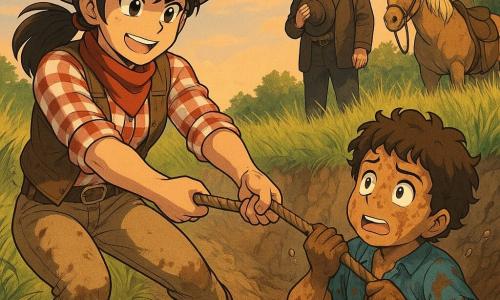
Silas and Sam worked together, tying him to the skiff, getting him aboard with a haul that left their arms shaking. Sam's small hands gripped the rope, and Silas's steadier ones directed the movements. They pushed through tangled branches and the whisper of logs. At one point a branch snagged the oar, and the current spun them. For a heartbeat the boat spun like a top and terror skied up their spines. Silas braced his legs, shoved his weight, and guided them free. They rode a small wave into calmer water and reached Sweetwater with cheers waiting on the bank.
Harlan wept when he stepped onto dry ground. The town wrapped him in blankets and fed him hot coffee. The rescue was a medicine more powerful than iron. People laughed and cried and clapped Silas and Sam on the back. Sam's eyes were bright the way a boy's are after a big adventure—tired, proud, and sure he could do anything.
Chapter Five: The Future Tied Fast
By the week's end, the river had calmed into a broader, slower course. The townspeople worked together to reinforce the bank with stone and rooted brush. Children hauled small rocks, pretending they were mighty dragons. Mrs. Larkin and her friends sewed patches for torn sails. Even Mr. Pritchard found a hammer and hammered with a firm, steady hand.
Silas oversaw the final lashings of the Martha June. He walked the ferry's deck and looked at the town from that angle—the schoolhouse roof with a rooster-shaped weathervane, the saloon with its bright green shutters, the general store's bell that winked in the sun. He thought how fragile such things were, how easily a river could carry them away, and how strong they could be when people worked together.
Sam was there, showing another boy how to tie a bowline. "Like this," he said, patient and precise. Silas watched him and felt a proud warmth. The boy had learned something about the world: that small hands can hold steady, that bravery can be shared.
On the last day, they rechristened the strengthened boom with a small ceremony—a handshake, a toast of cider from tin cups, and the clapping of children who admired it like a fort. Silas stood by the railing, feeling the ferry's steady rise and fall, and saw the Martha June not just as wood and rope, but as a promise. A promise that Sweetwater could stand against storms, that its people could bind its future to a steady line.
Before he left, old June took Silas by the shoulder. "You kept us from losing more than a boat," he said. "You kept our town's courage afloat."
Silas glanced at the river, now gentler, sun flaring on ripples like scattered coins. He thought of the night they'd faced the roar, of the way Sam had passed rope hand to hand, of how the whole town had become a single, stubborn thing.
"That's what we'll keep," Silas said. "All of it—tied fast."
They rode out of Sweetwater with the Martha June swinging calm behind them and the river whispering memories of a night it had roared. Sam waved from the dock, small and steady, already counting knots for the next day. Silas tipped his hat, feeling the tug of far horizons. The West stretched wide and wild, full of dangers and kindnesses, and he was ready for both—brave, clever, and never alone.