Chapter One: The Wide Wind
Dust rose like a slow tide as Mae Harper pushed her mare, Lark, along the rim of the prairie. The sky rolled in great blue waves; the sun was a hard coin that painted every ridge and blade of grass with gold. Mae tucked her hat lower and listened—to the distant lowing of cattle, to the rattle of a hawk's wings, to the whisper of the wind that seemed to carry secrets across the plain.
Mae had been a cowgirl for years, but she still felt that small, eager tug whenever the herd spread wide across the land. Today the ranch hands were off checking fences, and the herd grazed like a living ocean beyond the creek. Mae's new task sat heavy in her saddlebag: a slender, wooden whistle she'd carved herself. Her goal was simple and stubborn—learn to use that whistle to call the herd.
Her father had taught her the old calls when she was a girl. But a whistle—sharp and clear even in a storm—was a different language. Folks said the best whistles could gather a crowd of cows faster than a chisel could shape a brand. Mae eyed the whistle like a small tool of magic and tried it once, twice. The sound was thin and shaky, like a bird unsure of flight.
She rode closer to the herd, feeling both the thrill and the weight of responsibility. The calves were restless, and the older cows moved with careful, slow wisdom. Mae wanted them to know the whistle was a friend, not a command from a stranger. She wanted it to be a story they recognized.
Lark nuzzled her palm. Mae breathed in the scent of crushed sage and horse sweat and practiced again. This time a clear note rose and fell—short, honest. A single cow turned its head. Two. A breeze picked up the sound and carried it, and for a breath Mae felt a bridge unmade being sewn.
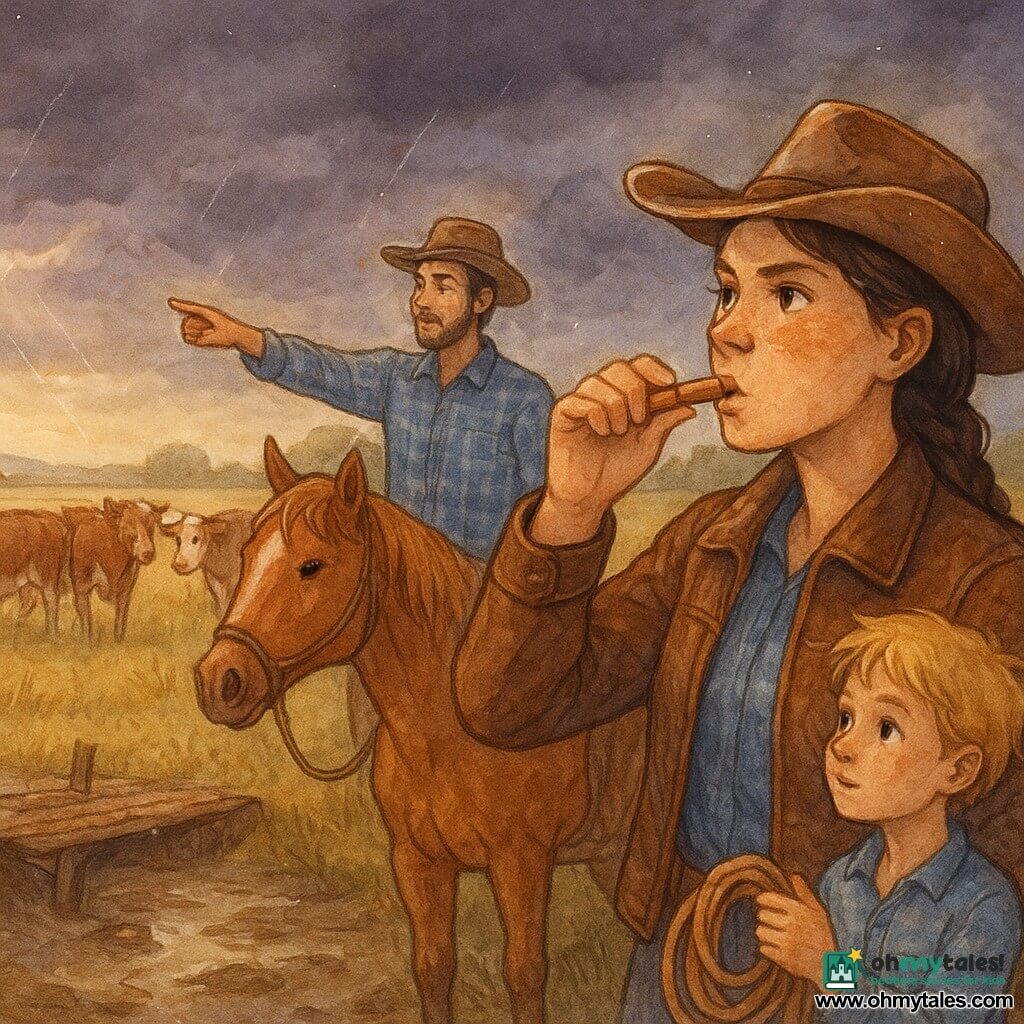
Then a shout cut across the prairie: "Mae! Storm's coming!" Her friend Eli Elliot loomed on the trail, face pinched with worry. Dark clouds marched in from the west, their undersides bruised purple. The herd would be scattered if the storm hit hard.
Mae's heart tightened. She could either chase the cows one by one until her legs burned, or she could trust the whistle. She slid from Lark's back and, with wet fingers from river water, set the little whistle to her lips. The first blast was bold and round, a silver coin thrown into the sky. The cows lifted their heads like ships sensing a lighthouse. A calf broke into a run. Others followed.
"That's it!" Eli cheered. "Keep going!"
Mae blew a series of notes, soft then firm, like footsteps and then an open gate. The herd began to gather, forming a slow, rolling mass toward the watering gulch. The clouds rushed closer, and the wind carried the whistle in fits and starts, but the cows came. Mae felt something else flutter through her—joy that came not from success alone but from making something new work. Creativity, she thought, was a rope between fear and triumph.
By the time the first raindrops spattered, the herd was mostly together. The storm roared like a distant engine. Mae smiled and told Lark, "Good work, girl." Lark snorted and shook her mane as rain started to sing on leather and grass. Mae knew this was only the beginning.
Chapter Two: Broken Bridge
After the storm, the world smelled clean and sharp as a new coin. The creek rose with new strength, tumbling over stones that glinted like scattered stars. The herd needed to be moved to higher ground for the night. The quicker Mae could gather them, the safer they'd be. But when she led them to the old wooden bridge that spanned the swollen stream, she found the center plank splintered and gone, the nails rusted away like forgetfulness.
The herd hesitated, snorting and pawing at the mud. The calves clustered near mothers' legs. A narrow path along the bank would be slippery; turning back would mean a long, exhausting detour. Mae felt the old knee-knots of worry, but she also felt the small, deliberate warmth of problem-solving.
Mae dismounted and walked the edge, whistle hung from a loop on her belt. She peered where the bridge had failed and then up at the cows. "All right," she murmured. "We can do this."
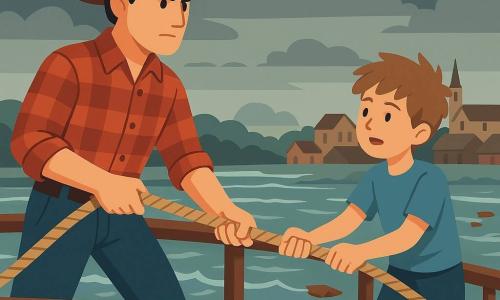
Using a rope and a length of canvas, Mae fashioned a makeshift ramp, anchoring it to a sturdy post and firm rock. She tied the rope at one end, threaded it like a lifeline, and tested the path herself first, boots slipping but holding. Then she called softly with the whistle—simple notes that said "come" and "careful." One by one, the cows crossed, hooves clattering on patched wood as rain-slicked beams groaned beneath them.
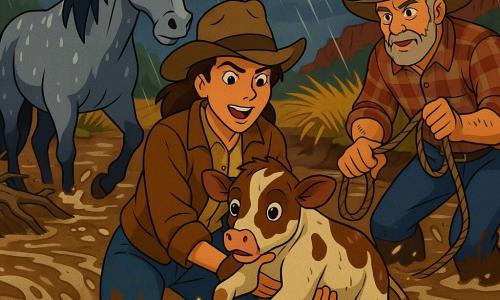
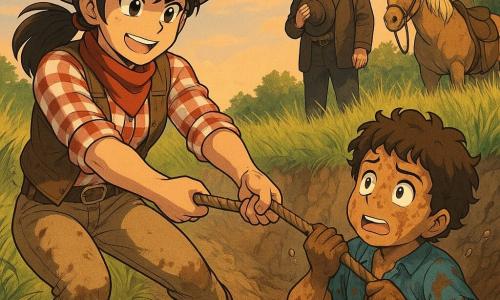
Halfway through the crossing, a calf slipped and skidded toward the water, its legs a frantic blur. Mae dropped the canvas, lunged, and grabbed the calf's flank. Water slapped her boots; the calf squealed like a tiny bell. She hauled it back, breath burning, heart a drum. Her hands shook, not from cold but from the fierce, bright edge of wanting to protect.
Eli and another ranch hand helped steady the ramp, and soon every hoof had found the safer bank. The herd moved on, quieter but bonded by the shared pinch of fear. Mae sat on a rock, towel pressed to a mud-bruised knee, and looked at the whistle in her hand. It seemed smaller now, but heavier with meaning. She felt clever and tired and proud—like someone who'd made a bridge where the world had tried to keep them apart.
The sun slid down like butter, and the herd settled into a sweeping fold of grass. Around the campfire, Mae roasted a piece of bacon and listened to the low murmur of cows and the distant croak of a raven. She hummed a pattern into the whistle, a little phrase she'd been shaping all week—soft at the start, then bright and firm. The note echoed into the evening and landed in the herd like a gentle order. A calf blinked and found its mother. A cow raised its head and answered with a long, friendly bellow. Mae folded her hands and watched the stars prickle alive overhead, feeling the day's small victories bloom.
Chapter Three: The Rustlers' Trail
They woke to tracks—hoof and boot impressions pressed into the morning dust, then a deeper pattern of wagon wheels like interrupted circles. Someone had been through during the night. A few heads of cattle were missing. Names ran through Mae's mind like a fast river: rustlers, thieves, trouble. Word on the line was that gangs sometimes moved through, trying to claim a herd that wasn't theirs.
Mae tightened her belt, set the whistle against her lips, and rode out with Eli and the others to follow the trail. The wind was pale and sharp, and the prairie seemed to hold its breath. The tracks led toward a ragged canyon, a place where shadows could hide a dozen secrets.
Somewhere halfway, they found a fresh campfire, still warm. A scrap of cloth snagged on a thorn bush flapped like a warning flag. Mae found a hoofprint with an odd nail pattern—marked and cruel—different from their herd's shoes. The rustlers had been slick, but in their haste they'd left clues.
Mae's creativity showed itself in small ways: she used the whistle to call a hawk that flew overhead, then mimicked the hawk's movement to spot a glint of metal behind a rock. They traced the rustlers to a narrow arroyo where the stolen cows huddled, restless and tense, penned by a flimsy corral built from thorn and lean branches.
The rustlers were three and rough as tumbleweed, faces like old dried leather and eyes bright with greed. They argued over numbers and plans, and in their squabble they grew careless. Mae felt the pulse of the moment. She could have charged, shouting and blazing, but that would risk the cattle and their own safety. Instead she let the whistle do the talking.
She walked out where the rustlers could see her, arms loose, hat tipped. She blew a clear command into the air—notes she'd practiced for moments of trouble: bold, then a rolling phrase that had the sound of gathering a crowd and closing a gate. The cattle listened, heads turning slowly, calves nudging their mothers. The rustlers stared, puzzled.
Then Mae used the land: she rode Lark along a ridge where the sun reflected off a shiny tin she'd placed earlier. The flash and the whistle together made an illusion of more riders coming. The rustlers' eyes widened; their bravado faltered. They hesitated, then bolted, perhaps imagining a posse or an army of ranch hands closing in. Eli and the others took up the chase and rounded up the nerves and the gentle kine.
Mae felt a rush—joy and relief braided together. It had been a test of wit more than muscle. Creativity had been the rope again: using light, sound, and courage to save what mattered. As they drove the herd back to the open, Mae let the whistle sing a gentle lullaby into the cooling air. The cows followed like a line of small ships finding harbor.
Chapter Four: The Story by the Fire
That night, the campfire made a small sun on the dark plain. The herd lowed quietly in a circle, like waves resting against a shore. Mae sat on an upturned bucket, whistle warm in her palm, embers painting her face with orange. Around her, the ranch hands propped their boots on stones, and Eli handed her a mug of coffee that tasted like the country—strong, with a single note of burnt sweetness.
Mae looked at the whistle then, at the smooth wood she had carved with an old pocketknife. It held the memory of the storm, the bridge, the arroyo, the moment a calf slipped and her hands had closed around it. She realized she had started the day believing simply that a whistle would gather cows. She finished the day understanding that the whistle gathered more than a herd: it gathered stories, courage, and a community.
"Tell it how you did it," one of the men urged with a grin. "Tell us the whistle story."
Mae smiled and leaned forward. The fire leaned back, and the stars leaned closer. She began to speak, and in her voice was the rhythm of feet on prairie and the snap of leather and a little bright laughter.
She described the whistle's first false note like a shy roostering bird and the later bold blast that had become a lighthouse. She told them about the bridge and the calf and how the canvas had smelled of river grass; how the rustlers had fled when faced by cleverness and a well-placed flash of tin. She told them about the way the herd listened when there was trust in the sound, and about how sometimes the trick was to be quieter than the wind and twice as steady.
Her hands moved as she spoke, sketching the path of the whistle in the air, a small, invisible rope pulling together other invisible things—courage and creativity, humor and patience. When she reached the end, she set the whistle on her knee like a small, sleeping animal.
"Sometimes," she said quietly, "a thing you make teaches you more than you ever knew. A whistle is not just a whistle. It's a question and an answer. The question is, will you try? The answer is, you make one note at a time."
The men listened, the flames flickering like applause. Around them, the herd sighed and shifted, content. Eli chuckled and tossed a stick into the fire, which sent a spray of sparks up as if the stars themselves were applauding.
Mae's story did more than close the day; it handed the younger hands something like a map. She talked about the best way to shape a note so the wind will carry it, how to read a cow's eye for worry, and how to make a bridge when a bridge is needed. She spoke of cleverness—the art of seeing new uses in old things—and the small brave steps that grow into courage.
When the tale was done, a hush wrapped the camp like a blanket. Mae picked up the whistle one last time, breathed in the night air, and played a single, soft phrase that folded into the dark. It sounded like home.
Later, as the fire dwindled and the herd slept, Mae lay back against Lark's warm side. She thought of tomorrow—the long ridges, the work, the chance to teach another hand to whistle and to see young calves look up and know the sound. Sleep came easy, a kind that fills you like quiet milk.
In the morning, Mae would ride into a wide day and try new notes, shape new calls, teach someone else that small tools can solve big problems. She would tell the story again, perhaps with new details, because stories grow the way a herd does: a little here, a little there, until they become a map not only of where you've been but of how you'll go forward.
For now, she closed her eyes with the whistle resting against her heart, and the prairie kept watch—wide, patient, and always open to the next brave and clever thing.