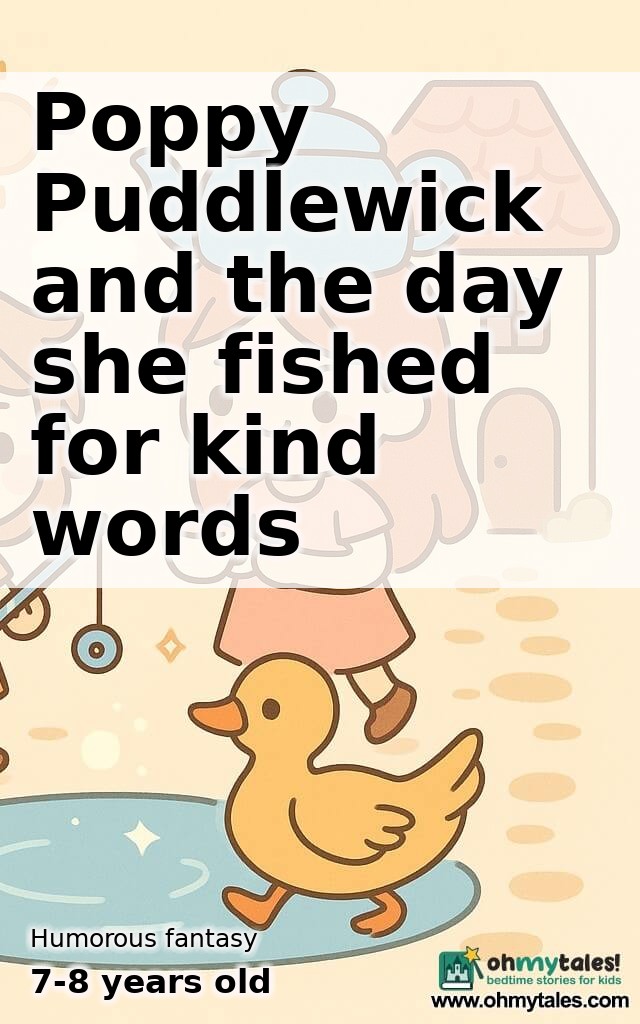
Chapter 1: The Very Ordinary Pond That Wasn't
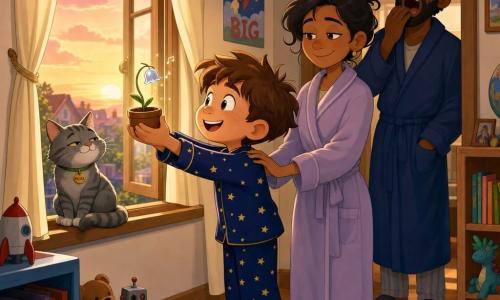
Poppy Puddlewick woke to the sound of a spoon tapping a teacup. She sat up, hair a tangle of plans. Today felt like the kind of day that needed a small adventure.
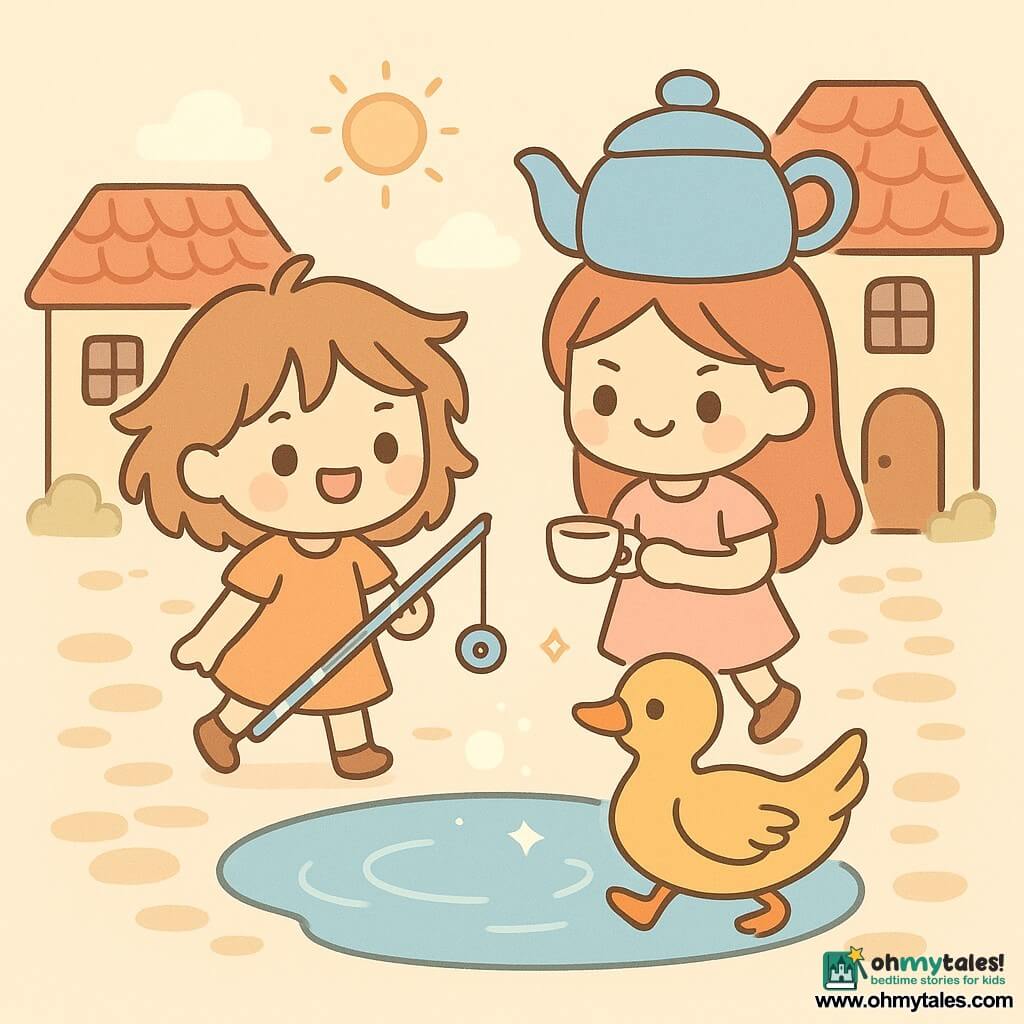
She had a fishing rod. Not an ordinary rod. It was painted stripey blue and smelled faintly of lemon sherbet. She had wrapped a bit of string around a pebble and tied a button on the end. It looked proud.
“Why are you packing a pebble?” asked Mummy from the doorway. She held two slices of toast like little flags.
“Because I'm fishing,” said Poppy, buttoning hope into her pocket. “For words.”
Mummy blinked. “Words?”
“Yes! Kind words. Sweet words. Words that make people grin like toast.” Poppy hopped down the stairs. Her shoes made polite squeaks on the hall mat. “There's a pond,” she declared. “Well, really a puddle, but ponds are just grown-up puddles.”
Outside, the sky was the color of milk with a wink of blue. The puddle sat in the middle of Wibble Lane, like a lazy mirror. Poppy knelt. She peered into its black-brown eye. Something shimmered. Tiny letters, like minnows, darted under the water.
“Hello?” whispered Poppy.
A small splash answered. A word bobbed up and popped. Hello! it cheered, in bubble letters, and then sank with a giggle. Poppy squealed with delight. This was better than lemon sherbet.
She tugged her stripey rod from behind the garden hedge. “Right,” she said to the puddle. “Let's see what you've got.”
She baited the button with a crumb of her toast. It twinkled. The button tasted of stories. Then she dangled it over the puddle. The water circled like it was listening.
A tug. A little tug so polite it wore white gloves.
“I'm fishing,” said Poppy firmly. “For kind words.”
A voice, soft as a sock, floated up. “Please don't take the word ‘scone',” it said, with a hint of mischief.
Poppy laughed. “I won't. I promise.” She reeled in the string. The button slid through the air and landed with a plop. A small, wet word clung to it. It smelled faintly of butter and bravery.
“Bravely-buttered!” read Poppy. “That's… a lot of adjectives.”
The word wiggled. “Use me when someone tries something new, like balancing on a wall or wearing a hat the wrong way,” it suggested.
Poppy put it in her pocket with the rest of her promises. She had a plan. She would fish all the kind words she could find and deliver them around town, like a letter carrier of happiness.
Chapter 2: The Quibbles and the Quackers
She walked down Wibble Lane, pockets jingly with small compliments. The town was all tile roofs and toothy hedges. Mr. Tumble, the baker, was arguing with his oven.
“It's browning too fast!” he complained, flour in his moustache like tiny clouds.
Poppy peeped in the bakery window. The oven looked offended. The crumbs on the counter were taking notes.
“Would you like a word?” she asked through the cracked door.
Mr. Tumble looked surprised. “A word? I thought you had to write them down.”
“Some words come ready-made,” said Poppy, tapping her pocket. “I've been fishing in puddles.”
Mr. Tumble blinked. Then he beamed. “Well, I could do with a brave word,” he said. “My new apprentice is making croissants that defy gravity.”
Poppy reached into her pocket and handed him a small, flopping word. It said, in soft floury letters, “Try-again.” Mr. Tumble took it like a warm bun.
“Try-again,” he said, and the oven sighed happily. The croissants stopped thinking of themselves as aerial artists and folded neatly into buttery crescents.
“Thank you!” said Mr. Tumble, stuffing a warm scone into Poppy's hands. “For the word and the scone.”
Poppy tucked the scone into her bag and waved. “Onwards!” she sang.
She skipped past the pond. A duck stood on one leg like a gentleman. It quacked to itself. Its reflection frowned. Ducks are very particular about reflections.
“Would you like a compliment?” Poppy offered.
The duck puffed out its chest. “I look ridiculous,” it declared. “My wing is on backwards.”
Poppy frowned. She had to be careful. The puddle-words were mischievous and could misunderstand.
She took out a shiny little word with a ribbon. It said “Marching-feather.” The duck read it and flapped once. It looked at its wing, then at Poppy, then at its reflection. It gave a little bow.
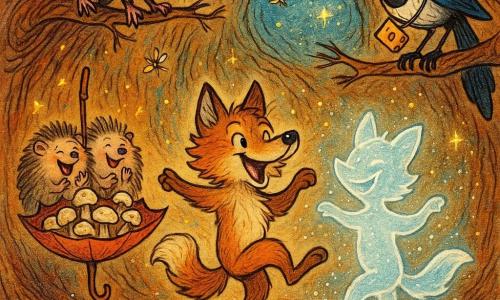
“Marching-feather!” it announced proudly. It hopped in a circle. The townsfolk peeped out windows and applauded the duck's parade. The duck bowed again and waddled away, quite pleased with its woke wing.
Poppy waved. She was feeling like a postbox of positivity. Her pockets were lighter now, but her bag smelled of scone and sunshine.
Then, from a narrow alley, came a small voice shouting about quibbles.
“You can't call my hat silly!” cried a girl with mischievous eyes. Her name was Tilda. She had a hat that looked like a teapot.
“That hat is a teapot!” insisted Mr. Crank, who liked rules the way squirrels like nuts.
Poppy paused. She loved arguing like she loved puddles—only until someone felt sad. Arguments were like hiccups; they needed a kind word to go away.
She plucked out a plump word. It said, in bubbly letters, “Lovely-differences.” She handed it to both Tilda and Mr. Crank. They read it together and coughed up tiny giggles.
“Lovely-differences,” murmured Mr. Crank, thinking of ribbons and teapots. His moustache tried to smile.
Tilda grinned and tipped her teapot hat. “Lovely-differences,” she echoed. She poured imaginary tea into the air. It smelled of rainbows.
Everyone clapped. Even a passing crow nodded, which is high praise for a crow.
Chapter 3: The Day the Puddles Got Chatty
Poppy's pockets were nearly empty. She had given away brave words, funny words, gentle words. Her bag shook with the last scone. She felt warm.
Then the puddle on Wibble Lane coughed. Not a real cough—puddles don't cough, they ripple with gossip—but it made a sound like a kettle.
“Poppy,” the puddle said, in a voice like trousers. “We are thirsty.”
Poppy blinked. “Thirsty? But you're full of words.”
“We are full of words that wander,” said the puddle. “Some are shy. Some like to hide under stones. We lost a very special word this morning: ‘You-can-do-it.' It slipped between the cobbles when Mrs. Moppet dropped her broom. We can't reach it.”
Poppy sat down, hands on her knees. “That word sounds important.”
“It is,” said the puddle. “Mrs. Moppet needs it. She is about to lead the town parade and her knees are doing a nervous dance.”
Poppy thought of Mrs. Moppet. She was the lady who could iron a shirt while balancing a cat and reciting poetry. Mrs. Moppet did not like nervous knees.
“How do we fish it out?” asked Poppy.
The puddle winked. “With a team,” it suggested. “You need cleverness and silliness.”
Poppy hopped. A plan fizzed like lemonade. She gathered Tilda with her teapot hat, Mr. Tumble who had flour on his elbow, the marching duck, and a small boy named Ben who could whistle backwards. They formed a circle around the puddle, like a ring of very odd flowers.
“Right!” said Poppy, because starting a plan with “Right!” always made it more official. “Tilda will distract with tea tricks. Mr. Tumble will bake a crumb bridge. The duck will perform a parade march. Ben will whistle backward to confuse the shy letters.”
They set to work. Tilda poured invisible tea into tiny cups and tied bows on them. Mr. Tumble kneaded a crumb bridge so steady that ants considered moving house. The duck marched; the puddle giggled. Ben whistled backward and the sound made the letters hiccup.
“Now we fish,” declared Poppy, with the stripey rod poised like a conductor's wand.
She lowered the button into the puddle and whispered, “Please come home, ‘You-can-do-it.'”
The water circled like it was thinking of a joke. A flurry of letters rose, wearing tiny hats. Poppy felt the rod tug, hard enough that her knees did a celebratory hop.
She reeled in the string. Out popped a sprightly word, dripping confidence. It looked like sunshine wearing sneakers.
“You-can-do-it!” sang Poppy. She clapped it into both hands and handed it to Mrs. Moppet who had arrived wearing sparkly boots and a worried hat.
Mrs. Moppet's eyes shone. She took the word carefully, as if it were made of paper cranes. “Oh,” she breathed. “Thank you. I needed that.”
She tucked the word into her pocket and stood up straighter than a rainbow on a pole. “Let us parade,” she cried. Her nervous knees did a little dance that turned into a confident march.
The parade began. Tilda juggled teacups that sang slightly off-key. Mr. Tumble balanced a tower of scones. The duck did three grand bows. Ben whistled backward all the way, sounding like a breeze going the wrong way. Everyone waved.
People threw kind words like confetti. Little phrases rained down—“Well done,” “Nice try,” “That was brave”—and landed on shoulders, hats, and the odd cat tail. The town hummed like a kettle ready to sing.
Poppy felt very proud. Her pockets were empty, but her heart was full of warm, wiggly feelings.
Chapter 4: The Return of the Letters
After the parade, the puddles felt lighter. The words floated back to their bedtime places, tired and happy. The pond in the middle of Wibble Lane yawned. “Thank you,” it said, and sounded like a drawer closing.
Poppy sat on the curb and licked a crumb from her finger. She listened to the town breathe out. The lamppost winked its one eye. Mr. Crank was trying to learn how to smile; it looked like he was practicing a tricky skip.
“You did good,” said Tilda, perched on a railing. She offered Poppy a ribboned biscuit. “You fished for kindness and it came.”
Poppy chewed thoughtfully. “I think kind words are like seeds,” she said. “They need to be planted where they're needed. Sometimes a seed looks like a silly hat or a marching duck.”
Tilda nodded as if she had just learned the most sensible thing in the world. “Would you like to teach my baby sister to juggle bread?” she asked.
“Only if she promises not to pour tea on the mayor,” Poppy replied.
They giggled and made a little promise. Promises are sticky like marmalade.
That evening, Mummy met Poppy at the gate with her arms open. “How was your day?” she asked.
Poppy hugged her and whispered, “I fished for kind words. We had a parade. A puddle helped.” She told the whole story, in small breezy sentences like skipping stones.
Mummy listened, eyes round and soft. “And did you learn anything?” she asked when the tale was finished.
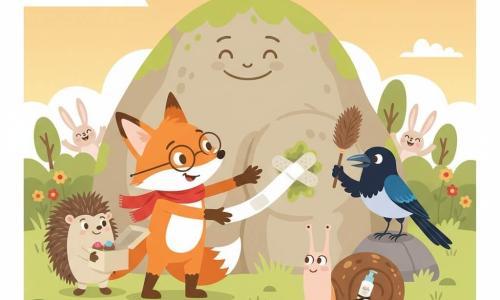
Poppy thought. She had learned many small things. How to be brave with a pocketful of scones. How to bandage a grumpy argument with a silly word. How puddles were excellent listeners when treated with respect and crumbs.
“Yes,” said Poppy at last. “That kind words grow when you give them away. They sprout smiles. And also,” she added with a secret grin, “that puddles make excellent accomplices.”
Mummy laughed and brushed a smudge of flour from Poppy's cheek. “Then tuck that lesson in your pocket,” she said. “Right next to the next scone.”
Poppy did. She tucked the lesson in like a treasure map. She fell asleep that night dreaming of puddles with bow ties and letters with tiny umbrellas. The town hummed outside, soft as a lullaby.
The next morning, when Poppy peered into the puddle, a small word peeked out and winked. It said, “Thank-you.” Poppy waved at it.
“See you tomorrow,” she said, and meant it.
Because the next day, and the day after that, and many days after, Poppy Puddlewick walked Wibble Lane with her stripey rod and a pocket full of courage. She fished for kind words and set them free. She learned that the best magic was not making things disappear, but making people feel lighter. She learned that words, given with a grin, made the world a bit more like a parade—bright, noisy, and impossible not to join.
And if, by chance, a duck insisted on practicing its bows by your front door, you should let it. Ducks, like kind words, prefer an audience.