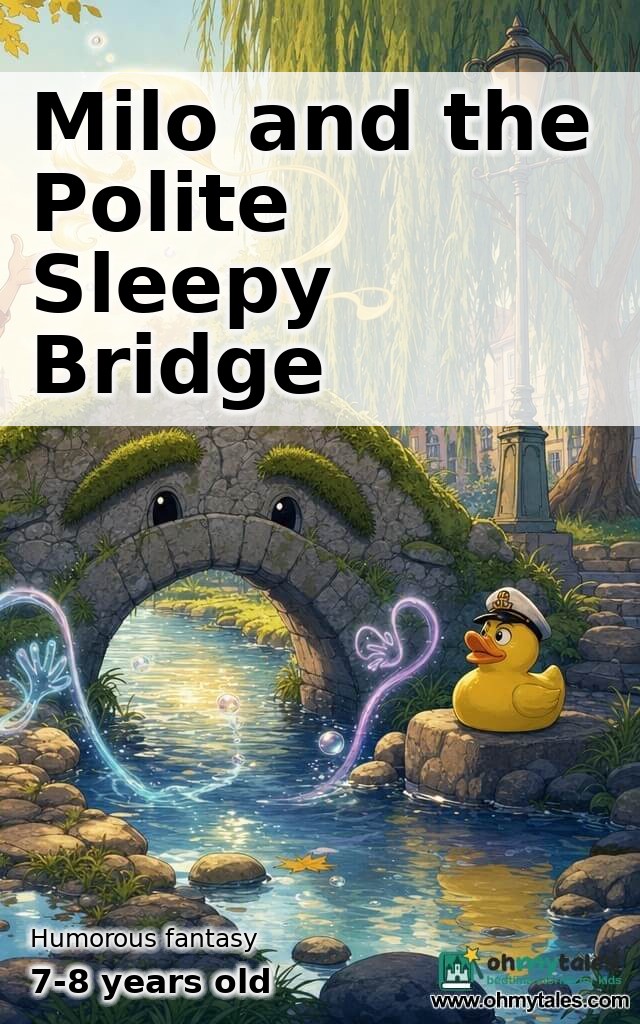
Chapter 1: The Bridge That Snored Politely
On Maple Street, where the puddles liked to copy the clouds, there was a small stone bridge that did a very strange thing.
It slept.
Not in a “fallen-over-in-the-mud” way. In a “proper nap with manners” way. The bridge lay across a narrow stream, its back arched like a cat stretching, and every morning it gave a soft, rocky snore that made the water ripple in polite little circles.
Most people didn't notice. Grown-ups were busy noticing important things, like meetings and shoes that pinched. Kids noticed, but they got used to it, the way you get used to a clock ticking.
Except Milo.
Milo was seven years old, bright as a button and twice as bouncy. He had a face that looked like it was always about to giggle, even when he was trying to be serious. Especially then.
Milo had decided—after careful thinking, a biscuit, and a second biscuit—that the bridge should wake up.
Not because it was in trouble. Not because it was broken. Just because waking a bridge sounded like the sort of thing a day was meant for.
He marched to the stream with a small backpack. In it were three very useful tools:
1) A rubber duck (for moral support).
2) A spoon (for tapping things).
3) A library book called “Polite Words for Beginners,” because Milo's mum said you could solve most problems with manners.
The bridge snored again. A ladybird waddled across its stones like it owned the place.
Milo cleared his throat. He remembered to use his best voice, the one he used when asking for jam.
“Excuse me, Bridge,” he said.
The bridge did not reply. It did not even do a “hmm?” It only snored, as if dreaming of being somewhere else—perhaps being a very busy bridge in a storybook, with knights and dragons and a snack cart.
Milo tried again, louder but still polite. “Please wake up!”
A leaf drifted down and landed on his hair. That was nature's way of saying, Not yet.
Milo looked around. There were signs of everyday magic everywhere, if you knew where to squint. The stream gurgled like it was telling jokes to itself. The reeds whispered secret recipes for soup. A pebble winked. Or maybe it was just wet.
Milo took out the spoon and tapped the bridge. Tap tap.
The bridge made a sound like a sleepy “thunk.” The water giggled.
Milo leaned closer. “Sorry to bother you,” he said, because you always said sorry when bothering bridges. “But it's daytime. You might be missing it.”
The bridge snored, and a tiny puff of dust rose like a yawn.
Milo sighed. “All right. We'll do this properly.”
He opened his book and flipped to the page titled: “How to Wake Someone Up Without Being Rude.”
It listed steps:
1) Say hello.
2) Say please.
3) Offer a cup of tea.
Milo frowned. He didn't have tea. He had a rubber duck.
He held up the duck. “Would you like a… motivational duck?”
The duck stared bravely into the bridge's silence.
Then Milo heard footsteps behind him. Light ones. Like someone tiptoeing on purpose.
Old Mrs. Pottle was coming down the path with her shopping bag and her hat with the wobbly flower on top. She was the kind of old lady who looked as if she might have a secret cupboard full of stories. Probably because she did.
She stopped and watched Milo. “Morning, Milo. Talking to stones again?”
“Yes,” Milo said politely. “I'm trying to wake up the bridge.”
Mrs. Pottle nodded as if that was a normal Tuesday. “Good. Bridges get sleepy. They listen to too many feet. Footsteps can be very dull, you know.”
Milo's eyes widened. “So it can hear me?”
“Oh, yes,” said Mrs. Pottle. “It's just pretending not to. Very common with bridges. Proud creatures. Won't wake up for just anyone.”
Milo stood a little taller. “I'm not just anyone. I'm Milo.”
“Exactly,” said Mrs. Pottle. “So you'll need the proper thing.”
“What's the proper thing?” Milo asked, eager as a puppy.
Mrs. Pottle leaned in, as if sharing a treasure map. “A Wake-Up Wish,” she whispered. “But not a big one. Bridges don't like big drama. They prefer small magic. Like socks that match, or toast that lands butter-side up.”
Milo imagined toast doing a little flip and landing perfectly. That felt like serious magic.
“How do I make a Wake-Up Wish?” he asked.
Mrs. Pottle reached into her shopping bag and pulled out a tiny brass bell. It was no bigger than a thimble, and it looked like it had been polished by someone who loved it.
“Ring this once,” she said. “Then say three polite words. Bridges adore polite words. They collect them like shiny pebbles.”
Milo took the bell carefully. It felt warm, as if it had been waiting for his hand.
“Three polite words,” he repeated. “Like… please, thank you, sorry?”
Mrs. Pottle smiled. “Perfect. Just don't say them in the wrong order. That can make a bridge start telling knock-knock jokes for a week.”
Milo gulped. A bridge telling knock-knock jokes sounded funny, but also exhausting.
He turned back to the bridge, held the bell, and took a deep breath.
Ding.
The sound was tiny but clear. It danced over the water like a silver fish.
Milo said, carefully, “Please. Sorry. Thank you.”
The bridge stopped snoring.
For one quiet moment, the whole stream seemed to wait.
Then the bridge's stones shifted—just a little—like someone rolling over in bed. A mossy patch lifted like an eyebrow.
Milo grinned. “Hello?”
The bridge made a sound that could only be described as a grumbley yawn. A pebble fell off the edge and plopped into the water, embarrassed.
Mrs. Pottle clapped softly. “There you are,” she murmured. “Now, Milo, remember: when you wake something, you must be kind. Waking up can be confusing.”
Milo nodded. “I'll be very kind. Extra kind. The kindest.”
The bridge's yawn turned into words. Slow, rocky words, like a sentence being built out of bricks.
“Who… rang… my… bell?” it rumbled.
Milo puffed out his chest. “I did. Excuse me, Bridge. I'm Milo. I hope you slept well.”
The bridge sighed. “I dreamed… of goats.”
“Nice goats?” Milo asked, because you had to be polite about dreams.
“Very… dramatic… goats,” said the bridge. “They wore… tiny… capes.”
Milo almost laughed, but he didn't want to be rude. He let the giggle stay inside and bounce around happily.
Mrs. Pottle winked at Milo. “I'll leave you to it,” she said, and walked on, her shopping bag swinging like a friendly pendulum.
Milo stepped closer to the bridge. “Bridge,” he said, “I have an important request.”
The bridge's mossy eyebrow twitched. “Do… you… need… crossing?”
“No,” Milo said. “I want you to be awake. Properly awake. Not just one eyebrow. The whole you.”
The bridge was quiet. Then it asked, in a voice like stones rubbing together gently, “Why?”
Milo thought hard. He could have said, Because it's funny. Because I want to. Because bridges shouldn't nap all day.
Instead he said, “Because you're part of the town. And I thought you might like to see the sunshine. Also, I'd like to say good morning properly. And maybe hear about the cape goats.”
The bridge made a sound that might have been a chuckle, if rocks could chuckle. “Manners… and… curiosity,” it said. “Acceptable.”
Milo beamed. Step one: wake bridge. Step two: keep bridge awake. Step three: do not accidentally start knock-knock jokes.
Easy.
Probably.
Chapter 2: Everyday Spells and Silly Problems
Keeping a bridge awake turned out to be trickier than Milo expected.
The bridge did not have eyelids, but it did have something called “sleepy stone thoughts,” and those were stubborn.
“Tell me about your day,” Milo suggested.
“My day,” said the bridge slowly, “is… feet… feet… feet.”
“That sounds boring,” Milo said, then quickly added, “Sorry. I mean, it sounds… important.”
“It is… important,” the bridge agreed. “But… boring… too.”
Milo understood. Even important things could be dull. Like brushing teeth. Or listening to Uncle Rob explain lawnmowers.
“So we need fun,” Milo announced. “We need everyday magic.”
The bridge's moss seemed to perk up. “Everyday… magic… is… best,” it rumbled. “Big magic… makes… a mess.”
Milo knew about mess. He had once tried to make “invisible” paint by mixing soap, toothpaste, and purple marker. The paint was not invisible. It was just rude-looking.
“All right,” Milo said. “Let's do small magic.”
He opened his backpack and pulled out the rubber duck. He placed it on the bridge as if it were a royal guard.
“This is Captain Quackers,” Milo said. “He is in charge of cheering.”
The duck said nothing, because it was a duck. But it looked very responsible.
The bridge stared. “Is… that… a… knight?”
“Sort of,” Milo said. “He's brave. And he squeaks.”
The bridge made a thoughtful grinding sound. “Squeaks… are… interesting.”
Milo had an idea. He gave Captain Quackers a gentle squeeze.
Squeak!
The sound bounced under the bridge and came back slightly different, like the bridge had added its own echo. The echo sounded like: Squeee-please.
Milo blinked. “Did you just make it polite?”
The bridge sounded pleased. “I… improved… it.”
Milo laughed. “That's amazing.”
He tried again. Squeak!
This time the echo returned as: Squeee-thank-you.
Milo doubled over giggling. “You're a manners bridge!”
“I… am… a bridge,” it said with dignity. “Manners… are… a bonus.”
Milo decided this was the kind of magic that was safe and perfect. It made things nicer instead of scarier.
Then a squirrel ran onto the bridge, stopped, and stared at the duck as if it had discovered a new kind of nut.
Milo said, very politely, “Hello, Squirrel. Please don't steal Captain Quackers.”
The squirrel sniffed and chattered, which in squirrel language probably meant, I do what I want, but with less grammar.
The bridge rumbled. “Squirrels… are… rude.”
“Not rude,” Milo corrected gently. “Just… busy.”
The squirrel darted away, flicking its tail like a comma.
Milo clapped his hands. “Okay. We need more wake-up fun. What else do you like?”
The bridge thought slowly, because bridges did not rush. If they rushed, people would fall in the stream, and then everyone would have wet socks. Wet socks were the enemy of joy.
“I like… songs… without… words,” the bridge said.
Milo nodded. “Like humming.”
He hummed a bouncy tune he'd made up for tying shoelaces. It went: hmm-hmm-hey, hmm-hmm-ho, shoes go tight, now off we go.
The stream joined in by gurgling on the beat. The reeds shushed in rhythm, not to stop him, but to add sound. The bridge's stones vibrated gently, like it was purring.
Milo felt proud. He was conducting an orchestra of normal things.
Then the bridge's mossy eyebrow drooped again.
“Oh no,” Milo whispered. “You're getting sleepy.”
“I… do… not… get… sleepy,” the bridge grumbled, which was exactly what someone says right before falling asleep.
Milo looked around for more help. Mrs. Pottle had said the bridge liked polite words, and that seemed true. But maybe it needed something else too.
He spotted a small sign stuck in the grass near the bridge. It was a town sign with neat writing:
PLEASE DO NOT FEED THE DUCKS TOO MANY BISCUITS.
Milo frowned. “That's about ducks, not bridges.”
The bridge rumbled, “Signs… are… powerful.”
“Are they?” Milo asked.
“Yes,” said the bridge. “They… tell… the world… what… to do.”
Milo stared at the sign. If signs were powerful, maybe he could make one for the bridge. A sign that said: PLEASE WAKE UP, BRIDGE. THANK YOU.
He didn't have paper, but he did have the spoon. And the dirt was soft.
Milo knelt and began to write careful letters in the soil, right where the bridge could see.
PLEASE WAKE UP BRIDGE
THANK YOU
He dotted the “I” in THANK YOU with a tiny pebble, because details mattered.
The bridge leaned—just a little—toward the message. “That… is… polite,” it said.
“And clear,” Milo added. “No confusion. No knock-knock.”
The bridge's stones shifted as if stretching. “I… feel… seen,” it admitted.
Milo's chest warmed. He hadn't expected the bridge to have feelings, but then again, he hadn't expected it to dream of cape goats either.
A jogger came by, wearing bright shoes. She waved at Milo. “Hi!”
Milo waved back. “Hello!”
She ran onto the bridge. “Nice day!”
The bridge, still half-awake, decided to be helpful. It echoed her footsteps as a polite rhythm: tap-please, tap-thank-you, tap-sorry.
The jogger slowed. She looked down at her shoes like they had started talking.
Milo tried not to laugh. He failed a little.
The jogger shrugged. “Cool bridge,” she said, and jogged on.
Milo whispered, “Bridge, you're doing manners magic again.”
“I… cannot… help… it,” the bridge said, sounding proud and sleepy at the same time.
Milo thought fast. “If you keep doing that, everyone will become extra polite. That could be… dangerous.”
“Dangerous?” the bridge repeated, alarmed.
“Well,” Milo said quickly, because he did not want the bridge to worry, “not scary dangerous. Just… imagine a whole town saying sorry at the same time. It would take ages to buy ice cream.”
The bridge made a horrified rumble. “Ice… cream… must… not… be… delayed.”
“Exactly,” Milo said. “So we need a plan. A gentle plan. Fun, but not too much.”
The bridge's mossy eyebrow lifted again. “I… am… listening.”
Milo grinned. “We'll wake you up properly with a quest.”
The bridge paused. “A… quest?”
“Yes,” Milo said. “But a small one. A low one. Like… a quest you can do without even standing up.”
The bridge sounded interested. “Acceptable.”
Milo pointed downstream. “There's a tiny wooden chest under the willow tree. I saw it yesterday. It's probably full of something magical.”
The bridge rumbled skeptically. “Or… full… of… old… sandwiches.”
“That's also exciting,” Milo said. “Old sandwiches have stories.”
The bridge made a slow, amused sound. “You… are… strange.”
“Thank you,” Milo replied automatically, because politeness was catching.
“We need that chest,” Milo said. “And we need it to help you stay awake.”
The bridge's stones creaked. “Bring… it… here.”
Milo saluted Captain Quackers, picked up his backpack, and skipped along the stream, feeling like an adventurer on the most silly mission in the world.
And, honestly, that was the best kind.
Chapter 3: The Quest for the Not-Too-Important Chest
The willow tree drooped over the stream like it was thinking sleepy thoughts of its own. Under it, half-hidden by grass and a brave patch of mud, sat the wooden chest.
It was small, about the size of Milo's lunchbox, with a metal clasp and a few scratches that looked like they came from enthusiastic squirrels.
Milo crouched beside it. “Hello, Chest,” he said politely, because he was having a day of greeting objects. “May I pick you up?”
The chest did not answer, because it was a chest. But Milo felt that greeting it was still the right thing to do. You never knew when a chest might be listening.
He tried to lift it. It was heavier than it looked, the way some books were heavier because they were full of dragons.
Milo puffed. He pulled. The chest shifted with a reluctant scrape.
A bubble rose in the stream and popped, as if the water was making a tiny “go on, then.”
Milo dragged the chest onto a flatter patch of ground and wiped mud off his hands.
Now came the big question.
Should he open it?
He remembered what Mum said about other people's stuff: If it isn't yours, you ask first.
But who did you ask when it was a chest under a willow tree?
Milo decided to try the polite way anyway. He leaned close and whispered, “Excuse me, Chest. Are you someone's?”
The chest sat quietly.
Milo waited. Still nothing.
He tried again, because sometimes magic needed patience. “Please could you give me a sign?”
A leaf fell from the willow and landed right on the clasp.
Milo nodded. “That's… a sign-shaped leaf.”
He took it as permission to at least look for a clue.
On the back of the chest, carved into the wood, were three words:
FOR BRIDGE USE
Milo gasped. “It's for the bridge!”
That solved the manners problem. If it was for bridge use, then using it for the bridge was the polite thing to do. Possibly the most polite thing.
He heaved the chest up, hugged it to his stomach, and waddled back along the stream like a penguin carrying treasure.
When he reached the bridge, it was dozing again. Not fully asleep—more like “thinking about napping.”
Milo called softly, “Bridge? I brought something for you.”
The bridge's stones shifted. “Is… it… tea?”
“No,” Milo admitted. “But it's almost as good. It's a chest that says FOR BRIDGE USE.”
That woke the bridge up faster than a bell. “A… chest?” it rumbled, suddenly alert. “From… the willow?”
“Yes,” Milo said proudly. “And I asked it politely. Mostly.”
The bridge hummed with interest. “Place… it… here.”
Milo set the chest on the center stone. Captain Quackers stood guard beside it, looking very serious for someone made of rubber.
The bridge leaned its attention toward the clasp. “This… is… mine,” it said, sounding surprised and pleased. “I… forgot.”
“You forgot your own chest?” Milo asked.
“I… sleep,” the bridge reminded him. “I… forget… many… things. Names… of… pigeons… and… the… year… it… rained… buttons.”
Milo blinked. “It rained buttons?”
“For… a… minute,” said the bridge. “Very… confusing.”
Milo put his hands on his hips. “All right. Let's open it. Politely.”
“How?” the bridge asked.
Milo checked the clasp. It had no keyhole. Instead, it had three tiny grooves shaped like words.
Milo leaned closer. The grooves were not letters, but they felt like them. Like the chest wanted to be spoken to.
The bridge rumbled, “It… opens… with… manners.”
“Of course it does,” Milo said. “Everything today opens with manners.”
He took a deep breath and spoke clearly, as if talking to someone shy.
“Please.”
The clasp clicked a little.
Milo continued, “Thank you.”
The clasp clicked more.
“And… sorry,” Milo added, because you never knew if a chest had been stepped on.
The clasp popped open with a soft, happy sound.
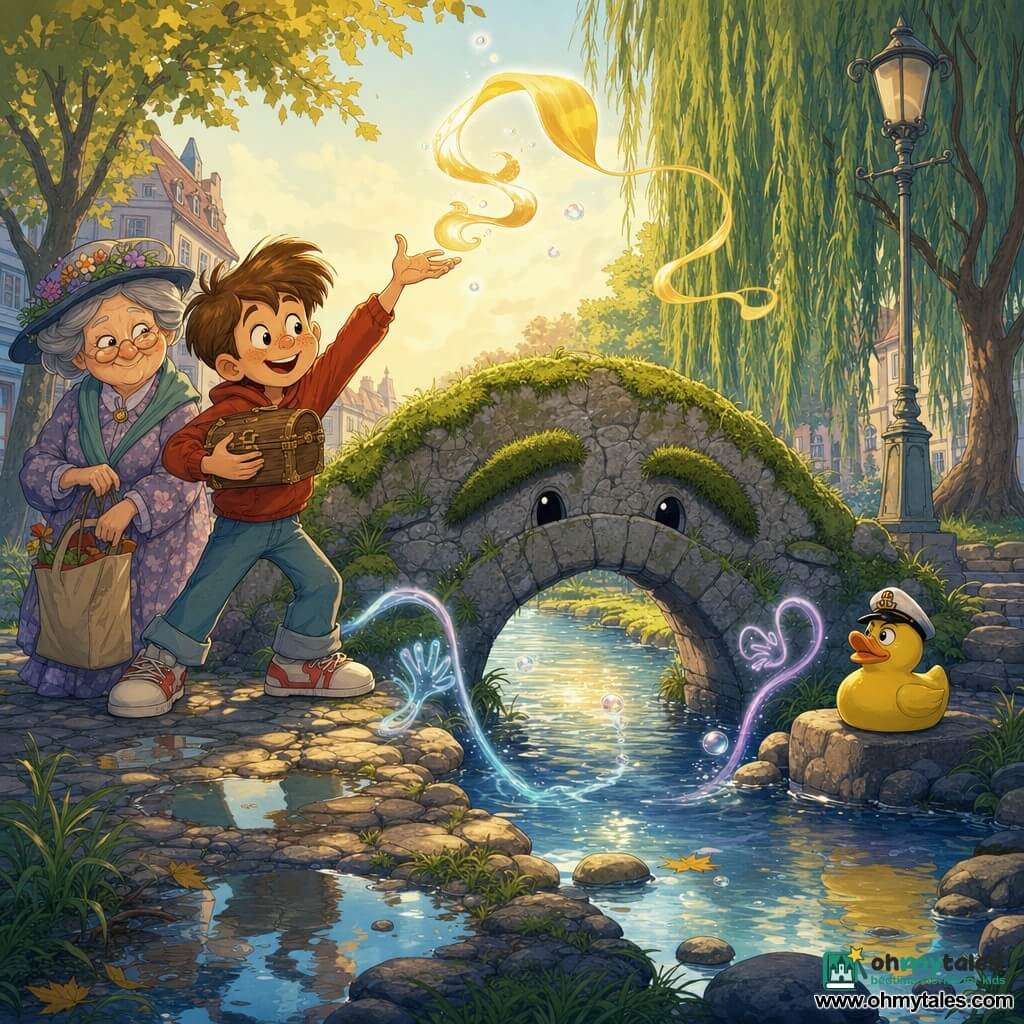
Milo lifted the lid.
Inside was… a yawn.
Not a real yawn from a mouth. A magic yawn, folded neatly like a blanket. It shimmered pale gold, like sunshine that had learned to behave.
Milo stared. “It's… a yawn.”
The bridge sounded relieved. “My… emergency… yawn,” it said. “For… waking… properly.”
Milo frowned. “But yawns make people sleepy.”
“Not… this… one,” the bridge explained. “This… one… is… a… reverse… yawn.”
Milo had heard of reverse things before. His socks were sometimes reverse, because he put them on in a hurry. But a reverse yawn sounded much more interesting.
“How do we use it?” Milo asked.
The bridge rumbled, “You… must… throw… it… upward… like… a… kite… made… of… tiredness.”
Milo reached in carefully. The yawn felt light, like a feather made of cozy.
He lifted it over his head. It stretched, as if it wanted to become bigger. It smelled faintly of warm toast and clean sheets.
Milo looked at the bridge. “Ready?”
The bridge's mossy eyebrow rose in a brave way. “Ready.”
Milo tossed the yawn into the air.
It floated up, unfolding, growing into a soft golden ribbon. It drifted above the bridge, then swooped down like a gentle wave and wrapped around the stones.
For a moment, everything went quiet. Even the stream stopped giggling.
Then the bridge took a huge breath.
Not a sleepy breath. A waking-up breath.
The stones shifted and settled. The arch seemed to straighten, proud and awake, like someone sitting up and stretching after a nap that was exactly the right length.
The bridge spoke again, and its voice sounded clearer, less crumbly. “Ah,” it said. “There… I… am.”
Milo clapped. “It worked!”
The bridge rumbled with something like laughter. “I… feel… awake… in… my… pebbles.”
Captain Quackers squeaked in celebration. The bridge echoed it back as a cheerful, “Squeee-thank-you!”
Milo grinned so wide his cheeks felt tired.
And then the bridge said, in a thoughtful voice, “Now… we… must… do… the… final… polite… thing.”
Milo blinked. “What's that?”
The bridge nodded toward the open chest. “We… must… close… it.”
Milo looked inside again. The reverse yawn was gone, used up like a good spell. The chest was empty now, but it still felt important, like a lunchbox after a picnic.
Milo rested his hands on the lid. “Before I close it,” he said carefully, “should we put something in it?”
The bridge considered. “A… reminder,” it said. “So… I… do… not… forget… again.”
Milo rummaged in his backpack. He found only the book, the spoon, and a small crumb of biscuit in the corner.
He chose the best thing: the book.
Milo hesitated. He liked that book. But he also liked being kind, and the bridge had needed help.
He opened the book to the first page and wrote, in his neatest seven-year-old handwriting:
GOOD MORNING, BRIDGE.
PLEASE STAY AWAKE.
THANK YOU.
SORRY IF I TAPPED YOU.
He tore out the page carefully, because it was an old library book and he did not want to make a huge mess. Then he paused, remembered manners, and decided not to tear it after all.
“No,” he said firmly. “That would be rude to the library.”
Instead, he took the biscuit crumb and placed it inside the chest. It was tiny but brave.
“This is a snack,” Milo said. “For if you wake up hungry.”
The bridge sounded touched. “That… is… thoughtful.”
Milo nodded. “And polite.”
He lowered the lid gently, as if tucking the chest into bed, which was funny because it had helped wake something else.
The latch clicked shut.
The bridge sighed happily—not sleepy, just satisfied. “Thank… you… Milo,” it said. “For… waking… me… kindly.”
Milo bowed, because it felt like the right kind of silly. “You're welcome,” he said. “And… sorry for the spoon tapping.”
The bridge rumbled warmly. “Accepted.”
Chapter 4: A Properly Awake Day
With the chest closed and Captain Quackers still on duty, the bridge seemed brighter, as if sunlight liked it more when it was awake.
People began to cross. A dad pushing a stroller. Two kids racing. A woman carrying flowers. Their footsteps made a cheerful tap-tap song.
The bridge did not turn all their steps into polite words anymore. Milo guessed it was behaving, because it didn't want to cause ice cream delays.
Still, every so often, when someone said “excuse me” or “thank you,” the bridge gave a tiny pleased hum, like a cat hearing its name.
Milo sat on the grass near the stream, watching. He felt a warm proud feeling in his chest, like he had swallowed a small cup of sunshine.
Mrs. Pottle came back along the path. She paused and looked at the bridge. “Well?” she asked.
Milo nodded. “Awake.”
Mrs. Pottle listened. The bridge did not snore. It simply stood there, doing its job in a very awake way, like it had decided being a bridge was actually quite interesting.
Mrs. Pottle smiled. “Good work. And did you use manners?”
Milo lifted his chin. “So many manners.”
“That's the best sort of magic,” said Mrs. Pottle. “The kind you can use anywhere. Even in a grocery store.”
Milo laughed. “Especially in a grocery store.”
The bridge rumbled softly, as if agreeing.
Milo stood up and brushed grass off his knees. He picked up Captain Quackers and gave him a respectful nod. “Mission complete.”
The duck squeaked once, like a tiny trumpet.
Milo turned to the bridge. “I have to go home now. But… good morning, Bridge. Have a nice day.”
The bridge's voice was calm and warm. “Good… morning… Milo,” it said. “Thank… you… for… the… sunshine… and… the… crumb.”
Milo grinned. “You're welcome.”
He started down the path, feeling light. Behind him, the stream gurgled, the reeds whispered, and the bridge stood awake, proud and polite.
And on the bridge's center stone sat a small wooden chest, neatly shut, holding one brave biscuit crumb and the promise of good manners for tomorrow.