Chapter 1: The Plan That Tickled
Milo was seven, which is an age when you notice important things. Like how toast always lands butter-side down. And how grown-ups say, “Be careful,” right before you are about to have the best idea of your life.
Milo's best idea arrived on a Tuesday and sat on his shoulder like a friendly pigeon.
“I'm going to build a Laughing Tower,” he announced at breakfast.
His mum blinked. “A tower of… laughing?”
“Not a tower that laughs,” Milo said, wise as a small owl. “A tower made of laughs. So it can reach the clouds and poke them gently.”
Dad sipped his tea. “Clouds are very sensitive. They might giggle.”
“That's the point,” said Milo.
Milo had noticed something else, too. In their town, magic wasn't big and scary. It was tiny and nosy. It hid in socks. It wiggled in kettles. It sometimes made the remote control vanish and reappear under the cat, as if the cat had invented it.
Milo grabbed his backpack and his notebook called BIG IDEAS (written in wobbly letters). He marched to the garden, where the old birdbath sat like a stone hat.
He cleared his throat. “Right. I need bricks.”
The birdbath bubbled.
A tiny voice came from it. “Bricks are heavy. Try giggles. Much lighter.”
Milo leaned in. In the water, a small face appeared—round cheeks, leaf-green hair, and eyebrows that looked like two caterpillars arguing.
“I'm Puddlewick,” said the face. “Garden spirit. Part-time splash. Full-time advice.”
“I want to build a Laughing Tower,” Milo said.
Puddlewick nodded solemnly, which was hard while floating. “A noble quest. You will need: one brave builder, three silly ingredients, and absolutely no onions.”
“Why no onions?”
“Because onions make tears,” said Puddlewick. “This is a laugh tower, not a sniffle tower.”
Milo wrote that down. He liked learning rules for magical things. They felt like secrets that wanted to be shared.
“Where do I get the ingredients?” Milo asked.
Puddlewick's caterpillar-eyebrows wiggled. “Everyday magic. It's everywhere. It just needs someone curious enough to look.”
Milo grinned. Curiosity was his best tool. Better than a hammer. Hammers were loud. Curiosity was sneaky.
“Let's go,” said Milo.
“Technically, I can't leave the birdbath,” said Puddlewick. “But I can shout advice at you. Loudly. Like a polite trumpet.”
“Good,” Milo said. “I like polite trumpets.”
Chapter 2: The Mischief of the Broom
Milo's first stop was the shed. Everyone knows sheds are where normal things go to become mysterious.
He opened the door. The broom leaned against the wall, pretending to be innocent.
“Hello, broom,” Milo said.
The broom did not answer, which is what brooms do when they are hiding something.
Milo picked it up. It felt warm, like it had been exercising. Then it wriggled in his hands.
“Whoa!” Milo laughed. “Are you ticklish?”
The broom hopped down and swept the floor in fast circles. Dust flew up, then turned into tiny sparkles, as if the dust had been waiting for a party invite.
From outside, Puddlewick shouted, “First ingredient: a giggle you didn't expect!”
Milo tried to stop the broom, but the broom had other plans. It zoomed between his legs. Milo wobbled like jelly on a trampoline.
“Broom! We are building, not dancing!”
The broom paused. Then it drew a shape in the dust: a tall spiral tower with a little flag on top. Then it added a smiling face.
Milo stared. “You understand me.”
The broom tapped the spiral, then tapped Milo's shoe, then bonked itself on the handle, like, “Oops, I forgot I'm just a broom.”
Milo giggled again. It was a clean, bright giggle, the kind that makes your ribs feel like they are singing.
He pulled out a small jar from his backpack—because Milo believed in being prepared for strange things, especially on Tuesdays—and held it under his mouth.
He giggled into the jar.
The giggle turned into a tiny golden bubble and floated inside, bouncing softly against the glass.
“Ingredient one,” Milo whispered.
The broom gave a proud swish and swept a path to the door, like a royal carpet, except made of dust and confidence.
Milo bowed. “Thank you, Sir Broom.”
The broom straightened, very pleased, and then immediately tripped over its own bristles, because pride is slippery.
Milo laughed so hard he had to lean on the doorframe.
Outside, Puddlewick called, “Careful! Too much laughing and you'll float away.”
“I wouldn't mind,” Milo called back. “As long as the tower comes with me.”
Chapter 3: The Kettle That Told Jokes
For ingredient two, Milo went to the kitchen. The kettle sat on the counter, shiny and quiet.
Milo stared at it suspiciously. “You look like you know things.”
The kettle did not deny it.
Milo filled it with water and clicked it on. It began to hum. Then the hum turned into words.
“Knock, knock,” said the kettle.
Milo's eyes went wide. “Who's there?”
“Steam,” said the kettle.
“Steam who?”
“Steam me up, I'm ready!” the kettle said, and let out a happy little whistle.
Milo snorted with laughter. It wasn't the joke. It was the kettle's proud, silly voice, like it had been practicing all week.
Puddlewick's voice floated in through the window. “Second ingredient: a joke from something ordinary!”
Milo grabbed another jar and held it near the kettle's spout.
The whistle curled into the jar like a ribbon made of sound. It sparkled and settled, warm and wiggly.
“Ingredient two,” Milo said.
The kettle sighed, pleased with itself. “I have more.”
“Save them,” Milo said kindly. “We might need extra giggles for tall parts.”
Milo looked around for ingredient three.
On the fridge was a magnet shaped like a dragon. It was a cute dragon, the kind that would probably ask nicely before breathing anything.
Milo tapped it. “Do you do magic?”
The dragon magnet burped. Quietly. It smelled like lemon.
Milo blinked. “That's… impressive.”
The magnet's tiny mouth moved. “I guard the Snack Realm.”
Milo nodded, serious. “A dangerous job.”
The magnet puffed out its chest. “I can offer you a mighty spell.”
“What spell?”
The magnet whispered, “The Spell of Slightly Moving Things.”
Milo watched as the spoon on the counter slid one inch to the left. It stopped. Then it slid one inch to the right, as if apologizing.
Milo laughed, but softly this time. “That is the most careful spell I've ever seen.”
Puddlewick called, “Third ingredient: a little magic that means well!”
Milo held up his last jar. The spoon shivered and dropped a tiny silver “ting!” into it—like a small, brave note.
“Perfect,” Milo said. “Now we build.”
Chapter 4: The Tower of Laughs and the Happy Silence
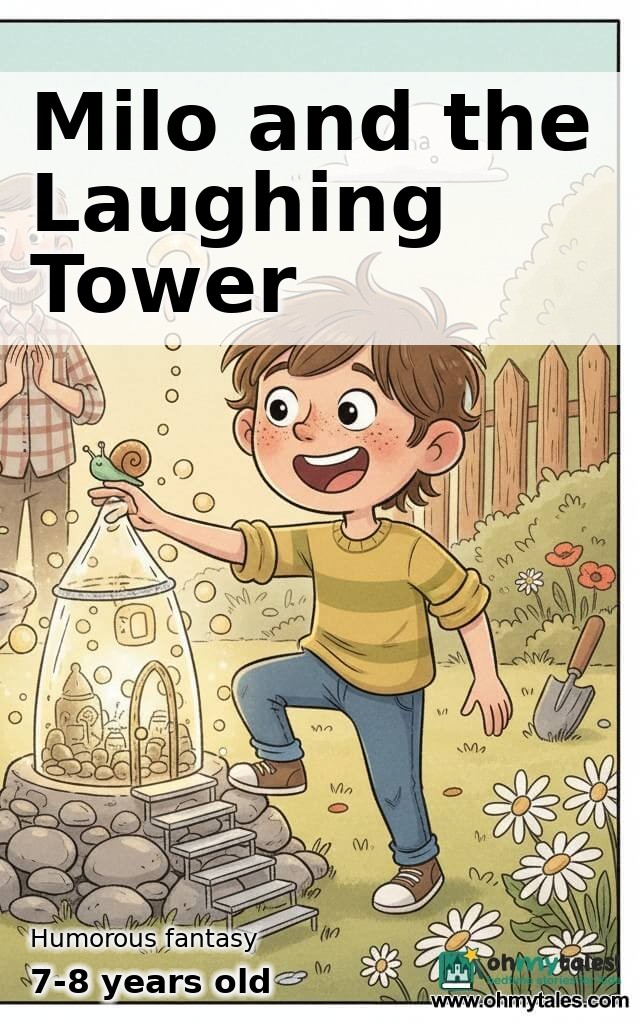
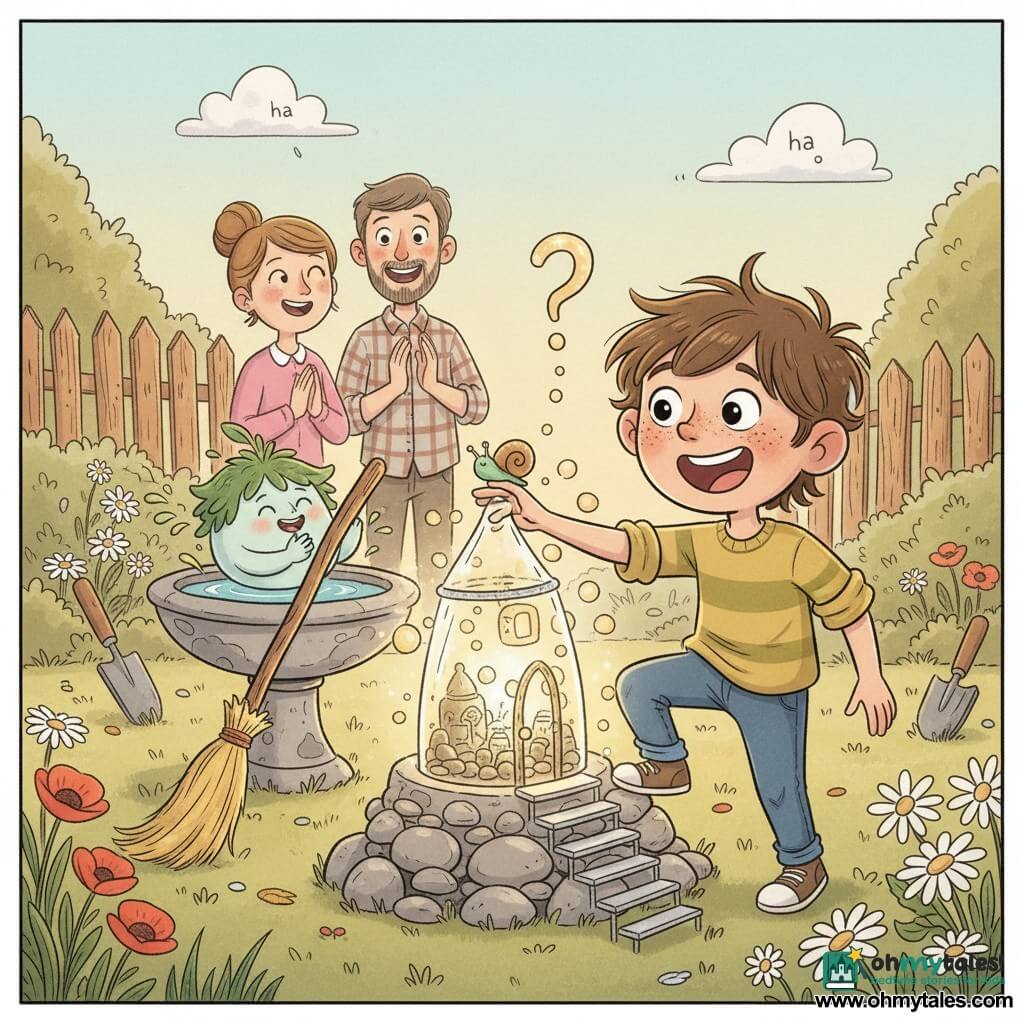
Milo chose the garden as his building spot. Towers should have good views, and the garden had daisies, a wobbly fence, and one extremely curious snail.
Puddlewick's face rose in the birdbath again. “Builder Milo! Do you have the three?”
Milo lined up his jars on the grass: golden giggle-bubble, ribbon-whistle, and silver ting-note.
“I do,” he said.
“Then stack them,” said Puddlewick, “but not like blocks. Like stories.”
Milo unscrewed the first jar. The giggle-bubble floated out and popped gently. In its place appeared a low, round stone that looked like it was smiling.
Milo set it on the ground. “Base stone.”
He opened the second jar. The ribbon-whistle swirled around the stone, wrapping it in warm air. Another stone appeared on top, then another, each one carved with tiny pictures: a broom bowing, a kettle winking, a spoon doing a very small dance.
Milo opened the third jar. The silver ting-note rang once, clear and kind. The sound became a thin, shiny stair that curled upward.
The tower grew to Milo's shoulder. Then to his head. Then a little higher, like it was standing on tiptoes.
Milo stepped back, hands on hips. “It needs a top.”
Puddlewick squinted. “A flag?”
Milo thought. A flag was nice. But Milo wanted something better.
He looked at the snail, who had been watching with deep interest, like a tiny professor.
“Hello,” Milo said. “Do you have any laughs?”
The snail took a long moment. Then it made a small, soft “pft,” like a bubble popping in a puddle.
Milo's smile spread slowly. “That's a secret laugh.”
He held out his palm. The snail crawled onto it and left a little shiny trail, curved like a question mark.
Milo placed the snail gently at the top of the tower. The trail hardened into a clear, glassy crown.
The tower shimmered. Not too bright. Just enough to look pleased with itself.
Milo climbed the shiny stair carefully. The tower felt steady, like it trusted him. At the top, he could see over the fence, over rooftops, all the way to the park. The clouds drifted above, puffy and calm.
Milo leaned toward them and whispered, “Poke.”
The clouds did not mind. One of them wobbled, as if it was holding in a giggle. Then it let out a tiny “ha,” more like a hiccup of happiness.
Milo laughed quietly. Below, Puddlewick said, “You've done it. A tower of laughs. And look—no onions.”
Milo climbed down and sat on the grass with his parents, who had come outside without him noticing. That was another kind of magic: grown-ups appearing when you least expect it.
Dad touched the tower's base stone. “It feels… cheerful.”
Mum smiled at Milo. “Did you build this?”
Milo nodded. “With curiosity. And a broom who thinks it's fancy.”
The broom, leaning by the shed, tried to look humble and failed.
They all sat together. The tower did not roar or sparkle wildly. It simply stood there, like a joke that didn't need to shout.
The garden grew still. The breeze softened. Even the kettle inside stopped trying to be funny for one minute.
Milo listened. Not for more laughter, but for what came after.
It was a silence that felt warm and full, like a blanket fresh from the dryer.
Milo closed his eyes and smiled.
The Laughing Tower reached up, the clouds drifted on, and the world held a happy silence.