Chapter 1: The Whirring Mouse with a Mind of His Own
In the heart of the old Willowwood Library, where the bookshelves stretched up like the trunks of ancient trees, lived a little mechanical mouse named Pip. Pip wasn't an ordinary mouse. He was made of shiny brass and silver, with tiny gears and springs that whirred and clicked as he moved. Most of all, Pip had a very special way of being: every now and then, his tail would twitch, his whiskers would wiggle, and he'd let out a little “Beep!” at the most unexpected moments. This was because Pip had what the other library creatures called the “Jumpy Springs,” which was their way of describing Pip's own version of Tourette's.
Pip loved the library. He zipped between the bookshelves, always curious, always excited. He liked to read over the shoulders of the bookworms, listen to the gentle shush of pages turning, and dream about the stories he might write one day. Sometimes, when he was especially happy or nervous, his tail would give an extra-strong twitch, and he'd beep so loudly that even the dust motes would dance in surprise.
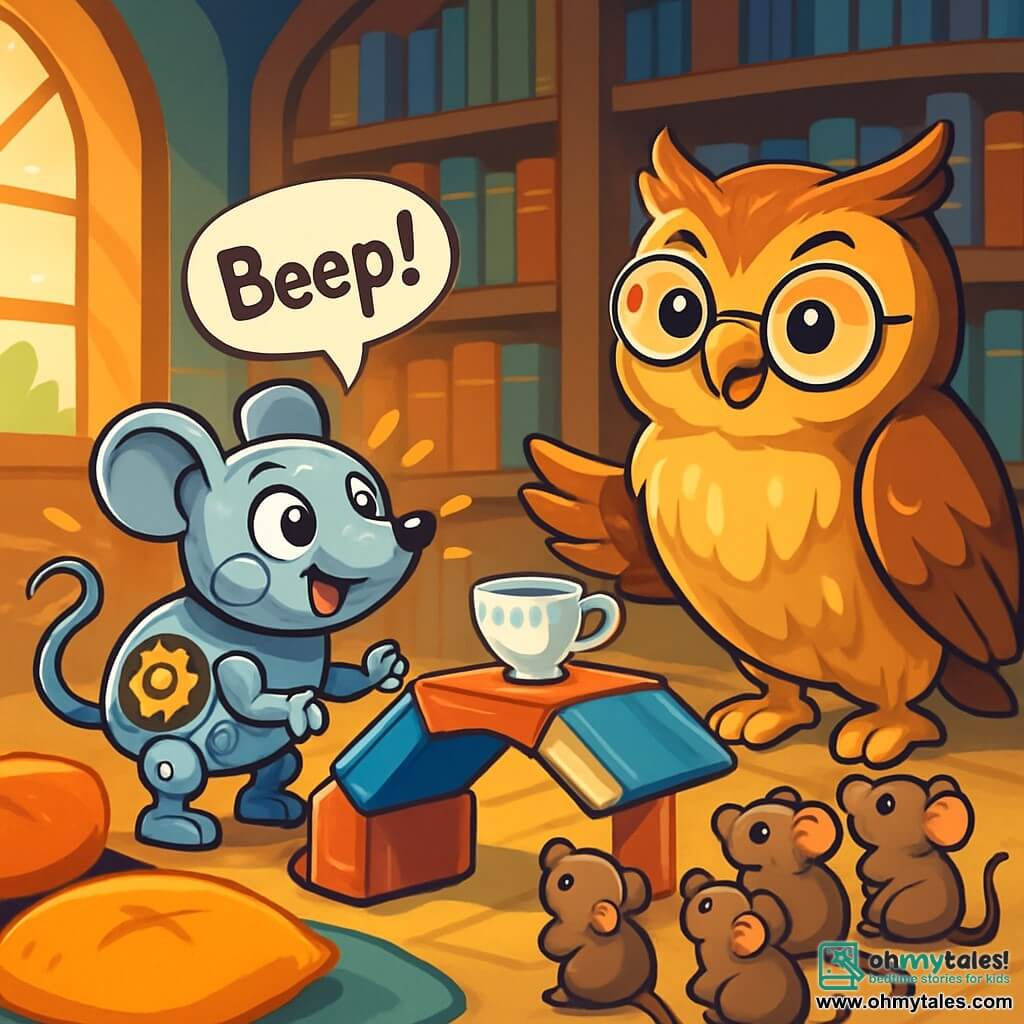
One sunny morning, Pip was exploring the section of the library filled with books about science and inventions. He was practicing his quietest tiptoe—tricky for a mouse whose springs sometimes popped at random—when he heard a deep, thoughtful humming. Peeking around a stack of encyclopedias, Pip spotted Professor Hoot, the wise old owl scientist. Professor Hoot wore round glasses perched on his beak and had a satchel bulging with blueprints and gadgets.
“Good morning, Pip!” Professor Hoot called, his feathers ruffling. “What brings you to the Land of Logic and Lenses today?”
Pip's gears whirred with excitement. “I want to learn all about inventions! Maybe I can invent something myself!” His tail twitched, and he gave a cheerful “Beep!”
Professor Hoot smiled warmly. “Splendid! Every inventor needs a spark of curiosity—and a few surprises along the way.” He winked. “Let's see what you can do.”
Chapter 2: The Great Book Stack Challenge
Professor Hoot flapped over to a table piled high with books. “Here's a challenge, Pip,” he said. “Can you build a bridge from these books that can hold a teacup on top without falling over?”
Pip's eyes shone. He loved a good challenge. “I'll try my best, Professor!” he squeaked.
He scurried around, choosing books of different sizes. Pip thought about balance and weight. He stacked a thick atlas at the bottom, then a dictionary, then a storybook with a bright red cover. Every so often, his tail gave a twitch, and he'd beep or jump, sending a book askew. But Pip didn't give up. He nudged the books back into place, adjusting and readjusting.
Nearby, a group of library mice watched. Pip could hear their whispers.
“He'll never do it,” squeaked Sable, the sleek grey mouse. “He's too jittery.”
Pip's whiskers drooped for a moment. But then he remembered what Professor Hoot had said: “Every inventor needs a spark of curiosity—and a few surprises.” Maybe his surprises could help.
Pip took a deep breath, focused, and used his quick, twitchy movements to gently slide the final book into place. His tail gave one last little flick, and—miraculously—the stack wobbled, then settled. Pip carefully placed the teacup on top. The bridge held!
Professor Hoot clapped his wings. “Bravo, Pip! Ingenious!”
Pip beamed with pride. For a moment, he forgot all about his jumps and beeps. He just felt clever and capable.
Chapter 3: The Sting of Words
Later that afternoon, Pip was feeling brave. He decided to show the other mice his book bridge. He zipped over to where Sable and her friends were nibbling on crumbs beside a pile of adventure novels.
“Look what I built!” Pip said, his gears humming with excitement. “I made a bridge from books, and it can hold a teacup!”
Sable rolled her eyes. “Probably just luck,” she muttered. “With all your twitching, it's a wonder you didn't knock it down.”
The other mice snickered. “Yeah, Pip's always making weird noises,” said one. “He's like a broken clock!”
Pip's heart sank. His tail drooped, and he felt smaller than ever. He tried to explain, “It's just how my springs work sometimes. But I can still do things. I just do them my way.”
But Sable wasn't listening. She just giggled and turned away.
Pip hurried back to his corner behind the history books. He felt a heavy ache in his chest, like a book had landed there and wouldn't budge. What if he really was just the “jumpy” mouse? What if his quirks would always make him stand out in the wrong way?
Just then, Professor Hoot swooped down beside him. “Pip, my boy, why the long face?”
Pip sniffled. “The others laughed at me. They said I was too jittery to do anything right.”
Professor Hoot nodded, his eyes wise behind his glasses. “Some creatures don't understand that the things that make us different are often the things that make us special.” He leaned closer. “Did you know that some of the greatest scientists in history saw the world in their own unique ways? They noticed things others missed. They invented things no one else could imagine.”
Pip listened, hope flickering in his heart.
“Your springs,” Professor Hoot said gently, “are like a melody that only you can hear. Sometimes they surprise you, but they also help you see the world differently. And that's a gift.”
Chapter 4: The Song of the Springs
The next day, Pip decided he wouldn't hide anymore. Instead, he invited everyone to the center of the library for a demonstration. He wanted to show them how his “melody” could make something wonderful.
He worked all morning, arranging books, building ramps, and setting up dominoes. He measured and planned, using his quick, nimble movements to place everything just right. When his springs made him jump or beep, he used it to his advantage—starting a chain reaction, nudging a book into place, or making a domino fall at the perfect moment.
When the crowd of creatures gathered, Pip took a deep breath. “Today,” he said, “I want to show you my Book Symphony!”
With a flourish, Pip twitched his tail and let out a proud “Beep!” The first domino tipped, knocking over a book, which set a marble rolling down a ramp, which flipped a page of a storybook. The storybook's page triggered a spring that sent a paper airplane sailing into the air. The airplane landed on a bell, which rang out a cheerful chime.
The library burst into applause. Even Sable was impressed.
“That was amazing, Pip!” she said, her eyes wide.
Pip glowed with pride. “Thank you. I guess my springs help me do things my own way.”
Professor Hoot nodded. “Every library needs a little music, Pip. Yours is the best kind—full of surprises and joy.”
Chapter 5: The Promise of Friendship
From that day on, Pip's melody became a treasured part of the library. Whenever his tail twitched or he let out a happy beep, it reminded everyone that every creature had a special tune to play.
One afternoon, Sable approached Pip with a shy smile. “I'm sorry for what I said before,” she said. “I didn't understand. But your Book Symphony was brilliant. Maybe you could teach me how to build something like that?”
Pip grinned. “Of course! We can invent together. Your steady paws and my quick moves might make the perfect team.”
They spent the afternoon stacking books and setting up new challenges, laughing whenever something unexpected happened. Soon, all the library creatures wanted to join in.
Pip realized that his melody—his own special way—wasn't something to hide. It was something to celebrate. With his friends by his side, the library was filled with new inventions, shared laughter, and the gentle music of acceptance.
And every night, as the stars shone through the library windows, Pip and his friends promised to always support each other, no matter how different their tunes might be.
Because in the great library of life, every melody—no matter how surprising—makes the story richer and the music sweeter.