Chapter 1: Words That Wiggle
Maya was ten, and her dyslexia made letters wiggle on the page like little ants at a picnic. She was imaginative and logical at the same time, which felt like having two bright flashlights in her head. When reading got bumpy, she did something that helped: she drew the words.
On the kitchen table, her homework sheet waited beside a glass of milk. The afternoon smelled like toast and pencil shavings. Maya wrote the word “because,” then turned it into a picture: a “bee” carrying a “cause” sign. She grinned. The word stopped wiggling and stayed put.
Her dad peeked over her shoulder. “Another word zoo?”
“It's a word museum,” Maya said, very serious. Then she added, “With animals.”
Dad laughed quietly. “That's the best kind.”
At school the next day, Ms. Patel announced, “We'll have a class showcase on Friday. You'll make a poster about something you learned this term. Clear writing, neat layout, and a short talk.”
Maya's stomach did a small flip. Posters meant big words. Big words meant wiggles. Still, she liked posters. Posters were puzzles: where to place things, how to organize them, what colors to use.
Ms. Patel handed out topics. Maya's sheet said: “Local Habitats.” She pictured ponds, hedges, squirrels, and the tiny spiders that built shiny webs in the morning.
Then Ms. Patel added, “You will work in pairs.”
Maya looked around. People were already scooting desks together. The classroom buzzed like a jar of bees.
“Pair with Leo,” Ms. Patel said kindly. “You both love details.”
Leo sat two rows away. He was quiet, always tapping his pencil in patterns. He nodded at Maya, not smiling, but not unfriendly either.
Maya stood with her topic sheet in her hand. Her brain started planning. If she made word drawings, would Leo think it was babyish? Would he want everything spelled perfectly, in plain letters?
She took a breath. “Hi,” she said. “Do you want to do ponds or parks or… something else?”
Leo blinked. “Ponds. They have rules. Food chains. It makes sense.”
Maya liked that answer. “Great,” she said. “And I can draw the words so they behave.”
Leo tilted his head. “Words don't behave.”
“They do if you give them costumes,” Maya said.
Leo looked at her for a second. Then, very softly, “Okay. Costumes could work.”
Chapter 2: The Poster Problem
After lunch, Maya and Leo spread their notes on the floor near the reading corner. The carpet smelled faintly of crayons. Maya laid out markers in a rainbow line. Leo arranged facts in straight columns.
They started with a title. Leo wrote, “POND ECOSYSTEM.” The letters were tall and tidy.
Maya tried to write “ecosystem” underneath, but the letters slid around in her mind. She pressed her pencil harder. The “y” appeared where the “s” should be, like it had jumped the line.
Leo noticed. He didn't say anything at first, but his tapping got faster.
Maya's cheeks warmed. She hated that feeling—the feeling that her brain had dropped a plate in front of everyone.
“I can do the writing,” Leo said quickly. “It's faster.”
Maya's fingers tightened around her pencil. She could let him. The poster would look perfect. But then it wouldn't feel like hers, or theirs. It would feel like she was carrying the glue while someone else carried the whole project.
“I want to help,” she said, steady but small. “My letters get mixed up sometimes. So I draw them.”
Leo frowned. “Like… pictures?”
“Like memory hooks,” Maya said. “Look.” She wrote “frog,” then turned the “f” into a flag, the “r” into a reed, the “o” into a pond bubble, and the “g” into a green tail. Suddenly the word looked like itself and a frog at the same time.
Leo leaned closer. “That's… actually useful.”
Maya felt a little taller. “I'm logical,” she explained. “I just need the words to match the idea. If the idea is clear, the word stays.”
Leo stared at the frog word. “Could we do that for tricky terms?”
“We can,” Maya said. “We can make a whole ‘pond word zoo.' Museum. Whatever.”
Leo's mouth twitched. It might have been a smile trying to escape.
They planned jobs. Leo would write the main headings in neat block letters. Maya would create the “costume words” for key vocabulary: “habitat,” “predator,” “larva,” “algae.” She would also draw small pictures next to them.
But then Ms. Patel walked by and paused. “Remember,” she said, “clear writing. The audience has to read it easily.”
Maya's stomach flipped again. Her costume words were clear to her, but would they be clear to others? Would Ms. Patel think she was just doodling?
When the bell rang, Maya carried the poster paper carefully. The hallway sounded like sneakers on tile and lockers clanging. She kept thinking about “clear writing,” and the ants-in-a-picnic feeling returned.
At home, she sat at her desk and opened her notebook. The page was bright under her lamp. She wrote a list:
1. Make words readable.
2. Make words memorable.
3. Make words kind to my brain.
She underlined number three twice.
Then she practiced. She wrote “habitat” and turned it into “HABIT” (a tiny house) + “AT” (an arrow pointing to a place). She laughed at her own joke. A habit at a home.
Her mom knocked and peeked in. “How's the poster going?”
Maya hesitated. “I'm worried people will think my words are messy.”
Mom came in and sat on the edge of the bed. “Your brain is like a bright kite,” she said. “Sometimes the wind pulls it in funny directions. But it can fly higher than most.”
Maya smiled a bit. “So… I should keep flying?”
“You should fly,” Mom said, “and you should ask for the right string.”
Maya thought about that. The right string could be thicker marker, or lined paper, or someone reading her draft aloud. The right string could be letting her show her strength.
She wrote one more thing on her list: 4. Ask for what I need.
Chapter 3: The Practice Talk
On Wednesday, Ms. Patel gave everyone ten minutes to practice their short talk with their partner. The classroom sounded like many small speeches happening at once, like a flock of birds each telling its own story.
Leo read from his notes without looking up. His voice was flat but accurate. “Algae produce oxygen. Tadpoles eat algae. Fish eat tadpoles. Herons eat fish.”
Maya listened and nodded. “That's the food chain,” she said. “We should make it easy to follow.”
She tried her own part next. The moment she looked at her notes, the letters began their tiny dance. Her throat tightened.
She remembered her list. Ask for what I need.
Maya raised her hand. “Ms. Patel?”
Ms. Patel walked over. “Yes, Maya?”
Maya's heart thumped. “Can I use my word drawings as cue cards? And can I practice by saying it in my own words instead of reading every line?”
Ms. Patel's face softened. “That's a smart plan. Yes. The goal is sharing what you know.”
Maya exhaled, slow and relieved. “Thanks.”
Leo glanced at her. “You asked,” he said, like that was a surprising science fact.
“I did,” Maya answered. “My brain likes tools.”
Leo nodded once. “Mine too.”
They worked on cue cards together. For “predator,” Maya drew a “P” shaped like a beak. For “prey,” she drew the “y” as a tiny tail hiding behind grass. For “larva,” she turned the word into a little comma-shaped creature with stripes.
Leo checked each card. “Readable,” he said. “Good spacing.”
Maya checked Leo's headings. “Interesting,” she said. “Not too crowded.”
When they practiced again, Maya didn't read. She pointed to her drawings and explained.
“In a pond,” she said, “everyone has a job. Some make oxygen. Some clean. Some eat. Some get eaten. It sounds mean, but it keeps balance. If one part disappears, the pond gets confused.”
Leo added, “Like removing a gear from a clock.”
Maya laughed. “Yes, but a wet clock with frogs.”
Leo made a tiny snort, which was basically a laugh in Leo language.
Later, during group work time, a classmate named Tessa wandered over. “Your poster is cool,” she said. “Why are the words… like cartoons?”
Maya felt a quick sting of worry. But she remembered the kite and the string.
“My letters like to move,” she said simply. “So I give them pictures to hold onto.”
Tessa nodded. “That's actually genius. Can you do one for ‘photosynthesis'? I can never spell it.”
Maya blinked. Then she smiled. “Yes. But it might look like a plant doing homework.”
Tessa laughed. “Perfect.”
Maya's chest felt warm. Not because everything was easy, but because she was not hiding. She was showing her way—and it was working.
Chapter 4: Friday's Showcase
Friday arrived with rainy windows and the smell of wet coats. The classroom looked like a mini museum: posters taped to walls, desks pushed aside, students holding cue cards like tiny passports.
Parents and another class came to visit. Ms. Patel stood by the door, greeting everyone. “Remember,” she told the class, “clear voices, kind listening.”
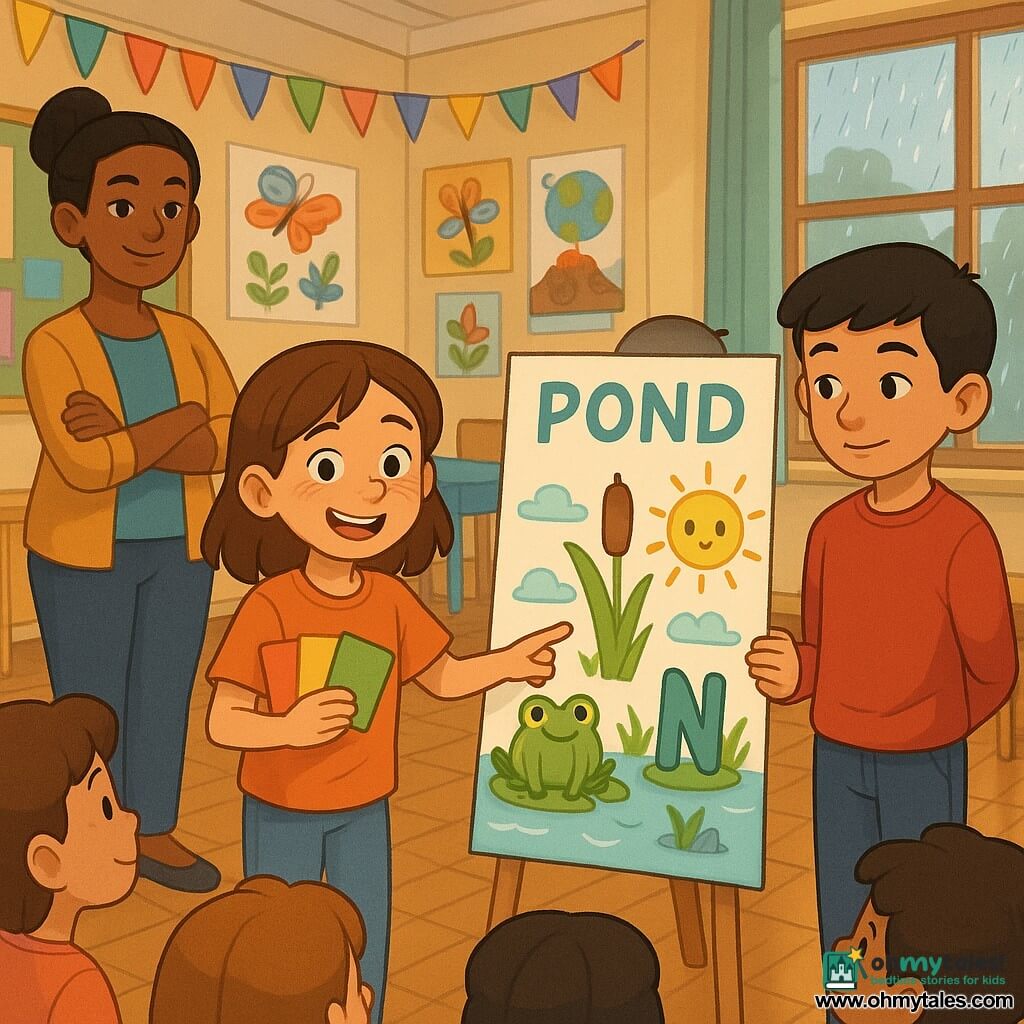
Maya and Leo set up their poster. The title was neat. Underneath were sections: “Plants,” “Animals,” “Food Chain,” “Human Impact.” Next to the key words were Maya's costume words—simple, colorful, and spaced out so they were easy to read.
Maya's hands were a little sweaty. She wiped them on her skirt and held her cue cards. Her brain felt like a busy train station: ideas arriving, leaving, bumping shoulders.
A group stopped in front of them. Ms. Patel, two parents, and three students from the other class.
Leo began. “This is our pond ecosystem poster,” he said. His voice was steadier today. “We chose a local pond because it has many connected parts.”
Maya took her turn. She pointed to the “habitat” card. “A habitat is a home for living things,” she said. “In a pond, the water, plants, and mud all help animals survive.”
She pointed to “algae.” “These are tiny plants. They can make food using sunlight. That's why ponds can look green.”
One of the visiting students squinted at the vocabulary. “Why is ‘predator' drawn like that?”
Maya smiled. “Because my brain remembers pictures better than plain letters,” she said. She didn't say the name again. She didn't need to. She had her metaphor, her bright kite, her costume letters.
“And it helps us all remember,” Leo added, surprising everyone, including Maya. “I used to mix up ‘prey' and ‘predator.' Now I don't.”
A parent leaned closer. “That's very creative,” she said. “And clear.”
Maya's shoulders loosened. Clear. The word sounded like clean water.
Then came the question part. Ms. Patel asked, “If people throw litter near a pond, what happens?”
Leo said, “It can harm animals.”
Maya added, “And it can break the balance. Like knocking over a row of dominoes. Even a small thing can make a big mess.”
A little boy from the other class pointed at Maya's frog word. “That one is my favorite.”
Maya grinned. “Frogs are good at jumping,” she said. “My words are, too. I just help them land in the right place.”
When the visitors moved on, Leo whispered, “You did well.”
Maya whispered back, “You did too.”
Leo looked at the poster again. “Our poster is different,” he said. “But different is… useful.”
Maya nodded. “Different is part of the pond.”
Chapter 5: The Respect That Stays
At the end of the day, Ms. Patel clapped to get everyone's attention. “You should be proud,” she said. “I saw teamwork, clear explanations, and many smart strategies. Some of you found new ways to show what you know.”
She looked at Maya and Leo. “Your visual vocabulary helped others understand. That's inclusion in action.”
Maya felt her face warm, but this time it was a good warmth, like sunlight through clouds.
As students packed up, Tessa came over holding a scrap of paper. “Can you draw ‘photosynthesis' for me?”
Maya took the paper. “Sure,” she said. She drew “photo” as a little camera sun, “syn” as two hands linking, and “thesis” as a tiny book. She wrote the letters carefully, giving them space to breathe.
Tessa watched. “I wish my brain did that.”
Maya paused, then shook her head. “Your brain does other things,” she said. “You're the fastest runner in our class. Your brain and legs are like rocket boosters.”
Tessa smiled. “True.”
Leo zipped his backpack and waited. “Can I keep a copy of the food chain cards?” he asked.
“Of course,” Maya said. “We can make more. Maybe for science words next time.”
Walking home, the rain had stopped. The street smelled fresh, and puddles reflected the sky like small mirrors. Maya felt tired in a happy way, like after finishing a long puzzle.
At home, she placed her cue cards in a box on her desk. Not hidden away, just stored, like tools in a drawer.
She thought about how it had started: worry, wiggles, and a poster that seemed too hard. Then she thought about how it ended: people understanding, people asking, people learning from her way.
Her brain wasn't a problem to fix. It was a bright kite that needed the right string, and her costume letters were one of her best strings.
Maya opened her notebook and wrote one last line, slow and proud:
“I can do things my way, and my way can help others too.”