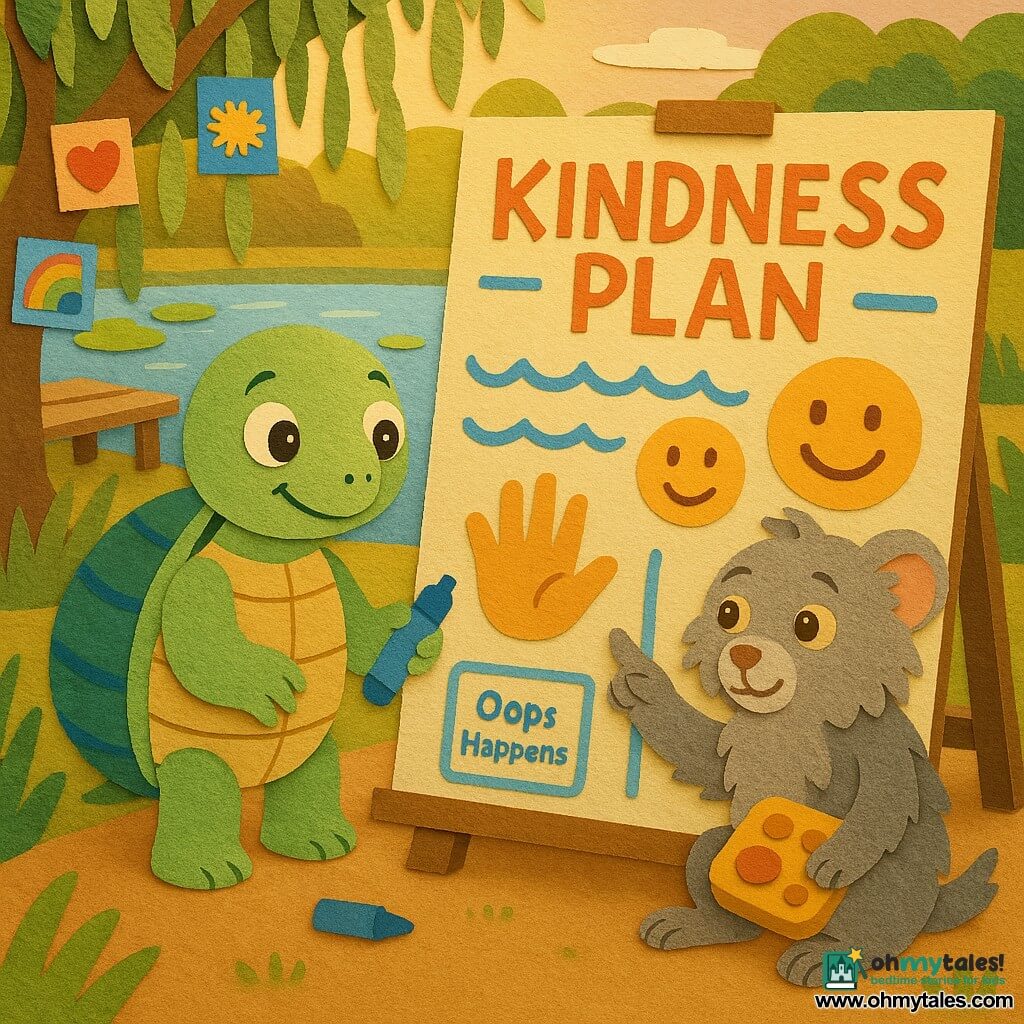
Chapter 1: Pebble's Backpack
Pebble the turtle liked routines. Morning sun on his shell. Cool pond water on his toes. A crunchy lettuce leaf for breakfast.
Today, though, his backpack felt extra bouncy.
Inside it were the supplies for Brookside School's “Many Ways to Speak” Day: colored paper, stickers, a little poster board, and one brand-new marker that smelled like blueberries. Pebble had begged for that marker. He also had a tiny snack box with apple slices shaped like stars, because his teacher said star-shaped food made brains “sparkle.”
Pebble didn't know about sparkle, but he did know about nerves.
“What if I say the wrong thing?” he whispered to the cattails as he waddled along the path.
The cattails didn't answer. They just swayed like they were practicing a slow dance.
At the school pond, everyone was arriving: squirrels with pencil cases, ducks with shiny rain boots, and a beaver who always brought more glue than anyone could possibly need.
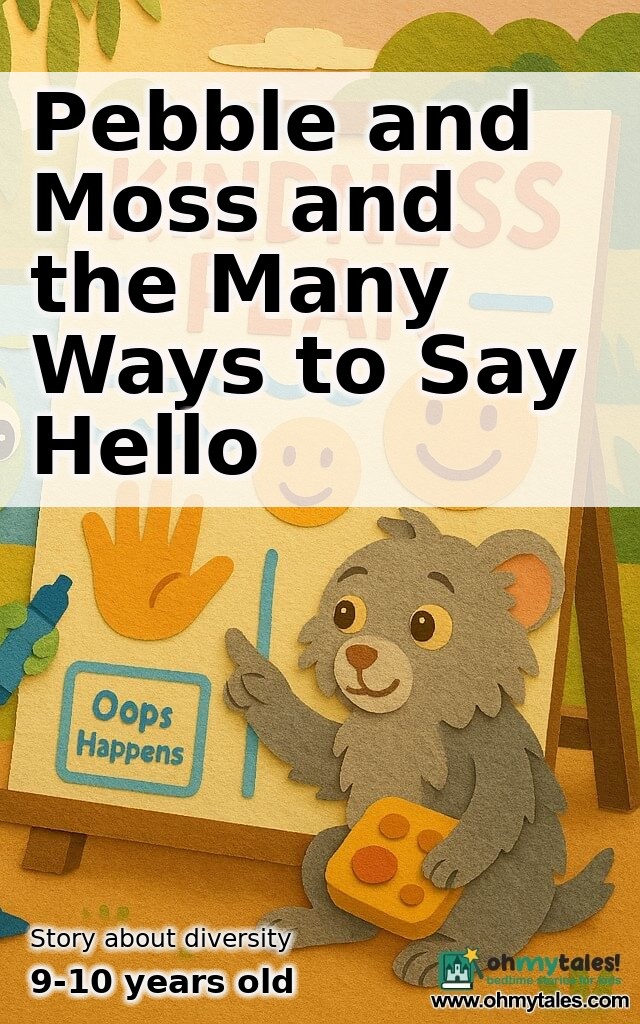
Pebble spotted his partner for the day near the picnic tables: Moss, a classmate with soft gray fur and careful eyes. Moss used a small vocal communicator—a sturdy device with big buttons. When Moss pressed a button, the communicator spoke in a clear, friendly voice.
Moss was already tapping it.
“HI PEBBLE,” the communicator said.
Pebble's shoulders loosened.
“Hi, Moss,” Pebble said, smiling. “Your communicator sounds cheerful, like it drinks hot cocoa.”
Moss pressed two buttons in a row.
“THANK YOU.”
“IT HAS A SUNNY VOICE.”
Pebble chuckled. “Mine would have a lettuce voice.”
Moss's whiskers twitched. Then Moss pressed:
“LET TUCE,” the communicator said, a tiny bit mispronounced.
Pebble blinked. “It said ‘let tuce.'”
Moss pressed another button.
“NEW BUTTON. STILL LEARNING.”
Pebble nodded slowly, like he was nodding at a very important cloud. “Me too,” he said. “I'm still learning how to be a good partner.”
Moss pressed:
“WE CAN LEARN TOGETHER.”
And Pebble thought, Maybe my backpack isn't the only thing that feels bouncy today.
Chapter 2: The Button Mix-Up
Ms. Heron, their teacher, clapped her wings once—soft, like a page turning.
“Today,” she said, “we'll create a kindness map. Each pair will make a poster showing ways people communicate. Speaking, signing, writing, pictures, devices, gestures, and even quiet listening.”
Pebble and Moss carried their supplies to a shady spot under a willow tree. The willow's branches hung down like green ribbons.
Pebble laid out the poster board. Moss arranged stickers into neat little piles: stars, hearts, leaves, and one sticker shaped like a tiny microphone.
Pebble drew a big circle in the middle and wrote, carefully, MANY WAYS TO SAY HELLO.
Moss watched the marker tip move, then pressed:
“GOOD LETTERS.”
Pebble's cheeks warmed. Compliments felt like stepping into sunlight.
“Thanks,” Pebble said. “Want to pick our first ‘hello'?”
Moss pressed a button.
“HELLO,” the communicator said.
Pebble added the word and drew a speech bubble beside it. Then he drew a waving paw. “What about waving?” he asked.
Moss pressed:
“WAVE,” the communicator said.
Pebble drew a little paw waving, and they both laughed because Pebble's drawing looked more like a squashed starfish.
“Your paw is… very creative,” Pebble said.
Moss pressed:
“IT IS BRAVE.”
Pebble grinned. “Yes. It's brave enough to be weird.”
They worked for a while, adding “smile,” “nod,” and “write a note.” The poster started to look like a garden of greetings.
Then a gust of wind scooted a few leaves across the table, and Pebble reached to catch the marker before it rolled away. In the same moment, Moss reached too.
Their paws bumped. The marker squeaked. Moss's communicator slid slightly, and Moss pressed a button by mistake.
“GO AWAY,” the communicator said, loud and clear.
Pebble froze.
The words landed on Pebble's shell like a cold raindrop.
Moss's eyes went wide. Moss pressed again, quickly.
“NO.”
“SORRY.”
“WRONG BUTTON.”
Pebble swallowed. He could see Moss's ears droop, like wilted flowers.
Pebble took a slow breath. Ms. Heron had taught them a trick: “When something hurts, pause and ask what it means.”
So Pebble paused.
“Did you mean that?” Pebble asked, gently.
Moss pressed:
“NO. ACCIDENT.”
“I LIKE PEBBLE.”
Pebble's chest loosened, like a knot untying.
“I believe you,” Pebble said. “Buttons can be tricky. Once I stepped on a squeaky toy and it sounded like I was yelling at everyone.”
Moss's mouth twitched into a tiny smile. Moss pressed:
“SQUEAKY TURTLE.”
Pebble laughed. “Exactly. A fierce, squeaky turtle.”
Pebble picked up the communicator carefully and set it back in place. “Want to make a button plan?” he asked. “Like… a ‘whoops' button?”
Moss pressed:
“YES. GOOD IDEA.”
They made a small corner on the poster labeled “Oops Happens.” Under it, they drew a finger pressing a button and wrote: “Try again. Ask. Be kind.”
The wind calmed. The willow ribbons swayed softly. And the cold raindrop feeling was gone.
Chapter 3: The Quiet Trail Challenge
After lunch, Ms. Heron led the class on a short walk called the Quiet Trail. It wasn't a test. It was a practice—how to notice things without rushing.
“Use your eyes, ears, noses,” Ms. Heron said. “And remember: not everyone notices the same way. That's a gift.”
Pebble walked beside Moss. The trail curved around the pond, past lily pads and tall reeds. Dragonflies zipped like living commas.
The rule was simple: talk only when you truly needed to. Otherwise, communicate in other ways.
Pebble liked the idea, but then he worried. How would he check in with Moss? What if Moss needed something?
Moss tapped the communicator softly.
“READY,” it said.
Pebble nodded. He pointed to his own eyes, then to the path, like: I'm watching with you.
They took a few steps. Pebble noticed the warm smell of mud and sun. He saw a feather stuck in a spiderweb, trembling like a tiny flag.
Moss stopped and pointed. Pebble followed Moss's paw to a line of ants carrying crumbs bigger than their heads.
Pebble mouthed, “Whoa,” without sound.
Moss grinned and pressed a quiet button.
“TEAMWORK,” the communicator whispered.
Pebble thought, Yes. Tiny teamwork.
Then the trail got tricky.
A narrow wooden bridge crossed a shallow stream. The planks were damp. Pebble's legs were short, and damp planks were slippery. He started across, slow and careful.
Halfway, he heard a squeal behind him—one of the ducklings losing balance. Pebble turned too fast, and his foot slid. His backpack wobbled. His blueberry marker bounced inside like it wanted to escape.
Pebble teetered, arms out like a baby scarecrow.
Moss's paw shot forward—not grabbing, not yanking, but offering a steady touch on Pebble's backpack strap. At the same time, Moss pressed the communicator.
“STOP,” it said.
Pebble stopped. He planted his feet. He breathed.
Moss pressed again.
“ONE STEP.”
“WAIT.”
“GOOD.”
Pebble did exactly that: one step, wait, good. One step, wait, good.
The duckling behind them regained balance, giggling, and waddled past with a whispered, “Sorry!”
Pebble reached the other side safely. He turned to Moss and mouthed, Thank you, exaggerating the shape of the words so it was easy to read.
Moss tapped:
“YOU'RE WELCOME.”
Pebble felt proud, not because he crossed fast, but because he crossed with help. The kind that didn't shout. The kind that fit.
As they continued, Pebble noticed something else: Moss was noticing him too. Not just his words, but his face, his pauses, his slow steps. Communication wasn't only sound.
It was attention.
At the end of the trail, Ms. Heron held up a pinecone.
“Tell me,” she said softly, “what did you learn in the quiet?”
Pebble raised a hand. “I learned that silence isn't empty,” he said. “It's full of looking.”
Moss pressed:
“AND FULL OF LISTENING,” the communicator added.
Ms. Heron's eyes shone. “Beautiful,” she said.
Chapter 4: The Kindness Map
Back in the classroom, the air smelled like crayons and pond breeze. Everyone hurried to finish their posters.
Pebble and Moss spread out their kindness map. It had greetings, pictures, and the “Oops Happens” corner. It also had a new part: “Quiet Trail Signals,” with drawings of pointing, nodding, and stepping slowly.
Pebble held up the blueberry marker like it was a magic wand. “Final touches,” he announced.
Moss pressed:
“MAKE IT BRIGHT.”
Pebble drew a rainbow path around the circle and wrote: “Different is helpful.”
Across the room, a squirrel pair argued about whether a thumbs-up should have a tail.
“It's a thumb,” one squirrel said, holding up a paw. “See?”
“But my paws don't do that,” the other squirrel complained. “My thumbs are… shy.”
Pebble giggled. Moss pressed:
“SHY THUMB.”
Pebble almost snorted water through his nose, which was an impressive turtle skill.
Then came presentation time.
Pebble and Moss carried their poster to the front. Pebble's shell felt warm with nerves again, but Moss stood steady beside him.
Pebble spoke first. “Our poster is about greetings and how people can communicate in lots of ways,” he said. “Speaking is one way. Moss uses a vocal communicator, which is another way. And we learned that mistakes can happen—like pressing the wrong button—so it helps to ask kindly and try again.”
Moss pressed the communicator.
“HELLO CAN BE A WAVE,” it said.
“HELLO CAN BE A SMILE.”
“HELLO CAN BE A DEVICE.”
“HELLO CAN BE PATIENCE.”
Pebble glanced at Moss. “Yes,” he said softly. “Patience is a kind of hello too.”
A beaver raised a paw. “Can I ask something?” the beaver said. “Does the communicator say exactly what Moss thinks?”
Moss pressed:
“YES.”
“SOMETIMES SLOW.”
“STILL ME.”
Pebble added, “It's like… sometimes my mouth is faster than my brain, and that's still me too.”
The class laughed kindly. Even Ms. Heron's beak tilted into a smile.
A duckling asked, “Can we learn some of Moss's buttons?”
Moss looked surprised, then pressed:
“YES PLEASE.”
So Pebble held the poster while Moss taught them a tiny “button language” list:
HELLO. THANK YOU. WAIT. HELP. TRY AGAIN.
The classroom became a chorus of gentle practice. Not teasing. Not rushing. Just trying.
Pebble watched everyone's different bodies and different ways. Some spoke clearly. Some mumbled. Some tapped. Some drew quick pictures. A few were quiet but had eyes that shone with understanding.
It looked like a patchwork quilt, and it felt warm.
When the bell rang, Ms. Heron said, “You did more than make posters today. You made room for each other.”
Pebble packed the supplies, careful with the blueberry marker. Moss packed the communicator, careful as if it were a small, brave bird.
Outside, the evening sky turned peachy, like it had been brushed with soft paint.
Moss pressed:
“WALK HOME?”
Pebble nodded. “Yes,” he said. “Let's.”
Chapter 5: Shared Translation Under the Willow
They stopped under the willow tree again, where the branches whispered in the breeze.
Pebble sat on a smooth stone. Moss sat beside him. The pond reflected the sky, and the water looked like it was holding a secret bedtime story.
“I had fun today,” Pebble said. “And I learned a lot.”
Moss pressed:
“ME TOO.”
Pebble took out a small notebook. “Can we do something?” he asked. “A shared translation. Like… we say the same message in different ways.”
Moss's eyes brightened. Moss pressed:
“YES. LET'S DO IT.”
Pebble wrote at the top of the page: OUR MESSAGE.
Pebble said, slowly, “Message: ‘We belong in the same class, and we can understand each other in many ways.'”
Moss pressed buttons carefully.
“WE BELONG,” the communicator said.
“SAME CLASS.”
“MANY WAYS.”
“UNDERSTAND.”
Pebble smiled. “Now I'll translate it into pictures,” he said.
He drew two small figures side by side—one turtle, one furry friend—with a big circle around them like a hug. He drew speech bubbles, a hand wave, a heart, and an ear.
Then Moss pointed at Pebble's drawing and made a slow, simple gesture: two paws together, then spreading apart like opening a book.
Pebble tilted his head. “That means… ‘share'?” he guessed.
Moss pressed:
“SHARE.”
“YES.”
Pebble wrote it down. “New word learned,” he said.
They sat quietly for a moment. A frog plopped into the pond with a tiny splash—like punctuation at the end of a sentence.
Pebble looked at their notebook page and recapped, because recaps made his brain feel tidy.
“Today we learned that people communicate in different ways,” Pebble said. “Speaking, devices, gestures, pictures, writing, and quiet looking. We learned that mistakes can happen—like a wrong button—but we can ask kindly and try again. We learned that help can be gentle, like ‘one step, wait, good.' And we learned that being different isn't a problem. It's a resource.”
Moss pressed, and the communicator's sunny voice said:
“BE KIND.”
“BE PATIENT.”
“BE PROUD.”
Pebble leaned back against the willow's trunk. The bark felt cool and safe.
“Good night, Moss,” Pebble said, his voice softer now, like the world was turning down its volume.
Moss pressed:
“GOOD NIGHT, PEBBLE.”
Pebble closed his eyes for a second, listening to the pond, the breeze, the far-off giggles of ducklings.
Different sounds. Different ways. One shared, peaceful day.
And Pebble felt, all the way down to his slow turtle heart, that he belonged.