Chapter 1: The Little Shop on Wheels
Mr. Tinkerbell wasn't a tall man, but he had tall ideas. Every morning he wheeled his painted triporteur down the cobbled lane with a basket of jars, springs, tin spoons and a tiny bell that always rang like a laugh. The triporteur was more than a cart—it was a little shop on wheels, patched with stickers and sticky notes, and its back was a snug workshop where Mr. Tinkerbell invented things that hummed, twinkled, or sometimes simply made people smile.
He loved to listen. "What if the rain sang when it fell?" a child once asked. "What if your shoes could tidy up your socks?" an old neighbor joked. Mr. Tinkerbell would tilt his head, eyes bright like the surface of a spoon, and write the oddest ideas into a small leather notebook with a ribbon that never stayed tied.
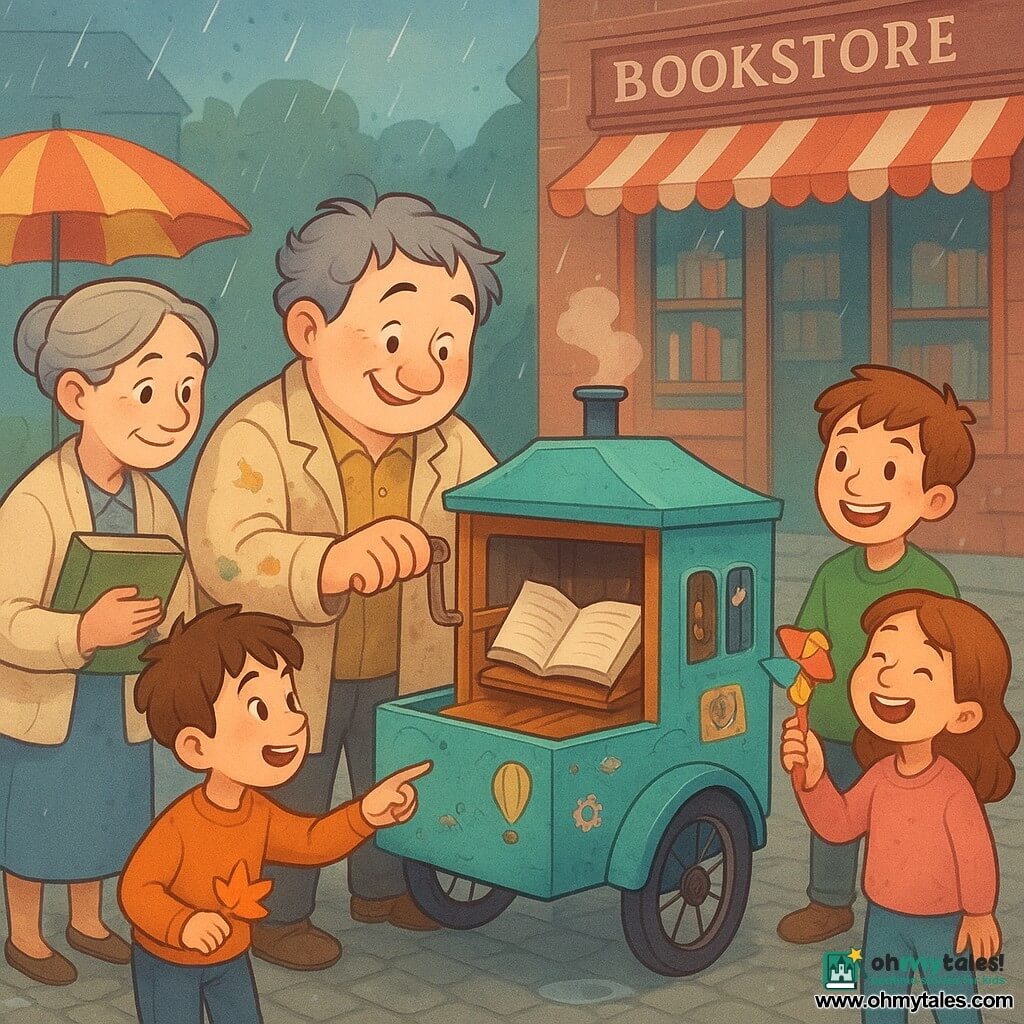
One rainy Tuesday, the triporteur came to a stop by the square. Children splashed in puddles, umbrellas bobbed like colorful flowers, and Mrs. Coble, the librarian, stood under a dripping tree, fanning her wet books with a newspaper. "Oh dear," she said, "I wish my books would dry without warping."
Mr. Tinkerbell winked. "I'll see what I can do," he said, not quite sure how, but sure that trying was part of the fun. He invited Mrs. Coble to sit in the little back of the triporteur, which smelled of lemon oil and warm metal, and began to pull out jars labeled "Ideas," "Spare Buttons," and "Maybe."
"Tell me more," he said, and she did. As she spoke, Mr. Tinkerbell scribbled, listening closely to every small complaint and big wish. Listening, he knew, was the beginning of invention.
Chapter 2: The First Try
Back at his workshop, Mr. Tinkerbell arranged paper sheets, tea towels, and a tiny fan he'd once used to cool a cup of soup. He tried to imagine a gentle way to dry books without bending their pages. He built a wooden cradle with soft cloth straps and a slow-turning wheel—not to spin the pages too fast—and a little hood that blew warm, not hot, air like a friendly breath.
"Ready?" he asked his notebook, as if it might clap. He placed a limp book inside and pressed the tiny switch. The wheel turned, the hood whispered warm air, and for a minute everything looked promising. Then—sproing!—a small spring popped from the cradle and pinged into a jar labeled "Unexpected Sounds."
"Oh!" Mr. Tinkerbell chuckled. He set the spring aside. He didn't feel bad. He felt curious. He made notes: "Too tense. Pages flutter. Spring too eager."
That afternoon, when Mrs. Coble came back, Mr. Tinkerbell tried again. They adjusted straps, slowed the wheel, added soft brushes like eyelashes to keep the pages apart. A group of children peered over the cart lip and suggested a leaf blower from one of their toy sets. A passerby offered a silk handkerchief he used when he played the trumpet. Mr. Tinkerbell listened to all of them, nodding, trying each idea with his hands and heart.
They tested the contraption in the square. The little hood blew warm air like a cat's purr. The books dried slowly, pages turning nothing like a hurricane. But the covers left a faint circle on one cloth—even inventors don't get it perfect the first time. "Close!" Mrs. Coble said with a hopeful grin. "Closer than I hoped."
Mr. Tinkerbell smiled. "Closer means we can learn," he said. He tucked that line into his notebook, and the ribbon finally stayed put for a moment.
Chapter 3: The Night of Quiet Fixes
That night, by the light of a small lamp shaped like a moon, Mr. Tinkerbell sat beside his triporteur and his notebook. He sketched, erased, drew new lines, and taped a little diagram of the cradle into the flap of his notebook. He tried to think like a book: "I like flat pages. I like gentle air." He listened to the creak of his wooden cart and to the distant snores of the city.
He had a thought. "What if the page turns itself, but very slowly, like a leaf falling?" he whispered. He spent the evening building a tiny counterweight from a button and some clay. He added padding made from an old scarf and a sponge from a tea-cup cleaner. He hummed to the parts as if they were friends.
At midnight, he tested the new cradle under the lamplight. The wheel lilted like a lullaby; the air hummed softly. The pages turned one by one, as slow as blinking. The cover stayed smooth. Mr. Tinkerbell felt a tickle of pride. Then the hood's tiny bell, a leftover pet shop ornament, chimed cheerfully and woke a neighborhood cat who meowed in the alley.
"Almost perfect," he murmured. He wrote: "Gentle. Slow. Listen to the book." He closed his notebook and left it on the small table by his bed inside the triporteur, the ribbon hanging like a tiny promise.
Chapter 4: Sharing and Surprises
The next day, the town was busy. Mr. Tinkerbell rolled his triporteur to the market and opened his workshop like a gift. "Come see the book cradle!" he called. Crowds gathered. Children who had suggested the leaf blower came with their toy in hand, proud and grinning. A baker donated a patch of soft dough to test whether it left marks, and a schoolteacher wondered if the cradle could help children with fidgety hands.
Mr. Tinkerbell listened to each new voice. "Make it smaller," said one child. "Make it louder so the library knows," said another. "Add a gentle timer," suggested the schoolteacher. He tried each mini-rule like a chef adding tiny pinches of spice. The cradle changed: smaller straps, a soft chime that only kind listeners could hear, and a tiny wooden clockwork that ticked like a heart.
They tried the machine on a stack of books. Page after page turned like a slow river, and the books came out warm and neat. The crowd clapped. A boy named Milo pointed at a crackle in the corner. "You forgot to make a guard so sticky notes don't flutter out," he said. Every time someone found a small problem, Mr. Tinkerbell did something strange—he smiled.
"Thank you," he said, genuinely. "What else can we try?"
The town helped. They added a pocket for sticky notes, a soft shelf for thin paper, and a tiny lamp so the cradle could be used anywhere. People donated simple things: a patchwork scarf, a battery from an old radio, a cork. The triporteur smelled of hot tea and sawdust and hope.
By evening, the cradle was cheerful and useful. Mrs. Coble held a dry book tenderly, like a child who finally stops crying. "It's wonderful," she said, and her eyes were a bright ribbon. Mr. Tinkerbell felt warmth spread in his chest. He had listened. He had tried. He had failed a little, then tried again with help.
Chapter 5: The Night Notebook
That night, after packing the triporteur and waving to neighbors, Mr. Tinkerbell climbed into his small bed. The town lights winked like fireflies. He reached for his leather notebook on the bedside table. It had a new smudge from dough and a sticker someone had given him that read "Nice Ideas Inside."
He wrote down everything—what worked, what didn't, who suggested the soft clock, and how the tiny bell woke the alley cat. He drew a tiny picture of Mrs. Coble smiling next to the cradle and added a note: "Listening makes invention kind."
Before closing his eyes, he opened a fresh page and whispered to the dark. "What about pillows that remember dreams?" he asked the night. He thought about a small pocket on the triporteur for lost mittens and a gentle little lamp that could tell bedtime stories. His pen moved like a slow bird; the words came soft and steady.
Outside, the rain began again, tapping the triporteur like someone practicing a tune. Mr. Tinkerbell listened, and the rhythm made him smile. He set the notebook on the table beside his bed, ribbon like a sleeping snake. It was ready for ideas that might visit him in the night.
He slept, and his breaths were even, like the turning wheel of the cradle. The next morning the town would have new needs, and new questions would knock on his painted door. Mr. Tinkerbell would listen, try, fail, learn, and ask for help. He would keep his ears open, his heart curious, and his hands busy.
And when the moon peeked in through the cart window, it seemed to nod. The notebook on the table waited patiently—pages empty like quiet boats—ready for the next gentle invention that would make someone's life a little softer, a little easier, and a little kinder.