Chapter 1: The Blank Page and the Spinning Pencil
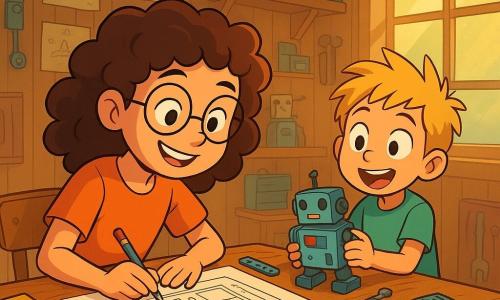
Mina's workshop smelled like paper, glue, and a tiny bit of cinnamon tea. Cardboard sheets leaned against the wall like sleepy giraffes, and a ruler lay across the table like a very serious bridge.
In the middle of it all sat Mina—young, curious, and famous (at least in her street) for building inventions out of cardboard. She liked cardboard because it didn't complain when you cut it. It didn't get offended if you taped it wrong. It simply waited, ready to become something new.
But tonight, Mina faced her toughest opponent: a blank sheet of paper.
She stared at it. The paper stared back. Mina twirled her pencil between her fingers, round and round, like a tiny planet orbiting her thoughts. Her eyebrows scrunched. Her lips made the kind of “hmm” that meant an idea was trying to hatch but still stuck in its shell.
“What would make tomorrow easier?” she whispered.
Inventors didn't just make cool things—they solved problems. They watched, they wondered, they tested, and they tried again. Mina loved that part. It felt like being a detective, except the clues were sticky notes and the suspects were… gravity and soggy cereal.
From the open window came the sound of summer: crickets chirping, a bicycle bell far away, someone laughing softly. The air was warm and sweet, the kind that made you want to stay awake a little longer.
Then she heard it: a small, unhappy sound from outside.
A scrape. A clunk. And a sigh so dramatic it could have won an award.
Mina stood up and peeked out the window.
Chapter 2: The Midnight Clunk
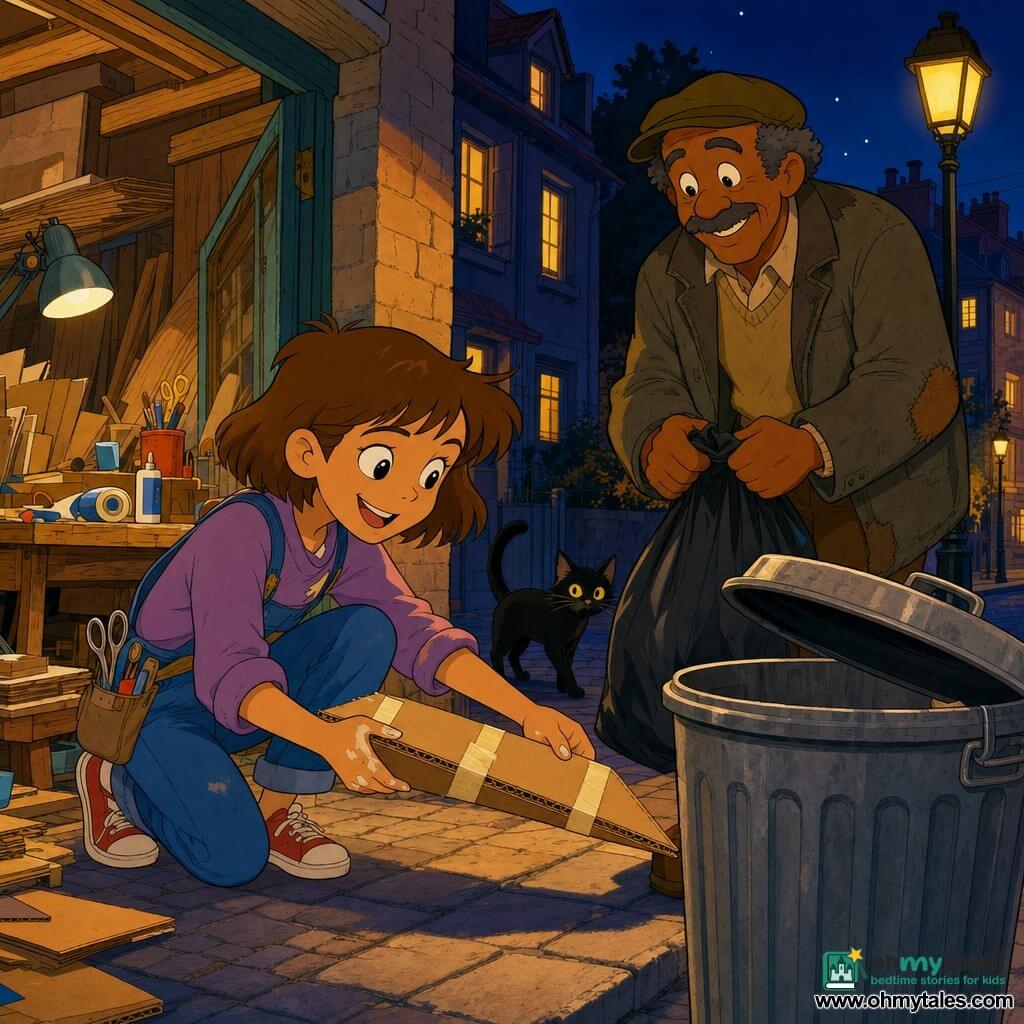
On the sidewalk below, Mr. Lyle from next door was wrestling with a trash bin. The lid kept flopping down like a grumpy hat.
Clunk.
Mr. Lyle tried to toss in a bag. The lid smacked his hand.
“Ow! This bin has manners like a cranky goat,” he muttered.
Mina giggled, then felt her mind click into inventor mode. Problems were everywhere, hiding in plain sight—like that lid, which seemed to enjoy being annoying.
She grabbed her notebook and hurried downstairs, her slippers whispering on the steps. Outside, the night was warm as toast. Many windows stayed open, glowing softly, as if the whole street was breathing together.
“Need help?” Mina asked.
Mr. Lyle looked up, surprised. “Oh, Mina! I'm fine. Mostly. Just battling the Beastly Bin.”
Mina studied the lid. She didn't touch it yet. Inventors often started with questions, not tools.
“What exactly is the problem?” she asked.
Mr. Lyle pointed. “I need both hands for the bag, but the lid wants to shut itself. I only have two hands. If I had a third, I'd be very popular at concerts.”
Mina nodded seriously, as if this were the greatest mystery of the century. “So the lid needs to stay open without you holding it.”
“Exactly.”
Mina wrote: LID WON'T STAY OPEN. HANDS TOO BUSY.
Then she looked around, letting her eyes do their inventor-walking. She noticed a broom leaning against the wall. A clothespin on a line. A little springy doorstop by the steps.
Her pencil twirled again, faster now. The blank page in her head wasn't so blank anymore.
“I think I can make something,” Mina said.
Mr. Lyle raised an eyebrow. “Out of cardboard?”
“Mostly,” Mina said. “Cardboard is braver than people think.”
Chapter 3: Cardboard Plans Under Summer Stars
Back in her workshop, Mina spread cardboard on the table like a picnic for ideas. She drew a quick sketch: a simple hook that could hold the trash bin lid open. Not fancy. Just helpful.
Inventors, Mina reminded herself, didn't always build rockets. Sometimes they built tiny kindnesses.
She chose a thick piece of cardboard and cut it into a long strip. She folded it to make it sturdier, like giving it a backbone. Then she taped it, pressing the tape down with the side of her thumb.
First test: She clipped it to a small box lid on her table.
The cardboard hook bent… and flopped.
Mina stared at it. Her face made a disappointed pancake shape.
“Well,” she told the cardboard, “you tried.”
But inventors didn't stop at the first flop. They learned. Mina poked the bend and noticed where it weakened.
“I need a stronger fold,” she said. “And maybe a triangle shape. Triangles don't wiggle as much.”
She cut two triangles and taped them on as supports. The hook looked a bit like a cardboard elbow wearing shoulder pads.
Second test: She clipped it again.
The lid stayed up—until the tape peeled and the whole thing slid off with a sad whisper.
Mina sighed. Not a dramatic sigh like the bin lid, but a thinking sigh. She twirled her pencil while staring at a fresh blank page, letting the paper calm her down. The pencil spun like a tiny windmill, turning worry into wonder.
“What am I missing?” she murmured.
Then she remembered something important about inventing: you don't just build. You observe the real object. A model is a guess; the real world is the teacher.
Mina took her cardboard pieces and a roll of tape and stepped back outside into the warm summer night. The windows were still open, and the streetlights made puddles of gold on the pavement.
At the trash bin, she studied the hinge, the rim, the way the lid landed. She noticed a small lip under the lid—like a tiny shelf.
“Aha,” Mina whispered. “A place to catch.”
Instead of a clip, she needed a wedge that could tuck under the lip and rest against the bin's side, like a gentle doorstop for a lid.
She rushed back inside, her brain buzzing like a friendly bee.
Chapter 4: Try, Tweak, Try Again
Mina built a new model: a cardboard wedge with ridges. She used layers—cardboard on cardboard—because layers were like teamwork. She pressed the pieces together, counting softly while the glue set.
While she waited, she wrote three rules in her notebook, rules she'd learned from many sticky, crooked projects:
1) Start with a problem you can name.
2) Test quickly so you can learn quickly.
3) Mistakes are not monsters. They're maps.
The glue dried. Mina carried her wedge outside.
Mr. Lyle was still nearby, now leaning on his broom like it was a wise old staff. “Round two?” he asked.
“Round… better,” Mina said.
She lifted the lid and slid the wedge under the little lip, bracing it against the bin's side. The cardboard fit snugly, like it belonged there.
Mr. Lyle carefully let go.
The lid stayed open.
It stayed open when he moved his hand away. It stayed open when a small breeze wandered past. It stayed open like it was proud of itself.
Mr. Lyle blinked. “Well, would you look at that.”
Mina's shoulders loosened with relief. “Try putting the bag in.”
He lifted the trash bag and tossed it in easily, with both hands free. No lid attacks. No goat-like manners.
Mr. Lyle laughed. “You've tamed the Beastly Bin! What do you call this miracle?”
Mina thought about it. Inventors sometimes named things, but they also explained them so others could copy them.
“It's a lid-wedge,” she said. “It holds the lid open by catching under the lip and pushing against the side. It's just cardboard, but the shape does the work.”
Mr. Lyle peered at it. “So the idea is more important than fancy materials.”
“Usually,” Mina said. “Cardboard is like practice. If it works in cardboard, it might work in stronger stuff later. But even cardboard can be enough.”
She felt warm inside, not just from the summer air. It was the warmth of making something useful.
A cat slipped by, silent as a shadow, and the crickets kept singing as if they approved.
Chapter 5: A Softer, Handier Morning
The next day, Mina woke up to a note tucked under her door. Mr. Lyle's handwriting leaned a little to the left, like it was hurrying.
“Dear Mina,
My hand thanks you. The bin behaved this morning. Also, I did not need a third hand at all.
Sincerely,
A Very Grateful Neighbor”
Mina smiled so wide her cheeks felt round.
She spent the morning improving her design. She added a little handle so the wedge could be pulled out easily. She drew clear steps in her notebook, because inventors shared. An invention wasn't only a thing—it was a way of thinking that could travel to other hands.
She even made a second wedge for Mrs. Kato down the street, who sometimes struggled with her recycling bin. Mina didn't deliver it yet; she liked to test things twice.
In the afternoon, Mina returned to her workshop. Sunlight lay on the table in bright stripes. The cardboard scraps looked like tiny boats after a busy harbor day.
Mina glanced at the once-scary blank sheet of paper. It wasn't scary now. It was friendly. It was full of possibility.
She twirled her pencil one more time, slower this time, like a lullaby for her thoughts.
“What next?” she whispered.
Maybe a shoelace helper. Maybe a snack container that didn't spill crackers like a confetti cannon. The world was full of small problems, and small problems loved small solutions.
Before dinner, Mina cleaned up. She stacked the cardboard, closed the glue, and wiped the table until it felt smooth under her palm.
Then she did her favorite ending-of-the-day ritual: she put every tool back in its place.
Scissors, ruler, tape, pencil, craft knife (locked safely away), all lined up like polite guests. She placed them methodically into their box, each tool settling with a soft clink, as if saying, “Goodnight. See you tomorrow.”
Mina closed the lid of the toolbox and listened.
Outside, summer evening returned, gentle and warm. Windows stayed open late again. Somewhere, a trash bin lid lifted without complaint.
Mina climbed into bed with the cozy tiredness of someone who had tried, failed, learned, and tried again—someone who had made the world a little softer and a little more practical, one piece of cardboard at a time.