Part 1: Morning on the School Grounds
Dew sparkled on the grass like tiny beads of glass. The school yard was quiet, except for a soft rustle from the hedge and the steady drip-drip of last night's rain sliding off leaves.
Mossy was awake early. Mossy was a small green turtle who lived in the corner garden behind the tool shed. He was careful and applied in everything he did. He liked straight paths, tidy piles, and jobs finished all the way to the end.
Today, he carried a little notebook made from pressed bark and a pencil stub he had found near the fence. He had been thinking hard.
The school was a busy place. During the day, the wind brought crumbs, wrappers, and dry leaves. Sometimes, when the rain came, bits of trash slid along the pavement and hid in puddles like sneaky fish.
Mossy did not like sneaky trash.
He took slow steps toward the building, passing the flower bed where marigolds held up orange faces to the sky. A ladybug watched him from a stem.
“Good morning, Mossy,” the ladybug said.
“Good morning,” Mossy answered. “I'm making a plan.”
“A plan for what?”
“For helping the planet,” Mossy said. He tapped his notebook. “But I want it to be something I can change at school.”
The ladybug tilted her small head. “A big thought for a small turtle.”
Mossy smiled. “Small things can still be real.”
He made a list with neat marks.
1) Less litter.
2) Less wasted water.
3) More sharing.
He stopped at a puddle near the door. A thin rainbow shivered on the water's surface, made from a drop of oil. Mossy's eyes widened.
“That doesn't look healthy,” he whispered.
From the gutter, a tired earthworm peeked out.
“It's from the parking strip,” said the earthworm. “Rain washes everything down. It all ends up somewhere.”
Mossy looked at the puddle again. He imagined it sliding into the drain, then into a stream, then into a river that tasted like metal instead of mud and clean stones.
He wrote another line in his notebook.
4) Keep rainwater clean.
Mossy's heart felt both heavy and hopeful. Heavy, because the problems were real. Hopeful, because his pencil was moving, and that meant he could start.
He turned his head toward the bike shed at the side of the yard. The bike shed had a wide roof and a row of metal loops where bikes usually rested. It was quiet now, but it always collected things—fallen leaves, stray paper, and sometimes plastic that fluttered in like a nervous bird.
Mossy decided to begin there.
Part 2: The Bike Shed Mystery
Near the bike shed, the air smelled like wet rubber and pine needles. The ground was a mix of gravel and hard-packed dirt. A thin line of ants marched past, carrying crumbs like tiny treasure.
Mossy moved along the wall, careful not to step on anyone's work.
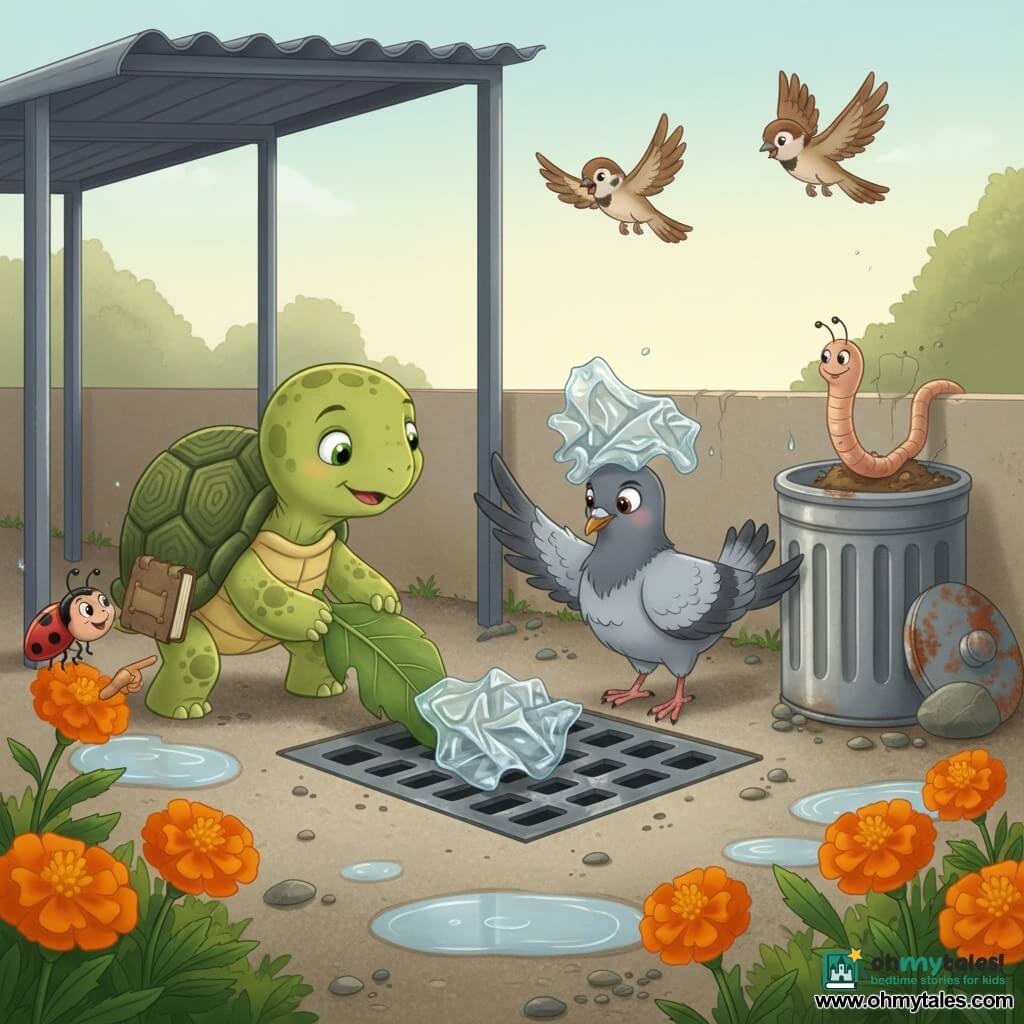
Under the bench by the bike shed, he saw it: a crumpled plastic snack wrapper, shiny as a beetle's back. It was stuck to a damp leaf.
Mossy reached for it with a steady claw. It slipped away, skittering a little in the breeze.
“Oh no,” Mossy murmured. “Come back.”
The wrapper slid toward a drain grate nearby. Mossy hurried, but turtles are not made for hurrying. He pushed, and the wrapper slid again. It was like chasing a leaf that did not want to be caught.
A gust of wind came, playful and strong. The wrapper scooted right to the edge of the grate.
“Stop!” Mossy called, though he knew wind did not understand.
A grey pigeon landed with a soft thump. His feathers were ruffled, and his eyes were bright.
“What's all the fuss?” asked the pigeon.
“Trash is trying to escape into the drain,” Mossy said, breathing fast.
The pigeon bobbed his head. “Ah. The Sneaky Slip.”
“The what?”
“The Sneaky Slip,” the pigeon repeated. “When litter slides into places no one sees. Then it travels far, far away.”
Mossy felt a shiver. “We can't let it.”
The pigeon hopped closer. “I can help. I'm quick.”
He flapped once, making a little burst of air. The wrapper lifted—up, up—then dropped right onto the pigeon's back.
The pigeon froze. “Oh.”
Mossy blinked. “It's on you.”
“I know,” the pigeon said, trying to look calm. “I can't reach it.”
Mossy thought fast. He glanced around. A small stick lay near the wall. A dry leaf lay beside it, wide as a hand.
Mossy nudged the stick with his nose. It rolled closer. He pushed it into place like a tiny lever, then carefully slid the leaf under the pigeon's tail feathers.
“Hold still,” Mossy said. His voice was gentle but firm, the way he felt inside when he wanted to do something right.
The pigeon stood like a statue.
Mossy lifted the leaf just a little. The wrapper slid off the pigeon's back and landed on the leaf with a soft crackle.
Mossy let out a happy sigh. “Got it.”
“Nice thinking,” the pigeon said. “You're like a slow lightning bolt.”
Mossy laughed. “Slow is fine if you keep going.”
They carried the wrapper together—Mossy pushing the leaf, the pigeon guiding with small hops—until they reached a bin tucked near the fence. The bin had a lid, but the lid was half open.
Mossy poked the lid. It wobbled and stayed open.
“That's not good,” Mossy said. “If the lid stays open, wind can steal the trash again.”
The earthworm had followed them and now wriggled nearby. “And rain can wash it out,” she added.
Mossy looked at the lid. The hinge was rusty. The lid was too heavy for him alone.
He wrote in his notebook again.
5) Fix the bin lid.
The pigeon puffed his chest. “We need more helpers.”
Mossy nodded. “Solidarity,” he said softly. “Not alone.”
They walked back to the bike shed. Mossy noticed something else: two water taps near the wall, with a thin drip falling from one of them. Drip. Drip. Drip.
A little puddle had formed, and it was spreading slowly toward the drain grate.
Mossy watched the drops. Each one seemed small. But together, they were making a river on the ground.
“Wasted water,” he whispered. “And it carries dirt.”
He touched the tap. It was turned almost all the way off, but not quite.
Mossy turned it gently until the dripping stopped.
The yard became quieter, as if it had been holding its breath.
“That was easy,” said the pigeon.
Mossy's eyes shone. “Easy is powerful.”
Still, Mossy's notebook felt full of tasks. He wanted a plan that would last, not just one good morning.
He looked at the bike shed roof. Rainwater ran off it in long lines when it rained. If that water was caught, it could be used for the garden. No need to waste clean drinking water on flowers.
Mossy imagined a barrel, a simple one, to collect rain.
He wrote:
6) Collect rain for plants.
Then he paused. How could he make changes at school if he could not talk to the humans who used it?
He thought of signs, but signs needed hands. He thought of meetings, but meetings needed voices people could hear.
Then a breeze carried a soft sound: the flutter of many wings. A group of sparrows landed in the hedge, chattering like a gentle rain of words. They knew every corner of the yard. They saw everything.
Mossy smiled. Maybe the school was full of helpers already—just not the kind that wore shoes.
Part 3: A Small Team and a Big Promise
By midday, the sun warmed the stones. The marigolds smelled sweet and spicy. Mossy gathered his helpers near the bike shed: the pigeon, the earthworm, the ladybug, and three sparrows who promised to watch from above.
Mossy opened his bark notebook and read his list, slow and clear.
“Less litter,” he said. “Less wasted water. More sharing. Keep rainwater clean. Fix the bin lid. Collect rain for plants.”
The sparrows chirped in a quick chorus.
The earthworm lifted her head. “I can loosen the soil in the garden beds. Healthy soil holds water better. Then we need less watering.”
“Good,” said Mossy, and he drew a small star by her name.
The pigeon bobbed. “I can patrol near the bike shed. If I see a wrapper, I can call the others.”
The ladybug said, “I can check the flowers and leaves. If I see sticky trash, I'll tell you.”
The sparrows offered to carry little bits of dry leaf and string to a safe pile, away from drains, so water could flow without carrying mess.
Mossy felt his chest grow warm. This was solidarity. Each friend had a small job, and together it made a strong net, like many threads holding a blanket.
Now came the tricky part: the bin lid.
Mossy studied it. The rusty hinge squeaked like a tired cricket. He needed something to keep it closed.
He spotted a smooth stone, round and heavy, near the edge of the path. It was too heavy for him. But not too heavy for a team.
Mossy placed himself at the front of the stone. The pigeon pushed from one side with his shoulder. The sparrows tugged at a small string tied around the stone, pulling in tiny bursts. The earthworm wiggled under the stone's edge, making the ground smoother so it could roll.
“Push… and breathe… push,” Mossy said.
The stone rolled. Slow. Then a little faster.
They guided it carefully to the bin, like moving a sleeping giant to a new bed. Then they placed it on the lid, not too hard, just enough weight to keep the lid down.
The lid stayed closed.
Everyone went quiet for a moment, proud and surprised.
“We did it,” whispered the ladybug.
Mossy looked at the drain grate nearby. No wrapper hovered there now. No puddle carried rainbow oil. The taps were silent. The ground looked calmer.
“It's not perfect,” Mossy said, “but it's better.”
He thought again about the rain barrel idea. He could not build a barrel, but he could prepare the place. Under the bike shed roof, there was a corner where water dripped in rainy weather. Mossy and the earthworm cleared leaves and tiny sticks so water could flow into one neat spot.
“When the humans notice,” Mossy said, “maybe they will put a barrel here.”
“And if they don't?” asked a sparrow.
“Then we keep the corner ready,” Mossy said. “We keep showing that it makes sense.”
The pigeon nodded. “Small steady steps.”
Mossy closed his notebook. He felt tired in a good way, like after making a bed smooth and neat.
The sky began to turn soft gold. Evening was coming, and with it, the quiet time before sleep.
Mossy had one more idea. A celebration, but gentle. Something that did not make new trash.
“A snack,” he said, “with almost no wrapping.”
The sparrows cheered.
Part 4: A Cozy Snack and a Greener Tomorrow
Behind the tool shed, Mossy kept a special box made from a hollow log. Inside were things he had found and cleaned: a small tin cup, a cloth napkin made from an old piece of soft fabric, and a little jar.
He invited his friends to the garden patch where mint grew in bright green bunches.
The pigeon brought a few fallen apples from beneath a tree at the edge of the yard. Some were bruised, but inside they were sweet and crisp.
The sparrows brought dry seeds they had found, and the ladybug guided them to a bush with ripe, dark berries that had dropped onto a clean leaf.
Mossy filled the tin cup with fresh rainwater caught in a wide leaf bowl. It tasted cool and clean, like a sip of shade.
They sat together in a circle. The grass tickled their feet and claws. A late bee hummed past, low and calm.
Mossy used the cloth napkin as their shared table. He placed apple slices on it. He placed berries in the little jar, no plastic bag needed. He sprinkled seeds on top like tiny stars.
“Thank you,” Mossy said, looking at each friend. “Today was better because we worked together.”
The earthworm's voice was soft. “I liked being part of it.”
The pigeon's eyes were kind. “I usually act alone,” he admitted. “But teamwork feels… lighter.”
The sparrows chirped, “Together-together-together.”
Mossy took a small bite of apple. It crunched gently. He listened to the sounds around them: leaves whispering, insects singing, the far-off call of an owl waking up.
He thought about tomorrow. There might be new litter. The tap might drip again. The wind might try another Sneaky Slip.
But now Mossy had a plan, and more than that—he had a team.
He opened his notebook one last time and wrote a short promise in careful letters:
“Small hands, small wings, small steps. Big help.”
Then he closed it and tucked it under his shell, safe and warm.
As the sky turned deep blue, the garden smelled like mint and cool soil. Mossy felt calm.
The planet did not need one giant hero. It needed many little friends doing what they could, where they were, with care.
Mossy yawned, slow and wide.
“Good night,” he said.
“Good night,” answered the others.
And near the bike shed, the bin lid stayed shut, the drain stayed clear, and the school yard rested, a little cleaner, a little kinder, ready for a greener tomorrow.