Part 1: The Cardboard Roll Surprise
Mila was five years old, and she liked to do small helpful things. She liked lining up her shoes neatly. She liked turning off the bathroom light. She liked saying, “I can do it,” and then trying.
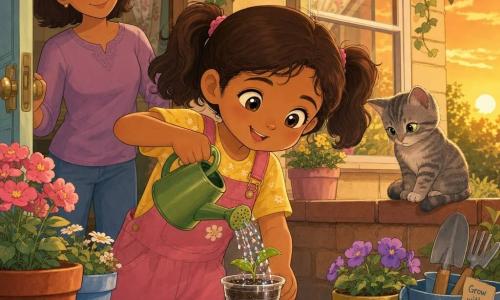
On a sunny afternoon, Mila sat at the kitchen table. The table smelled a little like oranges, because her mom had just peeled one. A soft breeze came in through the window, and it made the curtain move like a slow wave.
Mila had a small basket beside her. Inside were cardboard rolls from toilet paper and paper towels. Some were short and some were long. Mila ran her fingers over them. They felt smooth and light, like tiny tunnels.
“Today I'm going to make something,” Mila said to herself.
She found a paper plate, a little glue, and some crayons. She didn't want to use brand-new things if she didn't need to. She liked using what was already there.
First, she pressed the cardboard rolls flat, one by one, like making little leaf shapes. Then she dipped the ends in glue and stuck them around the edge of the paper plate. Slowly, a flower began to appear. Mila colored each “petal” with bright crayons—yellow like butter, blue like the sky, green like new grass.
When she held it up, it looked like a sun-flower, but also like a wheel, and also like something that could belong in a fairy garden.
Mom walked by and smiled. “That's beautiful,” she said. “What will you do with it?”
Mila thought carefully. She liked when her ideas had a place to go.
“I want to hang it,” Mila said, “so people see it and feel happy. And maybe… it can help the planet too.”
Mom's eyes crinkled in a warm way. “Art can help,” she said. “It can remind us to take care.”
Mila looked at the cardboard rolls left in the basket. She imagined them in the trash can, squished under old food and crumpled paper. Then she imagined them as flowers, rockets, crowns, and tiny houses for pretend mice.
She felt proud. Not a loud proud. A quiet proud, like a little candle shining inside her chest.
After her decoration dried, Mom tied a string through a small hole in the plate. Mila touched the string. It was rough, like a tiny rope for a tiny boat.
“Can we take it to the playground?” Mila asked.
“The park playground?” Mom said.
Mila nodded fast. The playground was her favorite place. It had a slide that got warm in the sun, swings that squeaked, and a sandy corner where ants made busy lines.
Mom glanced at the clock. “Yes,” she said. “But first, let's pack a few things.”
They packed a water bottle, a small snack, and a pair of gloves that fit Mila's hands. They also brought a little bag, the kind that could hold small treasures.
Mila didn't know exactly what would happen at the park. She only knew she wanted to show a good example. She wanted her hands to do kind things.
And the cardboard flower, light as a cloud, came with them.
Part 2: The Playground That Needed Help
The park was bright and green. Trees stood like tall, quiet friends. Their leaves made soft shadows on the path. Birds hopped on the grass, pecking and looking around, quick as tiny drums.
When Mila and Mom reached the playground, Mila stopped.
Something looked different.
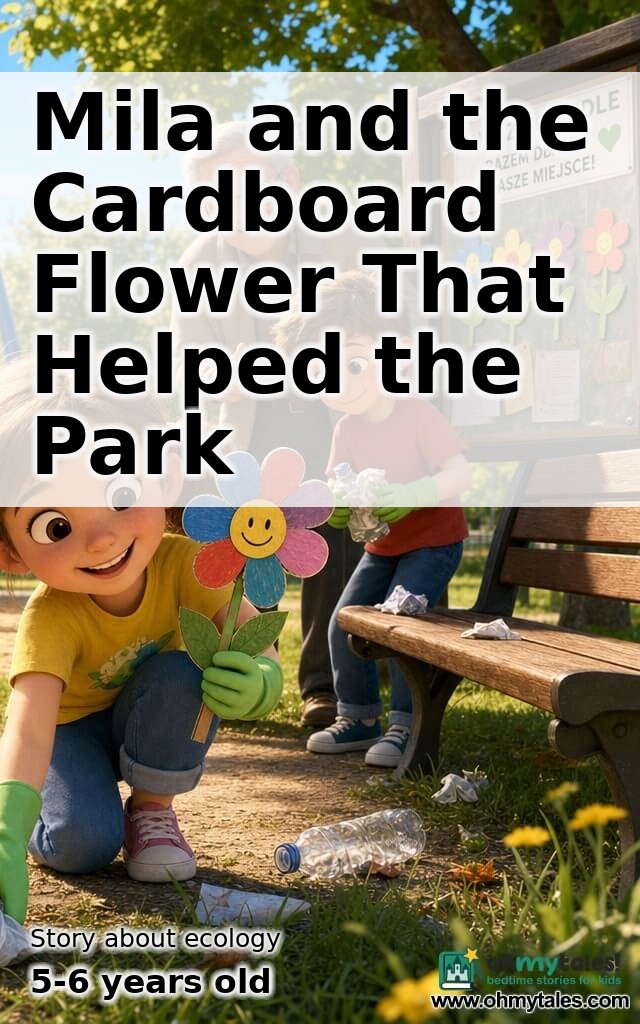
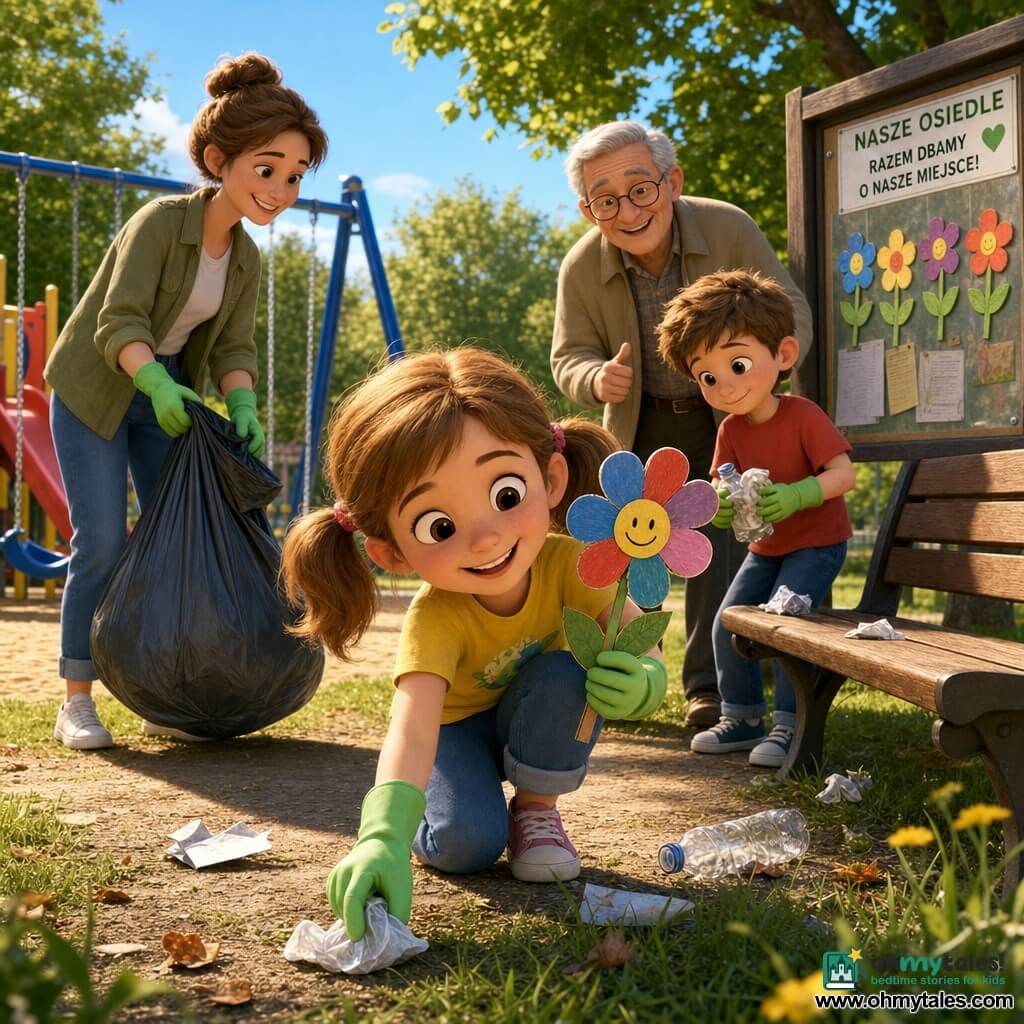
Near the bench, there were bits of paper and snack wrappers. A plastic bottle lay on its side, catching the sunlight like a shiny mistake. Under the swing, there was a little pile of leaves mixed with a crumpled bag.
Mila's stomach felt wiggly, the way it did before she tried something new.
A boy and his grandpa were nearby. The boy was holding a toy truck. He looked at the litter, then looked away.
Mila held her cardboard flower up and stared at it. It was bright and cheerful. But the playground looked tired.
Mom knelt beside Mila. “Sometimes places need a little care,” she said softly. “Not because people are bad. Sometimes they forget. Sometimes the wind blows things. Sometimes a bin is too full.”
Mila watched a wrapper flutter and then stick in a bush like a leaf that didn't belong.
She remembered what Mom said: art can remind us to take care.
Mila put on her gloves. They made her hands feel ready, like she was wearing superhero mittens.
“I want to help,” Mila said.
Mom opened the little bag. “We can pick up what we see. One piece at a time.”
Mila walked slowly, looking down. She picked up a wrapper with a picture of a cookie on it. She put it in the bag. She picked up a napkin that had turned gray. She put it in the bag too.
At first it felt strange, because it wasn't her mess. But then Mila noticed something: each time she picked up one thing, the ground looked nicer. The playground looked more like itself.
The boy with the truck watched. His grandpa watched too. The boy's cheeks turned a little pink.
Mila saw a bottle near the slide. It was too big for her small bag. She tried to lift it, but it rolled away.
It bumped into the sandbox edge and stopped.
Mila took a breath. She didn't get mad at the bottle. She just followed it.
Mom came over and helped her hold it steady. Together, they put it into a bigger bag Mom had brought.
A tiny twist of worry appeared when Mila noticed the trash bin nearby. It was stuffed full, like a mouth that could not chew anymore. Some trash peeked out the top.
Mila looked at Mom. “Where will it go?”
Mom nodded. “Good question. We can take our bag home and sort it. Some can be recycled. Some goes in the trash. And next time, we can tell the park worker the bin needs emptying.”
Mila liked that plan. It felt calm. It felt possible.
Soon the ground looked cleaner. The swing area was clear. The path by the bench looked neat. Even the bush looked happier without the wrapper.
Then a small mini-rebound happened.
Mila spotted her cardboard flower decoration, which she had rested on the bench, wobbling in the breeze. The string was sliding, sliding… and then—whoosh—it slipped right off the bench and floated down.
It landed near a muddy spot by the grass.
Mila's eyes grew wide. The decoration was her special thing, and now it had a brown smudge on one petal.
For a moment, Mila felt a hot sting in her throat. She had worked hard on it. She wanted it to stay perfect.
But Mom gently lifted the decoration and held it in the sun. “It's okay,” she said. “We can wipe it. And maybe it can remind us of something important.”
Mila blinked. She looked at the smudge again. It did not ruin the flower. It just showed it had been outside, doing real-world work, like Mila.
Mila wiped the spot with a damp tissue from Mom's bag. The petal looked better. Not brand new, but still bright.
Mila held the decoration close. She felt the quiet proud candle glow again.
The boy with the truck walked over. He shuffled his feet. “I can help too,” he said in a small voice.
Mila looked at him. She didn't need him to say sorry. She just liked that he wanted to help.
Mom handed him an extra glove. Grandpa smiled and nodded, like a tree bending kindly in the wind.
The boy picked up two wrappers and put them in the bag. Then he picked up three. Soon, his truck wasn't the only thing he was carrying. He carried care.
Mila watched the three of them—her, the boy, and Grandpa—moving around the playground like a small team.
It felt like the park was breathing easier.
Part 3: A Small Plan and a Warm Agreement
After the playground looked clean, they all sat on the bench. Mila ate a few apple slices. The air smelled like grass and warm wood. A butterfly floated past, as light as a whisper.
The boy's grandpa pointed to a tree. “See those leaves?” he said. “They make shade. Shade keeps the ground cooler. That helps insects and plants.”
Mila looked up. The leaves made a moving pattern on her knees.
Mom added, “And when we put trash where it belongs, animals don't eat it by mistake.”
Mila remembered a picture book where a turtle got stuck in plastic. The thought made her hug her water bottle.
The boy stared at the clean ground. “I didn't know it mattered so much,” he said.
Mila nodded. “Little things matter,” she said. “Like picking up one wrapper.”
Grandpa leaned closer. “That's true,” he said. “And working together matters too.”
Mila looked at her cardboard flower. She had made it from things people usually throw away. Now it felt like a tiny flag for a good idea.
“I want to hang this somewhere,” Mila said, “but not where it will get dirty again.”
Mom pointed toward the community board near the park entrance. It had posters about swimming lessons and lost cats. It also had a little space under a clear cover.
“We can ask if we can put it there,” Mom said.
They walked over together. A park worker was emptying a bin farther down the path. Mom waved gently and explained, using polite words. The worker listened and nodded.
“We can put it on the board for a week,” the worker said. “And we'll add a note: ‘Thank you for keeping our park clean.'”
Mila's heart felt big, like it had grown an extra room.
The boy helped Mila tape the decoration safely inside the clear cover. The flower looked bright against the plain board. Like sunshine that had decided to stay.
Then the boy hesitated. “I think… my little sister dropped a wrapper earlier,” he said. “I didn't pick it up.”
Mila looked at him. She could see he felt uncomfortable, like a sock twisted in a shoe.
Mom's voice stayed warm. “It's good to notice,” she said. “And it's good to fix things.”
Grandpa nodded. “We all learn,” he said. “That's how we get better.”
The boy took a breath. “Can we make it a plan?” he asked. “Like… when we come here, we bring a small bag and pick up five pieces.”
Mila loved that idea. It was simple. It was clear. It felt like a game, but also like real help.
“Yes,” Mila said. “And we can tell others. Not in a bossy way. In a friendly way.”
They all agreed. Mom would keep a few small bags by the door at home. Grandpa would remind the boy. Mila would bring her gloves.
Before they left, they walked around the playground one last time. The slide shone clean. The swings moved softly. The sandbox looked smooth, ready for castles.
Mila took a slow breath and listened. She heard birds, distant laughter, and the quiet sound of leaves.
As they headed home, the sky turned a softer blue, like bedtime paint. Mila held Mom's hand in one glove, and in the other hand she carried nothing at all—because the park was lighter now, and so was she.
At home, Mila washed her hands and watched the water swirl away, taking tiny bits of dirt with it. Mom helped her sort what they had collected: recycling in one bin, trash in another.
Mila placed the extra cardboard rolls back in her basket. They waited like ideas, ready to become something new.
That night, as Mila lay in bed, she thought of the playground and the way people had worked together. She thought of the boy who had joined in. She thought of the park worker who had listened. She thought of her flower hanging on the board, smiling at everyone who walked by.
Mila's eyes grew heavy. She felt safe.
She didn't feel like she had to save the whole world all at once.
She only felt that tomorrow, and the next day, she could do one small kind thing again.
And that, she knew, was how a happier planet could begin.