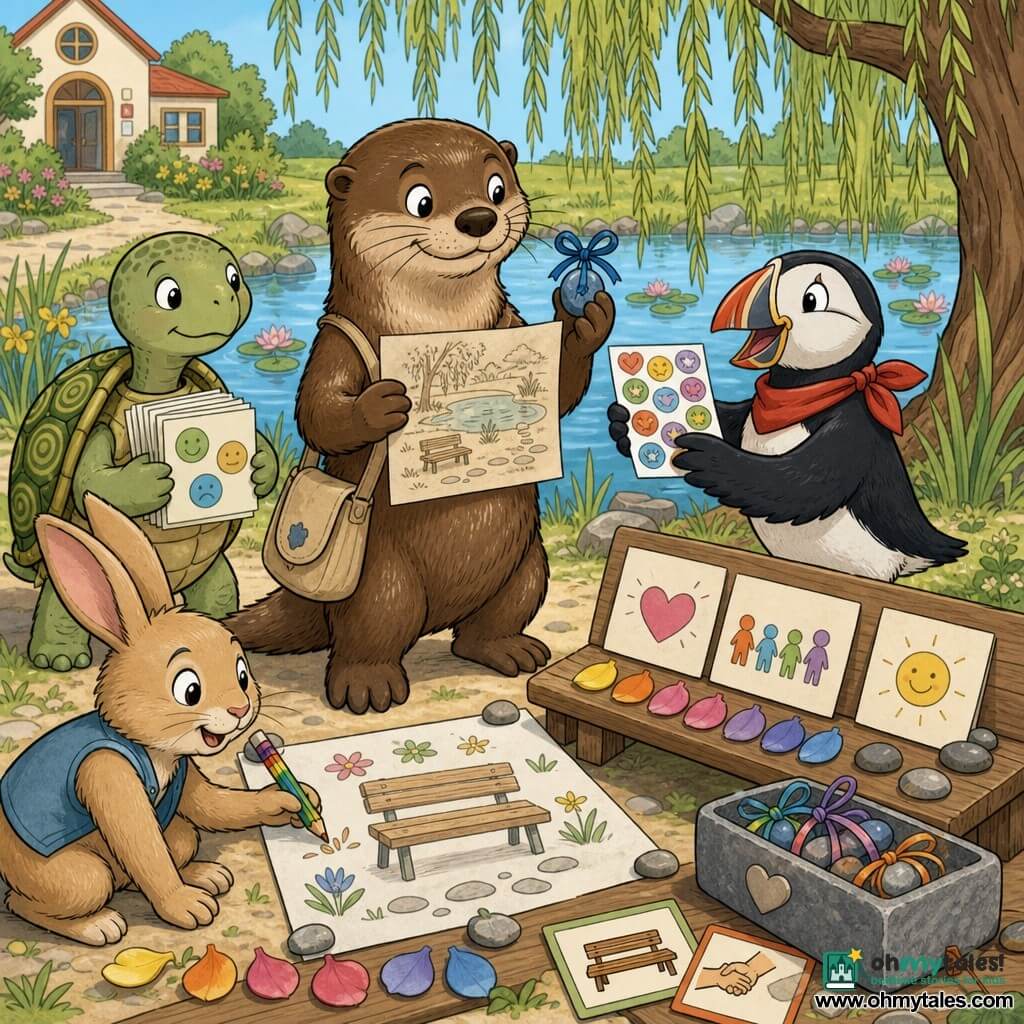
Chapter 1: Milo and the Fast-Looking Brain
Milo the otter loved rules, lists, and tidy lines, and he also had HPI, which meant his brain could think very fast and notice lots of details at once. In the morning, he liked to line up his river stones by size: tiny, small, medium, big, biggest. He counted them softly, tapping each one with a paw. Tap. Tap. Tap.
The riverbank smelled like wet grass and mint. A dragonfly buzzed by, and Milo's whiskers twitched. He checked his little schedule, written on a leaf with berry ink.
“Breakfast. Pack bag. Walk to school. Show-and-tell practice. Group project,” he read aloud.
His friend Pippa the puffin waddled over with a bright scarf flapping like a flag.
“Morning, Milo!” Pippa called. “Ready for school?”
Milo blinked. “Yes. I have everything.” He patted his bag, then patted it again, just to be sure. “Extra pencil. Extra eraser. Extra extra pencil.”
Pippa giggled. “You always have an extra extra.”
“It prevents surprises,” Milo said. He liked surprises only when they were small, like finding a smooth pebble shaped like a heart.
As they walked, Milo talked about the day. “First we will sit. Then Ms. Maple will explain. Then we will start the group project. I think we should make a poster with headings and subheadings. I already thought of seven headings.”
Pippa's beak opened and closed like she wanted to speak, but Milo's words rushed out like river water after rain.
At the school pond, animals bustled in. Squirrels carried notebooks. A shy hedgehog held a ruler like it was a brave sword. Someone's lunch smelled like warm bread.
Ms. Maple, a calm turtle with kind eyes, rang a small bell. “Good morning, class! Today we begin our ‘Neighborhood Helpers' project. In groups, you'll plan a small event for our community: a clean-up, a sharing table, a helpful guide, anything that makes life easier.”
Milo's paws tingled with ideas. He loved planning.
Ms. Maple read the groups. “Milo, Pippa, Juniper, and Taro.”
Juniper was a rabbit who liked to hop while she talked. Taro was a tortoise who spoke slowly and carefully, like each word was a pebble placed in the right spot.
They gathered at a table. Milo pulled out a neat paper with a title already written.
“I made a plan,” Milo announced. “Step one: decide the event. Step two: write roles. Step three: list materials. Step four—”
Juniper bounced. “Ooh! What if we do a welcome booth for new animals? With stickers!”
Pippa said, “And maybe a map of good places, like the berry stand and the quiet bench.”
Taro lifted his head. “I think… we could also include a page about feelings. Sometimes new animals feel lost.”
Milo nodded fast. “Yes. We will do that. First, we must choose the exact size of the poster. Then we must—”
Juniper's ears drooped a little. Pippa glanced at Taro. Taro's eyes went to his shell, like he was retreating inside.
Milo didn't notice right away. His mind was already building a perfect poster, straight lines and perfect boxes, like a little town where everything knew where to go.
Ms. Maple walked by and paused. “How is the planning going?”
“Very well,” Milo said. “I have a system.”
Ms. Maple looked at the others. “And how does everyone feel in the system?”
Juniper's nose twitched. “It's… fast.”
Pippa added softly, “We have ideas too, but Milo's plan is already running.”
Taro said, “I'm still thinking.”
Milo's whiskers quivered. “But thinking is easier if we move quickly. We have limited time.”
Ms. Maple rested a hand on the table. “Milo, your fast-thinking is a gift. But a team is like a raft. If one otter paddles too hard alone, the raft spins in circles. Let's practice listening as a kind paddle.”
Milo stared at the paper. He didn't want to spin the raft. He wanted to move forward, together.
Chapter 2: The Listening Practice
After lunch, Ms. Maple gathered the class on lily pads by the pond. The water made tiny shushing sounds on the shore. A breeze carried the smell of pine from the hill.
“Today we practice a skill,” Ms. Maple said. “Listening.”
A few animals groaned in a silly way. Listening sounded like “boring sitting.”
Ms. Maple smiled. “Listening can be active. It's not just ears. It's eyes, body, and patience.”
She held up three smooth stones. “These are our listening stones. Stone one: Stop. Stone two: Look. Stone three: Repeat.”
Milo leaned in. He liked steps.
Ms. Maple pointed to the first stone. “Stop. That means pause your words for a moment.”
Milo whispered, “Pause my words.”
“Stone two: Look. Watch the speaker. Notice their face, their paws, their tail. That helps you understand.”
Milo nodded.
“Stone three: Repeat. Say back what you heard, in your own words. That shows respect and keeps the message safe.”
Pippa raised a wing. “Like, ‘You said you want a map'?”
“Exactly,” Ms. Maple said. “Now, partners. One speaks for ten seconds. The other listens with the stones.”
Milo ended up with Taro. Taro blinked slowly. “I will speak first,” he said.
Milo held his paws together to stop himself from jumping in.
Taro began, “When I was new to this pond, I didn't know where to sit at lunch. I wanted a sign that said, ‘You can sit here.' But I was too shy to ask.”
Milo's brain raced. He thought: We can make a sign! We can make five signs! We can make a whole book!
His mouth opened.
He remembered stone one. Stop.
He closed his mouth gently, like putting a lid on a jar.
He remembered stone two. Look.
He looked at Taro's eyes. They were steady, but a little nervous.
He remembered stone three. Repeat.
“You felt shy,” Milo said carefully, “and you wanted a sign that showed you were welcome to sit with others.”
Taro's shoulders loosened. “Yes. That's it.”
Milo felt something warm and surprising in his chest. It wasn't the thrill of finishing a list. It was the calm feeling of making space.
Then it was Milo's turn to speak. “Sometimes my brain is very fast,” he said. “It notices everything. It wants to fix everything. But I forget to check if others are ready.”
Taro nodded. “Your speed helps. We just need to walk together.”
After the practice, Ms. Maple pulled Milo aside near the reeds. “How did it feel?”
Milo rubbed his paw on the grass. “Hard… and good. Like carrying a heavy bucket, but then putting it down.”
Ms. Maple chuckled. “That's a great picture. Your mind is like a bright lamp. It lights up the room quickly. Listening is learning when to aim the lamp so everyone can see.”
Milo pictured a lamp with a friendly shade. Not a blinding spotlight. A helpful lamp.
Back at the table, Milo took a deep breath. “Okay,” he told the group. “New plan. First, each of you says one idea. I will not write mine until last.”
Juniper's ears perked up. “Really?”
“Really,” Milo said. “If I forget, you can say, ‘Stone one,' and I will pause.”
Pippa grinned. “Deal.”
Taro nodded slowly. “Deal.”
Juniper hopped once. “My idea: a Welcome Day ‘Buddy Bench' near the pond. If you sit there, it means you want a friend.”
Pippa said, “My idea: a simple map with pictures, not too many words. Some animals read slower, and pictures help.”
Taro said, “My idea: a feelings card with faces. New animals can point to how they feel.”
Milo listened. Stop. Look. Repeat.
“You want a buddy bench,” Milo said to Juniper. “You want a picture map,” he said to Pippa. “You want feelings cards,” he said to Taro.
Then he added his idea last. “We can put them together. A Welcome Station: the bench, the map, and the feelings cards in a small box.”
Juniper clapped her paws. “That sounds awesome!”
Pippa puffed her feathers. “And we can make it bright, but not too busy.”
Taro smiled. “And calm.”
Milo wrote: “Bright but not busy. Helpful and calm.” He underlined it twice, and this time, the underline didn't feel like a fence. It felt like a bridge.
Chapter 3: A Plan with Room to Breathe
The next day, their group met after school under a willow tree. The leaves made soft shadows on the ground, like green lace. A few ants marched by in a straight line, and Milo admired their teamwork.
Juniper brought a box of crayons. “I brought every color!” she announced.
Pippa brought stickers shaped like stars and fish. “Some animals love stickers,” she said. “Some don't. We'll offer, not force.”
Taro brought a stack of blank cards and a small pouch of smooth stones. “For fidgeting,” he explained. “It helps me focus.”
Milo paused. “Could we put a few stones in the Welcome Station too? For anyone who likes to hold something while they talk.”
Pippa nodded. “Great inclusive idea.”
Milo felt proud, but he tried not to grab the project like a slippery fish. He placed his list on the ground where everyone could see.
“Here's a draft,” he said. “But it's not finished. We can change it.”
Juniper leaned over. “Can we add a drawing of the school pond? Like a big picture on the poster.”
“Yes,” Milo said. Then he stopped himself from adding ten more instructions. “What would you like on it?”
Juniper's eyes shone. “The lily pads, the snack table, the library log, and the quiet corner.”
“The quiet corner,” Taro repeated, looking relieved. “That's important.”
Pippa pointed with her wing. “We can use simple symbols. A book for the library. A leaf for the quiet corner. A berry for snacks.”
Milo started sketching boxes. His paw went fast-fast-fast.
Juniper giggled. “Milo, your paw is doing the river-rapids thing.”
Milo froze, then laughed too. “Sorry. Rapids again.”
“Stone one,” Pippa teased gently.
Milo set his pencil down. “Stop,” he said, smiling. He took a breath and looked at their faces. “Okay. Tell me the symbols you want, one at a time.”
They worked slowly, but it felt strong, like building a dam with many paws. Milo wrote a short line under each symbol. Not too many words. Just enough.
For the buddy bench sign, Juniper drew a bench with a big heart on it.
“What if someone is shy about sitting on it?” Taro asked.
Pippa tapped her beak. “We can add a second way. A ‘Hello Token.' If you carry it, it means you want someone to say hi.”
Milo nodded. “A token is small. That's good for shy animals.”
He pulled out a ribbon from his bag. “We can tie it to a smooth stone. Like a little flag.”
Juniper held up a blue crayon. “Blue ribbon! Blue feels calm.”
Taro added, “And we should say, ‘No pressure.' If someone doesn't want to talk, that is okay.”
Milo wrote on the poster: “You can join. You can watch. You can wave. All are okay.”
He paused and read it again. The words made him feel peaceful.
A squirrel named Nia wandered over, carrying a stack of books. “What are you doing?”
Pippa said, “We're making a Welcome Station for new students.”
Nia's eyes flicked to Milo's neat boxes. “It looks… very organized.”
Milo felt a pinch in his stomach. Sometimes “organized” sounded like “bossy.” He took a careful breath.
“It's organized,” Milo said, “because I like order. But it's for everyone. We're using everyone's ideas.”
Juniper chimed in, “Yeah! Milo's structure helps us not forget things.”
Taro nodded. “And we remind him to pause.”
Nia smiled. “Cool. Can I add something?”
Milo made space on the paper. “Yes. What would help you feel welcome?”
Nia thought. “A list of school routines. Like where to put your bag, when to line up. I worry about doing the wrong thing.”
Milo's eyes lit up. Routines! Lists! His favorite.
He almost said, “I already have ten lists,” but he remembered the lamp. Aim it kindly.
“That's a great idea,” Milo said. “We can make a small ‘Today at School' card. Simple steps.”
Pippa added, “We can put pictures, too.”
Juniper said, “And we can keep one extra card, in case someone loses theirs.”
Milo laughed. “An extra extra card.”
They all laughed with him, not at him. The willow leaves rustled, like they were clapping softly.
Chapter 4: Welcome Day
On Friday, the school pond sparkled in the sun. The air smelled like fresh mud and sweet berries. Ms. Maple set up a small table near the entrance with their Welcome Station.
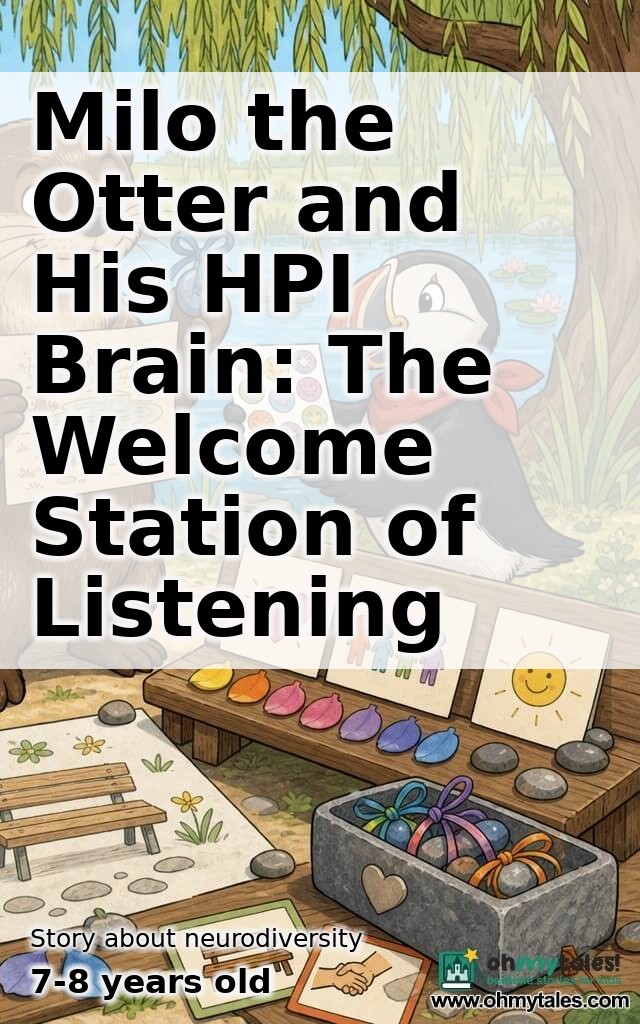
There was the buddy bench sign, bright but not busy. There was the picture map with symbols. There was a box of feelings cards. There were a few ribbon stones for fidgeting and for “hello tokens.” And there was Nia's routine card: “Hang your bag. Wash paws. Sit on a lily pad. Listen for the bell.”
Milo stood beside the table with his group. His fur was brushed neatly. His list was in his pocket, but he promised himself he would look at faces more than paper.
Ms. Maple announced, “Class, we have two new students today. Please be kind. Remember: everyone's brain works in its own way.”
The new students arrived: Lolo the little fox and Suri the young deer. Lolo's tail flicked fast. Suri's ears turned in different directions, catching every sound.
Pippa stepped forward. “Hi! I'm Pippa. This is our Welcome Station. You can choose what you want.”
Juniper waved. “No pressure!”
Taro spoke gently. “If you want, you can point to a feelings card.”
Suri looked at the cards and pointed to one with wide eyes. “This one,” she said quietly.
Milo leaned closer, but not too close. “That face looks like ‘nervous,'” he said. “Is that right?”
Suri nodded.
Milo remembered his own fast brain and how it could feel like a rushing river. He didn't say HPI again. He thought of Ms. Maple's words: a bright lamp.
“Thanks for telling us,” Milo said. “Would a simple routine card help? It shows what happens next.”
Suri took the card and held it like a small shield. Her shoulders lowered. “Yes,” she whispered.
Lolo bounced on his paws. “What's that stone with the ribbon?”
Juniper said, “It's a Hello Token. If you hold it, someone can say hi. If you don't want it, that's fine too.”
Lolo grinned and grabbed one. “I want two hellos!”
Pippa laughed. “One hello at a time, speedy fox.”
Lolo trotted to a group of beavers and held up the token. One beaver waved. Another said, “Hi! Want to sit with us?”
Lolo's grin grew bigger.
Suri stayed near the Welcome Station, looking around. The pond felt loud: splashes, chatter, a bell ringing, wings flapping. Milo noticed Suri's ears twitching.
He lowered his voice. “Do you want the quiet corner on the map?”
Suri looked at the picture of a leaf and nodded.
Milo turned to Taro. “Can you show her? You know the calm path.”
Taro nodded. “Yes. We can walk slowly.”
Suri followed Taro, clutching the routine card and a smooth stone.
Milo watched them go and felt proud of their teamwork. His plan had room to breathe, like a jacket that fit even when you stretched your arms.
Later, during class, Ms. Maple asked the groups to share what they made.
Juniper spoke first. “We made a Welcome Station, because starting somewhere new can feel big.”
Pippa added, “We used pictures and choices, so everyone can use it in their own way.”
Taro said, “We included calm tools, like stones, and feelings cards, because feelings are real.”
Then Milo stood up. His heart thumped, but in a friendly way.
“I like structure,” he said. “My brain is like a bright lamp. It lights up ideas fast. But I learned that the lamp works best when I aim it with listening. When I pause, look, and repeat, my friends' ideas shine too.”
Ms. Maple's eyes crinkled. “That is a strong lesson.”
At recess, Nia ran up. “Suri used the quiet corner and then joined our game later!”
Pippa said, “And Lolo gave out so many hellos that we ran out of tokens.”
Juniper groaned dramatically. “We need extra extra tokens!”
Milo laughed. “I can plan that.”
He stopped and looked at their faces. “But first… any other ideas?”
Taro said, “Maybe we can teach the class the listening stones.”
Pippa said, “Yes! Listening is for everyone.”
Juniper hopped. “And we can make the stones out of clay! Fun and useful.”
Milo nodded. “I hear you. Let's do it together.”
The sun warmed the pond, and the school felt like a place with many kinds of brains, many kinds of strengths, and one big rule: don't judge—get curious, get kind, and make room.
Milo held up his paw in the air, smiling, and gave a thumbs up. ?