Chapter 1
Milo was eight, and he had dyspraxia, which meant his body and his plans did not always match up. His brain could think of a neat idea in one second, but his hands might take an extra moment to follow. Some days his pencil slid off the page. Some days his shoelaces acted like slippery spaghetti. Milo was calm about it most of the time, but he still wished things would feel easier.
On Monday morning, Milo and his friend Ava walked into their classroom. Ava was eight too. She liked bright socks and tidy lists. Milo liked quiet corners and small, clear steps. The room smelled like paper and crayons, and the floor shone like it had been freshly cleaned.
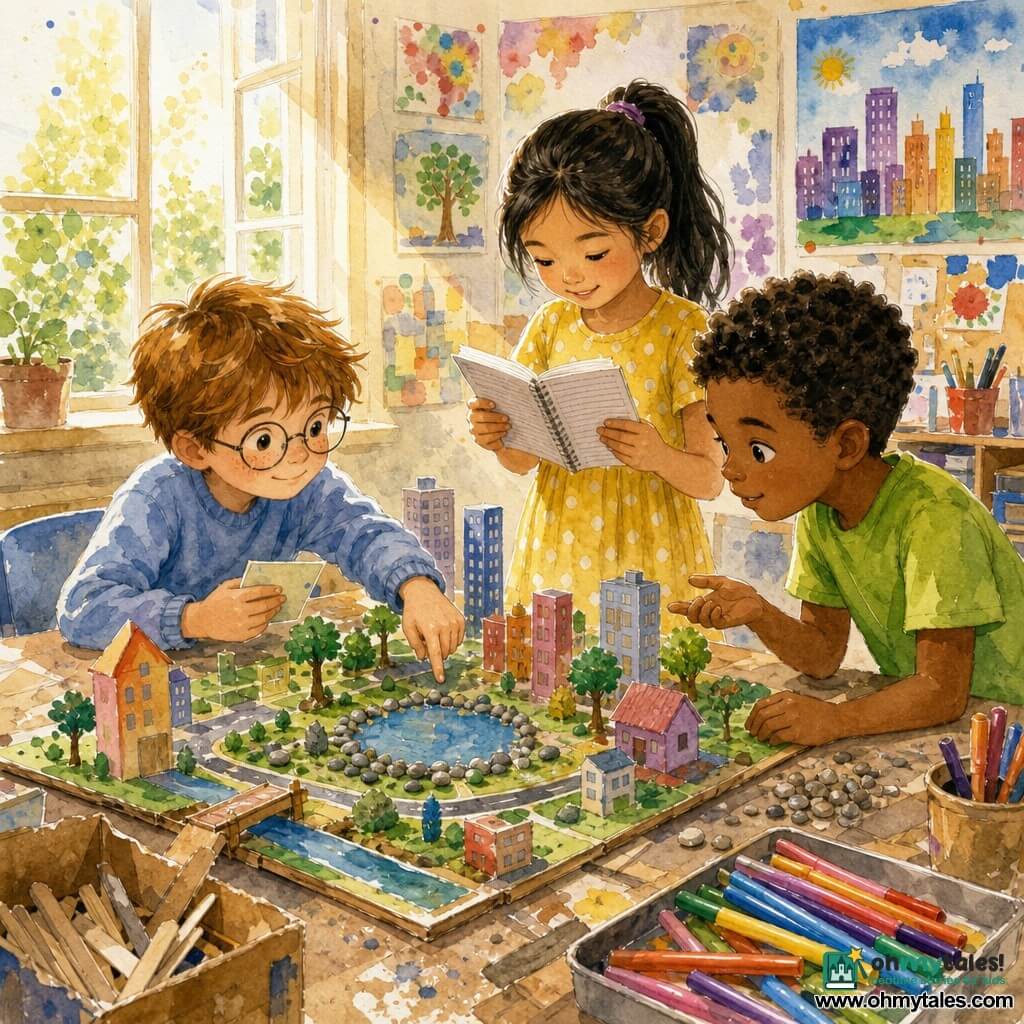
On the board, their teacher, Ms. Patel, had written: “Team Project Week: Build a Mini Town.” There were boxes of craft sticks, paper cups, tape, and markers on a table. Milo's eyes lit up. He loved making up stories about places. He could already imagine a little park with a tiny pond.
Ava leaned closer and whispered, “A town! We can make a bakery.”
Milo nodded. In his head, the town looked perfect. In real life, his fingers sometimes bumped into things like they were playing tag. He took a slow breath. Ms. Patel always said, “Slow is smart.”
Ms. Patel clapped once, gentle but clear. “You will work in pairs. You can choose tools that help you. You can take breaks. And you can ask for changes if you need them. That's called an accommodation, and it's a right.”
Milo liked how she said it. A right. Not a favor. Not a “maybe.” A right.
Ava and Milo picked a corner table near the window. Sunlight made warm squares on the tabletop. Milo ran his fingers along the edge of the tape roll. Smooth, then sticky. Sticky could be tricky.
They began by drawing a plan. Milo drew a park, very carefully. The lines wobbled a little, but the idea was strong. Ava drew a bakery with a big window.
Milo reached for the ruler to make a straight road. His elbow nudged the cup of markers. They tipped like dominoes. Markers rolled everywhere, clicking and clacking.
For a moment, Milo's face felt hot. Then he saw Ms. Patel's eyes. She did not look annoyed. She looked ready to help.
Ava laughed softly. “Markers are doing a parade.”
Milo smiled, because that was exactly what it looked like. He gathered the markers one by one, slower, using two hands. The floor was cool under his knees, and the plastic caps felt bumpy in his palm.
Ms. Patel came over. “Do you want a marker tray so they don't roll?”
Milo nodded. “Yes, please.”
She placed a shallow tray on their table. It had a low edge, like a tiny fence. The markers stayed put. Milo's shoulders loosened.
Ava tapped the plan with her pencil. “We can do this step by step,” she said.
Milo liked that. Step by step felt like a friendly path.
Chapter 2
The next day, they started building. The classroom buzzed with quiet talk and the snip-snip of scissors. Milo chose the thick scissors with the soft handles. Ms. Patel kept different tools in a big bin. There were grip pencils, a slanted writing board, and even putty to hold paper still.
Milo tried cutting a rectangle for the bakery door. The paper shifted. His cut went crooked. The door looked like it was leaning in the wind.
Ava held it up. “Our bakery is super welcoming,” she said. “Even the door is waving hello.”
Milo chuckled. He could feel the worry in his chest get smaller. He tried again, but this time he used a trick. He put a strip of tape under the paper to stick it to the table. The paper stayed still. His scissors moved better.
Ms. Patel nodded from across the room, as if she had noticed his strategy. That made Milo feel proud, like he had found a key.
Later, they needed to glue craft sticks into a bench for the park. Glue could be messy. Milo squeezed too hard and a blob came out, like a white snail.
“Oh no,” Milo murmured.
Ava pointed. “That snail wants a home.”
Milo grabbed a cotton swab from the supply cup and scooped the extra glue away. He had learned that cotton swabs were good for tiny fixes. He also learned that wiping right away made everything easier.
He looked at the bench. It was not perfect, but it was strong. Strong was important.
At lunchtime, Milo and Ava sat together. Milo opened his lunchbox slowly. The zipper sometimes got stuck. Ava waited without rushing him. The cafeteria smelled like pizza and apples. Chairs scraped and kids laughed.
A boy from their class, Jayden, walked by. He was eight too, with a quick grin. He glanced at Milo's hands and the slow zipper.
Milo felt that hot face feeling again, but then Jayden said, “Hey, can I sit? My table is super noisy.”
“Sure,” Ava said.
Jayden sat and sighed in a silly, dramatic way. “My ears are tired,” he joked. “They need a nap.”
Milo smiled. He liked how Jayden said what he needed. Like it was normal.
Jayden leaned closer. “Your mini town is going to be cool. I saw your park sketch.”
Milo's chest warmed. “Thanks,” he said.
After lunch, back in class, Ms. Patel announced a small change. “Tomorrow, we will share our towns with the class. You can choose how you share. You can talk, point, or have a partner read your notes.”
Milo liked choices. Choices were like handrails on stairs.
That afternoon, Milo wrote short notes about their town. Writing could be tiring for him, so he used a grip pencil. It made his fingers feel steadier. He wrote in short bursts, then shook his hands out, like he was flicking water off them.
Ava watched. “Your notes are clear,” she said.
Milo nodded. Clear was his goal.
As they worked, Milo remembered the word dyspraxia again. It was part of him, but it did not define his whole day. He had ideas. He had patience. And he had tools.
He looked at their mini park. The pond was a blue circle of paper. Around it, Milo placed tiny “stones” made from gray beads. He did it with tweezers, very slowly, and it worked. His fingers felt like they were learning a careful dance.
Ava clapped quietly. “Look at that! Pebbles!”
Milo grinned. “It's my favorite part.”
Chapter 3
On sharing day, Milo woke up early. Outside, the air smelled like wet grass. Inside, he packed his backpack and checked it twice. He liked checking things twice. It made his mind feel calm.
In class, their mini town sat on a tray so it would not slide. That was Ms. Patel's idea. Milo liked the tray. It was like a safe road for their town.
When it was their turn, Milo's stomach fluttered, but not in a scary way. More like little butterflies doing a gentle loop.
Ava stood beside him. “We can do this together,” she whispered.
Milo held his note card. Ms. Patel smiled at him, steady and kind.
Ava began, reading the first line. Then Milo pointed to different parts as she spoke. Pointing felt easier than talking a lot. His arm moved slowly, but it reached the bakery, the park, the pond, the bench.
Jayden raised his hand. “Can I ask a question?”
Ms. Patel nodded.
Jayden asked, “How did you make the tiny stones?”
Milo swallowed, then answered in a small voice. “Tweezers,” he said. “And I went slow.”
Jayden nodded seriously, like this was wise. “Slow is smart,” he repeated.
Some kids giggled, but it was friendly. Milo felt tall inside, even though he was not tall outside.
After the sharing, Ms. Patel had everyone sit in a circle. The carpet was soft and a little scratchy, like it wanted to tickle your knees. She held up a poster with big, simple words: “Different Brains, Different Strengths.”
“We all learn in different ways,” she said. “Some people need more time. Some need quiet. Some need to move. Everyone deserves what helps them do their best. That's part of fairness.”
Milo liked that: fairness was not everyone getting the same thing. Fairness was everyone getting what they needed.
Ms. Patel asked, “What did you notice this week?”
Hands went up.
Ava said, “Planning first helped us.”
Jayden said, “Using trays kept stuff from rolling away.”
Another kid said, “Breaks helped me think.”
Ms. Patel looked at Milo. “Would you like to add something?”
Milo felt the butterflies again. He remembered how his hands sometimes bumped things. He also remembered the tape trick, the cotton swab, the tweezers, the tray, and Ava waiting without rushing.
He said, “My hands are like… a puppy on a leash.”
The class went quiet, listening.
Milo continued, “A puppy is happy and wants to go fast. But it needs time and a good path. If I go step by step, my puppy-hands can do great work.”
A few kids smiled. Jayden made a tiny “woof” sound under his breath, and Milo almost laughed out loud.
Ms. Patel nodded. “That is a wonderful metaphor. Thank you, Milo.”
After circle time, Ava and Milo carried their town to the display shelf. Milo held the tray with both hands. Ava walked beside him, close enough to help, but not grabbing. That felt respectful.
At recess, the sky was bright. The playground smelled like warm plastic and dust. Milo and Ava sat on a bench for a minute, watching kids run.
Ava bumped her shoulder gently into his. “Next week, we should make a mini zoo,” she said.
Milo pictured tiny animals. He pictured his careful puppy-hands placing them one by one. He felt calm, like a smooth stone in his pocket.
Jayden ran over, breathy from playing. “If you make a zoo, I want to build the snack stand,” he said. “A snack stand is very important.”
Ava laughed. “Very important.”
Milo looked at both of them. “Okay,” he said. “But we'll need a tray for the snacks.”
Jayden saluted like a soldier. “Tray captain reporting for duty.”
They all giggled, and the sound felt light, like a kite in the air.
As the bell rang, Milo stood up. He knew there would be days when his puppy-hands tugged and bumped again. But now he also knew there were paths, tools, and people who understood. He had the right to ask for what helped. He had ideas that mattered.
Ava held out her pinky finger. Milo hooked his pinky with hers, a small promise.
“Friends?” Ava asked.
“Friends,” Milo said.
Jayden held out his pinky too, grinning. “Team friends.”
Their pinkies linked for a moment, and Milo felt sure of something simple and strong: they would keep building, together.