Chapter 1: The Boy Who Drew Games
Milo was seven years old, and he liked to make things that worked. He made paper kites that did not crash. He made tiny boats from corks that did not tip. And most of all, he made games.
Not the kind that made people trip or bump into chairs. Milo did not like that. He liked games that felt safe, like a blanket fort. Games that made everyone laugh and still keep their knees happy.
One sunny afternoon, Milo sat at the kitchen table with a pencil and a notebook. On the page he drew a big circle. Inside it he drew swirls and dots.
“This one is called Treasure Twirl,” he whispered to himself. He drew a path with soft turns, not sharp corners. He added a rule in neat letters: “No pushing. One at a time. Cheer for the next player.”
His little sister peeked at the page. She pointed at a drawing of a shark with a smile. “That shark looks like it wants a cookie,” she said.
Milo laughed. “It's a friendly shark. In my game, the sharks are the helpers.”
Just then, a gentle tap came at the window. Milo looked up. A sea breeze had somehow slipped into the room, smelling like salt and sun-warmed shells.
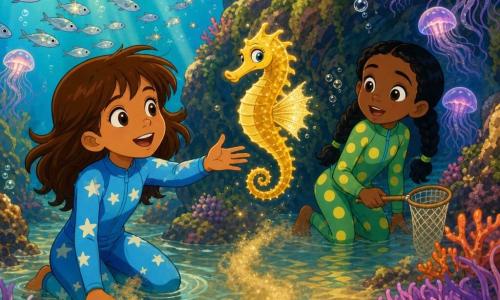
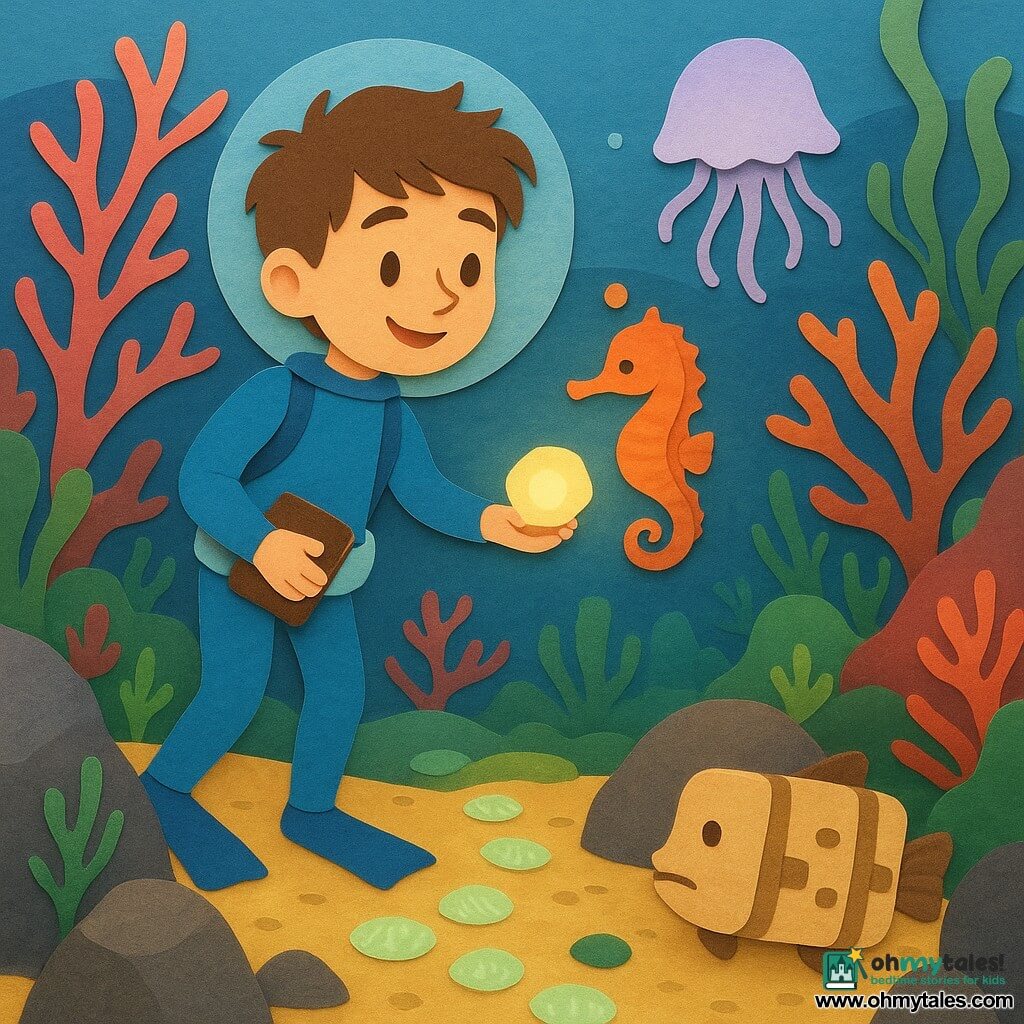
On the windowsill sat a very small seahorse. It wore a tiny belt with a shiny buckle. The seahorse blinked slowly, as if it had all the time in the world.
Milo blinked back. “How did you get here?”
The seahorse leaned close to the glass. A tiny bubble floated from its mouth, and inside the bubble were words, clear as writing on a page:
PLEASE INVENT A SAFE GAME FOR THE REEF FESTIVAL.
Milo's mouth fell open, then he closed it and took a calm breath. Milo felt brave, but he also liked to think first. That was his best kind of courage.
He opened the window just a little. The seahorse did not wiggle in a slippery way. It sat politely, like a guest.
The bubble words popped, and a new bubble appeared:
I AM PIP. THE REEF NEEDS YOU.
Milo looked at his notebook. A safe game for the reef? Under the sea? His heart did a small hop.
“I want to help,” Milo said. He spoke softly, like you speak in a library. “But I can't breathe underwater.”
Pip's eyes sparkled. He lifted his tiny belt buckle. It flashed like a coin in the sun. Another bubble floated up:
BORROW THE BUBBLE BELT. IT MAKES A BREATHING BUBBLE. ALSO, IT TICKLES A LITTLE.
Milo smiled. A belt that tickled sounded like the kind of trouble he could handle.
He slipped on his swim shorts, tucked his notebook into a waterproof pouch, and followed Pip outside. They walked to the beach where the water shimmered like a sheet of blue glass.
Milo wrapped the belt around his waist. The buckle clicked. A clear bubble rose around his head like a round helmet.
He took a careful breath. The air tasted clean, like morning.
“Okay,” Milo said, steady and bright. “Let's invent the safest game the sea has ever seen.”
And with Pip guiding him, Milo stepped into the water. The world turned quiet and blue, and the adventure began.
Chapter 2: The Hall of Strange Creatures
Under the sea, everything moved like a slow dance. Sunlight spilled down in wiggly lines. The sand below was pale gold, dotted with tiny tracks.
Milo swam with small kicks, keeping his arms close. He remembered safety rules, even in a magical bubble. No wild flapping. No rushing.
Pip floated beside him, swishing his tail like a ribbon.
Soon, they reached a place where coral rose in towers and arches. It looked like an underwater city made of living stone. Fish zipped through windows of coral like little colorful arrows.
A crab with a shell painted like a ladybug marched by. It lifted one claw in a greeting, then hurried on.
Milo's eyes grew wide. “So many creatures,” he whispered.
They entered an open space shaped like a big bowl. Around it, sea plants waved like soft flags. In the middle stood a platform made of smooth rock. A sign made from driftwood was tied to a coral branch.
It read: REEF FESTIVAL PLANNING.
A group of sea creatures waited there, and they were the strangest, friendliest crowd Milo had ever seen.
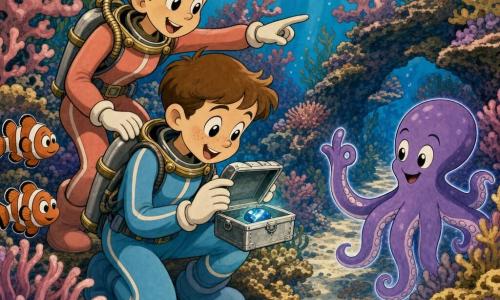
An octopus wore a hat made of seaweed. Every time it blinked, its skin changed color, like a mood ring. A flat fish lay on one side, smiling as if it knew a silly joke. A long eel peeked from a coral hole, wearing what looked like a tiny scarf.
And there, hovering near the platform, was a jellyfish that glowed soft purple. It glided with gentle grace, like a floating lamp.
Pip swam forward and did a small bow. The creatures all turned their eyes to Milo. Milo felt their attention, but he did not feel scared. Their faces looked curious, not sharp.
The octopus lifted two tentacles, as if it were clapping slowly. “Welcome,” it said in a voice that sounded like bubbles popping. It spoke real words, and Milo's bubble helmet somehow let him understand.
Milo tried not to stare at all eight arms. He failed a little, but in a polite way.
“My name is Milo,” he said. He remembered to speak clearly, not too loud. “Pip told me you need a safe game.”
The jellyfish drifted closer. Its glow brightened like a nightlight. “We do,” it said. “Last year, our game was ‘Chase the Fast Fish.' It was exciting, but too many tails got tired.”
The flat fish sighed. “And someone bumped the snack seaweed.”
The eel poked its head out farther. “No one likes a bumped snack.”
Milo nodded. “A game should be fun, not ouchy.”
The octopus changed color to sunny yellow. “Exactly! We want a game for everyone. Tiny shrimp. Slow turtles. Bouncy dolphins. Even shy sea cucumbers.”
Milo pulled out his notebook. The paper inside stayed dry. He held it close and looked around the bowl-shaped space.
He saw coral branches that could be gentle gates. He saw smooth stones that could be markers. He saw long kelp that could be soft ropes.
Milo began to imagine.
“Can I ask questions?” he said.
Pip nodded so hard his snout wiggled.
Milo pointed to the platform. “Do you have a place where players can rest?”
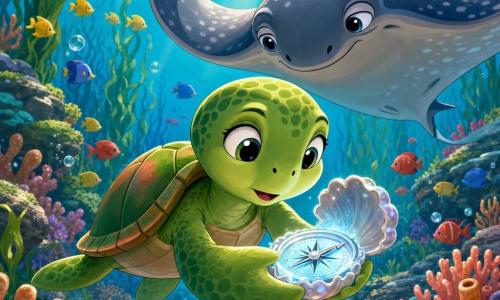
A turtle paddled in from behind a coral tower. It was old, with kind eyes. It had a little patch of moss on its shell like a green cap.
“Rest is important,” the turtle said. “We have calm corners. We call them Quiet Coves.”
Milo liked that. Quiet Coves sounded like they were made for careful thinking.
He pointed to a patch of sandy ground. “And what about the smallest creatures? Do they need to stay near the bottom?”
A shrimp popped up from the sand and waved. “We do! Also, we are good at hiding.”
Milo smiled. “Hiding can be part of a game, as long as everyone knows the rules.”
The octopus leaned in. “We like rules,” it said. “Rules keep games fair.”
Milo's pencil scratched lightly as he wrote: SAFE, FAIR, REST SPOTS, NO BUMPING, EVERYONE INCLUDED.
Then he looked up at the glowing jellyfish. “What do you wish the game felt like?”
The jellyfish drifted in a slow circle. “Like wonder,” it said. “Like we are exploring, not racing.”
Milo felt a warm spark in his chest. Exploring. That sounded like him.
He drew a new circle on his page. A gentle path. Soft stops. Friendly helpers.
He did not have the whole game yet, but he had the heart of it.
And then the water around them dimmed a little, as if a cloud passed above the sea.
From behind a coral arch, something very odd floated into view.
It was a fish that looked like a suitcase.
Not a scary suitcase. A silly one. It had a boxy body and a little latch-like mouth. It bumped into a rock with a quiet thunk, then spun around as if it was confused.
The eel blinked. “Oh dear,” it said. “That's a Trunkfish. They mean well, but they get lost in their own corners.”
The trunkfish tried to turn, but its stiff shape made it clumsy. It drifted toward the planning sign, wobbling like a toy.
Milo watched carefully. A safe game would need to help creatures like that too.
He wrote one more note: MAKE IT SAFE FOR CLUMSY FRIENDS.
Then Milo took a calming breath inside his bubble helmet.
“Let's test ideas,” he said. “We'll invent with our eyes open.”
Chapter 3: The Lost Lantern Maze
The octopus led Milo and Pip through a coral hallway into a wide area filled with tall rocks. Between the rocks grew sea fans that looked like lace. Tiny fish hid in the lace like confetti.
“This is where we used to play Chase the Fast Fish,” the octopus said. “Too twisty. Too quick.”
Milo floated slowly, studying the space. He pictured players racing and bumping and getting tired. Then he pictured something else.
He pulled out his notebook and drew lantern shapes.
“I think the game should guide you,” Milo said, “not push you.”
The turtle nodded. “Like a trail.”
Milo's pencil moved in small, quick lines. “We can use glow things,” he said, looking at the jellyfish. “Soft lights. Like little signs that say ‘This way is safe.'”
The jellyfish glowed a little brighter. “We can help,” it said. “Our light is gentle.”
The flat fish yawned in a dramatic way. “As long as the light does not point at my face while I'm napping.”
Milo giggled. “No face-pointing. Deal.”
Pip zipped forward and returned with a cluster of tiny glowing shells. They shone pale green, like mint candy.
“We call these moon shells,” Pip said. “They glow when you tap them.”
Milo's eyes lit up. “Perfect!”
He had an idea for a game now, but it needed a problem to solve. All good inventions did. They were like puzzles that turned into fun.
As they placed moon shells in a gentle path, the trunkfish from earlier drifted by again. It bumped a rock, then bumped it again, as if the rock had moved and was being rude.
The trunkfish made a small grumbling sound. It did not seem angry. More like puzzled.
Milo swam closer and held his hands out, palms open, to show he was calm. “Hi,” he said softly. “Do you need help?”
The trunkfish tried to turn toward him but got stuck between two rocks.
Pip whispered, “They get wedged sometimes.”
Milo looked at the rocks. There was space, but not enough for a boxy body to twist.
He remembered a trick from moving furniture at home: don't force it; change the angle.
Milo swam above the trunkfish and tapped one moon shell twice. It glowed brighter. Then he tapped another shell a little to the side, making a new glow point.
He spoke gently. “Follow the light,” he said. “Small moves. One bump is enough.”
The trunkfish blinked. It turned a little toward the brighter shell. It wobbled, then slid out of the tight spot. It was free.
The trunkfish's latch-mouth opened and closed, like a quiet thank you.
The octopus changed color to proud purple. “You solved it without rushing,” it said.
Milo felt happy, but he stayed focused. “A safe game should have light paths,” he said, “and also help stations.”
He drew a small symbol: a shell with a circle around it.
“What is that?” asked the shrimp, popping up.
“It means a Pause Point,” Milo said. “A place where you stop and rest. Or where a helper can guide you.”
They kept placing moon shells. Milo chose wide turns and open spaces. He marked Quiet Coves near sea plants that waved softly.
Then something else happened, something small but important.
A line of tiny sea slugs, bright as jelly beans, began to crawl right across the path.
They were so colorful that Milo almost forgot to blink. One was blue with yellow dots. One was pink with white stripes. One looked like it was wearing a frilly skirt.
The turtle chuckled. “Sea slugs always travel together.”
The octopus leaned close. “If players rush, they might bother the slugs.”
Milo nodded. Here was another safety puzzle. How could a game stay fun and still respect the sea?
Milo tapped a moon shell near the slug line. It glowed. He tapped two more shells in a gentle curve around them.
“A detour,” Milo said. “The path can bend. The game can change without breaking.”
The jellyfish floated above the slugs, glowing softly like a little crossing light. The slugs kept moving, calm and steady, like a tiny parade.
Milo watched them with admiration. They were not fast, but they were determined. They were resilient in their slow way.
Milo wrote in his notebook: RESPECT ALL CREATURES. LET THE GAME BEND.
When the last slug had passed, Milo tapped the shells again and returned the path to normal.
The octopus nodded. “This is good thinking.”
Milo finally named the game out loud, tasting the words like candy. “We'll call it The Lantern Maze.”
The eel's scarf fluttered. “A maze sounds tricky.”
Milo shook his head. “Not a scary maze. A friendly maze. It guides you with light. It has Pause Points. It has Quiet Coves. And it has helpers.”
Pip twirled. “I can be a helper!”
The trunkfish drifted closer and bumped a moon shell gently, making it glow. It seemed pleased with itself.
Milo smiled. “Even the clumsy friends can help,” he said.
They tested the path. The turtle tried it slowly. The shrimp tried it with quick little hops. The flat fish slid along the sand with a proud wiggle.
Each time, the lantern shells gave clear, gentle clues. Each time, the players had space. No rushing. No bumping. Just exploring.
Milo's heart felt as bright as the shells.
Still, one last thing mattered to Milo more than all the glowing lights.
A safe game needed one more rule.
A kindness rule.
Chapter 4: The Reef Festival Handshake
The day of the Reef Festival arrived, and the whole coral city seemed to sparkle. Streamers of seaweed waved from rock to rock. Bubbles rose like balloons. Fish swam in patterns that looked like dancing.
Milo hovered near the start of the Lantern Maze. His notebook was open to the final page.
At the top he had written, in big letters: RULES FOR A SAFE GAME.
Below it were simple rules, easy to remember:
1. One player at a time in narrow spots.
2. Follow the lantern shells. If you feel lost, find a Pause Point.
3. No pushing. No teasing. Cheer for everyone.
4. Detours are allowed. Sea life comes first.
5. If someone is tired, rest in a Quiet Cove.
And at the bottom, Milo had added the most important rule of all:
6. Start and end with a handshake.
Pip read it and tilted his head. “Why a handshake?”
Milo thought of all the times games had gone wrong on the playground because someone felt left out. He thought of how a handshake could say, We're in this together.
“It means,” Milo said, “we agree to play safely. We agree to be kind. And when we finish, we say thank you.”
Pip's eyes softened. “That is a good rule.”
The octopus floated up wearing a fresh seaweed hat, now decorated with tiny shells. “Everyone is ready,” it announced.
Creatures gathered at the start. There were small ones and big ones. Fast ones and slow ones. The sea slugs even came, lined up neatly, like they were the judges of good behavior.
The jellyfish glowed at the first lantern shell. The trunkfish stood near a Pause Point, ready to guide anyone who wobbled. It looked very serious, like a boxy lighthouse.
Milo felt a flutter in his belly. Not fear, just excitement. He was proud, but he also wanted the game to truly work for everyone.
The turtle came first. It placed a flipper gently against Milo's hand.
Milo took the flipper carefully, making sure not to squeeze too hard. The turtle's skin felt like smooth rubber, warm with life.
They shook once, calm and steady.
Then the turtle began. It followed the lantern shells, stopping at each Pause Point. It rested in a Quiet Cove and smiled at the sea plants waving like slow fans.
When the turtle reached the end, it looked brighter than before, as if joy had polished its shell.
Next came the shrimp, then a small school of fish who played as a team, taking turns like a careful relay. Each time someone reached a slug crossing, the detour shells lit up, and everyone nodded as if the sea itself was part of the game.
There were tiny mistakes, but they were gentle mistakes. Someone turned too early and found a Pause Point right away. Someone got distracted by a starfish doing a slow wave, and then remembered the lantern path.
Each time, a helper guided them with kindness.
Milo watched, learning even now. That was part of being creative too. You invent, you test, you adjust.
At last, the octopus swam the maze. It changed colors in the lantern light, like a moving rainbow. When it finished, it floated back to Milo.
The octopus held out a tentacle.
Milo reached out. He wrapped his small hand around the soft tip. It felt a little like holding a wet glove, but friendlier.
They shook once.
The octopus's eyes crinkled with happiness. “Your game is safe,” it said. “And it is full of wonder.”
Milo's cheeks warmed. “Thank you for helping me make it,” he said. “I couldn't have invented it without your ideas.”
The jellyfish drifted close, glowing like a bedtime lamp. “You were brave to come,” it said. “And wise to listen.”
Pip zipped around Milo's head in happy circles. “And you didn't even complain when the belt tickled!”
Milo laughed. “I almost did.”
The festival ended with a calm, joyful feeling. Creatures rested in Quiet Coves. The moon shells dimmed to a soft glow, like stars tucked into the sand.
Milo knew it was time to go home. He felt a tug in his chest, the kind you feel when you leave a place you will remember.
He swam to the edge of the coral bowl where Pip waited.
Pip held out his tiny fin.
Milo offered his hand, careful and steady.
They shook.
It was a simple thing, a small squeeze and a small promise.
Then Milo returned the bubble belt. The water carried him upward, light as a floating leaf. He rose to the surface where the sky was pink and gold.
On the beach, Milo sat for a moment and listened to the waves. In his notebook, he wrote one last line:
CREATIVITY IS MAKING SOMETHING NEW, AND MAKING IT KIND.
He closed the notebook, feeling brave and thoughtful at the same time.
And far below, the Lantern Maze glowed softly, guiding the reef in gentle, sparkling turns.