Part One: The Straight Path
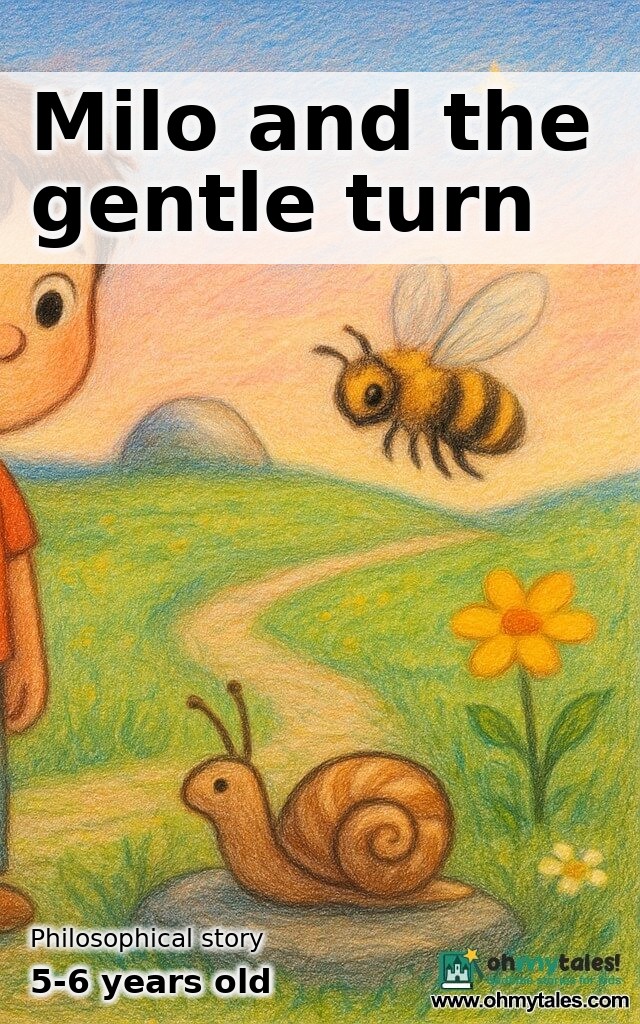
Milo was five, and he walked like a little arrow. He liked lines that did not wiggle. He liked socks that matched. He liked counting his steps because numbers felt like tiny pebbles in his pocket, smooth and sure.
Behind his house there was a path made of pale stones. It ran straight through a meadow and aimed toward a low hill. Milo called it the Straight Path. It felt honest. It did not whisper secrets. It simply went on.
In Milo's world, grown-ups loved short reasons.
“Hold hands so you don't fall.”
“Eat soup so you grow.”
“Sleep early so tomorrow is kind.”
They were modest truths, like small lamps that light only the next step. Milo liked them. He carried them in his head the way a snail carries its house.
One evening, when the sky was strawberry pink and the wind smelled like warm grass, Milo walked the Straight Path alone, very carefully. He was not running away. He was just practicing being brave in a quiet way.
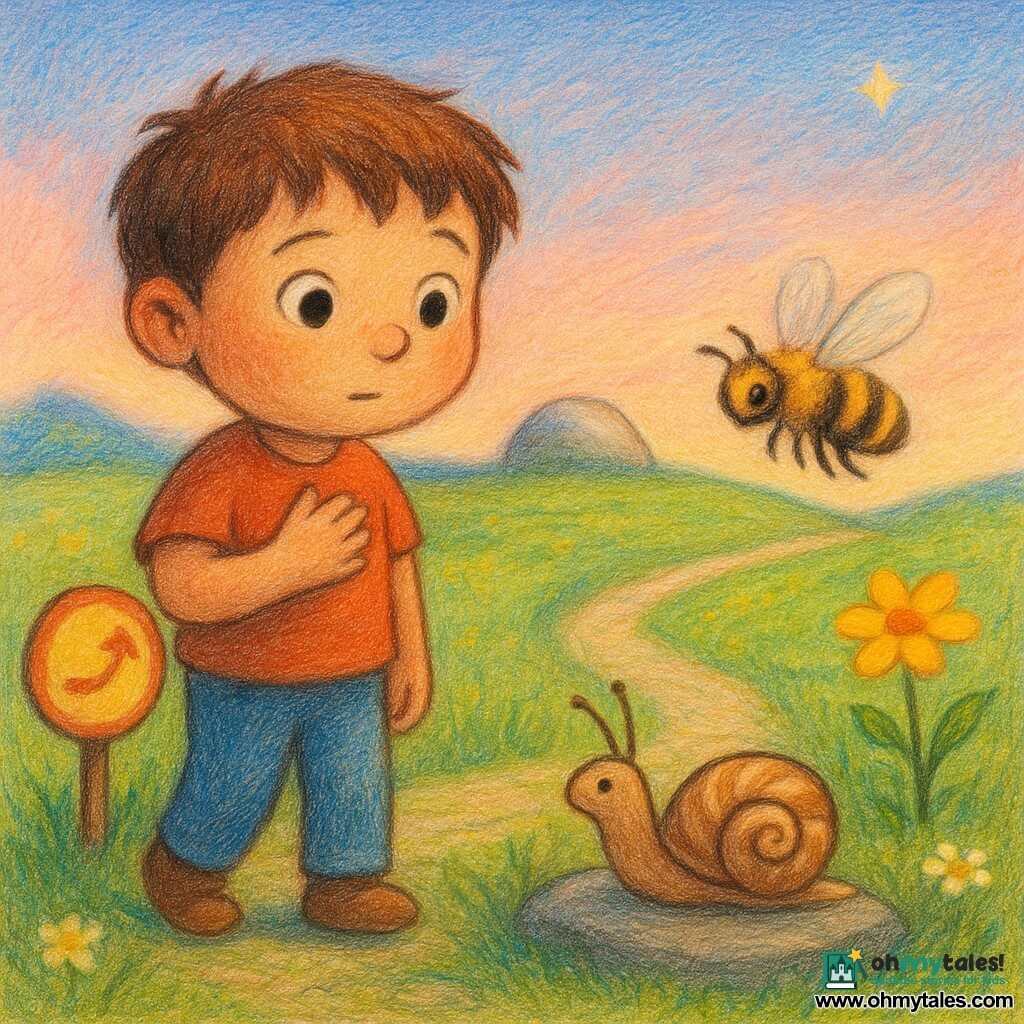
He found something odd right in the middle of the stones: a sign the size of a dinner plate, stuck into the ground. On it, someone had painted a simple picture. It showed the Straight Path. Then, beside it, it showed a turn, like a bent elbow. Above the turn was a small star.
Milo looked up. There was no star yet. The sun was still awake. But the picture felt like a question placed on the ground.
Milo had a thought that was round, not straight.
“When do you change your way?”
He did not know who had left the sign. Perhaps the wind. Perhaps a patient bird. Perhaps the hill itself, bored of being looked at from only one angle.
Milo walked on, but the sign stayed in his mind like a soft pebble in his shoe. Not painful. Just there, reminding him.
Along the meadow, he saw simple, sensible things. A daisy did not try to be a rose. A small ant carried a crumb and did not complain about its size. Everything seemed to say, “Do what you can, and do it kindly.”
Milo liked that. Still, the question sat beside his heart.
When he reached the low hill, he found a stone shaped like a loaf of bread. On it someone had carved a tiny line, straight as Milo's favorite path. Beside it, someone had carved a tiny curve, like a smile.
Milo touched the curved line. It felt warm from the sun, and it made him think of laughing. He did not know why.
On the hilltop, he could see far. The meadow was a green blanket. The Straight Path was a white stitch. And, just to the side, there was another way he had never noticed before. It was thinner, half-hidden by tall grass, like a shy ribbon.
Milo stood very still. The world did not shout. It waited.
He decided, for today, to go back the Straight Path. He was not ready yet. But he took a good look at the shy ribbon path, so it would not feel lonely.
As he walked home, the sky turned to blueberry. A small star appeared, as if someone had turned on a tiny lantern.
Milo remembered the sign with the star above the turn.
The star did not tell him what to do. It only blinked, like an eye that says, “I see you thinking.”
Part Two: The Ribbon of Grass
The next day, Milo woke with a small twist inside him, like a curled leaf. It was not a bad feeling. It was a wondering feeling.
At breakfast, his spoon clinked softly in his bowl. The sound felt like a little bell saying, “Today.”
Milo went to the meadow again. The Straight Path waited, as always. Straight things are very patient. They never hurry. They believe you will come.
But Milo also saw the shy ribbon path. In the morning light, it looked less shy. It sparkled with dew. Dew is like the meadow's jewelry, tiny beads that disappear when the sun laughs.
Milo took three steps onto the Straight Path, just to be polite.
Then he stopped.
He tried to decide like a grown-up: short reasons, modest truths.
“If I stay straight, I won't get lost.”
“If I turn, I might find something new.”
His thoughts lined up like toy blocks. But then they fell over, because his heart added another block.
“If I turn, I must be gentle.”
Milo looked at the tall grass. It waved as if it was saying hello. He took one step onto the ribbon path.
It felt different. The ground was softer. It was like walking on a whispered sentence. The Straight Path had been a clear word. This new way was a quiet song.
Soon, the ribbon path made a tiny bend. Not a big turn, just a polite curve around a puddle. The puddle was a small mirror. In it, Milo saw the sky upside down. It made him giggle. The sky looked silly that way, like it was trying to do a handstand.
Milo continued. The grass brushed his knees. He imagined he was a small boat and the grass was a green sea. He imagined his courage was a sail. Not a huge sail, just enough to catch a breeze.
Then came a mini-surprise.
The ribbon path split into two small lines. One line went toward a cluster of bushes with red berries. The other went toward a patch of yellow flowers.
Milo stopped again. Two choices felt bigger than one. He held his hands together like a tiny judge.
He tried the modest truths again.
“Berries can be tasty.”
“Flowers can be pretty.”
Neither truth helped.
So he watched. He watched like a cat watches a moving string, slow and careful. A bee bumbled toward the yellow flowers, wearing its fuzzy coat like a brave little worker. A bird hopped near the berry bushes, eyeing the red dots like bright buttons.
Milo thought, “They are both good.”
He also thought, “Maybe life is like that. Two good ways, and you can choose one without being unkind to the other.”
He chose the yellow flowers. Not because they were better. Just because the bee had made them look friendly.
The flowers nodded in the wind. Their yellow heads were like small suns that did not burn. Milo walked between them, and they painted his legs with soft pollen dust, like invisible glitter.
And then, on a flat stone, he saw something lying there.
It was a tiny snail on its back. Its shell was a little house, striped like a cinnamon roll. Its feet waved in the air, slow as sleepy curtains.
Milo knelt down. The snail looked helpless, but not dramatic. It was simply stuck.
Milo knew a short reason for helping: “If I can, I should.”
He slid his finger under the snail gently, as gently as if he was lifting a bubble. He turned it over onto the damp ground.
The snail began to move, leaving a silver line behind. The line shimmered in the sun like a thin promise.
Milo smiled. He did not need the snail to say thank you. Kindness does not always use words. Sometimes it is just a quiet fix.
He kept walking, and the ribbon path led him to a small place with a single tree.
The tree was not tall. It was not famous. It had ordinary leaves and a few apples still small and hard. But under the tree was shade as cool as a cup of water.
Milo sat down. He listened.
He heard wind. He heard a faraway dog. He heard his own breathing, coming and going like a calm tide.
Milo thought about the Straight Path. It was safe. It was clean. It was certain.
He thought about the ribbon path. It was not certain, but it was alive. It had mirrors of puddles and forks of choice and snails needing help.
He touched the grass and whispered in his mind, “What is the meaning of walking?”
The tree did not answer with a sentence. It answered with a simple thing: an apple leaf fell and landed on Milo's knee.
The leaf was shaped like a small boat.
Milo understood in his five-year-old way. Meaning might not be a big word. Meaning might be small, like helping a snail, or choosing with a kind heart.
And then he noticed something else.
The ribbon path did not stay ribbon-thin. It slowly curved back, like a friend returning. Far ahead, it seemed to meet the Straight Path again.
Milo laughed softly. “Even turns can lead home,” he thought.
Part Three: The Chosen Turn
The sun began to slide lower, like a sleepy coin slipping into a pocket. Milo stood up. He brushed grass from his knees. He looked at the two ways now visible: the ribbon path curving toward the Straight Path, and another little opening in the grass that curved away toward the hill.
The hill waited like yesterday's thought.
Milo's chest felt warm and busy. He knew he could go home the easy way by following the ribbon path back to the Straight Path. He also knew he could make a bigger choice and go toward the hill, where the loaf-shaped stone and the carved smile waited.
This felt like the real question the sign had asked.
“When do you change your way?”
Milo considered his small truths.
“Going home is good.”
“Exploring is good.”
“Being kind is best.”
He placed his hand on his belly, where brave feelings sometimes hide. He remembered the snail. He remembered the bee. He remembered the upside-down sky.
He decided that changing your way is not about being bored. It is not about running from what is straight. It is about listening for the moment when kindness needs you, or when your heart grows curious in a gentle, safe way.
Milo chose the turn toward the hill.
The grass grew taller. It tickled him like soft feathers. A cloud passed over the sun, and for a moment the world became quiet and gray, as if it was holding its breath. Milo felt a tiny pinch of worry.
Then the cloud moved on. Light returned, golden and friendly. The pinch melted. The world seemed to say, “A little shadow is normal. Keep going.”
When Milo reached the hill, he found the bread-shaped stone again. The carved straight line and the carved smile were still there. Milo traced both with his finger.
He thought, “Straight is good. Curved is good. A smile is a curve.”
At the top, the wind greeted him like a big soft dog, not jumping, just leaning in. Milo looked down and saw the meadow, the paths, the bush, the flower patch, the tree.
He saw that the Straight Path was still strong and clear. It did not look angry that Milo had turned away. It simply existed, like a reliable friend.
He saw the ribbon path too, making its gentle curves. It looked like it was drawing a picture on the meadow, showing that the world could be both simple and surprising.
Above him, the first star appeared again. Right on time, like a tiny night nurse checking in.
Milo sat on the hill and made his choice feel solid inside him, the way you press sand in a bucket to make a good castle.
He told himself, without speaking out loud, “I will walk straight when straight is kind. I will turn when turning helps, or when my heart needs to learn. I can decide. I can be gentle.”
The star blinked. It did not clap. Stars do not clap. They just shine, as if they are proud in a quiet way.
Milo went down the hill and followed the curve that led back toward home. On the way, he saw the snail's silver trail on a stone, still shining faintly. It looked like a little necklace left behind.
When he reached the Straight Path again, he stepped onto it with respect, like stepping onto a familiar rug. He was not the same as yesterday. He was still Milo, still an arrow-boy who liked neat socks and counting steps. But now he also carried a soft curve inside him.
At home, the windows glowed like honey. Milo's bed waited, warm and simple. The world felt safe again, but not small.
As he fell asleep, he imagined the paths as two friends holding hands: one straight, one curvy, walking together under the star.
And in his sleepy mind, he understood a bedtime truth, modest and bright:
Life is not only about staying on one line. Life is also about choosing with kindness, and being brave enough to make a gentle turn.