Part 1: The Cardboard Clock
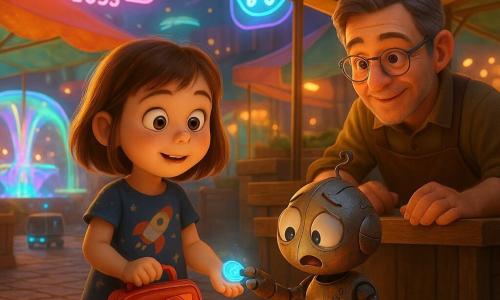
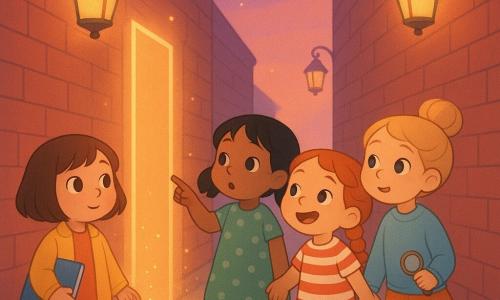
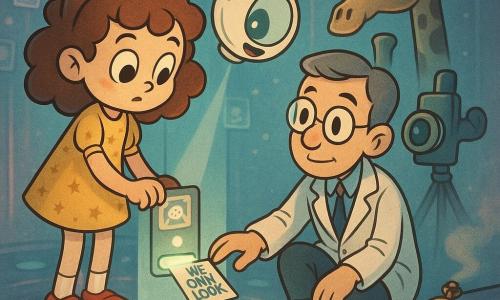
Mia was six years old, and she loved two things more than pancakes: building and asking “What if?”
Her room was a happy mess of tape, string, bottle caps, and bright paper. On her desk sat a shoebox with a round paper clock on top. The hands were made from two spoons.
Mia tapped the clock face. “If time is like a river,” she said, “then maybe I can ride it.”
Her grandma laughed softly from the doorway. “Time is a river, yes. But rivers have rules. You can't splash other people's boats.”
“I won't!” Mia promised. “I will be careful as a kitten.”
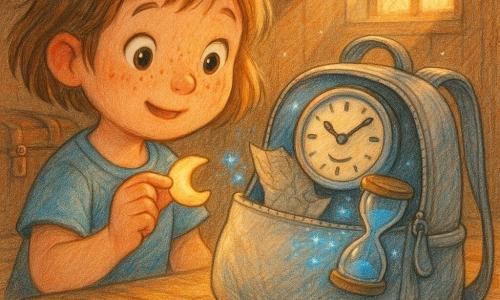
Grandma came in and set down a small tin box. It made a gentle clink. “This is for your memory things,” she said. “Ticket stubs, little notes, buttons… Anything that helps you remember.”
Mia opened it. Inside was a tiny brass compass, a blue ribbon, and a folded paper that said, in neat writing: REMEMBER WHERE YOU BELONG.
Mia hugged the tin box. “I will.”
She turned back to her shoebox machine. She had added a bicycle bell, because every good machine should have a “ding.” She had added a flashlight, because exploring without light felt silly. And she had added Grandma's old kitchen timer, because timers always sounded serious.
Mia pressed a bottle-cap button she had painted green.
Nothing happened.
Mia frowned. “Hmm. It needs… a spark!”
She looked around and spotted her glow stickers—little stars that shone at night. She stuck three stars on the machine, right by the clock.
Then she whispered, “Please work. I have a plan.”
She set the kitchen timer to five minutes and said, “Rule One: I come back when the timer rings. Rule Two: I don't take big stuff. Rule Three: I don't change things that don't need changing.”
Grandma peeked in again. “What are you doing, Mia?”
“Science,” Mia said, very calmly, like a captain.
Grandma raised an eyebrow. “Then take your memory box. If you go anywhere, you should leave a breadcrumb of remembering.”
Mia slipped the tin box into her backpack. She took a notebook and a pencil too. On the first page she wrote, in big letters: TIME TRIP NOTES.
Mia climbed into the shoebox machine. It did not fit her whole body, so she sat behind it and held it like a steering wheel.
She rang the bicycle bell. “Ding!”
She turned the spoon-hands to twelve.
The glow stars shimmered. The flashlight blinked. The kitchen timer ticked louder.
And then—whoosh!—the air felt fizzy, like soda in her nose.
Mia squeezed her eyes shut.
When she opened them, she was not in her room.
She was standing on wooden boards that smelled like wet sun and old rope. Seagulls cried above her. Water slapped against posts. Boats bobbed and creaked.
A river port.
Mia gasped. “It worked.”
A man in a cap walked by carrying a basket of shiny fish. He blinked at Mia. “You lost, little miss?”
Mia remembered Grandma's rule about not splashing other people's boats. She smiled politely. “I'm… visiting.”
The man chuckled. “Well, you picked a lively day. Watch your toes. Carts roll fast.”
Mia stepped aside as a cart rattled past, pulled by a sturdy horse. She stared at the horse's warm brown eyes.
“Hello,” she whispered. The horse snorted like it was saying, Hello back.
Mia opened her notebook. “Time Trip One: River port. Smells: fish and wood. Sounds: gulls and wheels.”
She touched her backpack to make sure her tin memory box was still there.
It was.
The kitchen timer in her backpack ticked. Mia felt brave.
Then she noticed something odd.
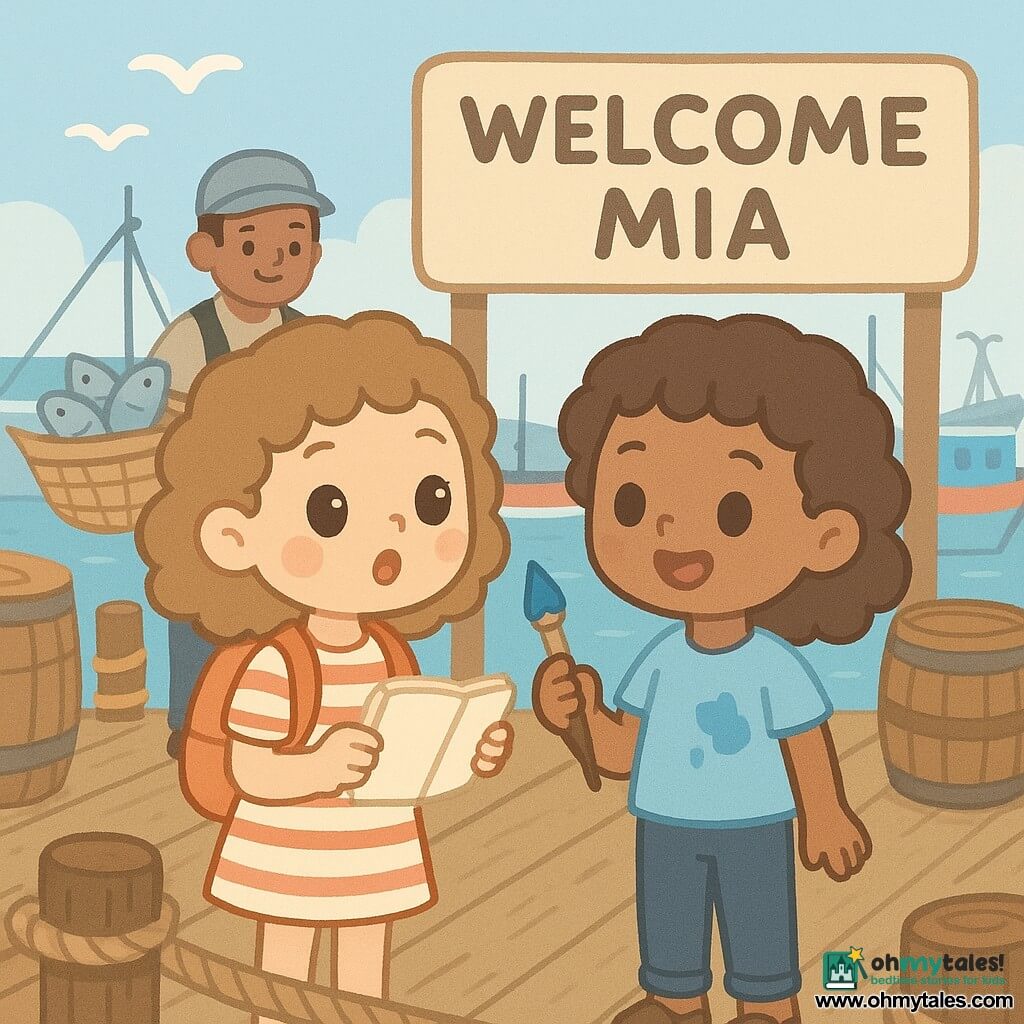
On a post near the water, someone had nailed a sign. It was painted in chunky letters.
WELCOME, MIA.
Mia's mouth fell open. “How does it know my name?”
The river wind fluttered the sign as if it were waving.
Mia took one slow step closer. A little paper corner peeked from behind the sign, like it was hiding.
Mia reached out and pulled it free.
It was a note, folded small.
She unfolded it carefully.
It said: DO NOT MEET YOURSELF.
Mia's eyes grew round as buttons. “Meet myself? Why would I—”
Behind her, a child's voice called, “Hey! That's my sign!”
Mia turned.
And there, on the dock, was a little girl who looked just like Mia—same curly hair, same dimple, same bright eyes.
The other Mia held a paintbrush. Blue paint dotted her fingers.
Mia squeaked, “Oh no.”
The other Mia squinted. “Who are you?”
Mia's kitchen timer ticked faster in her ears. She remembered the note.
DO NOT MEET YOURSELF.
But she already had.
Part 2: The Mischief of Time
Mia backed up so fast she nearly bumped into a barrel. “I—um—my name is… Nia,” she blurted.
“Nia?” the other Mia said. “That's almost Mia.”
Mia nodded too hard. “Yes! Almost. Like… a cousin.”
The other Mia stared. “I don't have a cousin.”
Mia tried a new smile, the kind you use when you spill juice. “Maybe you do in the future.”
The other Mia's eyes sparkled. “Future? Are you from the future?”
Mia's heart thumped. She wanted to tell the truth. But the rule was clear: don't meet yourself, and don't make the river splash.
“I'm just visiting,” Mia said again.
The other Mia pointed at Mia's backpack. “What's in there?”
“Sandwich,” Mia said quickly.
“Show me!”
Mia hugged her backpack. “No, thank you.”
A bell clanged somewhere. Men called out. “Boat coming in! Clear the dock!”
The other Mia grabbed Mia's hand. “Come on! You can watch with me!”
Mia's hand felt warm in the other Mia's hand. It also felt strange, like holding your own mitten.
They stepped back as a long boat slid in. It had barrels, baskets, and a big rolled-up sail. People cheered, and someone tossed an apple. It bounced once and rolled toward the edge.
Mia saw it heading for the water.
Without thinking, she dashed forward and snatched the apple.
“Nice catch!” the other Mia shouted.
Mia froze. Had she changed something? Maybe the apple was supposed to fall.
Then a boy ran up, panting. “My apple! I dropped it!”
Mia held it out. “Here you go.”
The boy grabbed it and grinned. “Thanks! I was going to cry.”
He ran off.
Mia let out a quiet breath. “Okay. That felt… helpful. Not splashy.”
The other Mia giggled. “You're fast, Nia.”
Mia looked around, trying to find a safe way to leave. The river port was busy, but the air felt friendly. Still, meeting herself felt like standing between two mirrors.
“Listen,” Mia said softly, “I have to go soon.”
“Wait!” the other Mia said. “If you're from the future, tell me something. One thing!”
Mia's cheeks warmed. She didn't want to break time. But she also didn't want to be rude.
She looked down at the other Mia's paintbrush. “You like painting,” Mia said carefully.
The other Mia blinked. “I do!”
“That won't change anything,” Mia told herself.
The other Mia beamed. “Then I will paint the biggest sign ever!”
Mia's eyes flicked to the WELCOME, MIA sign. “Maybe… not the biggest.”
The other Mia tilted her head. “Why?”
Mia pulled the folded note from her pocket, then thought better of it. She did not show it.
“Because,” Mia said, picking her words like small stones, “some surprises are better when they stay surprises.”
The other Mia made a face. “That sounds like a grandma saying.”
Mia almost laughed. “Yes. It does.”
A new sound rose from Mia's backpack.
BEEP! BEEP! BEEP!
The kitchen timer.
Mia jolted. “That's my… sandwich alarm!”
The other Mia laughed so hard she snorted. “Sandwich alarm! Silly!”
Mia stepped back. “I have to go now. Goodbye!”
“Wait—” the other Mia reached out, and her paintbrush flicked.
A tiny dot of blue paint landed on Mia's notebook.
Mia looked down. A neat blue circle stained the page.
It was small. It was harmless.
But it was new.
Mia's stomach fluttered. “Is that a splash?”
The other Mia waved. “Bye, Nia!”
Mia clutched her notebook and whispered, “Rule One: come back when the timer rings.”
She turned the spoon-hands on her shoebox clock.
The air fizzed again.
Whoosh!
The dock, the gulls, the blue paint smell—all swirled like a page turning.
Mia landed with a soft thump… on another dock.
This one looked different.
The boards were smoother. There were no horses. A shiny metal crane stood tall. A loud motorboat hummed by, leaving white foam.
Mia blinked. “Another time.”
A sign nearby read: RIVER PORT FESTIVAL — 1952.
Mia stared at the numbers. “Nineteen… fifty-two,” she whispered, sounding them out.
A woman in a polka-dot dress walked past holding a paper cup. “Lemonade! Cold lemonade!”
Mia's mouth watered.
She kept one hand on her backpack and one on her notebook.
The blue dot was still there.
Mia opened the tin memory box and took out the brass compass. The needle wiggled, then settled.
Mia smiled a little. “It remembers north, even when time changes.”
She walked along the port, watching people dance to music from a crackly radio. Children ran with balloons. Someone tossed popcorn into the air and caught it with their mouth.
Mia laughed. “That looks hard.”
She found a quiet spot by a stack of crates. She wrote in her notebook:
TIME TRIP TWO: 1952. Sounds: music, motorboat. Smell: lemonade.
Then she noticed something that made her heart hop.
On a wall, there was a poster.
A bright poster with a painted girl holding a paintbrush.
And the words: MIA'S PORT PARTY! TODAY!
Mia swallowed. “Oh… that sign got bigger.”
A man nearby said, “You coming to the party, kid?”
Mia forced a small smile. “Maybe later.”
She hugged her backpack. The tiny blue paint dot suddenly felt heavier than a rock.
Had she started a whole tradition by accident?
Mia remembered Grandma's tin box. Memory was good. But this felt like a trail she didn't mean to make.
She sat on a crate and thought hard.
“If I panic,” she whispered, “I might splash more.”
She took a breath in. She let it out.
Then she had an idea.
“Time is a river,” Mia said. “Rivers carry things. But I can choose what I throw in.”
She opened her notebook to the blue dot and drew a circle around it with her pencil.
Under it she wrote: A SMALL ACCIDENT. NOT A BIG CHANGE.
She nodded, like a scientist agreeing with herself.
A little boy ran by and tripped. His balloon slipped from his hand.
It floated up, up, up.
The boy's eyes filled with tears. “My balloon!”
Mia stood. She could help. Helping was not splashy, right?
She grabbed a loose string from a crate, tied it to a small hook, and, with a careful jump, snagged the balloon ribbon as it dipped.
She handed it back. “Here!”
The boy's face lit up. “You saved it! Thank you!”
Mia felt warm inside. “You're welcome.”
The man with the lemonade smiled. “You're a good helper.”
Mia held her notebook close. “I'm trying.”
And then, from deep in her backpack, a new sound started.
A gentle tick-tick-tick.
Another timer?
Mia frowned and pulled out the tin memory box. It was not ticking.
The sound came from her shoebox clock.
It was glowing.
The spoon-hands were turning by themselves, slowly, like they were searching.
Mia's eyes widened. “Oh! The machine is… choosing.”
The hands stopped at a number.
1960.
Mia gulped. “Next stop?”
Whoosh!
Part 3: The Remembering Dock
Mia arrived at the river port again, but now there were tall buildings in the distance. Cars honked. People wore bright shirts. A sign said: 1960.
Mia looked around and saw something familiar right away.
A little bench near the water.
On it sat an older lady with silver hair, a soft sweater, and a calm smile.
Mia's breath caught. “Grandma?”
Grandma turned her head slowly, as if she had been expecting the river to speak.
She looked at Mia and said, very gently, “Hello, Mia.”
Mia's knees wobbled. She walked closer. “You know me?”
Grandma patted the bench. “Sit, little time-traveler.”
Mia sat. The wood was warm from the sun.
Grandma took out a tin box from her bag. The same kind as Mia's.
Mia whispered, “You have one too.”
Grandma opened it. Inside was a brass compass… a blue ribbon… and a small notebook page with a blue dot.
Mia stared. “That's… my dot.”
Grandma nodded. “A tiny splash can become a tiny story. But a tiny story is not always a problem.”
Mia's eyes filled a bit. “Did I mess up time?”
Grandma smiled kindly. “You made a festival poster and a painting tradition at the port. People liked it. It made them happy. That's not a mess.”
“But the note said, ‘Do not meet yourself,'” Mia said.
Grandma leaned in. “And you learned why. It makes your head spin, doesn't it?”
Mia nodded fast. “Yes. Like two mirrors.”
Grandma chuckled. “Time rules are there to keep you steady. Not to scare you.”
Mia looked down at her shoes. “I tried to be careful.”
“You were careful,” Grandma said. “You also helped a boy with an apple, and another with a balloon. Helping is a good kind of ripple.”
Mia chewed her lip. “But what about memory?”
Grandma tapped the tin box. “Memory is how we carry the best parts of the past without dragging the whole past behind us. We keep what matters. Kindness. Lessons. Love.”
Mia hugged her backpack. “I brought my box.”
“Good,” Grandma said. “Now, tell me. What did you notice at the ports?”
Mia brightened, glad to share. “The smells changed. The boats changed. The music changed. But the river stayed. It kept going.”
Grandma nodded. “And so do you. You change, but you stay you.”
Mia looked at Grandma's tin box again. “How did you get my blue dot?”
Grandma's eyes twinkled. “Because I remembered it. And because you wrote it down. Writing is a gentle anchor.”
Mia smiled. “An anchor! Like boats.”
“Yes,” Grandma said. “A memory anchor.”
Mia's shoebox clock in her backpack began to beep again. Not loud. Just firm.
Mia's shoulders drooped. “Time to go back?”
Grandma reached out and squeezed Mia's hand. “Back to your agreed moment. Rule One.”
Mia nodded. She stood up and faced the river. It glittered like a long, silver ribbon.
“I'm still a little worried,” Mia admitted.
Grandma pointed to the water. “Look. The river carries leaves, little sticks, and sometimes a bright balloon. It does not stop. But it also does not forget where it is going.”
Mia took a deep breath. “Okay.”
Grandma handed Mia something small.
A folded note.
Mia opened it.
It said: REMEMBER WHERE YOU BELONG.
Mia's throat felt tight, but in a cozy way. “That was in my box.”
Grandma smiled. “Then it is in mine, too.”
Mia tucked the note into her notebook next to the blue dot.
“I will go now,” Mia said.
Grandma nodded. “When you're back, tell your present-day grandma what you learned.”
“I will,” Mia promised.
Mia turned the spoon-hands to twelve again.
“Goodbye!” she called.
Grandma waved. “Goodbye, brave Mia. And remember—small ripples, kind ripples.”
Whoosh!
The world fizzed and folded.
Mia blinked and found herself sitting on her bedroom floor, the shoebox machine in front of her, the glow stars dim now like sleepy fireflies.
The kitchen timer on her desk rang out its last little trill.
Mia grabbed her notebook and flipped it open.
The blue dot was there.
The note was there.
Her time trip notes were there, in her own handwriting.
Mia hugged her tin memory box to her chest. “It wasn't a dream,” she whispered.
Grandma knocked and came in. “Tea time,” she said. Then she paused. “You look like you've been on an adventure.”
Mia smiled, wide and bright. “I have.”
Grandma sat on the bed. “Tell me.”
Mia climbed up beside her and began, “First I went to a river port with horses, and I met someone who looked like me—”
Grandma lifted a finger. “Ah. Mirrors.”
Mia nodded. “Yes. But I tried to be careful. And I learned that memory is like an anchor.”
Grandma's eyes softened. “That's a good lesson.”
Mia opened her tin box and placed the blue ribbon inside very neatly. Then she added her notebook page with the blue dot, carefully folded.
She closed the lid with a gentle click.
Mia looked at the shoebox machine and patted it once. “No more trips today,” she said. “Time needs rest.”
Grandma laughed softly. “And so do little explorers.”
Mia leaned her head on Grandma's shoulder. Outside, the evening light slid across the window like a slow, kind river.
Mia felt safe in the present, with her memories held close, like treasures that did not weigh her down at all.