Chapter 1: The Neat Notebook
Maya liked to be ready.
Not “ready” like a cookie left on a plate for later (though that was nice too). She liked to be ready like her boots lined up by the door, like her phone charged, like her hair tied back with the same blue band every time.
Maya was a volunteer firefighter. That meant she had a regular job during the day, and when her town needed help, she put on her uniform and helped as part of a team. She didn't do it for fame. She did it because she cared, and because she believed courage could be calm.
Tonight, the fire station smelled like clean soap, rubber, and something a little like old books. Maya walked in with a small notebook tucked into her jacket pocket. The notebook had a red cover and a tiny sticker of a smiling ladder on the front.
On the first page she had written, in neat letters:
“Things to check. Things to replace. Things to learn.”
She went straight to the gear room. Helmets hung on hooks like sleepy turtles. Jackets waited on racks, thick and heavy, with bright stripes that caught the light. Gloves were paired like best friends.
Maya did her favorite part first: checking.
She looked at a jacket's shiny stripes. Still bright. She checked the clasp. Still strong. She turned a glove inside out and felt for any thin spots. Then she sniffed it. It smelled like… yesterday's smoke and today's soap.
She opened her notebook and wrote:
“Glove smell: okay. No holes.”
Maya's friend Jae, another volunteer, came in carrying a box. Jae always walked like he was trying not to wake up a sleeping cat.
“Evening,” he said softly.
“Evening,” Maya replied. She kept her voice gentle, like the station itself asked everyone to speak kindly.
Jae set the box down and peeked at Maya's notebook. “Still writing everything?”
Maya nodded. “If I don't write it, my brain tries to hold it all, and then it drops it like a slippery bar of soap.”
Jae chuckled. “That's a very clean problem.”
Maya smiled. “Exactly.”
She went to the big red engine. It was parked like a patient, friendly animal. Maya checked the side compartments, one by one. In each one, tools rested in special spots so everyone could find them fast: hoses, nozzles, lights, a first-aid kit, and a big yellow bag with straps.
She pointed her flashlight at the labels. Some were a little faded.
Maya wrote:
“Replace: two faded labels on compartment doors.”
Then she checked the batteries in the handheld light. It turned on, but the beam looked sleepy.
Maya wrote:
“Replace: batteries in light #3.”
Being methodical made Maya feel peaceful. Some people liked surprises. Maya liked lists.
She walked past the kitchen area where a kettle sat ready for tea. She liked that too: the idea that brave work could also include warm drinks.
On the wall was a poster with big letters:
“Stop. Think. Act.”
Maya read it every time. Stopping didn't mean freezing. It meant taking a tiny moment to choose the smartest next step.
She opened her notebook again and drew a small star. Under it she wrote:
“Remember: stop, think, act.”
The station was quiet. No sirens. No rushing. Just the soft hum of lights and the happy feeling of being prepared.
Maya put her notebook back in her pocket. She was about to help Jae with the box when a gentle beep sounded from the alert system.
Maya's phone buzzed too.
A call was coming.
Her calm courage sat up straight.
Chapter 2: The Beep and the Busy Minutes
The alert was not a scary wail. It was a clear signal that said, “Team, we are needed.” Maya took a deep breath, like she was smelling a flower and blowing out a candle.
She moved quickly, but she didn't bump into anything. Methodical didn't mean slow. It meant smart.
Maya pulled on her boots, then her thick pants, then her jacket. She clicked the clasps: one, two, three. She placed her helmet on her head and checked the strap.
Jae was already heading for the engine.
The message on the screen said: “Smoke from toaster. Apartment building. No fire seen.”
Maya felt relieved. A toaster problem was usually small and easy to solve, especially if everyone stayed calm.
The engine rolled out of the station with a rumble that felt like a big purr. Maya sat in her seat, hands folded for a second as she looked out at the streetlights.
The town at night looked like it was tucking itself in. A cat crossed the road like it owned the place. Somewhere, a window glowed with a nightlight.
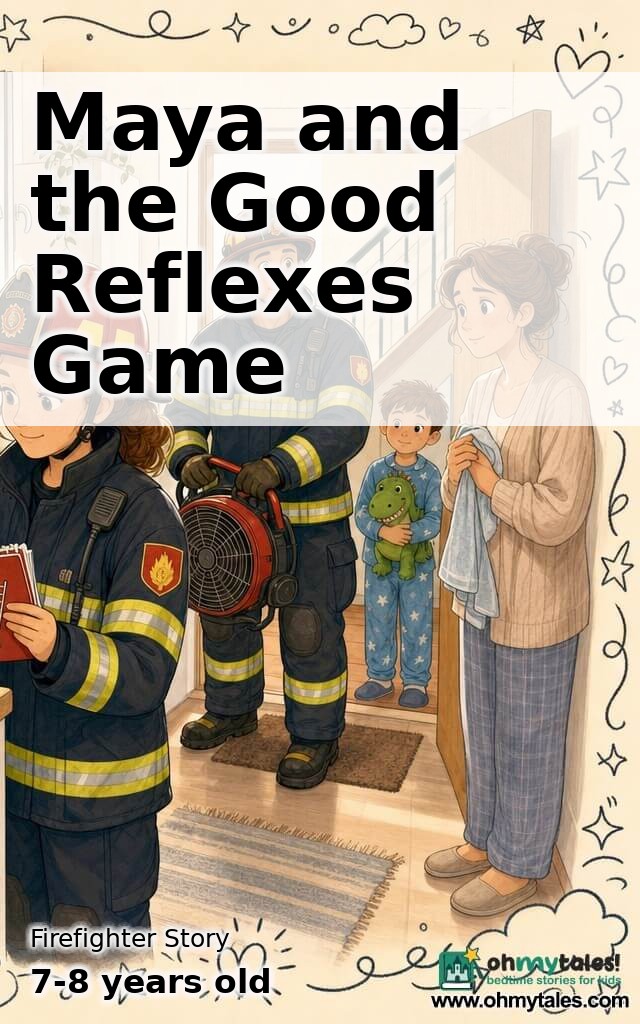
When they arrived, the apartment building was quiet. A few people stood outside in pajamas and slippers. Some held phones, and one kid clutched a stuffed dinosaur that looked very serious about safety.
Maya stepped out and gave her warmest, calmest smile. She spoke gently, using her “it's going to be okay” voice.
She walked up the stairs with her team. The hallway smelled like toast that had tried too hard.
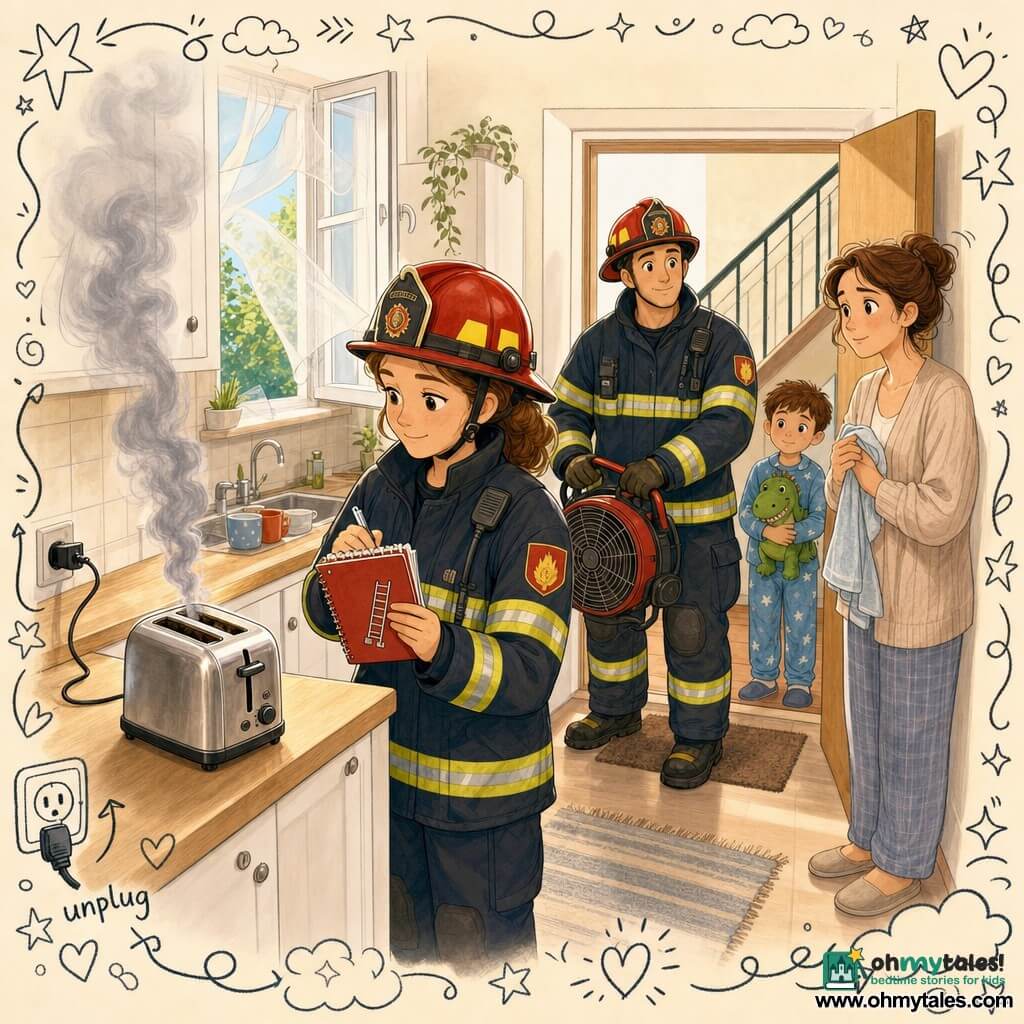
At the apartment door, a woman stood with wide eyes and a towel in her hands. “I think it's the toaster,” she said, and then quickly added, “I unplugged it!”
“Good job,” Maya said. “Unplugging is a smart first step.”
Inside, the kitchen was a little cloudy, like someone had shaken a pillow made of burnt bread crumbs. No flames. Just smoke and a toaster that looked embarrassed.
Maya's team moved the toaster to a safe spot away from anything that could catch fire. Another firefighter opened a window. Cool air rushed in, and the smoke began to drift away, as if it had remembered an appointment somewhere else.
Maya looked around for hazards, the way she had been trained. She checked that the stove was off. She checked that no towels were near hot things. She noticed a small smoke alarm on the ceiling.
She pointed at it. “May I test your smoke alarm?”
The woman nodded.
Maya pressed the test button. The alarm beeped loudly, then quieted.
“Perfect,” Maya said. “It's working.”
The serious dinosaur kid peeked around the doorway. Maya waved softly. The kid waved back, then held the dinosaur up like it was also waving.
Maya went back into the hallway and met the building manager. They talked quietly about what happened and what to do next. It was simple: the toaster needed replacing, and the family would keep the window open for a while to clear the last of the smoke.
Before leaving, Maya remembered her notebook. She pulled it out and wrote quickly, even while standing.
“Call: toaster smoke. No flames.
Reminders:
- Unplug toaster if safe.
- Open windows for fresh air.
Equipment notes:
- Used one small fan (check later).
- Used spare batteries? No.”
She liked to write it down right away, because details could float away like smoke.
Downstairs, the pajamas-and-slippers crowd had relaxed. Someone even yawned. Maya loved that yawn. It meant, “Things are normal again.”
A neighbor asked, “Is it okay to go back in?”
“Yes,” Maya said, “as long as you smell normal air. If you still smell strong smoke, keep your windows open. And if anyone feels dizzy, tell an adult.”
The neighbor nodded, calmer now.
On the way back to the station, Maya watched the streetlights slip by. Her team chatted quietly. Someone joked that the toaster had tried to become a dragon.
Maya said, “It was a very small dragon. More like a lizard with crumbs.”
Jae laughed. “A crumb lizard.”
Maya wrote that too in her notebook, because it made her smile:
“New word: crumb lizard.”
When they arrived back at the station, the engine settled into its space. The quiet returned, like a blanket.
But the job wasn't over. Maya knew what came next.
After every call, they checked everything again.
Ready wasn't a one-time thing. It was a habit.
Chapter 3: Cleaning, Checking, and Kindness
Back in the gear room, Maya took off her helmet and set it in its spot. She hung her jacket on the rack, then went straight to the engine compartments.
Jae helped bring out the small fan they had used to push smoky air out of the kitchen window. It was not a huge fan, more like a sturdy box with a handle. It had done its job well, and now it needed care.
Maya checked the fan's cord. No cuts. She wiped the dust off the outside with a cloth. She checked the switch. It clicked the way it should.
Then she opened her notebook.
“Fan: cleaned. Works. Return to compartment.”
Maya went to the first-aid kit next. Even if they hadn't used it, she liked to check it. Bandages were stacked in neat rows like tiny pillows. The scissors were in place. The cold packs were still cold enough to feel like winter in a wrapper.
She wrote:
“First-aid kit: all stocked.”
Then she paused at the handheld light #3, the one with the sleepy beam.
Maya switched it on again. The light flickered like it was blinking.
“Yep,” she murmured.
She wrote:
“Replace: batteries in light #3 (AA).”
Maya didn't just write what to replace. She liked to write why, too, in kid-friendly words, because sometimes children visited the station and asked questions.
So she added:
“Reason: light must be bright so we can see clearly.”
Maya checked the hoses. Hoses were like long, strong snakes that carried water where it was needed. She ran her hand along a hose to feel for bumps or cracks. It felt smooth and sturdy.
“Hose good,” she whispered, then wrote it down.
She also checked the nozzles, the pieces that helped control the water. Some nozzles made a wide spray like rain. Some made a strong stream like a water cannon. Firefighters chose the best one for the job.
Maya wrote:
“Nozzles: clean and turn smoothly.”
Next were the breathing masks. Maya didn't need one tonight, because there were no flames and only a little smoke. But masks were important for bigger calls. Smoke could hurt lungs, and firefighters wanted to keep their bodies safe while they helped others.
Maya checked the straps and the clear face part.
“Mask: strap good. Face clear.”
She wrote:
“Reminder: clean mask after use so it stays clear.”
Then she looked at the labels on the compartment doors. Two were faded enough that they looked like they had been in the sun too long.
She wrote, underlined twice:
“Replace: compartment labels A and C (hard to read).”
Because in an emergency, nobody wanted to squint.
Maya's methodical checking had another purpose too. It was kindness. When the next volunteer arrived, they would trust the gear. When the next family needed help, the team would be ready.
In the kitchen, Jae put on the kettle.
Maya sat at the table with her notebook open. She made a small list called “To Do Tomorrow,” because the best sleep came from knowing the list existed and didn't have to live inside her head.
“To Do Tomorrow:
1) Buy AA batteries for light #3.
2) Order new labels A and C.
3) Check fan filter (again).”
Jae set two mugs on the table.
Maya blew gently on her tea. The warmth felt like a soft thank-you.
On the wall, the “Stop. Think. Act.” poster watched over them like a quiet coach.
Maya thought about the family with the toaster. She hoped the serious dinosaur kid was back in bed, dinosaur tucked under an arm, thinking, “We handled it.”
Maya didn't think firefighters were only brave in big fires. Sometimes bravery looked like unplugging a toaster. Sometimes it looked like opening a window. Sometimes it looked like asking for help.
And sometimes bravery looked like writing down “Buy batteries,” because future-you would be grateful.
Maya took another sip and felt her eyelids grow heavy, just a little. The station was calm, and the town was safe.
Then Maya had an idea.
Kids visited the station on school trips and asked, “What should we do if there's smoke?” They remembered better when it was a game.
A bedtime-safe game. A giggly game. A game that could live in their minds like a friendly flashlight.
Maya turned her notebook to a clean page and wrote:
“New game idea: Good Reflexes Game.”
Jae lifted an eyebrow. “What's that?”
Maya smiled. “A game to remember what to do. Want to test it?”
Jae nodded. “As long as the toaster dragon doesn't return.”
“It won't,” Maya said. “We sent it back to Crumb Land.”
Chapter 4: The Good Reflexes Game
Maya stood up and cleared a small space in the kitchen. She kept her voice low and soothing, because even games could be calm.
“This is how it works,” she said. “I say a situation. You choose the best reflex. No running needed. Just thinking.”
Jae sat at the table like a student who hoped there would be snacks.
Maya held her notebook like a quiz card.
“Situation one,” she said. “You smell smoke in your kitchen.”
Jae pretended to sniff the air. “I say, ‘Hello, smoke, please leave politely.'”
Maya gave him a patient look. Jae grinned. “Okay, okay. First reflex: stop and look. Find where it's coming from.”
“Good,” Maya said. She tapped the poster on the wall. “Stop. Think. Act.”
She wrote in her notebook, neat as ever:
“Game rule: Stop. Think. Act.”
Maya continued. “If you see a toaster making smoke but no flames, what's a safe reflex?”
Jae answered, “Unplug it if it's safe, and keep anything that can burn away from it.”
Maya nodded. “And tell an adult.”
“Right,” Jae added quickly.
Maya wrote:
“Reflex: Unplug if safe. Tell an adult. Keep space around it.”
“Situation two,” Maya said. “The smoke alarm beeps.”
Jae made a loud “BEEP! BEEP!” that was a little too joyful.
Maya laughed softly. “A little quieter, sleepy town.”
Jae whispered, “Beep.”
Maya said, “When it beeps, do we ignore it?”
“No,” Jae said. “We listen. We check. If there's smoke or fire, we get outside.”
“And what about hiding?” Maya asked.
Jae shook his head. “No hiding. Go out.”
Maya wrote:
“Reflex: Listen to alarm. Don't hide. Go outside.”
“Situation three,” Maya said. “There's a small fire in a pan.”
Jae's eyes widened. “Like a tiny campfire pancake?”
“Not tasty,” Maya said gently. “What's a safe reflex for a kid?”
Jae thought. “Get an adult right away. Don't carry the pan. Don't throw water if it's oil.”
Maya nodded, pleased. “Yes. Some fires need special care, and kids should get help fast.”
She wrote:
“Reflex: Get an adult. Don't carry hot pan. Get help.”
Maya flipped the page and drew three simple pictures: a hand stopping like a traffic sign, a thinking face, and a walking foot.
“Now the memory part,” she said. “This game needs a chant.”
Jae leaned forward. “A calm chant?”
“A calm chant,” Maya agreed.
She spoke slowly, like a bedtime poem:
“Stop your feet, think it through,
Act with care—ask for help too.”
Jae repeated it, and this time his voice sounded like he was reading a story to a sleepy kid.
Maya smiled. “Perfect.”
She added one more part, because she wanted the game to teach kindness, not just safety.
“Bonus reflex,” she said. “If you see someone scared, what do you do?”
Jae answered quickly. “You use a calm voice. You stay with them. You help them go outside.”
Maya wrote:
“Kind reflex: calm voice, stay together, help others.”
Maya looked down at her notebook. The page was full of neat lines and simple reminders. She could imagine teaching it to kids during a station visit. She could imagine a child whispering the chant in their bedroom, feeling safer.
Jae stood up and stretched. “So, we learned safety and poetry. That's a good night.”
Maya nodded. “And we replaced the toaster dragon with a game.”
Jae yawned. “Crumb Land will miss it.”
Maya closed her notebook gently. She placed it back in her pocket, where it felt like a small, steady heart.
Outside, the town was quiet. Inside, the station was ready again: gear checked, notes written, kindness practiced, and a new game born.
Maya turned off the kitchen light and walked toward the bunk room. Her steps were soft. Her mind was calm.
She whispered the chant one more time, just for herself, like a goodnight promise:
“Stop your feet, think it through,
Act with care—ask for help too.”
And with that, Maya—the methodical volunteer firefighter—rested, knowing that being prepared was a way of taking care of everyone, one careful note at a time.