Chapter 1: Dust, Sun, and a Promise
The morning sky over Red Mesa Station was the color of pale milk, and the sun was already warming the boards of the platform. Dust danced in tiny swirls near the track, as if the ground itself was practicing a two-step.
Mae Redding swung down from her mare, Juniper, with a soft thump. Mae was a cowgirl with a steady gaze and a kind mouth that smiled easily. Her hat was sun-faded, her boots were scuffed, and her shirt smelled faintly of saddle leather and soap. She liked simple things: a clean canteen, a well-tied knot, and doing a job the right way.
Today, Mae had one clear wish. She wanted to check the rails at the station.
Not because she was bored. Not because she wanted to show off. She wanted to check them because last week a freight car had bumped and rattled in a strange way, and Mae had noticed. Rails were like a long, metal road. If that road wasn't safe, people and supplies couldn't travel. And in the wide West, travel mattered.
Inside the small station office, the air smelled of paper and coffee. Mr. Lyle, the station agent, sat behind a desk that looked tired around the corners. His mustache twitched when he saw Mae, like it was trying not to smile too much.
“You're early, Mae,” he said.
Mae tipped her hat. “Rails don't check themselves.”
Mr. Lyle chuckled. “True enough. I was about to send someone down the line with a hammer. But if you're offering—”
“I am,” Mae said. She kept her voice light, but her heart felt strong and sure. “I'll walk the first stretch past the cottonwoods. Listen for hollow spots, look for loose spikes. Then I'll circle back before the noon train.”
Mr. Lyle slid a small pouch across the desk. “Spare spikes. And here's a rail hammer. Don't go trying to fix the whole world with it.”
Mae lifted the hammer. It felt solid in her hand, like a good idea. “No promises,” she said, and the mustache finally let the smile win.
Outside, Juniper snorted as if she approved of hammers and plans. Mae patted her neck, then started down the track on foot. The rails ran straight as a ruler into the distance, shining where the sun touched them. Far off, red cliffs rose like giant sleeping animals. A hawk circled above, drawing slow loops in the sky.
Mae's boots crunched on gravel beside the ties. She tapped the rail with the hammer—ting, ting—listening closely. Most taps sang out clear, like a bell. Mae breathed in warm air mixed with sage and dry grass and felt happy, the way she always did when she was doing something useful.
But then, after a bend near the cottonwoods, one tap sounded different.
Thonk.
Mae stopped. She tapped again. Thonk. Not bright. Not right.
Her eyebrows lifted. “Well now,” she murmured, and her smile turned thoughtful. Adventure, it seemed, had just stepped onto the track.
Chapter 2: The Odd Sound on the Line
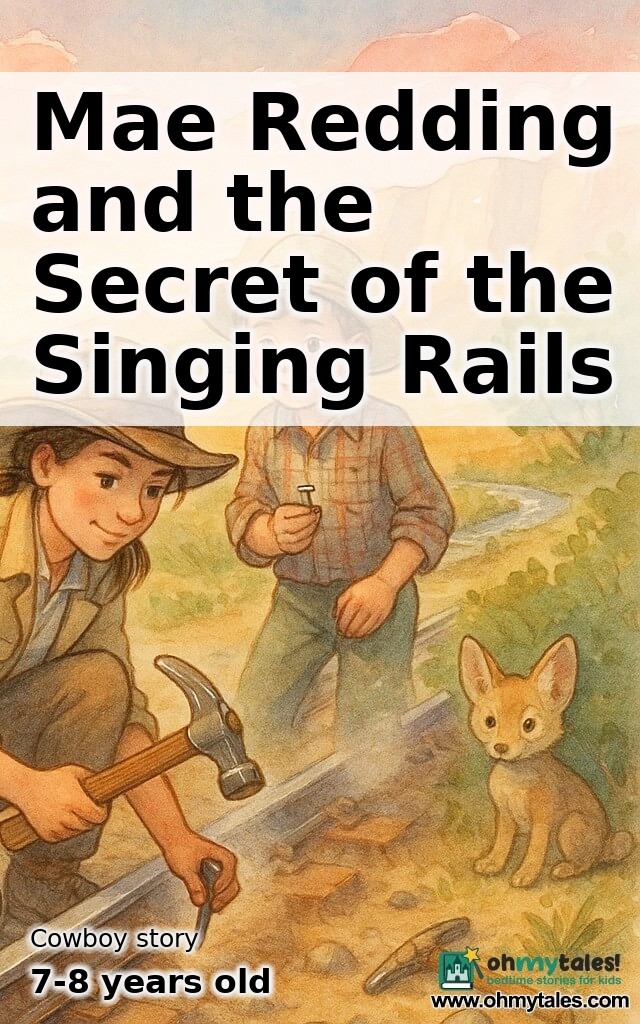
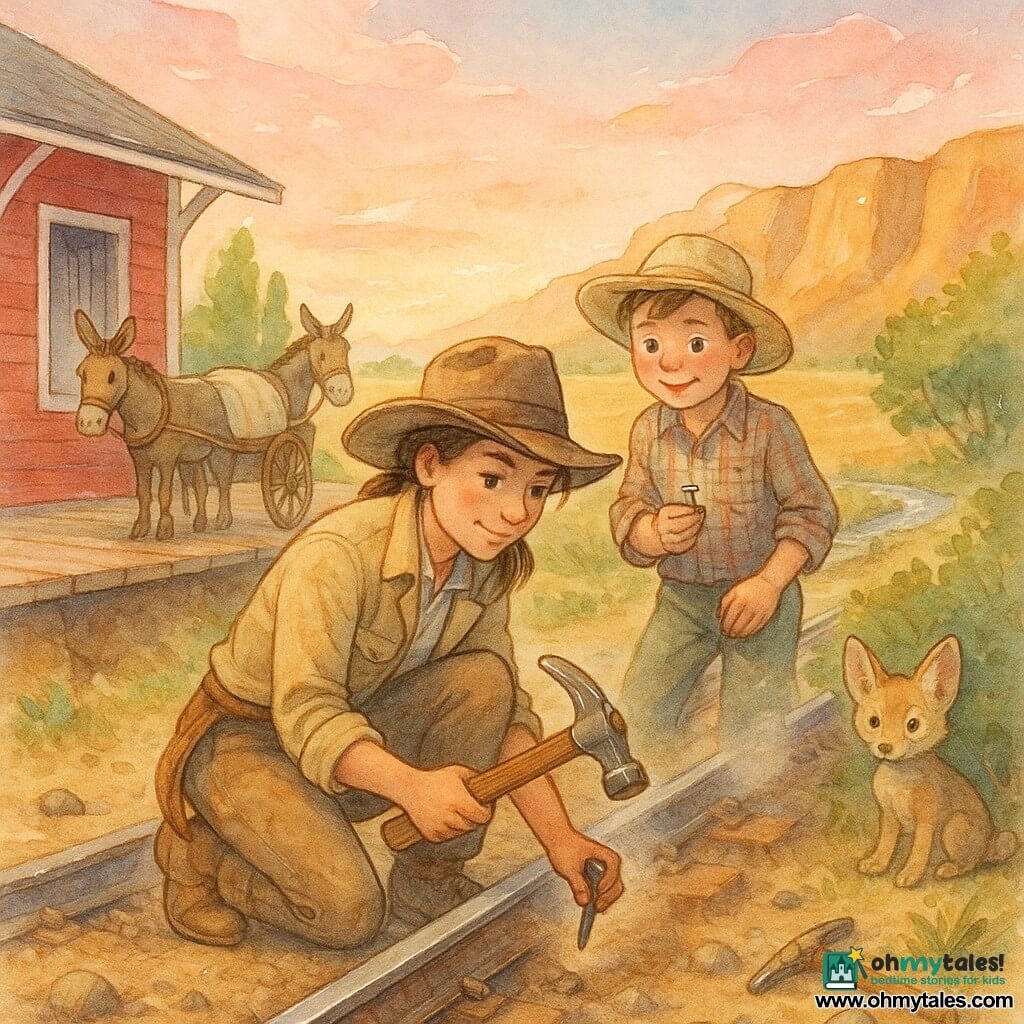
Mae crouched beside the rail. The metal looked fine at first, but when she leaned closer, she saw it: a spike that wasn't seated all the way down. It sat a little proud, like a tooth that didn't want to chew.
She ran her finger along it. The spike wiggled.
Mae sat back on her heels. Loose spikes could mean the rail had shifted. A shifted rail could make a train ride bumpy at best, and at worst… Mae didn't let her thoughts gallop too far. No need to borrow worry from tomorrow. Still, she felt her stomach tighten in a sensible way.
She checked the ties. One of them had a small crack, and a few stones were missing from the ballast. Something had been disturbed here.
Mae stood and scanned the area. Cottonwood leaves fluttered, shining green and silver. The creek nearby made a quiet gurgling sound. Everything looked peaceful.
Then she noticed tracks in the dirt. Not horse tracks. Not wagon tracks. Small, quick marks. And beside them, a thin line in the dust, as if something had been dragged.
Mae followed the marks a short way off the track. Behind a clump of brush, she found the cause: a round rock about as big as a melon, sitting where it didn't belong. The dragged line led right back toward the rails.
Mae let out a small laugh, relieved. “A rock. That's your big secret?”
But rocks didn't move themselves. Not usually.
She looked up—and spotted a pair of bright eyes watching her from the shade. A small coyote pup, all legs and curiosity, froze like it had been caught in a silly act. Its ears were too big for its head, and its tail swished as if it was trying to sweep the dust into a neat pile.
The pup took one step back. Mae stayed still. Coyotes could be shy, and Mae didn't want to scare it. The pup glanced toward the rock, then toward Mae, then sneezed.
Mae kept her voice soft. “You didn't mean trouble, did you? Just playing.”
The pup's nose twitched. It didn't look scary. It looked like a creature that had learned the world by bumping into it.
Mae's eyes traveled over the brush and creek bank. Maybe the pup had been digging, rolling rocks, making a game of pushing things downhill. A game that had nearly become a problem.
Mae's courage wasn't the kind that shouted. It was the kind that stayed calm and did the next right thing.
First, she needed to make the track safe.
She carried the rock farther from the rails, setting it in a dip where it couldn't roll. Then she returned to the loose spike. She took a spare spike from her pouch and placed it near her knee. With her hammer, she tapped the wiggly spike, testing how far it would go.
It sank a little, then stopped.
Mae pressed her lips together. The tie beneath might be weak. She didn't have time to replace a tie before the noon train. But she could make a smart, temporary fix and warn the station.
She pulled the spare spike and drove it into a stronger spot beside the rail, carefully angling it so it would hold. Tap-tap-tap—her hammer rang out, bright and clear. She felt the rail steady.
Then she gathered stones and packed them under the tie, fitting them snug like puzzle pieces. She used her boot heel to tamp them down. It wasn't perfect, but it was firm.
Mae stood, dusted her hands, and checked again. Ting. Ting. The rail sounded healthier now, like it was glad to be listened to.
The pup watched from the shade, head tilted. Mae pointed her hammer at it, not meanly, just as if she were talking to a mischievous child.
“Alright, partner,” she whispered. “No more rolling rocks near the shiny road.”
The pup blinked, as if it agreed in its own wild way. Then it scampered off, paws flicking up little puffs of dust.
Mae exhaled. One problem steadied. But she wasn't finished. If one spot was loose, there could be others.
She started walking again, tapping as she went—ting, ting, ting—her ears tuned like a fiddle. The wind picked up, carrying the smell of sun-baked earth. Far away, something whistled: not a train, not yet, but a warning that time was moving fast.
Mae quickened her pace.
Chapter 3: The Gully and the Runaway Cart
The track dipped near a shallow gully where the ground had been cut by spring rains. It wasn't deep, but it was wide enough to make a wagon driver pay attention. Mae had always liked this part of the line. The view opened up, and you could see miles of prairie rippling like a golden blanket.
Today, the gully looked different.
A corner of the embankment had crumbled, leaving a soft edge where the gravel should have been packed tight. It wasn't a disaster. It wasn't even close. But it was enough that Mae's sensible worry returned, knocking politely at her thoughts.
She knelt, scooped a handful of gravel, and let it spill through her fingers. Too loose. If the noon train passed here at full speed, the track might shake more than it should.
Mae glanced back toward the station. It was a long walk, and the sun was climbing. She could go back now, warn Mr. Lyle, and they could slow the train. But she also wanted to do more than warn. She wanted to help.
Mae looked around for anything useful: rocks, boards, a shovel, anything.
That's when she heard a new sound—wheels clattering, a fast rattle getting closer.
Mae turned and saw a small supply cart bouncing along the packed dirt road that ran near the tracks. It was a two-wheeled cart loaded with sacks—probably flour or feed. The cart had no driver.
Behind it, a boy ran with his arms pumping, hat flapping like a frightened bird.
Mae's boots moved before her thoughts finished. She ran toward the road, waving her arms. The cart rolled faster, pulled by a mule that looked very surprised to be in charge of anything. The mule's ears were up, and its hooves kicked dust like it was trying to outrun its own mistake.
The boy puffed as he ran. “Stop! Stop!”
Mae angled herself toward the mule, not in its path, but alongside where it could see her. She kept her body low and her movements steady. She didn't shout. Shouting could make fear grow.
She called in a firm, calm voice, “Easy now. Easy.”
The mule's eye rolled toward her. Mae reached for the lead rope that dangled loose, slapping against the mule's shoulder. The cart bounced hard, and one sack slid, threatening to spill.
Mae matched the mule's pace. Her legs burned. Her lungs pulled in hot air. She felt the world narrow to dust, hooves, and that swinging rope.
Then her fingers caught it.
The rope was rough, and it yanked her hand. Mae dug in her heels and ran with it, giving steady pressure, not a sharp pull. She spoke again, as if her voice were a gentle fence.
“Easy. You're alright.”
The mule slowed, not because it suddenly became polite, but because it understood this: someone knew what they were doing. The cart's clatter softened to a rattling roll. Mae guided the mule toward a patch of softer ground near some scrub, where it would slow naturally.
At last, the mule stopped. It blew out a long breath, like it had been holding in a whole storm.
Mae patted its neck. “Good job,” she said, and she meant it. Animals didn't plan to make trouble. They just tried their best, same as people.
The boy reached them, bent over with his hands on his knees. His cheeks were red as sunset.
“That was my fault,” he gasped. “I'm Tom. I forgot to knot the rope right. He spooked at a jackrabbit, and then—whoosh!”
Mae tilted her head, her smile returning. “That jackrabbit has fast feet and a big sense of drama.”
Tom managed a small laugh, and the fear drained out of his face. He looked at Mae's hammer and pouch. “Are you checking the rails?”
“I am,” Mae said. “And I found a loose spot by the gully. I could use a hand, if you're willing.”
Tom straightened, eager now that the cart wasn't running away. “Yes, ma'am! I can help. I'm strong. Well… strong enough.”
Mae's eyes twinkled. “Strong enough is perfect.”
Together, they unloaded two sacks from the cart and rolled them to the side, making the cart lighter. Then Mae led the mule to a sturdy post near the road and tied it with a knot that looked like it would hold through a stampede of butterflies.
Tom watched closely. “How do you make it like that?”
“Practice,” Mae said. “And trust your hands. They learn.”
They carried rocks from the edge of the gully and packed them into the crumbled spot. Mae chose the biggest stones for the bottom and the smaller ones for gaps, like building a tiny fort for the earth. Tom fetched gravel in his hat, trotting back and forth, proud as if he were hauling gold.
Mae checked the track again, tapping with her hammer. Ting. Ting. The sound was steady. The rail felt firm beneath her palm.
In the distance, a train whistle called—clear and bright. It wasn't close yet, but it was on its way.
Mae wiped her brow. “Time to tell Mr. Lyle to slow the train over this stretch, just to be safe.”
Tom nodded fast. “I'll run!”
Mae put a hand on his shoulder, stopping him gently. “We'll go together. And we'll walk. Running makes the story sound worse than it is.”
Tom blinked, then grinned. “Yes, ma'am. Walk it is.”
They headed back toward the station, dust curling around their boots, the land wide and welcoming around them.
Chapter 4: The Noon Train and the Friendly Finish
Red Mesa Station came into view just as the noon train's whistle sounded again, louder now. The platform shimmered in the heat. A couple of travelers waited in the shade, fanning themselves with tickets. Mr. Lyle stood near the edge, watch in hand, looking like a man who liked schedules to behave.
Mae and Tom approached, both dusty, both steady.
Mr. Lyle's eyes widened. “Mae? And Tom? Why do you look like you've been wrestling a windmill?”
Tom started to speak, then remembered Mae's calm. He took a breath.
Mae explained quickly and clearly: the loose spike, the rock, the crumbled gully edge, the cart that tried to become a runaway parade. She kept the facts neat, like tools in a box. Mr. Lyle listened, his mustache drooping with worry for a second—then lifting again as Mae described how they'd packed rocks and steadied the rail.
“You did right,” Mr. Lyle said. He stepped into the office and tugged a cord that rang a bell. Then he waved a signal flag in a careful pattern as the train approached, telling it to slow.
The locomotive rolled in with a proud chuff-chuff, steam curling like white ribbons. Its sides gleamed. The engineer leaned out, eyes sharp but friendly. Mr. Lyle spoke with him, pointing down the line. The engineer nodded and raised two fingers in thanks.
The train eased forward after stopping, moving slower than usual. As it passed the gully, the wheels clicked smoothly over the joint—click-clack, click-clack—steady as a heartbeat. No big shake. No trouble. Just safe travel, the way it should be.
Tom let out a long breath he didn't know he'd been holding. “We did it,” he whispered, more to himself than anyone.
Mae's chest warmed. “You did it, too. You kept going back for gravel even when your hat tried to fall off.”
Tom pushed his hat down, embarrassed. “It has a mind of its own.”
When the last car rolled by, Mr. Lyle came over. “Mae, you've got a good eye. And Tom, you've got good legs. I'm proud of you both.”
Tom's face brightened like a lantern. “Thank you, sir.”
Mr. Lyle turned to Mae. “You wanted to check the rails. Looks like you did more than that.”
Mae shrugged, but her smile was bright. “Rails are part of the town. So are kids and mules that forget who's driving.”
Tom looked down at his boots. “I'm sorry about the cart. I could've caused a mess.”
Mae crouched so she was eye level with him. Her voice was gentle, sure, and full of trust. “You made a mistake. Then you owned it and helped fix things. That's what matters. And next time you'll tie the knot right.”
Tom nodded hard. “I will. I promise.”
Mae stood and reached into her pouch. She pulled out the last spare spike, shiny and new. She placed it in Tom's palm.
Tom's eyes went wide. “For me?”
“For you,” Mae said. “Not to hammer into anything,” she added quickly, because she could see an idea trying to jump into his brain. “Just to remind you. One small piece can hold something big, if it's set right.”
Tom closed his fingers around it like it was a treasure. “I'll keep it safe.”
The travelers nearby smiled. The station felt brighter, as if the sun had decided to be extra friendly.
Mae walked to Juniper and loosened her cinch a notch. The mare flicked an ear, listening. Mae stroked her neck, grateful for the quiet strength that waited without complaint.
Tom hovered nearby, still holding the spike. He glanced toward the cottonwoods, where the creek bent and the brush thickened.
“I saw a coyote pup earlier,” he said. “Did you?”
Mae's eyes crinkled. “I did. It tried to play a game with a rock. I think it learned the rails aren't a playground.”
Tom looked relieved. “Good. I don't want it to get hurt.”
“Neither do I,” Mae said. “Out here, we look out for what we can.”
Tom hesitated, then held out his hand. In it was a small, round biscuit wrapped in cloth, a little squashed from the cart adventure. “My ma packed these. I… I want you to have it. For helping.”
Mae accepted it carefully, as if it were something delicate. “Thank you, Tom.”
Tom grinned. “Friends share biscuits.”
Mae laughed, a warm sound that matched the bright day. Then she held out her own hand, dusty glove and all.
Tom shook it, firm and proud.
The wind drifted across the open land, carrying the smell of sage and steam and fresh-baked bread. The rails stretched on, safe and shining, and the West felt wide enough for courage, smart thinking, second chances, and new friends.