Chapter 1: The Camp That Walked
In the wide Sahel where the wind combs the grass and the sun drums on the earth, a nomad camp rested for one night only—then it would stand up and walk again.
Goats blinked like little judges. Kettles whispered on coals. Tents crouched low, the color of sandy bread. And in the middle of it all moved a man named Amadou, quick as a lizard on warm rock, laughing as if his laughter could chase away thirst.
Amadou carried water skins, fixed rope knots, and told jokes to the children who followed him like curious sparrows.
“Amadou!” called old Mama Kadi, her voice thin but sharp as a needle. “You run so much, you will wear holes in the ground.”
“If I make holes,” Amadou grinned, “maybe rain will fall into them.”
The children snorted with giggles. Even Mama Kadi's eyes softened.
But when the evening came and the campfires bloomed like orange flowers, Amadou sat near the edge of the dunes and squinted into the distance. He frowned at the horizon as if it had stolen something from him.
He could see… almost nothing. A blur of heat. A line where earth and sky shook hands and refused to tell secrets.
A boy named Sidi wandered over, holding a roasted millet cake. “What are you staring at, Amadou?”
“I want to learn to look far,” Amadou said, as if confessing a wish to the wind. “Far like the hawk. Far like the elder who sees tomorrow hiding inside today.”
Sidi chewed. “Why? The goats are already close enough.”
Amadou's eyes stayed on the trembling line. “Because the world is a drum. If you listen only to the beat beside you, you miss the rhythm coming from far away.”
Behind them, the camp breathed, warm and busy. A stranger's cough rose from the main fire. Someone had arrived—dust on his shoulders, thirst in his mouth.
And as the camp moved to welcome him, Amadou's wish sat inside him like a seed, tapping on his ribs: Look farther. Look farther.
Chapter 2: The Guest and the Griot's Riddle
In nomad camps, hospitality is not a door you open only for friends. It is a shade tree that leans toward every traveler.
The stranger was led to the fire. A bowl of milk appeared. A cloth was offered to wipe his face. No one asked, “Who are you?” before asking, “Are you well?”
Amadou watched with pride. He liked the way his people welcomed a guest the way the earth welcomes rain—without counting the drops.
The stranger drank, sighed, and said, “May your tents always find good ground.”
Mama Kadi nodded. “May your road be smooth.”
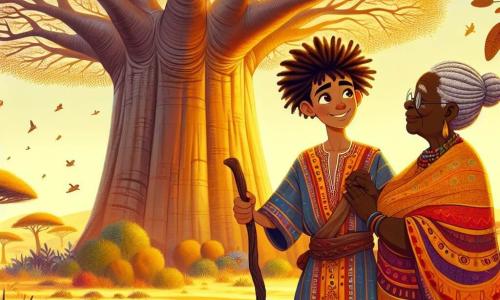
Then an old griot, Baba N'Golo, cleared his throat. His beard was white as ash, and his voice had the rhythm of sandals on hard earth. He always spoke as if he were singing to the ancestors.
Baba N'Golo tapped his staff—tap, tap, tap. “People of the moving camp, people of the patient camel, listen.”
The children shuffled closer. Even goats angled their ears.
Baba N'Golo looked at Amadou with a smile that held secrets. “I hear you want to see far.”
Amadou sat up. “Yes, Baba. My eyes feel short. They stop at the first dune like a donkey refusing to climb.”
Laughter bubbled around the fire.
Baba N'Golo chuckled. “A donkey can be stubborn, but even a donkey learns when the load is shared. Tell me, Amadou: what is ‘far'?”
Amadou opened his mouth, then closed it. Far was… far.
The griot leaned in. “Here is a riddle for your pocket. Listen well: The farther you look, the smaller you must become. The farther you listen, the quieter you must be.”
Sidi whispered to another child, “Does he mean we must turn into ants?”
Baba N'Golo's eyes twinkled. “Not ants. But humble. Tomorrow, Amadou, you will walk with me. We will visit the place where the horizon keeps its goats.”
“The horizon has goats?” Sidi blurted.
“It has everything,” Baba N'Golo said calmly. “Including lessons for busy men.”
That night, Amadou lay under his blanket. The camp murmured—ropes creaking, camels grunting, women laughing softly as they braided tomorrow into today. Above, the sky was dark velvet pricked with early stars, shy and scattered.
Amadou stared upward, but his mind was already walking ahead. He wanted to look far. He wanted to be the man who could spot rain before it was born.
Yet somewhere deep inside, another voice asked: And when you see far, will you still see the person beside you?
Chapter 3: The Hill of Listening Stones
At dawn, the camp began its slow dance of packing. Tents folded like careful hands. Pots clinked. Camels rose with the grumpy sigh of old kings.
Baba N'Golo beckoned Amadou. “Come. Before the sun grows a hot tongue.”
They walked away from the camp, their footprints stitching the sand. The world smelled of dust and distant herbs. A lark sang, small but stubborn, as if it could lift the sky.
They reached a low hill scattered with flat stones. The stones lay stacked and balanced, not by chance but by many hands over many seasons.
Baba N'Golo touched one with respect. “These are listening stones. Travelers stop here, stack a stone, and leave a wish. The stones remember.”
Amadou peered. “How can a stone remember?”
Baba N'Golo smiled. “A calabash remembers water by the taste it leaves. A stone remembers footsteps by the way it wears smooth.”
He sat, facing the horizon, and patted the ground beside him. “Sit. We will practice looking far.”
Amadou sat, eager as a pup.
“First,” said the griot, “close your eyes.”
Amadou blinked. “But I came to see.”
“To see far,” Baba N'Golo replied, “you must first learn to see near—inside yourself.”
Amadou closed his eyes. The world did not disappear; it changed. He heard wind brushing the grass like a mother smoothing a child's hair. He heard an insect clicking, tiny as a pebble falling into a cup. He heard his own breath, rushing in and out like a shy tide.
“Now,” Baba N'Golo said softly, “open your eyes, but do not grab the horizon with them. Let your eyes rest, like a bird sitting on a branch.”
Amadou opened his eyes. The distance still shimmered, but he tried not to wrestle it.
“What do you see?” asked the griot.
Amadou frowned. “Sand. Heat. Sky.”
Baba N'Golo nodded. “That is what eyes see when the heart is impatient.”
He lifted his staff and pointed—not at the horizon, but at something closer. “See that thorn bush? Count its shadows.”
Amadou counted quickly. “Many.”
“Good. Now look beyond it. Not at the far, far line. Look just one step beyond.”
Amadou did. A darker patch of earth appeared. Then another thorn bush. Then a pale rock.
Baba N'Golo hummed, pleased. “Far is not one jump. Far is many small steps. If you try to swallow the whole sky, you will choke.”
Amadou laughed, then squinted again. “But what about seeing rain?”
Baba N'Golo picked up a stone and held it in his palm. “Rain does not announce itself with a trumpet. It sends quiet messengers: a change in wind, a faint smell, a line of birds flying as if pulled by invisible rope.”
He leaned closer, voice low. “And there is another messenger. People.”
“People?” Amadou echoed.
“A stranger arriving early. A child asking for extra water. A neighbor's camel walking stiffly. When you read people, you see far.”
Amadou stared at the stones. He had come to learn the horizon. Instead, he was being asked to learn kindness with sharper eyes.
Then Baba N'Golo said, “Today you will use your new looking to help the camp. Someone will need you. Be ready.”
Amadou straightened, suddenly nervous. The hill felt like a drum that had been struck, and the sound was rolling toward the camp.
Chapter 4: The Thirsty Family and the Short Path
When they returned, the camp was already moving, a slow caravan threading through the land. Amadou trotted alongside, scanning the distance with his “resting bird” eyes.
At first, he saw nothing. Then, one step beyond the thorn bush, he noticed a thin line in the sand—fresh tracks, not from their own animals. Another step beyond: a flutter of cloth, pale as a moth wing.
“Baba,” Amadou whispered. “There—movement.”
The griot nodded, pleased but not surprised. “Go. Go gently.”
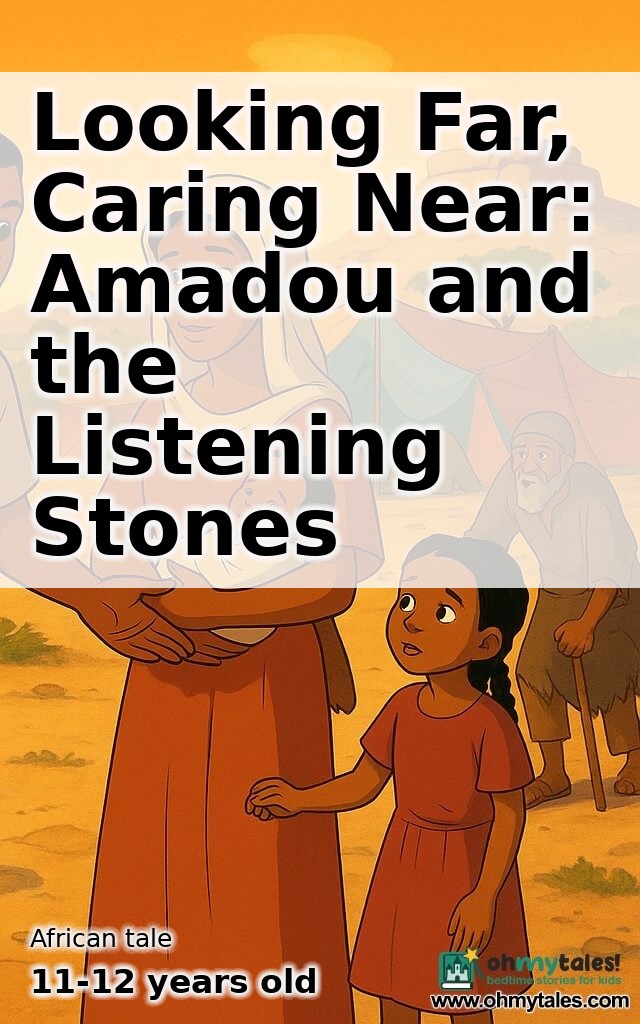
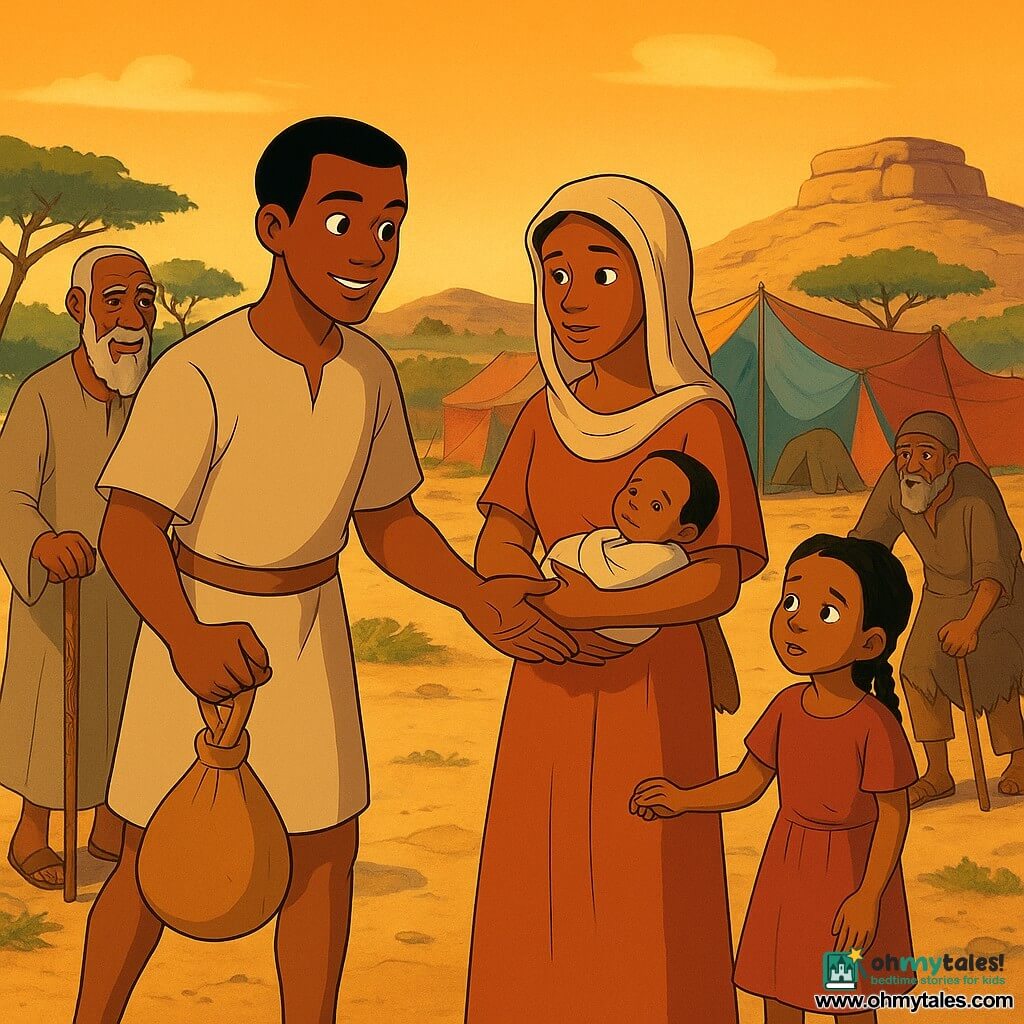
Amadou walked toward the fluttering cloth. As he approached, he saw a small family: a woman holding a baby, a girl about Sidi's age, and an older man leaning on a stick. Their donkey stood with its head low, like a tired question.
The woman's eyes were cautious, but not unfriendly. The girl's lips were cracked. The baby made a sound like a tiny cough.
Amadou swallowed. His heart beat like a fast drum.
“Peace,” Amadou said, using the old greeting. “You are welcome on our road.”
The older man's shoulders sagged with relief. “Peace. We have walked under a hard sun.”
Amadou remembered Baba N'Golo's words: The farther you look, the smaller you must become. So he did not puff himself up like a rooster. He lowered himself like shade.
“Come,” he said. “Our camp is near. We have water and milk.”
The woman hesitated. “We do not want to take what you cannot spare.”
Amadou smiled. “A shared cup does not empty a camp. It fills it.”
He guided them toward the caravan. Some people turned their heads, noticing the newcomers. Amadou felt a pinch of worry—water was always precious. But then Mama Kadi marched over, her face firm.
“You found guests?” she asked.
“Yes,” Amadou said quickly. “They are thirsty.”
Mama Kadi clicked her tongue, not angry—thinking. Then she called out, “Bring the guest bowl. Bring dates. Make shade.”
No one argued. A cloth was stretched between poles. A bowl appeared, shining with fresh milk. Dates were poured into a woven tray like small, sweet stones.
The girl stared at the food as if it might vanish. Sidi stepped forward, trying to look casual.
He offered his own millet cake, now half-eaten. “It's a little broken,” he admitted, “but my teeth promise it tastes good.”
The girl laughed—small, surprised laughter that sounded like the first drop of rain. “Broken is fine,” she said, and took it.
Amadou felt warmth in his chest. He had wanted to learn to look far, to see storms and faraway paths. Yet the first thing his new eyes found was a family in need.
As the guests drank, the older man sighed. “May your eyes never fail you.”
Baba N'Golo, standing nearby, murmured to Amadou, “You found them because you looked one step beyond. And you helped them because you looked one step within.”
Amadou nodded. But even as he did, a shadow crossed his thoughts. If he had not looked… if he had kept his eyes stuck on the horizon line like a stubborn donkey… what would have happened to them?
The camp moved on, and the guests walked with them. The road ahead shimmered, but Amadou's attention felt different now. The horizon was no longer just a distant line. It was a promise, and a warning, and a story still being told.
Chapter 5: The False Lake and the Honest Eyes
Later that day, the sun climbed higher, fierce and proud. Heat danced above the sand, weaving illusions the way a trickster weaves lies.
Sidi ran up beside Amadou, pointing excitedly. “Look! Water!”
Far ahead, something gleamed—blue and bright, like a lake spilled across the earth. Even some adults murmured, hope rising like bread.
Amadou's heart jumped. He wanted it to be true. He wanted to be the man who could see far and say, “There! Water waits for us!”
But Baba N'Golo's voice floated in his memory: Do not grab the horizon with your eyes.
Amadou narrowed his gaze, letting it rest. He looked at the edges of the shining blue. It trembled strangely. He watched the wind. He sniffed the air. No dampness. No cool breath. No birds circling low to drink.
He walked to Mama Kadi and spoke respectfully. “That water is a liar,” he said. “It is the sun playing mirror games.”
Mama Kadi lifted her chin. “Are you sure?”
Amadou swallowed. “Not with pride. With care.”
Baba N'Golo came closer. “Let the young man speak. He has been learning.”
Amadou pointed—not to the blue shine, but to a line of darker shrubs farther left. “There. The plants are greener. And look—tiny birds keep flying that way.”
Sidi squinted. “I thought they were just showing off.”
“Birds do show off,” Amadou said, “but they also know where to drink.”
The leaders of the caravan discussed quietly. Finally, Mama Kadi said, “We turn left.”
Some people grumbled. “But the water is straight ahead!”
Amadou raised his hands. “A straight path is not always a true path.”
The older guest man—still traveling with them—nodded. “Mirages are like rumors,” he said. “They shine, and they harm.”
They changed direction. The false lake slid away, fading like a joke that isn't funny anymore.
After a while, the air changed. A thin coolness brushed Amadou's cheek, like a wet finger. Then he smelled it—water, faint but real. Not a flood, not a river singing loudly, but a small hidden well where the ground held its secret in a tight fist.
When they reached it, the camp let out a cheer. Even the camels seemed less grumpy.
Sidi slapped Amadou's shoulder. “Your eyes are growing long!”
Amadou laughed. “Not long. Just honest.”
Baba N'Golo leaned close. “Remember: seeing far is not for showing off. It is for keeping people safe.”
Amadou looked at the well, at the guests drinking with grateful faces, at the children splashing just enough to be happy. He understood something simple and heavy: the farther you see, the more you must care.
Chapter 6: The Sky's Bowl of Stars
That evening, the camp settled near low acacia trees. Fires flickered, telling orange stories on everyone's faces. The guests helped where they could—gathering sticks, soothing goats, sharing their own small bundle of dried herbs as thanks.
Mama Kadi noticed. “Good,” she said. “A guest who becomes family brings luck.”
After dinner, Baba N'Golo called everyone close. The night had arrived quietly, wrapping the land in dark cloth. Above, the sky opened its great bowl.
Stars poured out.
They did not come all at once. First a few, then many, then more than anyone could count—tiny lamps hung by invisible hands. The Milky Way spilled like pale millet across black ground.
The children gasped as if they had never seen it before, even though the sky had been there all their lives. That is the trick of beauty: it is old, yet it always feels new.
Baba N'Golo began to speak, his voice low and musical. “Listen, children of the moving camp. Listen, travelers and guests. The sky is a storybook, and the stars are its letters.”
Sidi raised a hand. “Can you read it, Baba?”
Baba N'Golo smiled. “Sometimes. But reading the sky is like reading people. If you rush, you miss the meaning.”
He nodded at Amadou. “This man wanted to look far.”
Amadou felt shy, but he did not hide. He sat upright, letting the firelight warm his face.
Baba N'Golo continued, “He learned to look one step beyond the thorn bush. He learned to notice a flutter of cloth. He learned to see that a shining lake can be a lie. And he learned something older than all dunes—hospitality.”
Mama Kadi's voice cut in, fond as a blanket. “Hospitality keeps a camp alive. A closed hand dries up. An open hand becomes a river.”
The guest woman rocked her baby and said softly, “Your open hands saved us.”
Amadou looked at the stars. They seemed farther than anything—farther than wells, farther than horizons, farther than fear. Yet they also felt close, as if the night was leaning down to listen.
He spoke, careful and clear. “I thought looking far meant staring hard. But it means paying attention. It means being quiet enough to notice. It means making space—space in your eyes for the road, and space in your heart for people.”
Sidi whispered loudly, “So… to see far, you must not be a donkey.”
Laughter rolled through the camp like a friendly drumbeat.
Baba N'Golo lifted his staff and pointed at a bright cluster of stars. “See those? We call them the Traveler's Hands. They remind us that the road is long, and no one should walk it alone.”
Amadou followed the line of stars with his gaze. He did not try to grab them. He let them be. And in that letting, he felt something settle inside him—like a stone stacked carefully on a listening hill.
The fires crackled. The guests breathed safely. The camp, for once, did not feel like it was running. It felt like it was rooted—rooted in kindness, rooted in attention, rooted under a sky that watched and watched and watched.
And above them, the stars kept shining, patient as elders, teaching their silent lesson: The farther you wish to see, the more gently you must look—and the more warmly you must welcome those who share your path.