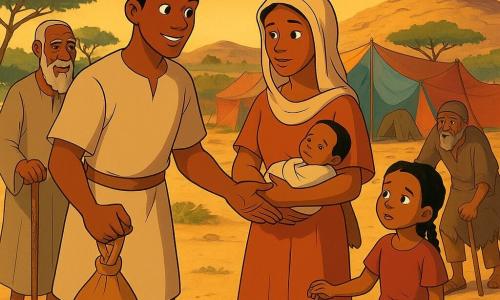
Chapter One: The Whispering Baobab
In the heart of the sunlit savannah, where the grass swayed like dancers to the drumbeat of the wind, lived an adolescent named Kwame. His village, Oduya, nestled beside the great Limpopo River, was a tapestry of laughter, tradition, and age-old stories woven by ancestors. Each day, the village bustled with life—women pounding yam, men returning from the hunt, children chasing each other under the broad sky as birds painted streaks of sound above.
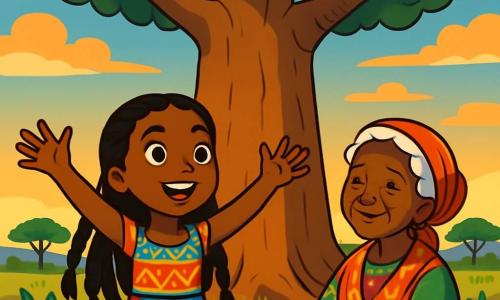
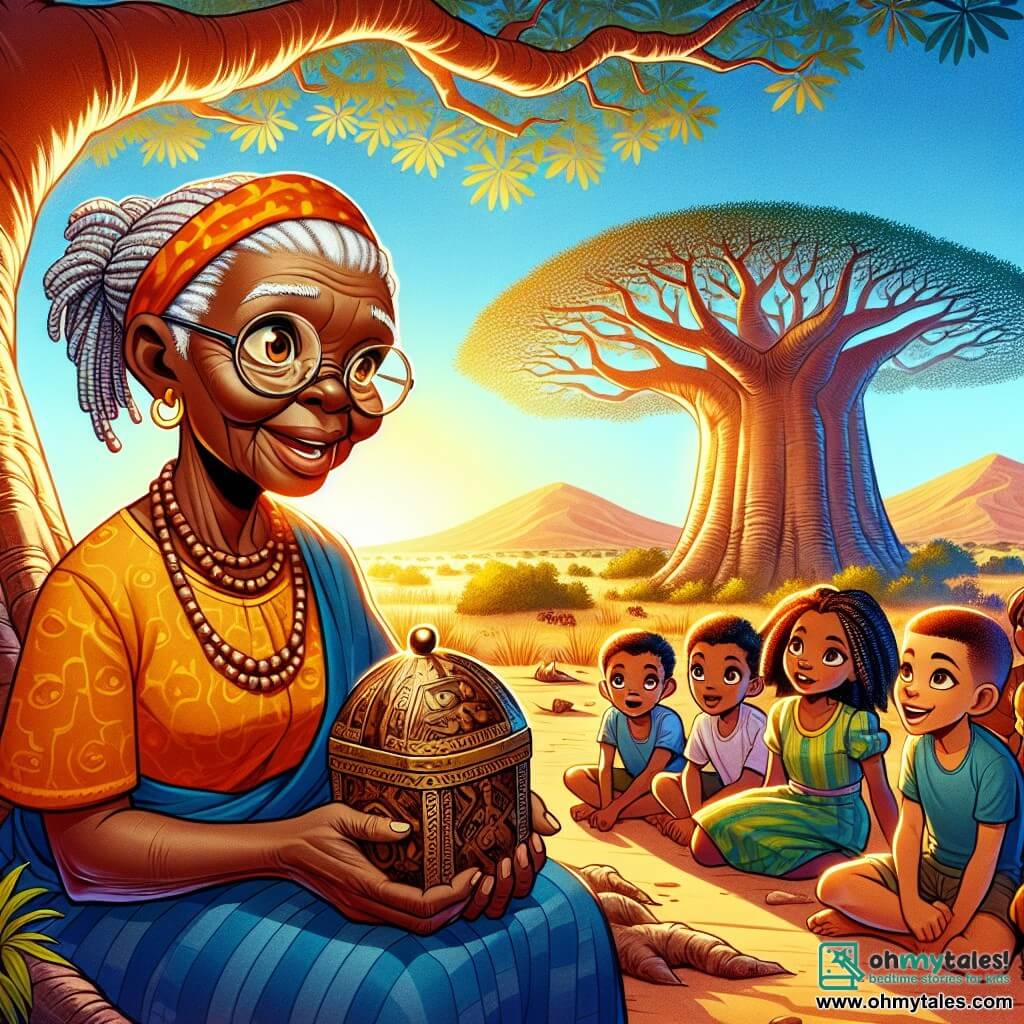
Kwame was wiry and quick, with eyes like amber beads, always sparkling with curiosity. He listened more than he spoke, preferring the company of the wild and the wisdom of elders. His grandmother, Nana Efua, was a revered griot, the village storyteller. At dusk, under the ancient baobab tree—the Whispering Baobab—she spun tales of clever animals and the spirits of old. Kwame drank in her stories like sweet palm wine, his mind swirling with dreams of adventure and secret knowledge.
One evening, when the sun dipped low, setting the sky aflame, Nana Efua beckoned Kwame closer. Her voice was velvet and thunder, “Kwame, my child, the world is a riddle. Those who solve its puzzles find their place among legends. Remember, true power lies not in strength, but in wisdom and wit.”
That night, haunted by her words, Kwame could not sleep. He gazed at the baobab, its branches clawing at the moon, its trunk scarred with the stories of generations. As midnight deepened, a breeze—soft as a ghost's sigh—stirred the leaves. Kwame heard a whisper, so faint it could have been imagination.
“Seek beneath my roots,” it breathed, “and discover what the mind can do when awake…”
Chapter Two: The Secret Beneath the Earth
Before dawn, Kwame slipped from his hut, his footsteps silent as a leopard's prowl. The air was cool and rich with the promise of secrets. At the base of the baobab, he pressed his ear to the bark. Again, he heard the whisper, clearer now, drawing him to a patch of earth shaped like a heart.
He dug with trembling hands. The earth was stubborn, as if guarding its treasure. At last, his fingers brushed against something solid—a small wooden box, carved with intricate symbols: eyes, birds, and spirals that seemed to move in the half-light.
Kwame opened the box. Inside lay a shimmering stone, smooth and warm, pulsing with a gentle light. Wrapped around it was a strip of aged leather, etched with the same patterns. Suddenly, the world blurred. Kwame tumbled into a vision—he saw himself outwitting a horned beast, tricking mischievous spirits, and standing among wise elders. The vision faded, leaving him breathless.
A voice, woven with wisdom and mischief, echoed in his mind: “This is the Stone of Amani. With it, your mind will be sharper than a serpent's tooth, your tongue swifter than the river's rush. But beware—cleverness without kindness is a shadow that devours the sun.”
Kwame clutched the stone, hiding it close to his heart. He knew his life had changed, and that a journey—one filled with riddles and tests—awaited him.
Chapter Three: The Problem of the Drought
Days passed, and Oduya was struck by drought. The river shrank; crops withered. The people's laughter faded, replaced by the groan of hunger and worry. The elders gathered, faces lined with concern, discussing how to appease the Rain Spirits.
Kwame watched in silence, his mind racing. He felt the Stone of Amani grow warm in his pocket. That night, as the village slept, he crept to the riverbank, hoping for inspiration.
There, he met a strange figure—a tall man clothed in smoke, with eyes the color of rain. “Why do you trouble the night, young one?” boomed the figure.
Kwame replied, “Our village thirsts, wise spirit. I seek a way to bring the rain.”
The spirit's lips curled into a sly smile. “Then answer my riddle, and the rains will return: ‘I have a mouth but never speak, a bed but never sleep. What am I?'”
Kwame's heart raced. He thought of the dry river, the way its mouth yawned at the rocks. “It's the river!” he exclaimed.
The spirit laughed, a sound like thunder rolling across the plains. “You are clever, Kwame. But wisdom alone is not enough. Tell your people to dance the rain dance as one, not alone, and to give thanks whether rain comes or not. In unity, blessings flow.”
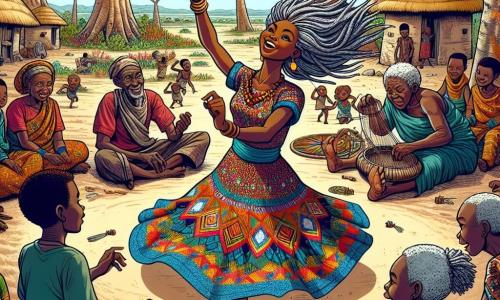
Kwame nodded, racing back to share the spirit's message. The next day, the entire village gathered, dancing and singing, their voices weaving together like threads in a kente cloth. Clouds gathered, and soon, rain fell in silver sheets, drenching the earth and hearts alike.
Chapter Four: The Trickster's Challenge
As the village rejoiced, word of Kwame's cleverness spread. One day, a mysterious traveler arrived. He wore a hat made of woven grass, and his eyes sparkled with mischief. He introduced himself as Anansi, the fabled trickster.
“I hear there is a boy here who thinks with the quickness of a gazelle,” Anansi purred. “But are you clever enough to outwit me?”
Kwame felt the Stone of Amani warm against his skin. “I accept your challenge, Anansi,” he said, voice steady as a drumbeat.
Anansi grinned. “Let us play a game of riddles. If you lose, I take your precious stone. If you win, I give you a gift that will help your village forever.”
A hush fell. The whole village gathered, some nervous, others excited. Anansi began, “I am taken from a mine, and shut up in a wooden case, from which I am never released, and yet I am used by almost every person. What am I?”
Kwame frowned, thinking. He remembered Nana Efua's tale of scribes and knowledge. “It is pencil lead!” he declared confidently.
Anansi clapped. “Well done. Now your turn.”
Kwame's mind whirled. He remembered the way the moon winked in and out behind clouds. “What is always in front of you, but can't be seen?”
Anansi's brow furrowed. After a long silence, he snapped his fingers. “The future!”
The village erupted in laughter and cheers. The riddles danced back and forth, each more complex than the last. Finally, Kwame posed, “The more you take, the more you leave behind. What are they?”
Anansi's smile faded. He paced, muttered, then stopped. “Footsteps!” he shouted.
But Kwame, with the help of the Stone, had planned a trick of his own. “But tell me, Anansi, whose footsteps? If you cannot answer whose footsteps, then I win.”
Anansi laughed, delighted. “Clever, clever boy! You have bested the old trickster. As promised, here is your gift.” He handed Kwame a pouch filled with seeds. “Plant these, and your village will never know hunger again.”
With a swirl of dust and laughter, Anansi vanished.
Chapter Five: The Journey to the Mountain of Spirits
Soon, stories of Kwame's wisdom traveled beyond Oduya. One day, a delegation from the distant village of Njoro arrived. Their problem was dire: a terrible beast, the Njovu Nyoka—a monstrous elephant-snake—was terrorizing their people.
“We beg you, Kwame,” they pleaded, “help us outwit this beast.”
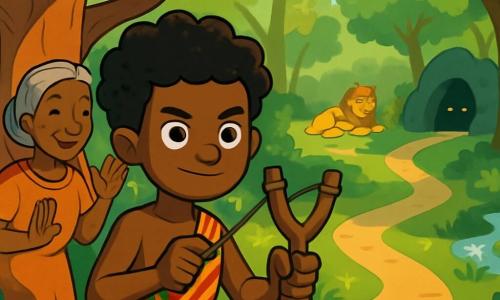
Kwame, guided by the Stone, agreed. He traveled with the delegation, passing through forests humming with life, villages where the sound of drums was thunder and joy combined, and hills flecked with wildflowers.
At Njoro, the elders offered Kwame kola nuts, blessing his journey. That night, he climbed the holy mountain, seeking counsel from the ancestors. As the stars blinked in the velvet sky, Kwame closed his eyes. The Stone shimmered, and suddenly, ancestral spirits swirled around him, luminous as fireflies.
“Njovu Nyoka is strong, but not wise,” intoned one spirit. “His pride is his weakness. Trick him, and you shall prevail.”
Kwame descended at dawn, mind alight with a plan.
Chapter Six: The Battle of Wits
At the edge of the village waited Njovu Nyoka, scales gleaming, tusks like spears, eyes burning with arrogance. The ground trembled with each step.
“HUMAN,” it hissed, its voice like wind through hollow bones, “who dares face Njovu Nyoka?”
Kwame stood tall, hiding fear beneath a mask of calm. “Oh great Njovu Nyoka, I have heard you are the wisest creature in all the land. But tell me, can you solve the riddle of the Stone of Amani?”
The beast snorted. “Speak your riddle, foolish boy!”
Kwame took a breath. “What belongs to you, but other people use it more than you do?”
Njovu Nyoka's tongue flicked in confusion. Days passed—three, to be exact—as the beast pondered the riddle, growing weaker without food or water. Finally, it roared, “I give up! Tell me the answer, so I may eat you for my patience.”
Kwame smiled. “The answer is: your name.”
Njovu Nyoka howled, defeated. “You have bested me. Spare me, and I will leave your people in peace.”
Kwame nodded. “There is wisdom in mercy. Go, and trouble the villages no more.”
The beast slithered away, humbled. The people of Njoro celebrated, gifts and songs showering Kwame, who had used mind over might to save them.
Chapter Seven: The Circle of Wisdom
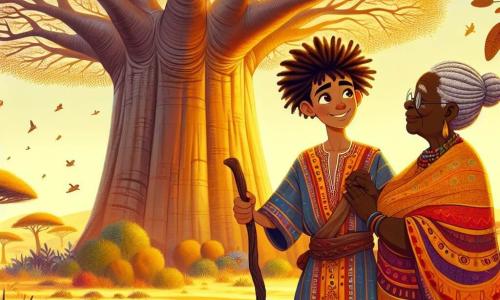
Returning home, Kwame was greeted as a hero. Yet he remained humble, always recalling Nana Efua's words: “Wisdom shines brightest when shared.”
Kwame called for a gathering beneath the Whispering Baobab. All the neighboring villages came—young and old, hunters and healers, griots and chiefs.
He stood, holding the Stone of Amani high. “I was given this stone as a gift, but its true power is in the sharing of knowledge and working together. Alone, a spark; together, a blazing fire.”
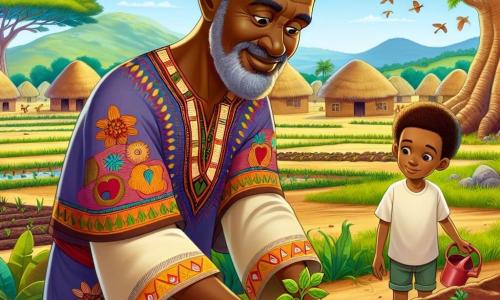
He shared the seeds Anansi had given him, teaching each village how to plant them. Soon, the land bloomed with new crops, and hunger became just a memory. He taught the children riddles, and encouraged the elders to tell their stories. The villages came together, forming a great alliance—one based not on strength, but on wisdom, unity, and compassion.
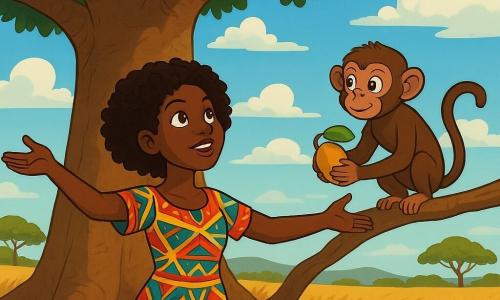
In time, Kwame passed the Stone of Amani to another—a young girl whose eyes sparkled with questions. He became a wise elder, and his stories were told beneath the baobab for generations.
The villagers learned that the greatest power was not in magic stones or clever riddles, but in the courage to think deeply, act kindly, and unite for the good of all.
Thus, under the shade of the eternal baobab, the story and its lessons lived on, as enduring as the land itself.