Chapter 1: Cobblestones That Wanted to Dance
The alley was usually quiet—just old cobblestones, sleepy shutters, and the smell of bread drifting from the corner bakery. But today the cobblestones seemed to hum underfoot, as if they were warming up for a song.
Luca and Maya—both eleven, both too curious to stay still—stood at the alley's mouth and stared.
At the far end, the carnival parade was gathering like a bright storm. Feathers bobbed above the crowd. Drums thumped in quick, happy bursts. A trumpet tested a note that spiraled into the air like a golden ribbon.
Maya's eyes sparkled. “Listen to that. It's like the street has a heartbeat.”
Luca adjusted the little mask he'd made from cardboard and glitter. It was shaped like a fox, because he'd decided foxes looked like they had plans. “If we follow the head of the parade,” he said, “we'll see everything first. The biggest float, the best dancers… the—”
“The confetti cannon,” Maya finished, grinning. “You mean the confetti cannon.”
Luca didn't even pretend to deny it. He was honest like that—honest enough to admit his greatest dream was to be hit by confetti before anyone else.
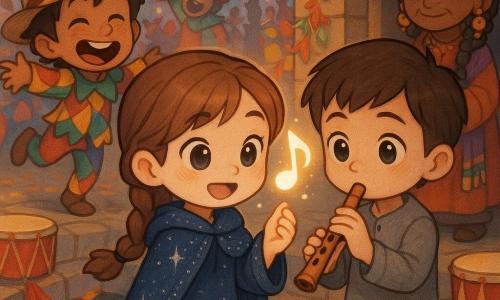
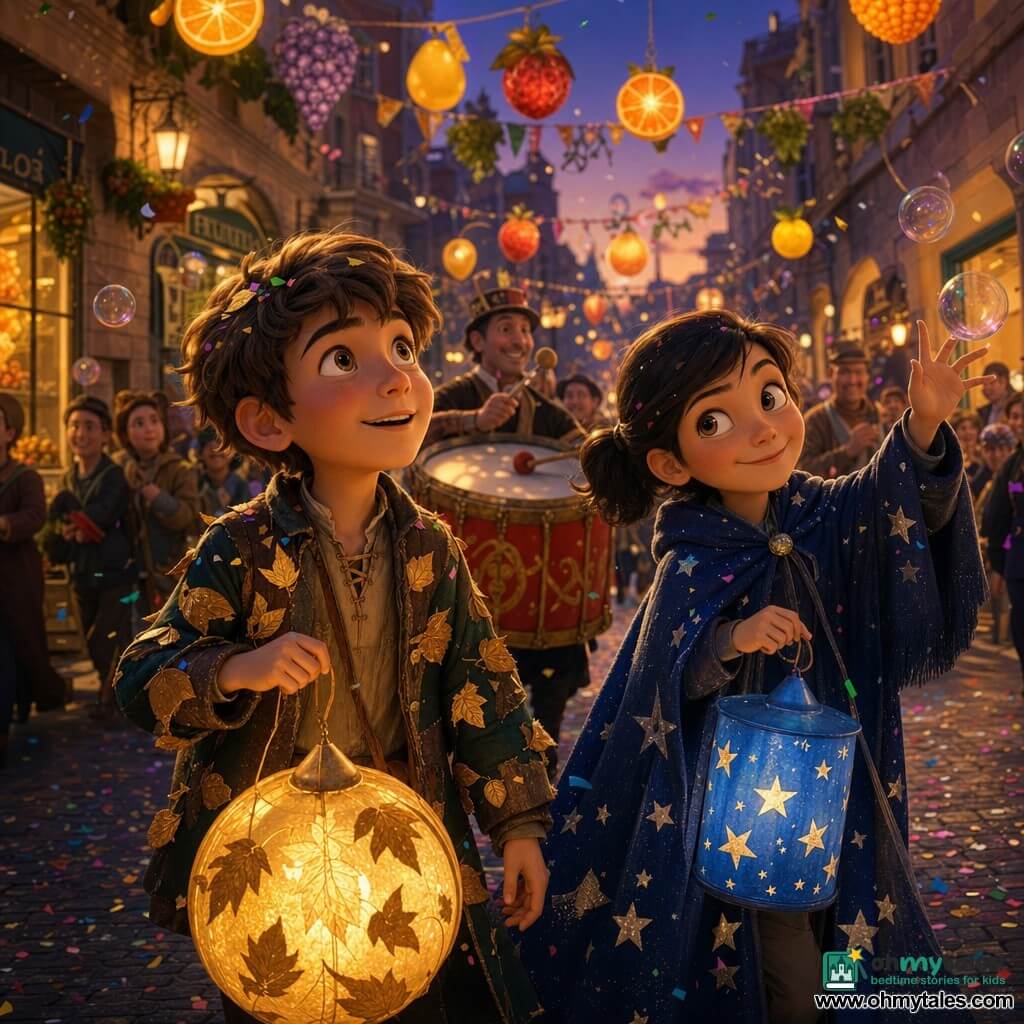
They were wearing costumes they'd stitched and taped together themselves. Maya had a cape made from a shiny blue tablecloth, painted with tiny stars. Luca wore a jacket covered in paper leaves that rustled when he moved, like he carried a small forest around with him.
A woman in a skirt of rainbow ribbons twirled past the alley entrance, laughing. A tall man on stilts leaned down to wink at a child, his hat a spinning pinwheel. Someone shook a tambourine, and the sound scattered like coins.
Luca leaned forward, almost stepping out.
Maya caught his sleeve. “Wait,” she said. “We can't just rush in. We'll get swallowed.”
“I can handle it,” Luca said, though his voice came out a little squeaky, like a balloon.
The parade's front—its head—was there, somewhere among the sparkly chaos. Luca could feel it. If he could just slip through and follow the leader, he'd be part of the first wave, the very tip of the celebration.
A trumpet blared again, louder this time.
Maya pointed. “Look.”
At the alley's edge, tucked beside a stone wall, sat a little wooden sign with a painted arrow: PARADE START—THIS WAY. Under it, another smaller sign wobbled on a nail: PLEASE LINE UP AND WAIT YOUR TURN.
Luca groaned. “Waiting is a crime against fun.”
Maya lifted one eyebrow, the way she did when she was about to be annoyingly correct. “Waiting is how you don't get trampled by a man wearing six meters of feathers.”
Luca opened his mouth to argue, then shut it again, because honesty also meant admitting Maya had a point.
They stepped into the alley, where lanterns were strung from wall to wall. The lanterns were shaped like fruit—lemons, cherries, oranges—and they glowed as if summer had been trapped inside them. Music bounced between the stone buildings, making the narrow space feel like a magical tunnel.
At the far end, where the alley spilled into the main street, the parade waited like a giant, colorful animal about to leap.
Luca swallowed. “Okay,” he said. “We line up. But we still aim for the head.”
Maya nodded. “We aim. Patiently.”
Luca sighed like a dramatic actor. “Patiently,” he agreed, as if it were a spell he didn't fully trust.
Chapter 2: The Feathered Traffic Jam
They found the line quickly—because it wasn't exactly subtle. A cluster of kids in costumes stretched along the wall like a row of bright candies.
There was a pirate with a foam sword, tapping it against his boot. A pair of twins dressed as popcorn buckets. A girl in a dragon onesie that looked both fierce and incredibly cozy.
At the front of the line stood a volunteer wearing a vest that said PARADE HELPER in bold letters. He held a clipboard like it was the most powerful object in the world.
“Name?” he asked Luca, without looking up.
“Luca,” Luca said.
“Costume?” the volunteer asked.
“Forest fox,” Luca replied, making a small spin so the paper leaves rustled.
The volunteer finally glanced up. “Nice rustle. Next!”
Maya stepped forward. “Maya. Star-cape.”
The volunteer nodded. “Approved. You two are in the Junior Lantern Section. Stay together, no pushing, and when the drumbeat changes—follow the lantern bearer.”
Luca's stomach sank. “Junior Lantern Section?”
Maya tried not to laugh, failed, and covered it with a cough. “Sounds important,” she said.
“It sounds like the part where we wave politely while everyone else does backflips,” Luca muttered.
They shuffled into place. The line crept forward, then stopped, then crept again. Somewhere ahead, a float's wheels squealed as someone adjusted it. A drum began a steady rhythm—boom, boom, ba-boom—like someone knocking on a giant door.
Luca craned his neck. “If we could just… slip through… maybe we could—”
A sudden gust of wind swept down the alley, tossing confetti scraps that hadn't even been thrown yet. Something soft floated right into Luca's face and stuck there.
He peeled it off. It was a feather—pink, huge, and slightly ticklish.
Maya giggled. “Congratulations. You're first at something.”
Luca held the feather like evidence. “This is a sign. The parade is calling me to the front.”
The dragon girl turned around. “Or the feather is calling you to stop itching your nose,” she said, smiling.
Luca tried not to grin back. “Fair.”
The line inched again. The music grew louder, then softer, then louder. A saxophone started a playful tune, and the alley seemed to sway. Luca's feet began tapping on their own.
Maya leaned close. “Here's the thing,” she said. “We can't push past everybody. That's not fair.”
“I know,” Luca admitted. He hated how true it was. Being honest sometimes felt like stepping on a Lego—sharp and unavoidable. “I just… really want to follow the head.”
Maya's eyes softened. “Then we'll find a way that doesn't wreck the carnival for others.”
“How?”
Maya pointed toward the side wall. There, squeezed between two barrels, was a narrow doorway with a curtain of beads. The beads were bright and shiny, and they clinked like tiny bells when the wind touched them.
Above the doorway hung a sign painted in swirling letters: LANTERN MAKER—ENTER IF YOU DARE TO WAIT.
Luca squinted. “That sounds suspiciously like waiting.”
“It sounds like a shortcut that requires patience,” Maya said, and her smile was mischievous, like she'd just found a secret level in a game.
The line stopped again, and a parade helper called, “Hold! Feather adjustment!”
Luca looked at the beaded doorway. He looked at the slow-moving line. He looked at the pink feather in his hand, as if it might vote.
“Okay,” he said. “We dare.”
They slipped out of the line, careful not to bump anyone, and approached the beaded curtain. The beads clicked a welcome-song as they parted.
On the other side, the air smelled like paper and paint and something warm, like cinnamon. A workshop glowed with lantern light. Lanterns hung from the ceiling in every shape imaginable—fish, moons, crowns, even a grinning potato.
And behind a table covered in colored paper sat an old man with eyebrows so bushy they looked like two friendly hedgehogs.
He glanced up. “Ah,” he said, as if he'd been expecting them since last Tuesday. “Two young travelers who want to be where the music starts.”
Luca's cheeks warmed. “Is it that obvious?”
The man chuckled. “It's obvious to anyone who's ever wanted something very badly. Welcome to my little lantern cave. I'm Mr. Brill. And yes—there is a way to reach the head of the parade.”
Luca's heart jumped. Maya held up a finger. “What's the catch?”
Mr. Brill tapped the table. “You must earn it. Not with speed. Not with elbows. With patience.”
Luca glanced at Maya. She gave him a look that said, Told you so, but kindly.
Mr. Brill slid two sheets of paper toward them—one gold, one midnight blue. “Make a lantern,” he said. “A lantern that can keep a secret and still shine. If you do, I'll show you the side path to the front.”
Luca reached for the gold paper.
Maya reached for the midnight blue.
And somewhere outside, the drums kept knocking, steady and eager, like the carnival itself was waiting too.
Chapter 3: The Lantern That Wouldn't Hurry
Mr. Brill's workshop buzzed with quiet magic. Scissors snipped like tiny insects. Glue pots sat steaming gently, smelling sweet and sharp. A basket of ribbons shimmered as if it had swallowed a rainbow.
On the table, Mr. Brill placed two small candle-lights—safe ones, tucked inside glass, the kind that flickered without burning anything down. “These go inside,” he said. “But only after you finish the shell.”
Luca picked up the gold paper. It was smoother than it looked, like it had been polished by sunbeams. “So we just… build it?”
“Build it,” Mr. Brill agreed, “but don't fight it. Paper has feelings. It likes to be persuaded, not bullied.”
Maya whispered to Luca, “Did he just say paper has feelings?”
Luca whispered back, “I think he did.”
Mr. Brill's hedgehog eyebrows twitched. “I heard that. And yes, I did.”
Maya laughed, then leaned over her blue paper, suddenly serious in the way she got when she was focused. She measured with a ruler, drew neat lines, and folded carefully, pressing each crease with her fingernail.
Luca, meanwhile, decided to speed-run the lantern, as if there were a timer above his head. He folded, then unfolded, then folded again. The paper crinkled in protest.
“Come on,” Luca muttered. “We're missing the head of the parade.”
The gold paper sprang slightly out of shape, like it was pouting.
Mr. Brill slid a cup of cinnamon tea toward him. “Hurry makes crooked lanterns,” he said. “Crooked lanterns make crooked paths.”
Luca frowned. “That's… poetic. And annoying.”
“Most true things are,” Mr. Brill replied cheerfully.
Maya didn't look up. “Luca,” she said softly, “slow down.”
Luca wanted to argue. He wanted to say that time was racing, and the parade head was slipping away, and confetti didn't wait for anyone.
But then he saw Maya's lantern taking shape—clean edges, a smooth curve, little star-cutouts that would let light spill through like a constellation.
It was beautiful. And it wasn't rushed.
Luca took a long breath. He sipped the tea. It tasted like warm sugar and brave decisions.
“Okay,” he said to his paper, as if apologizing. “Let's try again.”
He began folding more gently. He lined up the edges. He pressed, waited, and pressed again. The gold paper relaxed, smoothing out, becoming cooperative.
As they worked, the sounds of the parade seeped through the walls—drums, laughter, a shout of “Make room for the jellyfish dancers!” The temptation to sprint back outside tugged at Luca's legs.
He kept folding.
Maya glanced at him. “Look at you,” she said. “Being patient.”
“Don't get used to it,” Luca said, but he smiled.
Minutes passed like slow confetti—floating, twirling, landing softly. Luca's lantern grew into a round shape with cutout leaves, like his forest jacket. When he held it up, light from a hanging lantern shone through the leaf holes and painted patterns on his hands.
Mr. Brill clapped once. “Now that,” he said, “is a lantern that has learned to breathe.”
Maya finished tying a ribbon around the top of hers. “Mine's a night sky,” she said. “With a secret.”
“And what secret does it keep?” Mr. Brill asked.
Maya's eyes flicked to Luca. “That we want to be at the head,” she said, “but we won't shove our way there.”
Mr. Brill nodded, pleased. “A fine secret. A polite secret.”
He handed them the glass candle-lights. They placed them inside their lanterns, and the lanterns came alive—gold leaves glowing, blue stars shining.
The workshop brightened as if it approved.
Mr. Brill reached under the table and pulled out two thin sticks with hooks at the end. “Lantern poles,” he said. “Now you are lantern bearers. That means people will follow you.”
Luca's mouth fell open. “People will follow us?”
“Not everyone,” Mr. Brill said. “Just those who understand that light is shared.”
He waddled to the beaded curtain and pushed it aside. Behind it was not the alley they'd entered from, but a narrow passage between buildings—an old service walkway paved with smaller stones, half hidden by vines and banners.
From the end of this passage, Luca could see the main street from a different angle. He could see the front of the parade—still gathering, still not moving yet, because something was being arranged.
“The head is waiting,” Luca whispered.
Mr. Brill leaned close. His voice dropped like a drumbeat. “Here is the rule of the side path: you may walk it, but you may not run it.”
Luca's first instinct was to say, That's ridiculous.
His second instinct—new and surprising—was to nod.
Maya lifted her lantern, and the stars danced on her cheeks. “We can do that,” she said.
Luca lifted his, and the leaf-shadows fluttered on his hands. “We can,” he agreed, and meant it.
They stepped into the passage, lanterns glowing, the carnival music wrapping around them like a scarf.
And they walked—one steady step at a time—toward the place where the parade began.
Chapter 4: The Side Path of Sparkling Surprises
The hidden passage was cooler than the alley, and it smelled faintly of wet stone and crushed mint. Banners hung overhead, brushing their hair like friendly hands.
As Luca and Maya walked, the lantern light bounced off the walls, making the vines look like they were made of emerald glass. Somewhere above, someone practiced a flute melody—soft, quick, then soft again, like a bird showing off.
Luca's legs begged him to sprint.
He didn't.
He counted his steps instead. “One… two… three…”
Maya noticed. “Are you turning walking into homework?”
“It's not homework,” Luca said. “It's… a strategy.”
“A strategy for patience?”
“A strategy for not exploding,” Luca admitted.
They rounded a corner and nearly bumped into a pair of performers crouched by a door. One had painted her face like a sunflower, bright yellow petals around her eyes. The other wore a suit covered in mirrors, reflecting a hundred tiny Mayas and Lucas.
The sunflower woman lifted a finger to her lips. “Shh,” she whispered, then grinned. “You're early lanterns.”
The mirror man tilted his head. “Or late,” he said. “Time does funny dances at carnival.”
Maya held up her lantern. “We're trying to reach the head of the parade,” she said, honest and calm.
The sunflower woman's grin widened. “Then you'll need a blessing,” she said. She reached into her pocket and pulled out two small packets of seeds. “Sunflower seeds. For luck. And for patience. Sunflowers don't rush, you know. They just keep turning toward the light.”
Luca took the packet carefully, like it was a treasure. “Thanks,” he said. “Do we… eat them?”
The mirror man laughed. “You can. Or you can keep them. Either way, remember: growing takes time.”
They continued down the passage, walking under a rope of tiny bells. The bells chimed as they passed, and the sound scattered behind them like glittering footsteps.
Then the passage widened into a small courtyard hidden between buildings. In the center sat a carnival cart piled with costumes—extra hats, spare capes, a cluster of feather boas that looked like sleepy parrots.
A sign on the cart read: LOST COSTUMES—PLEASE RETURN WITH A SMILE.
Maya touched a cape made of green satin. “Imagine losing your costume on carnival day.”
Luca's honest brain immediately pictured it: the panic, the embarrassment, the feeling of being left out.
He spotted something on the cart: a small red cap with a gold tassel. It looked official, like it belonged to someone important—maybe the drum leader, maybe the parade guide.
Maya saw it too. “That looks like it belongs at the front.”
Luca swallowed. “If we bring it… maybe someone there will let us stay close.”
Maya nodded. “And it's the right thing to do.”
They looked around the courtyard. No one seemed to be guarding the cart, but a narrow window above was open, and laughter drifted down.
Luca called up, “Hey! Is anyone missing a red cap?”
A head popped into view—an older teen with face paint like a lightning bolt. “Oh! That's Captain Riff's cap!” he shouted. “He's been searching everywhere and blaming the wind. Please take it to him—he's at the head, near the big drum!”
Maya's eyes widened. “That's exactly where we're going.”
Luca picked up the cap. It was heavier than it looked, stitched well, with a tiny stitched note inside that read: IF FOUND, RETURN TO CAPTAIN RIFF. THANK YOU FOR YOUR HONESTY.
Luca felt something warm in his chest, like the lantern light had moved inside him.
They left the courtyard and stepped into the last stretch of the side path. The music grew louder, clearer. The drums were no longer just a heartbeat—they were words without language, saying, Come closer. Come closer.
At the end of the passage, two parade helpers stood like cheerful gatekeepers. One wore a vest covered in patches. The other had a hat shaped like a giant strawberry.
“Lantern bearers!” Patch-Vest said, eyes on their glowing creations. “Nice craftsmanship.”
Strawberry-Hat leaned in. “And what have you got there?” he asked, pointing to the red cap.
“A lost cap,” Luca said. “We were told it belongs to Captain Riff.”
Patch-Vest's face brightened. “Oh, you legends. Captain Riff has been stomping like a thundercloud.”
Strawberry-Hat stepped aside and gestured toward the main street. “Go on, then. Walk—don't run—straight to the head.”
Luca's feet tingled with joy. “We will,” he promised.
Maya lifted her lantern a little higher, and the blue light spilled onto the cobblestones like a small piece of night sky.
Together they stepped out of the hidden passage and into the main street—right near the front, where the parade's head waited, shimmering and alive.
Chapter 5: Captain Riff and the Rule of the Drum
The head of the parade was even more magnificent up close. A giant drum stood on a wheeled platform, painted with swirling patterns in red and gold. Around it gathered musicians in bright vests and dancers with ribbons tied to their wrists. A float shaped like a sea serpent rested nearby, its painted scales glittering like it had been dipped in sugar.
At the very front, pacing in a circle, was a man with a mustache so sharp it could have sliced bread. He wore one boot higher than the other and carried two drumsticks like they were royal scepters.
Even without his cap, he looked like a leader.
“That's him,” Maya whispered. “Captain Riff.”
Captain Riff stopped pacing and pointed at a musician. “No, no, no! That note sounded like a sneeze. We are a fanfare, not a cold!”
The musician rolled his eyes affectionately and tried again, producing a bright, clean blast.
Captain Riff nodded. “Better. Now where is my cap? I cannot lead with my hair in the wind. My hair has opinions!”
Luca stepped forward, lantern pole in one hand, cap in the other. He cleared his throat. “Um—Captain Riff?”
Captain Riff spun around. His eyes landed on the red cap, and his mustache nearly jumped off his face. “My cap!” he cried, snatching it gently—surprisingly gently—and placing it on his head with a dramatic flourish. The gold tassel bounced like it was applauding.
He stared at Luca and Maya. “You two,” he said. “You found it?”
Luca nodded. “It was in the lost costume cart. There was a note inside.”
Captain Riff touched his heart. “Honesty,” he said solemnly, then immediately brightened. “Magnificent. Honesty is rarer than a quiet drumline.”
Maya smiled. “We also made lanterns,” she said, holding hers up.
Captain Riff leaned in, and the star-cutouts painted tiny points of light across his cheeks. For a moment, he looked less like a strict leader and more like a kid who'd just discovered a secret.
“These are parade-quality lanterns,” he declared. “And you walked here, didn't you? No running?”
Luca glanced at Maya. “We walked,” he said. “Even when it was hard.”
Captain Riff nodded, pleased. “Then you understand the first rule of the drum: the beat does not obey you. You obey the beat.”
He raised his drumsticks and tapped them together—click, click. The sound cut through the crowd like a tiny command.
“If you want to stay near the head,” Captain Riff continued, “you must keep your lanterns steady. The front sets the rhythm for everyone behind. One wobble here becomes a wobble in the whole parade.”
Maya stood taller. “We can do steady.”
Luca swallowed. The responsibility felt heavy, like the cap must have before it was returned. But it also felt exciting, like being handed a piece of the carnival's magic.
“We can do steady,” Luca said, honest and determined.
Captain Riff grinned. “Excellent. Then you two will walk just behind me, beside the big drum. You will be my lantern stars and forest leaves.”
Luca's heart did a cartwheel. “Really?”
“Really,” Captain Riff said. “But remember: the head moves only when it is time. Until then… we wait.”
Luca's grin faltered a little. “Wait… more?”
Captain Riff pointed at the musicians. “We tune. We check straps. We breathe. Waiting is part of the music.”
Maya nudged Luca. “See? Even important people wait.”
Captain Riff overheard and winked. “Especially important people.”
So Luca and Maya stood at the front of the parade, lanterns glowing, and practiced being steady. Around them, dancers stretched, ribbons fluttering. A clown offered a balloon animal to a toddler who looked suspicious of joy. The sea serpent float's painted eye seemed to watch them like a friendly guardian.
Luca's arms started to ache from holding the lantern pole. He wanted to shift, to wiggle, to do anything but stand still.
He took out the sunflower seed packet and turned it over in his fingers.
Growing takes time, he remembered.
Maya whispered, “You okay?”
Luca nodded slowly. “I'm… learning not to panic-wiggle.”
“That's my favorite kind of learning,” Maya said.
Captain Riff raised his sticks again. “Positions!” he called.
The crowd hushed like a curtain falling.
Then the drum gave a deep, rolling boom that seemed to roll right through Luca's chest.
The parade head began to move.
Chapter 6: The Parade's First Steps
When the head of the parade stepped forward, the whole street changed. It was as if the world had been waiting for this exact moment to start smiling.
The drum beat set the pace—boom, boom, ba-boom—and Luca and Maya walked beside it, lanterns held high. Their lights spilled onto the cobblestones, turning the street into a river of gold and midnight blue.
Captain Riff marched with dramatic elegance, like every step was part of a performance. He snapped his fingers at the brass section, and the trumpets answered with bright, spiraling notes. The saxophone slid in like a mischievous cat. The crowd cheered, a wave of sound that lifted the parade and carried it forward.
Luca kept his lantern steady. He focused on the rhythm, matching his steps to the drum.
Maya walked smoothly, her cape fluttering behind her like a small galaxy. She leaned toward Luca and whispered, “You're doing it. No panic-wiggle.”
Luca whispered back, “Don't jinx me.”
A dancer with ribbons twirled past, and one ribbon brushed Luca's lantern. The leaf cutouts flickered wildly for a second.
Luca's arms jerked.
The lantern wobbled.
His heart jumped into his throat.
Captain Riff didn't turn his head, but his voice floated back, calm and firm. “Steady, lanterns. The front is a promise.”
Luca took a breath. He lowered his shoulders, relaxed his grip, and found the beat again. Boom. Boom. Ba-boom.
The lantern steadied, its gold glow settling like sunlight after a gust of wind.
Maya gave him a quick, proud look. “Nice save.”
They passed through the cobbled alley they'd started in, but now it looked completely different. The fruit lanterns overhead swayed, and the music bounced off the stone walls so the whole narrow space seemed to sing along.
Children waved from doorsteps. Someone tossed a handful of confetti that fluttered down slowly, as if it also refused to hurry.
A confetti piece landed on Luca's nose.
He went cross-eyed trying to look at it, and Maya snorted with laughter.
“Don't drop the lantern,” she warned, still giggling.
“I'm not,” Luca said, voice muffled because he was trying not to laugh too hard. “I'm being… dignified.”
Captain Riff suddenly shouted, “Surprise break!”
The drum stopped.
For one terrifying second, Luca thought something had gone wrong.
Then the sea serpent float's mouth opened, and a burst of bubbles poured out—thousands of shimmering bubbles, floating over the crowd like tiny glass planets.
Kids shrieked with delight, reaching up to pop them. The bubbles reflected the lantern lights, the costumes, the sky—each one holding a miniature carnival inside.
Maya lifted her free hand and popped a bubble. “That,” she said, “was worth waiting for.”
Luca watched the bubbles drift. A few floated right over the head of the parade, sparkling above Captain Riff's cap like a crown of tiny moons.
Luca felt something click into place inside him. Waiting hadn't stolen the fun. It had stretched it out, like a song held on a perfect note.
The drum started again, and the parade flowed onward, joyful and unstoppable.
They turned a corner into a wider street, and the crowd grew thicker. The noise grew louder. The colors multiplied—greens, reds, purples, and blues, spinning together like paint in water.
Then Luca saw it ahead: the confetti cannon, perched on a float like a dragon about to sneeze glitter.
His mouth went dry. “Maya,” he whispered.
She followed his gaze. “Oh no,” she whispered back, delighted. “Oh yes.”
Captain Riff raised a hand. The music softened, building tension like a joke about to land.
The cannon tilted.
Luca's heart hammered, but he didn't rush. He kept walking with the beat, lantern steady, eyes forward.
Because now he understood: if you wanted the best moment, you didn't chase it. You met it.
The confetti cannon fired.
A storm of color exploded into the air—paper stars, shiny strips, tiny circles—spinning and swirling above the parade head.
Luca and Maya walked right into it.
Confetti rained over their hair, their shoulders, their lanterns. Gold leaf-shadows danced through the falling colors. Blue star-light flickered through the fluttering pieces.
Luca laughed out loud, unable to keep it in. “I'm in it!” he shouted.
Maya's laughter joined his. “You're officially confetti-approved!”
Captain Riff threw his head back and laughed too, then snapped his fingers and the band burst into a bright fanfare that made the air itself feel fizzy.
And still, Luca kept his lantern steady.
Chapter 7: The Last Turn and the Echo
The parade wound through the town like a living ribbon, looping past balconies and market stalls, past a fountain where someone had placed a crown of flowers on the statue's head.
As the afternoon leaned toward evening, the sky turned soft—pale gold at the edges, deepening into blue. The lanterns mattered more now, glowing brighter against the dimming light.
Luca's arms were tired, but it was a good tired, the kind that came from doing something real. Every time he shifted his grip, he did it slowly, carefully, without wobbling.
Maya walked close, matching him step for step. “You know,” she said, “you wanted to follow the head of the parade.”
“I did,” Luca said.
“And now you're basically part of it.”
Luca looked ahead. Captain Riff's red cap bobbed confidently. The big drum rolled like thunder tamed into rhythm. The musicians' cheeks puffed and relaxed, puffed and relaxed, like they were breathing joy into the street.
“I guess I am,” Luca said, wonder in his voice.
They reached the edge of the town square where the parade would split—half going toward the river, half toward the hill. Captain Riff slowed the drumline, and the music softened into a final, elegant phrase.
He turned to Luca and Maya. “Lantern bearers,” he said, “you have done well. Honest hearts. Steady hands. Patient feet.”
Luca felt proud in a quiet way, not the shouting kind. “Thank you,” he said.
Captain Riff tipped his cap. “Now,” he announced, “the head continues. But your section turns back to guide the lantern children. They will need your light.”
Luca blinked. Part of him wanted to protest. He'd made it to the head—why leave it now?
Then he glanced back and saw the Junior Lantern Section approaching: kids with smaller lanterns, wide-eyed, trying to keep pace, some looking nervous in the big crowd.
Maya touched Luca's sleeve. “We can help them,” she said softly.
Luca nodded. Honesty again. If he loved the front because it felt special, he had to admit: sharing that feeling mattered more.
Captain Riff lowered his voice. “This is another kind of leading,” he said. “It takes patience too.”
Luca lifted his lantern pole. “We'll do it,” he said.
Maya lifted hers. “We'll be steady,” she added.
They turned, walking back along the parade's edge, guiding the younger kids into their place. Luca smiled at a little boy whose lantern shook like a nervous firefly.
“Match the drum,” Luca told him. “Just listen. One step at a time.”
The boy nodded and steadied his lantern, copying Luca's pace.
Maya helped a girl adjust her ribbon so it wouldn't tangle. “No rushing,” she said kindly. “The light arrives when it arrives.”
The parade flowed on, two streams of music drifting in different directions. Captain Riff's drumline moved toward the hill, the brass shining, the fanfare bright.
Luca watched them go, a pinch of longing in his chest—then a warm swell, because he knew he'd been there. He'd earned it without pushing, without cheating the rhythm.
As the distance grew, the music softened. The drum became a far-off heartbeat. The trumpets turned into a shining thread.
The lantern children behind Luca and Maya giggled and whispered and walked more confidently now, their lights bobbing like a field of friendly stars.
Luca breathed in the night air, sweet with confetti and cinnamon and the last traces of bubbles.
Maya leaned close. “Did you get what you wanted?” she asked.
Luca looked at his lantern—the leaf cutouts still glowing, steady and warm. He looked at the kids following his light. He looked toward the hill, where the parade head had gone.
“Yes,” he said honestly. “And more.”
Far away, from the direction of the hill, a final fanfare rang out—bright, proud, and fading—its echo rolling gently over the cobblestones like a friendly goodbye.