Lift-Off from the Base
Max Keene had practiced breathing like an astronaut for weeks — slow in, hold the wonder, slow out. The Intergalactic Youth Base orbited Earth like a bright thought above the clouds, full of bunks that smelled faintly of ozone and excitement. Posters of planets and friendly alien faces lined the corridors. Every night Max stared out at the window and imagined how the stars might look if they were close enough to touch.
He was eleven, with a mop of hair that refused helmets and a persistent curiosity that made his mother laugh and his school teacher sigh. Max loved small machines, big maps, and asking questions until people found answers they hadn't thought of before. So when the notice blinked on the base's message board — "Cultural Exchange Candidate Selected: Max Keene" — the world around him swelled like a balloon. He read the message three times, then a fourth for good measure, as if the letters might change into secret instructions.
"You're nervous, aren't you?" asked Mara, the base's exchange coordinator. She had a calm voice like warm water and a badge shaped like a comet. Max realized he was fidgeting with the straps on his utility vest. He grinned and nodded. Inside, his chest felt like someone had turned on a festival of butterflies.
"You'll be fine," Mara said, handing him a small box. Inside, a wrist band slid around his arm with a whisper of soft metal. "This is a translator and a memory-link. It will help you understand and be understood. But remember: machines can help, curiosity must lead."
Max slipped the band on and felt a tiny buzz, as if the device had winked. "What's Nebulon Five like?" he asked.
"It's different," Mara said, and that was the honest kind of answer adults gave when they wanted you to discover things rather than be told them. "Light, song, and ideas that grow like vines. Be kind. Be brave. Ask lots of questions."
The exchange ship, called the Starwisp, was waiting like a silver beetle on the launch pad. Its hull shimmered with tiny paints that shifted color to match the sky. Max climbed aboard with a group of volunteers: two cadets from the base, a shuttle pilot named Kito who told jokes in the accents of a dozen worlds, and a quiet girl from the base named Anika who loved astronomy and wearied of words less than numbers. They all had the same excited, nervous glow on their faces.
As the engines hummed and the base slid away beneath them, Max pressed his forehead to the window. Earth shrank into a blue coin and the stars spread out like a field of glass pebbles. His translator pulsed once — a gentle green — and he whispered, "Here we go."
Kito laughed. "You'll tell us when you meet your first alien, right? Don't start a galactic incident on our watch."
"No promises," Max said. He felt small and important at once, like a seed riding a comet.
The journey would be long enough for everyone to learn each other's names and short enough to make impatience sharp. They played card games invented on three planets, ate food that shimmered (engineers called it nutriblend), and shared silly stories. Max learned to fix a broken stowage latch with a paper clip and a thoughtful twist. He learned that Anika drew star charts in the margins of her sleep pad. He learned how laughter makes a small ship feel like a home.
When the Starwisp slipped through the last veil of blue and the stars outside bent into a bright tunnel, Max could feel the band at his wrist warm. It was the kind of warmth that was not hot or cold, but sure. He folded his hands and promised himself he would listen first, speak second, and learn everything he could.
Across the Long Blue Road
Space, Max discovered, had patterns. Meteoroids moved like a flock of silver birds. Nebulae rolled in swaths of color he had only seen in paintings. The ship's windows became a movie screen where comets cut graceful arcs and distant suns winked like old friends. The long trip let the group settle into a rhythm. Kito would tell jokes that made even the robots smile; Anika would point out tiny blue suns and give them names; Max would invent new games where he mapped their own laughter on a chart.
The translator band learned his voice and began to hum little tunes when it translated alien signals. Once, while the crew were repairing a fin on the ship, the hull sensors screamed and a soft tumble of rocks pelted the outer shell. The crew worked, tools clinking like clockwork. Unseen outside, tiny stones were trying to wear the Starwisp into a pattern of dents.
"Thruster bind," Kito said, hands moving in practiced motions. He flipped a panel and the world outside went from frantic to an organized dance. The ship adjusted, skimmed through the danger like a skater, and breathed again. Max felt a surge of pride. "Maybe being small and curious is a good thing," he murmured.
Their route took them through a corridor that the interstellar charts labeled the Long Blue Road — a river of light where particles from old stars drifted. It was beautiful and slow, and the ship coasted along as if following a gentle current. Through the band on his wrist, Max saw small blips of data on his inner view: Sindri, the Nebulon envoy, sending greetings; Kito sending back a joking quip; and an official message from the Intergalactic Council reminding them to be on their best diplomatic behavior.
"Best behavior is overrated," Anika muttered, smiling. "Besides, if we ever met someone who judged us for our shoe choices, they'd be missing out."
"Besides," Max said, "people aren't shoes."
They laughed. Laughter made the stars feel friendlier.
Every night, Max would lie awake and watch the Long Blue Road. He thought about the Nebulons — how they might smell, if they had noses; how they might laugh, if their mouths were different; what colors their thoughts made when they smiled. His wristband pulsed soft blue. He whispered to himself, "Curiosity, lead," and let his imagination float out among the stars.
On the third day, their band lit up with an urgent pattern. A signal from nearby — old, crackling, and musical. It wasn't their scheduled arrival. The captain's face took on a map of concern.
"Uncharted relic beacon," the captain said. "It could be a lost ship or an old instrument. We can't ignore it."
Max's heart sped. An uncharted relic? That was the kind of thing stories were made of. He volunteered without thinking. "I'll go on the scout," he said. Mara's lessons were in his head — listen, then act.
The scout pod drifted like a bubble through space. Inside, small controls smelled faintly of soap and metal. The beacon glowed ahead, a green flash that promised a secret. When Max matched the pod's sensors to the signal, he saw a pattern carved on the relic's hull — tiny lines that looked like a map and a child's doodle all at once. He traced the lines with a fingertip and felt them hum. The translator buzzed, and in his head a small clear voice arrived: curiosity is a compass.
Max laughed — a breath of joy. The relic's map showed a route that would take them a little closer to Nebulon Five. A detour. It might add hours to their trip, but it might also give Max a small story he could tuck in his pocket.
"Captain says no detours unless it's necessary," Kito said later when Max suggested following the relic's route.
"It's necessary," Max answered, because sometimes necessity is sewn from curiosity. His band blinked green, like approval, or perhaps like agreement.
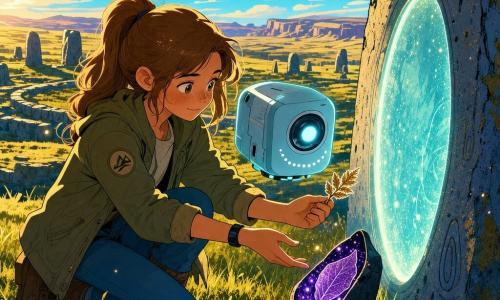
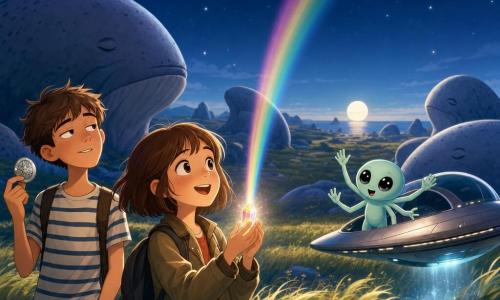
They followed the relic's path and found a tiny moon that was more garden than rock. It had plants that hummed when wind passed, and stones that kept secrets in their rings. It was the sort of place where the unexpected felt like an invitation. Max collected a small, flat stone that shivered like a small memory when he touched it. He put it in his pocket.
The detour hadn't been required in any strict way, but it had been necessary for Max. He'd learned that being chosen didn't mean following a line; sometimes it meant carving a tiny, bright path through the long blue road.
First Footsteps on Nebulon Five
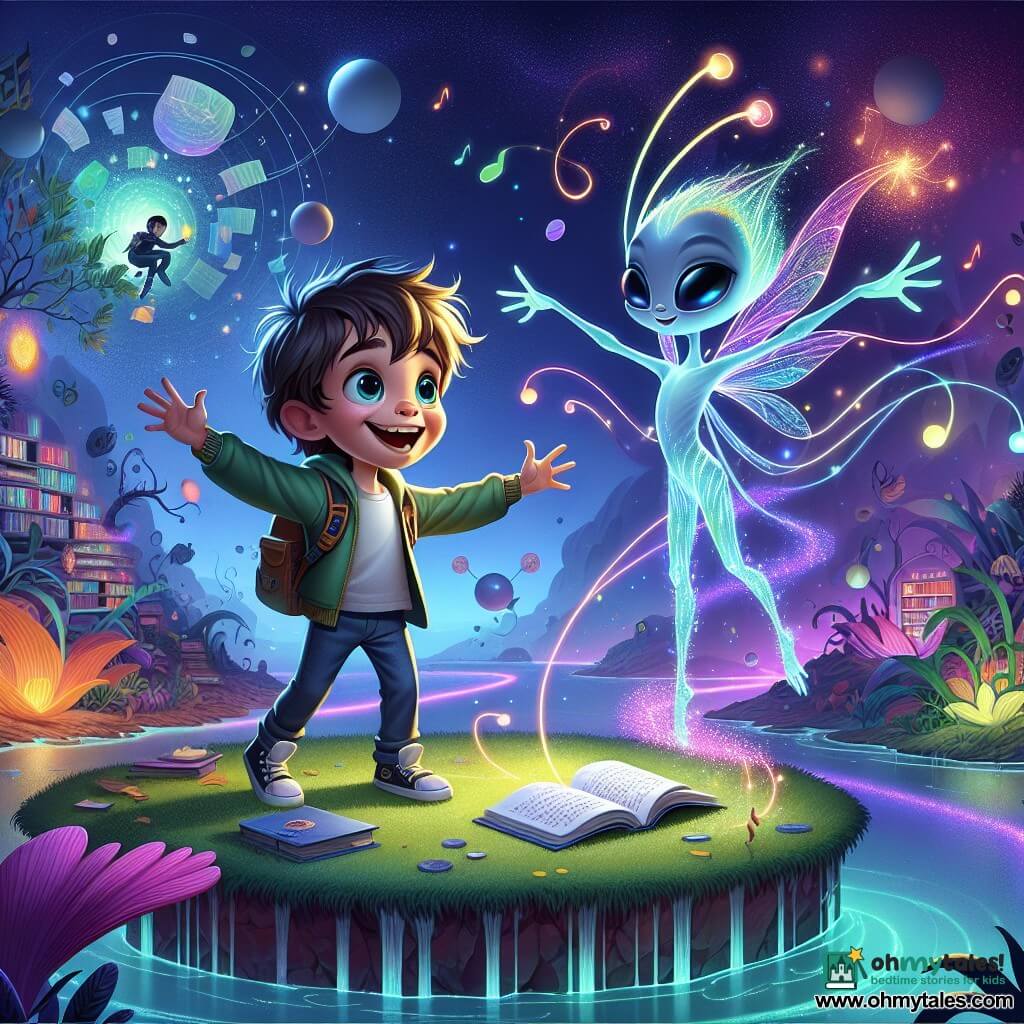
When Nebulon Five finally appeared, it looked like a ribbon of light. At first glance it was a blur of greens and violet, but as the Starwisp drew closer the planet revealed gentle floating islands, each one rimmed with a halo of glowing mist. The sky above held soft auroras that rippled like silk. Below, rivers made of liquid light threaded between islands.
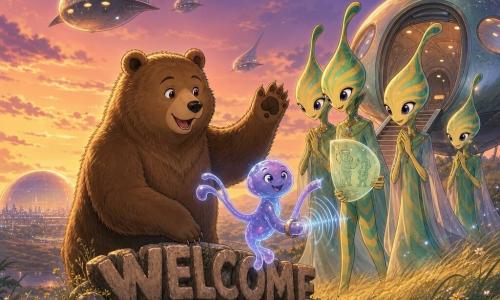
They descended to a landing port shaped like a spiral shell. As the Starwisp set down, the band at Max's wrist thrummed and translated incoming messages into colors he could almost see. An envoy met them at the ramp — tall, slender beings whose skin shimmered like bubbles. Their heads bore graceful tendrils that shifted like musical notes. Their eyes were big and honest. Max felt his breath catch.
"Welcome, children of Earth," said the leader, whose voice sounded like wind through glass. The translator band rendered the sound into words and a soft melody. Max's throat felt like it was full of small bells.
He stepped forward first because his feet had learned to step toward things instead of away. "Hello," he said, and his voice sounded small in the vast air. The Nebulon smiled. Around them, other Nebulons clustered, letting colors wash across their skin like stamps of greeting and curiosity.
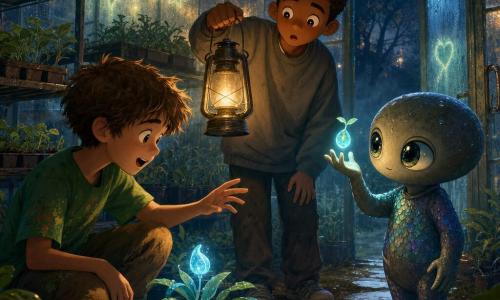
They took the visitors through the city, and everything seemed to hum with polite brightness. Houses were grown, not built, their walls knitted from living vines and light. Children — if they could be called children — drifted near, their bodies trailing tiny ribbons of glow. Max found one of them behind a glowing pylon, peering shyly. The child looked at his wristband, then at Max. A bright chime of curiosity pulsed between them.
"What's your name?" Max asked, and for the first time his translator didn't translate words but a warm glow that made the air taste like honey. The Nebulon child's tendrils curled shyly and a set of colors sparkled: a light, a blue, a laugh. "I am Ori," Max's band said in neat letters on the inside of his eye as the translator translated emotion into speech.
Ori was small and quick, like a skip of starlight. They tugged Max and led him to places the official guides did not show. "We learn with light," Ori explained in a voice that blinked in colors. "We tell stories by changing. Here, listen."
The Nebulons sang. But their songs were not notes as Max knew them; they were pulses of color and tiny changes in the way light gathered and fell. Max's band translated the meaning — stories of rivers that remembered, of sky islands that moved by will, of grandparents who stored memories in crystal trees. When Max tried to mimic a color-pulse, his skin didn't change, but the band projected a soft glow, and the Nebulons clapped their tendrils in delighted surprise.
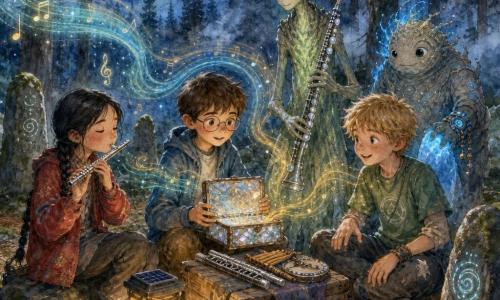
They invited Max to share something from Earth. He had thought about bringing a book, or a photo, or his favorite toy train. Instead he took out a small recorder he always carried and played a short piano melody he knew by heart. The notes were simple: a spark and a question. The music wove into the Nebulons' light and, for a moment, it felt like two languages shaking hands.
Then, in the middle of the exchange, a Nebulon elder — their translator calling them High-Memory — paused and looked troubled. A small device in their hand was dim. "Archive blinks," the translatorband said, which didn't sound alarming until an elder's light dimmed and a hush passed like rain.
Max felt a pinch of worry. When the elders looked worried, the whole planet's colors softened. Something important was missing, and the missing thing had a way of making everything feel unfinished. The officials spoke quickly, and the band translated a phrase that sat in Max's stomach: "We are losing old stories."
"Old stories?" Max asked.
The elder's colors flickered. "When the Echo Storm comes, it blurs tales into mist. We must find what is lost."
Max's hand went to the stone in his pocket. It shivered like it knew a secret. He thought of the relic, the garden moon, the tiny map. He thought of Ori, bright and curious. He thought of the melody he had shared. Max didn't know how to fix great dullings in alien archives, but he knew he could look. He promised Ori and the elder he would try.
The Library of Floating Pages
The Nebulon Library was not a building so much as a garden of suspended pages — each page a leaf of light that drifted like a snowflake. They hung in the air, tethered by thin filaments of thought. When people reached out, the pages tilted and shared their memories in warm ripples of color. The Library smelled faintly of rain and lemon and the sort of quiet that makes thoughts feel safe.
Max floated inside the library on a platform that seemed to know where he should go. The elders moved with him, their tendrils murmuring, and Ori zipped ahead, pointing with a bright spark that meant "look there!" Rows of luminous leaves fluttered like stars turned into pages. Some told of festivals, others of long-forgotten maps, and some kept recipes for foods that tasted like old afternoons. But several spaces were empty. Gaps where light had been or should have been, and the empty places echoed like rooms without furniture.
"We think the Echo Storm has scattered the pages," one elder explained. "It carries fragments across islands and into silence. But only fragments. The stories become whispers in stones, in river songs, in the shells of wind."
Max's hands were suddenly full of ideas. He could play with maps. He could ask the rivers, he thought, because everything here seemed to remember something if you listened the right way. He reached for the stone in his pocket. When he touched it, its shiver became a small sound in his head — a direction.
"Follow the echoes," the band whispered, translating the stone's hum into advice. "They hide in little things."
They set off — Max, Ori, and a small team of Nebulon children who clutched glowing nets like butterfly catchers. They listened to the city: the gossip of the wind, the clink of light against husks, the slow recollection of stones. They combed gardens and caves. In a cave where the rocks hummed like throat-strings, they found scraps of light pinned to stalactites like fireflies. In a shallow pool, they saw ripples that spelled out half a poem.
Max's translator turned colors into words and into tiny sketches on his inner eye. He learned to read the way a river sang about a road, or how a tree kept a recipe by folding one leaf differently. The relic map he had found fit like a missing corner in their navigation chart, and it led them to a small isle that wasn't on the official maps. It was a place Ori's family remembered only in a passing color.
They landed on the isle and found a cluster of crystal mushrooms that chimed when touched. Between the mushrooms, a faint trail of dried light led to a hollow. Inside the hollow was a little globe of silver, caught in roots and dust. When Max picked it up, it pulsed and a tiny projected page unfolded — two sentences in flowing Nebulon script and a melody that felt like warm bread.
"It is a memory globe," Ori whispered. "Some one placed a story inside when the last Storm blew. It must be returned."
The globe's projection faded at first, then brightened as Max held it. It showed an old festival where islands floated closer and elders taught children how to weave words into light. The elders gazed at it with misty colors. "We had nearly forgotten this song," one said, and the library's empty spaces seemed to ease.
They gathered more fragments: a note in a shell, a verse in a rock, a recipe tucked into a river's eddy. Each recovery stitched the library's gaps. Sometimes the pages were not missing but misplaced — sitting in a child's pocket, or stuck to the side of a memory tower. Each recovered fragment came with a small celebration that smelled of citrus and chimes.
Max learned that stories could live in surprising places. A child's drawing held an age-old map if you tilted it the right way. A stone hummed a recipe if you listened through its rings. Curiosity was the thread that pulled these fragments back together. The adults clapped their tendrils in approval. Ori kept brightening like a light bulb at each discovery.
But as the day waned, the elders grew quiet again. The band on Max's wrist pulsed a cautious blue. The storm, they said, would come back. The Echo Storm was like a weather for stories, a swirling of colors that could turn memory into soup. They had a little time left to mend what they could.
Max felt small things weld into a big plan. "If stories can be in rivers and rocks," he said, "maybe we can make a pattern that'll hold them while the storm passes. Like... a song or a light pattern. Something that makes memories stick."
The elders' colors shifted. "A holding pattern," one translated slowly, as if tasting the idea. "That could protect the threads."
Ori's tendrils touched Max's hand. "We can weave it together," Ori said. "You have music. I have pulses. We can..." The idea sat in the air like a promise.
They would weave a pattern of sounds and light that echoed across the island, across the city, across the floating pages. It would be a shelter for stories.
The Storm and the Weaving
When the Echo Storm arrived, it looked nothing like a storm Max had seen on Earth. There were no winds to bend trees, no thunder to rattle windows. Instead, it was a gentle blur that glided over the planet like a school of silver fish. Colors dulled for a heartbeat, then brightened in strange new orders. Voices frayed at the edges. Memories slipped like soap out of a hand.
The elders moved quickly, their tendrils shaping a circle, calling out patterns. Max and the children spread across the Library's gardens, carrying instruments, lights, and panels salvaged from the Sky Market. Max had a small keyboard he loved; the keys were patched but they sang. Anika had taught him how different rhythms could steady a machine's pulse. Ori showed him how to bend light into loops. The Nebulon children hummed and pulsed like a choir of small suns.
At first the storm seemed curious, touching the edges of their patterns and then moving on. But soon it grew more playful, stretching fingers into the places where memories lay. A recipe that had nearly returned to a grandmother's shelf lifted away again. A line of a poem dissolved into the air and became a pale mist.
Max's hands shook, but he steadied himself by thinking of the small piano tune he had played earlier. "We will do this together," he told the group. "If the storm tries to take things, we will hold them. Hold onto the rhythm." His band lit up and the translator converted his intention into a soft green that rippled through the crowd.
They started simple. A steady beat from Max's patched keyboard. A counter-pulse from the Nebulons' light loops. An adult elder provided a low humming tone that seemed to anchor the pattern. Together they formed a wave: sound built on sound, light woven through, like a net knitted to catch memory.
The Echo Storm buffeted them, and for a terrifying moment, a gust of white noise swept through and the music faltered. A fragment of a page floated away, and Max felt it like a tug on his chest. He ran after it with Ori, who trailed bright ribbons so the page would not vanish into the vastness.
"Sing!" Ori pulsed, colors sharp and pleading.
Max didn't sing well; his voice wobbled like a small boat. But he found a steady rhythm — a pattern that matched the beat of his heart. He clapped, he hummed, he tapped the keyboard with a gentleness that turned panic into persistence. The Nebulons mirrored his pulse with glowing loops. Old and young, alien and human, sounded and shone in a pattern that felt like glue for lost things.
Slowly, impossibly, the pages that had drifted began to stick to the net of sound and light. The story fragments, which had been untethered, found their way back to a place where they could be told again. The elders joined the chorus, their colors deep and full, and the library hummed like a restored instrument.
At the storm's core, a great swell of noise tried to lift their creation and scatter it. Max's keyboard keys stuck, and for a heartbeat he thought they had failed. But then, from the Starwisp's little collection of recorded Earth sounds, a child's laughter played — a simple recording the crew had kept for morale. The laughter was bright and fearless. It sewed a stitch in the pattern.
"Use what makes you brave," Anika's voice came through Max's band. He didn't know she had used the ship's recorder, but the effect was immediate. The Nebulon children echoed the laugh with a burst of cyan, and their ripples added to the weave. The storm's edges softened, as if it had been splattered with sunlight.
When the Echo Storm finally moved on, it did so like a cat after a game: disappointed but pleased. The library's pages shivered and then settled, brighter than before. The circle of music and light had held them safe.
Max sat down on the ground and let out a breath that felt like a whole day. Ori leaned against him, sharing a warm pulse. The elders' colors flowed like a slow river, full of gratitude.
"You did it," one elder said, their voice like a bell. "You and your friends wove a protection. You saved our stories."
Max's cheeks warmed. He had been brave, but it had not been a lone kind of brave. It had been a brave that came from a team, a brave that listened, laughed, and learned. He looked at the people around him — at Kito, who had been on the ship but sent a recorded cheer; at Anika, whose steady hand had found the right rhythm; at Ori, whose pulse had never left the edge of possibility. Max felt like he had been given a new kind of map — one that charted friendship as much as stars.
The Nebulons celebrated with food that changed flavors when you smiled, and with light dances that made the air smell like rain. They presented Max with a small token: a pebble that stored a color. When he held it near his band, it projected a tiny loop of the storm's colors — not threatening, but tame, like a memory you could touch.
"You are our first friend from Earth," Ori said, brightness looping like a ribbon. "You are brave."
Max felt his chest swell. "No," he said, shaking his head with a grin. "We are friends."
Return with New Stars
The exchange program continued after the storm, but it felt different. The Nebulons walked beside the humans with a new sense of ease, and the humans carried the planet's light like a favorite song. The lost stories were not all returned — some were still scattered in hidden places — but the spirit of finding them had planted itself in everyone's hearts.
Max spent his last days on Nebulon Five collecting small wonders. He traded Earth's simple jokes for Nebulon light puns. He learned how to braid light into small loops and how to hum a tone that made the plants lean in. Ori taught him the word for "memories that smell like rain," and in return Max taught Ori how to whistle a tune he'd learned from his grandfather.
On their final night, the Nebulons held a ceremony where they traded artifacts of meaning. Max offered the small stone map he had found on the moon. He presented it with a shy speech and a shaky tune. The Nebulons unrolled a sheet of light and placed a glowing leaf into his hands — a leaf that, when held, played the gentle chorus of their city.
"You will remember this place," the elder said, and the leaf pulsed a rippling amber that tasted like honey. "And we will remember your kindness."
When the Starwisp rose from the spiral shell and the planet drifted away, Max watched Nebulon Five grow smaller until it was a soft ribbon. He felt bittersweet; leaving was like closing a book with a dog-eared corner. He tucked the pebble and the leaf into a pocket inside his vest. The band on his wrist flashed a final green, like a wink.
Back at the Intergalactic Youth Base, his return was not a parade but a gentle welcome. He carried stories, and that was enough. His parents were there, older and brighter than he remembered, and they hugged him until his ribs cracked a little with relief. He told them about Nebulon light songs and floating islands, about Ori's quick laughter and the way a recipe could be a map. He did not tell them everything; some things needed to feel like sparkling secrets.
Weeks later, Max would go back to school, where his classmates had not been to other planets but had been on bus rides and bicycle loops. He drew pictures of Nebulon Five in the margins of his homework, and Anika printed a star chart showing the Long Blue Road. He kept the leaf-and-pebble duo in a drawer, the pebble soft as a memory and the leaf small and bright when he stroked it.
He learned that curiosity was never wasted. It could stitch a library, steer a pod, and convince a planet that a small human with an eager smile was worth trusting. He learned that friends could come with tentacles or freckles, with laughter or light. He learned that when storms come, people and planets knit together to hold the stories they loved.
One evening he stood on the base's observation deck and looked up at the smudged sky. A satellite winked by and somewhere beyond, a ribbon of light marked the Long Blue Road. Max took the pebble out and watched a swirl of soft color breathe inside it. He thought of Ori, of the elder's slow smile, of the taste of a Nebulon recipe that had changed flavors with every memory.
"Will they remember us?" he asked the pebble, half-laughing.
The pebble glowed a small, steady green. The band on his wrist pulsed as if to nod. In Max's pocket, the leaf hummed a tiny memory loop of the library. It wasn't the same as being there, but it was enough to make the stars feel like friends.
Max tucked the pebble back in and put his hand on the railing. He felt a gentle promise — not only to travel farther, but to always go somewhere with questions in his pocket and kindness in his step. The universe felt less like a place of strange things and more like a neighborhood where everyone kept a story to share.
As he turned to go inside, the night sky seemed to lean in, full of patient lights. Max smiled, because he knew he would never stop being curious. And somewhere, across the sea of stars, there were glowing tendrils that probably twitched when they thought of him. He waved, small and confident, and the stars winked back.