Part 1: Dr. Milo and the Quiet Clinic
Morning light slipped between the tall buildings and painted golden lines on the sidewalk. Cars whispered by, and a bus sighed at the corner. Inside a small clinic with a green door, Dr. Milo washed his hands and hummed a soft tune.
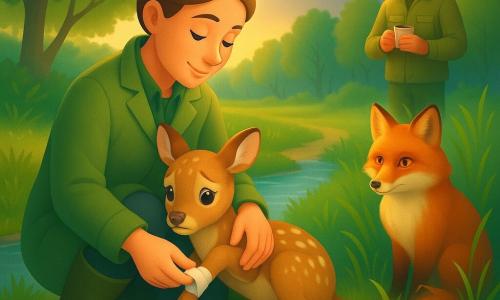
Dr. Milo was a wildlife veterinarian. That meant he helped animals who did not live in homes—animals from parks, rivers, rooftops, and empty lots. He was a modest man. His coat was clean but a little faded. His shoes were scuffed from many walks. He never bragged. He just smiled and did the next kind thing.
A bell jingled.
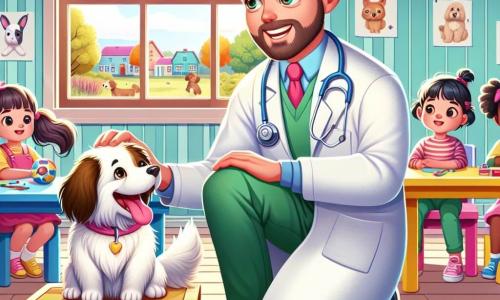
A boy and his mom stepped in, and a small dog trotted beside them. The dog was fluffy and white, with ears like little clouds. The boy held the leash very tight, as if the leash might fly away.
Dr. Milo crouched down to the dog's level. “Hello there,” he said gently.
The boy's fingers stayed clenched around the leash. His face looked worried.
Dr. Milo looked up and gave the boy a warm smile, the kind that said, I see you. “You're holding on like a strong helper,” Dr. Milo said. “But your hand can rest a bit. Your dog is safe here.”
The boy blinked. His grip loosened just a little.
The mom let out a small breath. “Thank you,” she said. “He's nervous.”
“That's okay,” Dr. Milo said. “Lots of people feel nervous when someone they love needs help.”
The dog wagged its tail, then sneezed.
“Achoo,” the boy whispered, and he finally giggled.
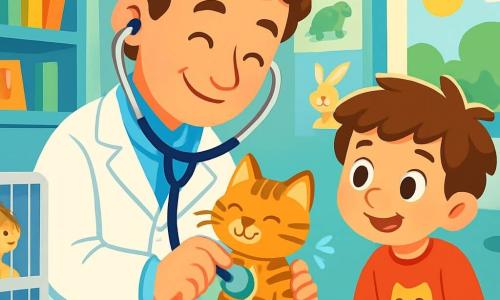
Dr. Milo examined the dog with calm, careful hands. He listened to the dog's heart with a stethoscope. “Thump-thump,” it went, steady and brave. He looked in the dog's ears and eyes. He felt the dog's belly softly.
“Looks like a mild allergy,” Dr. Milo explained. “Maybe pollen. We'll make him comfy.”
“How?” the boy asked.
“First,” Dr. Milo said, holding up one finger, “we check. Second, we clean. Third, we treat. And always—always—we are gentle.”
The boy nodded like this was an important plan.
Dr. Milo wrote a note and handed the mom a small paper. “A rinse for his paws after walks can help,” he said. “And a tiny medicine for the itching.”
The dog licked Dr. Milo's hand as if saying thank you.
When they left, the bell jingled again, and the clinic became quiet.
Dr. Milo looked at the day's list on his board. Most were wildlife calls: “pigeon with hurt wing,” “squirrel with limping paw,” “duck tangled in string.”
He picked up his worn canvas bag. Inside were bandages, a tiny flashlight, soft towels, and a little box of tools. His bag was not fancy, but it was ready for kindness.
Before he could step outside, the phone rang.
“Wildlife Clinic, Dr. Milo speaking.”
A shaky voice answered. “Um… hello. I'm at the city fountain. There's a raccoon. I think it's stuck.”
Dr. Milo's eyes softened. “You did the right thing by calling. Is the raccoon breathing?”
“Yes,” the voice said. “But it keeps trying to pull away. It looks scared.”
“Okay,” Dr. Milo said. “Stay a safe distance. Don't try to grab it. I'm coming.”
He hung up, grabbed his bag, and headed into the bright city morning.
Part 2: The Fountain Rescue
The city fountain sprayed glittering water into the air. Pigeons strutted around the edge like they owned the place. People sat on benches with snacks and paper cups.
Near a bush, Dr. Milo saw the raccoon.
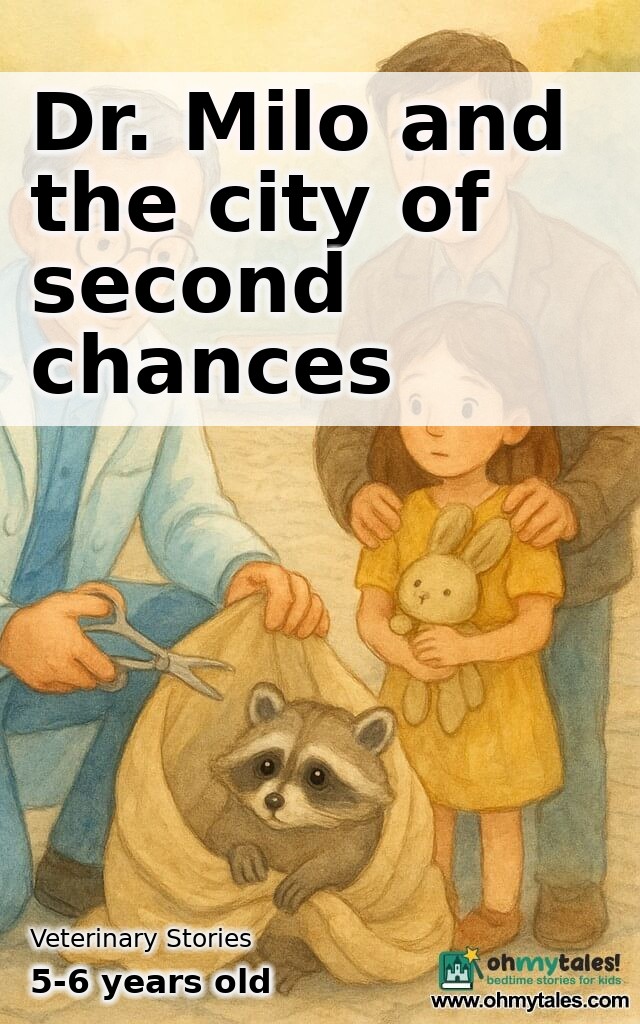
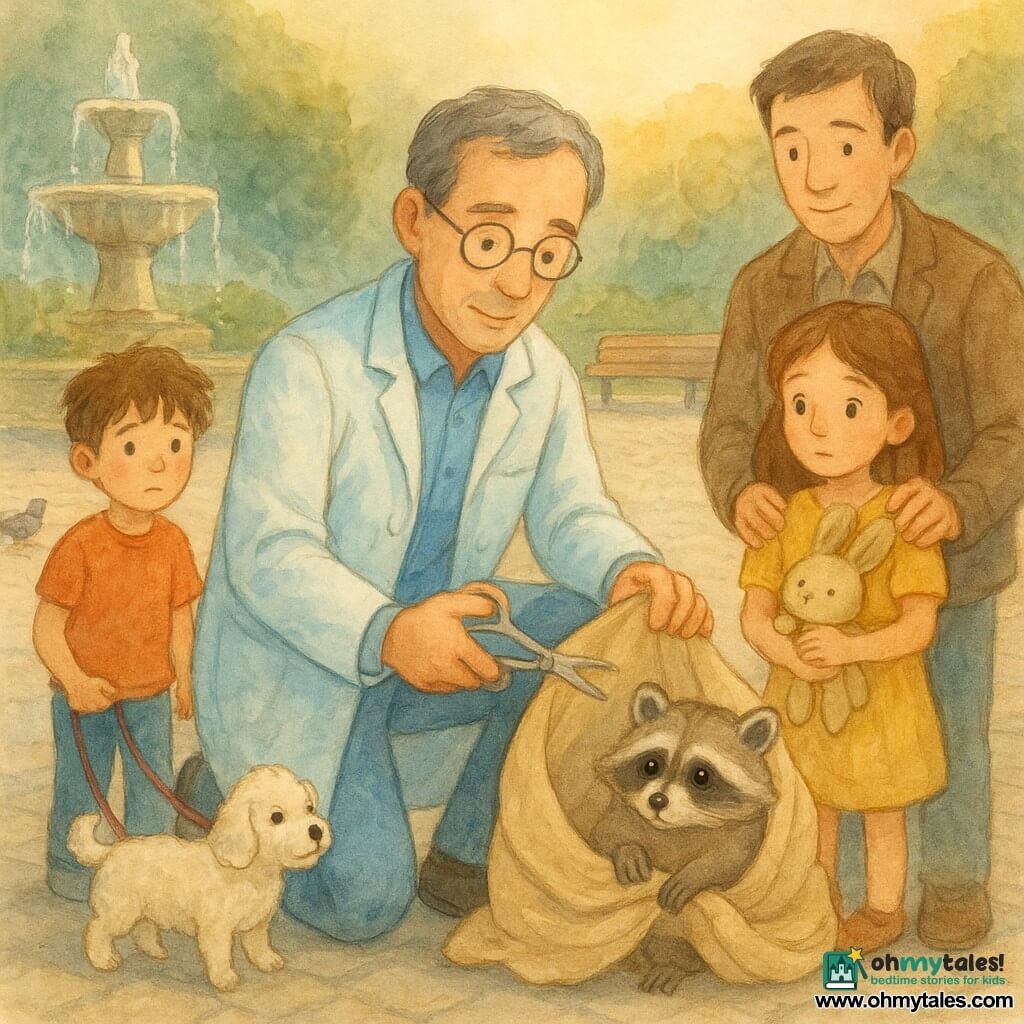
It was small, with a ringed tail and curious eyes. One paw was caught in a loop of plastic—maybe a piece of a broken handle from a bag. The raccoon tugged, and the loop tightened. It hissed softly when anyone got close.
A girl stood nearby with her dad. She clutched a stuffed rabbit. Her eyes were wide.
“I'm Dr. Milo,” he said to them. “Thank you for staying back. Wild animals can bite if they're scared.”
The girl nodded fast. “I wanted to help,” she said. “But Daddy said not to touch.”
“Daddy was right,” Dr. Milo said kindly. “Helping also means being safe.”
He knelt a few steps away from the raccoon, speaking in a calm, low voice. “Hello, little one. I'm not here to hurt you.”
The raccoon froze. Its nose twitched.
Dr. Milo slowly opened his bag and pulled out a thick towel and a small net. He moved like a slow cloud drifting across the sky—no sudden jumps.
“Why a towel?” the girl asked.
“A towel can feel like a soft cave,” Dr. Milo said. “It helps the animal feel covered and less scared. And it protects my hands.”
He placed the towel over the raccoon with gentle care. The raccoon wriggled, but the towel made it calmer. Dr. Milo guided it into the net in one smooth motion.
“Good job,” the dad whispered.
Dr. Milo carried the net to a quiet spot behind a low wall where the fountain sounds were softer. He spoke as he worked, because teaching was part of caring.
“When an animal is trapped,” he said, “we do three things: we keep everyone safe, we stop the pain, and we fix the problem.”
He used small scissors with rounded tips. “These are special scissors,” he explained. “They're made to cut things like string without poking skin.”
He lifted the trapped paw just a little and snipped the plastic loop. It fell away like a tiny broken ring.
The raccoon's paw was red and puffy.
“Ouch,” the girl said, hugging her stuffed rabbit tighter.
“Yes,” Dr. Milo agreed. “But we can help.”
He checked the paw carefully. “No bone sticking out. That's good.” He pressed lightly to see if the raccoon flinched. It did, but not too much. “It's sore, but I think it will heal.”
He cleaned the paw with a gentle rinse from a small bottle. The raccoon shivered.
“I'm sorry,” Dr. Milo murmured, “but this keeps germs away.”
“What are germs?” the girl asked.
“Tiny things we can't see,” Dr. Milo said. “They can make wounds sick. Cleaning chases them away.”
He dabbed the paw with a soft pad. Then he spread a thin layer of medicine that smelled faintly like herbs.
“Now,” he said, “we need to see if you can walk.”
He carefully lifted the towel. The raccoon blinked in the light, then put its paw down. It took one step… then another. It limped, but it could move.
“That's a good sign,” Dr. Milo said.
The raccoon looked at him, and for one moment its eyes seemed less scared. Then it turned and hurried into the bushes, tail bobbing like a striped flag.
The girl clapped once, then remembered to be quiet. “It's free!”
Dr. Milo smiled. “You helped by calling attention and staying safe.”
The dad nodded. “Thank you, Doctor.”
Dr. Milo picked up the plastic loop with a tissue. “This is why we throw trash away,” he said, showing it from a distance. “To us it's just garbage. To animals it can be a trap.”
The girl's face grew serious. “I'll tell my friends.”
“That's a big kindness,” Dr. Milo said.
As he walked back toward the street, his phone buzzed again.
“Dr. Milo,” said the clinic assistant, “we got another call. A pigeon on the library steps. It can't fly.”
“I'm on my way,” Dr. Milo said.
He looked up at the city skyline. So many windows. So many corners where animals could get into trouble. His job was like being a quiet guardian, moving where help was needed.
And he didn't do it for applause. He did it because every heartbeat mattered.
Part 3: Wings, Warmth, and a Small Twist
The library steps were wide and gray, warm from the sun. A pigeon sat near the bottom, feathers puffed up like a tiny coat. One wing drooped.
A few people stared. Someone tossed a crumb.
Dr. Milo raised a hand. “Please don't feed it right now,” he said kindly. “It may need care first.”
A teenager stepped back. “Sorry,” he said.
Dr. Milo crouched. “Hello, friend,” he whispered to the pigeon.
He moved slowly and covered the pigeon with a light towel. Then he held it close, supporting its body so it felt secure.
Back at the clinic, Dr. Milo placed the pigeon in a small, quiet box with air holes. “Dark and calm helps,” he explained to a little girl who was visiting with her grandpa. The girl stood on tiptoes to see.
“Is it going to be okay?” she asked.
“We will do our best,” Dr. Milo said. “That's what vets promise.”
He showed her his tools on the counter. “This is a thermometer,” he said, holding it up. “It tells me if an animal is too hot or too cold. This is a scale. Even small animals need the right amount of medicine, and weight helps us measure.”
The girl leaned closer. “Do animals get scared?”
“Yes,” Dr. Milo said. “That's why we use soft voices and gentle hands. And we watch their body language.”
“Body language?” she asked.
“How they move,” Dr. Milo said. “If a bird flaps hard and tries to escape, it's frightened. If it sits very still with half-closed eyes, it may be tired or hurt. We listen with our eyes.”
He opened the box just enough to peek. The pigeon's eyes were dull, and it breathed fast.
Dr. Milo frowned slightly. “Hmm.”
“A problem?” Grandpa asked.
“A small twist,” Dr. Milo said softly. “The wing may not be the only issue. Fast breathing can mean stress… or something stuck.”
He listened with a tiny stethoscope made for small animals. Then he gently checked the pigeon's beak and throat.
He found a thin piece of string, like thread, tangled near the pigeon's tongue.
“Oh no,” the girl whispered.
“Strings are tricky,” Dr. Milo said. “They can hide. And they can hurt.”
He used a small tool like tweezers, very carefully. “We never pull hard,” he explained. “We go slow so we don't tear anything.”
One gentle tug, then another, and the string slid free.
The pigeon took a deeper breath. Its chest rose and fell more calmly.
The girl exhaled like she had been holding her own breath too. “It can breathe!”
“Yes,” Dr. Milo said, and his smile returned. “Good noticing, Dr. Milo,” he said to himself in a playful whisper, making the girl giggle.
He wrapped the drooping wing with a light bandage, not too tight. “Bandages are like hugs,” he explained, “but they must not squeeze.”
He placed the pigeon in a warm corner with a heat pad under half the box. “Animals can choose,” he said. “If it's too warm, it moves to the other side.”
The girl nodded. “Like choosing a blanket!”
“Exactly,” Dr. Milo said.
Later that afternoon, the pigeon stood taller. It sipped a little water. It even made a soft coo.
Dr. Milo wrote notes on a chart. “Wildlife vets keep records,” he explained to the girl and grandpa. “It helps us remember what we saw and what we did. That way we make smart choices.”
The girl looked proud, as if she was part of the team. “So you're like a doctor and a detective.”
Dr. Milo chuckled. “Yes. A kind detective.”
When the visiting pair left, Dr. Milo cleaned the table and washed his hands again. He always cleaned. It protected the animals.
Outside, the sky began to turn peach and lavender. Dr. Milo packed a small carrier. The pigeon would stay overnight. Tomorrow, if the wing looked stronger, Dr. Milo would bring it to a safe place near the river where other pigeons gathered.
He turned off one lamp, then another, leaving only a gentle night light.
A final knock came at the door.
Dr. Milo opened it to find the boy from the morning. The same fluffy dog sat beside him, wearing a tiny blue bandana. This time, the boy held the leash more softly.
“I wanted to say… thank you,” the boy said. “My dog is not itching now.”
Dr. Milo's eyes warmed. “I'm glad.”
The boy looked down, then up again. “Do you help only wild animals?”
“Mostly,” Dr. Milo said. “But I also help people learn how to help. That's part of the job too.”
The boy nodded slowly. “I told my neighbor not to throw bread near the trash. Because it can make animals come close and get stuck.”
Dr. Milo crouched to the boy's height. “That's a wise thought,” he said. “Kindness can be sharing, but kindness can also be keeping places clean and safe.”
The boy smiled. “I want to be brave like you.”
Dr. Milo shook his head gently. “I'm not brave all the time. I'm careful. I ask for help when I need it. And I try again when things are hard.”
The boy's shoulders relaxed. “I can do that.”
“Yes,” Dr. Milo said. “You can.”
The dog wagged its tail and pressed its nose to Dr. Milo's palm.
“Good night,” the boy said.
“Good night,” Dr. Milo replied.
After they left, Dr. Milo locked the green door and stepped outside. The city was quieter now. Streetlights hummed softly. A faraway car whooshed by. Somewhere, a train rumbled like a sleepy giant.
Dr. Milo walked a few steps, then stopped to look back at his small clinic. Inside, a pigeon rested with a bandaged wing. In bushes by the fountain, a raccoon used its paw again. In an apartment nearby, a fluffy dog slept without itching.
Dr. Milo breathed in the cool evening air. He felt tired in a good way, the way you feel after helping.
He headed home at an easy pace. The sidewalk was smooth under his feet. The world seemed to settle.
And soon there was a gentle silence, only softly stirred by a few sounds of the city.