The Last Case
Maya Finch was a young detective with quick eyes and a gentle smile. She loved puzzles. She loved lists. She loved putting things in the right order. She had decided to take a long rest after one last case. “I will hang up my hat after today,” she told her cat at breakfast. “One more mystery.”
That morning, the mayor called. “Detective Finch,” said Mayor Bloom. “The golden key for the town clock is missing! The Spring Fair starts at noon. The clock will not chime without the key. Can you help?”
“I will,” said Maya. “Let us think clearly. Let us listen.”
She arrived at the hall under the clock tower. The hall smelled like flowers and warm bread. People hurried and talked. The big clock in the tower stood still. Its hands were stuck.
Mayor Bloom wrung his hands. “I saw the key on its hook at eight o'clock,” he said.
Maya looked at the wall where the key should hang. She saw a tiny silver glitter star on the floor. She saw a green fern tip by the window. She saw a dusting of white near the stage, like flour.
She nodded. “I need a clear timeline,” she said. “Please tell me what happened and when. We will put the times in order.”
“I am Rosa,” said a woman with a watering can. “I am the gardener. At eight-fifteen I heard the clock chime. It was working then.”
“I'm Gus,” said a man with a set of keys. “I am the janitor. At eight-thirty I locked the back door. I swept fast.”
“I am Lina,” said a woman with bright ribbon. “I teach music. At eight-forty I hung shiny music ribbons near the hook.”
“I'm Tom,” said a man with flour on his apron. “I delivered buns at eight-fifty. One box tipped. Puff! Flour everywhere. Sorry.”
Maya wrote down each time in neat numbers. She kept her voice calm. “Good,” she said. “We have a start.”
She bent to look closer at the floor. The dust of flour near the stage made a soft trail. The silver glitter star looked like it came from a music sticker. The fern tip by the window said the window had been used.
Maya looked up at the clock. “We will solve this,” she said softly. “We will need careful thinking and patience.”
Putting the Times in Order
Maya placed five sticky notes on a bench. On each she wrote a time and a simple sentence.
8:00 – Mayor saw the key on the hook.
8:15 – Rosa heard the clock chime.
8:30 – Gus locked the back door.
8:40 – Lina hung shiny ribbons by the hook.
8:50 – Tom brought buns. Flour puff!
She stepped back and looked. “What do you notice?” she asked, as if you were standing right there with her. “When could the key have gone missing? Before eight-fifty? After eight-fifteen?”
She pointed at the notes. “The clock chimed at eight-fifteen. So the key was still around then. At eight-forty, shiny ribbons were near the hook. Something could have happened.”
Maya spoke to each person again, one by one.
“Gus, when you swept, did you see the key?” she asked.
Gus frowned. “No. I swept fast. I did hear a small clink. I thought it was a ribbon clip.”
“Lina, did you touch the hook?” asked Maya.
“I hung the ribbon on a nail under the hook,” said Lina. “I stuck little glittery music stickers onto the ribbon. One sticker fell.”
“Tom, where did you spill the flour?” Maya asked.
“By the stage,” said Tom. “I set down the boxes there.”
“Rosa, did you open the window by the fern?” asked Maya.
“Yes,” said Rosa. “Just a crack. The hall felt warm.”
Maya tapped her pencil. She looked again at her notes. She wanted to set the moments in a perfect line. She wanted the story to make sense.
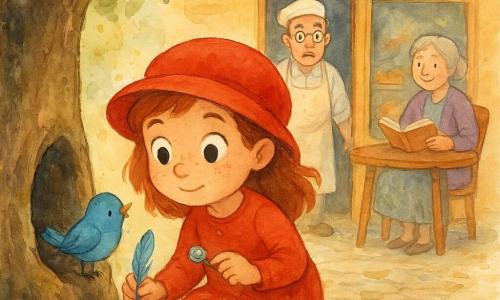
Just then, she heard a soft meow from under the stage. She also felt eyes watching her. She turned and saw a small, curious child peeking from behind a tall pillar. The child wore a red cap and a careful, thinking face.
Maya smiled with her eyes. She did not speak. She lifted one finger to her lips in a small, quiet signal. It was a discreet gesture that said, “Shh. Come if you like.”
The Quiet Signal
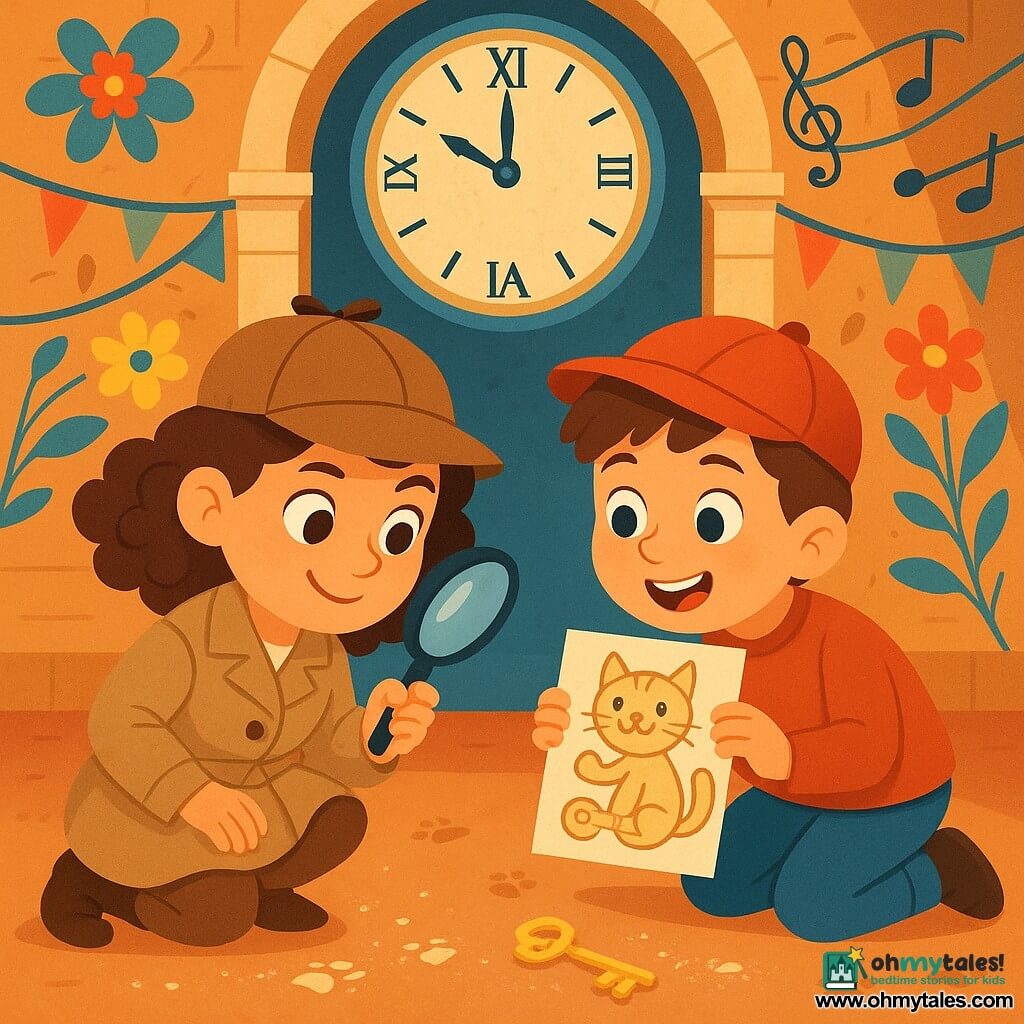
The child gave a tiny nod back. They made a discreet, tiny wave toward the stage. Then they tiptoed to Maya's side and slipped a folded paper into her hand. No one else noticed.
Maya opened the paper. It was a drawing. A cat with black-and-white fur batted a shiny oval shape under a curtain. A little star sticker shone in the corner of the picture.
Maya crouched so her face was level with the child. “Did you see this?” she whispered.
“Yes,” the child whispered. “I am Pip. I came early to see the ribbons. At eight-something, the music lady hung shiny things. They glittered. Whiskers, the hall cat, chased the sparkle. I heard a clink. Something fell. Whiskers pushed the shiny thing under the stage. Later I smelled buns. That was after.”
Maya's eyes lit up. “After the ribbons and the clink. Before the buns,” she said. “Thank you, Pip. That is important.”
She stood and looked at the sticky notes again. She moved her finger from eight-forty to an empty space between eight-forty and eight-fifty. She drew a small star there.
She spoke softly, so you could think with her. “Order matters. Let us test this timeline:
8:00 – Key on hook.
8:15 – Clock chimes. Key still around.
8:30 – Back door locked.
8:40 – Shiny ribbons hung. A sticker falls. A clink.
Between 8:40 and 8:50 – Cat chases sparkle, bats shiny key under stage.
8:50 – Buns arrive. Flour puff by the stage.
Does that fit the clues?”
She pointed. On the floor near the stage were tiny white paw prints in flour. On one paw print, a little music note sticker stuck and shone. Near the window, the fern tip trembled, as if a breeze had just passed. It made sense. Shiny ribbons could sway. The key could bump. A clink. Then a curious cat could come and play.
Maya took a small flashlight from her pocket. “Perseverance,” she said gently. “We keep going.”
She got down on her hands and knees and peered under the stage. “Hello, Whiskers,” she said in a calm voice.
Two yellow eyes blinked back in the dark. Something glinted like a small sun. Maya reached slowly. She did not rush. She moved a crate. She moved a coil of cord. She listened and watched.
Clockwork Answer
When she came back up, the golden key lay in her hand. It was dusted with flour and a tiny bit of glitter. A fern fiber clung to its chain. Whiskers followed, tail up, purring.
The whole hall went still. Then everyone began to talk at once.
“The key!” cried Mayor Bloom.
Maya raised her hand. “Let us share the answer,” she said. “Step by step.”
She pointed to the notes. “At eight, the key was on the hook. At eight-fifteen, the clock still worked. At eight-forty, Lina hung shiny ribbons near the hook. A sticker fell. There was a clink. The window was open a crack, so the ribbons swayed. The key wobbled. It slipped. Pip saw Whiskers chase the sparkle and bat the key under the stage. At eight-fifty, Tom brought buns and spilled flour, which made the tiny paw prints we can see now.”
She looked around. “We solved it with careful eyes, clear order, and kind help.”
Gus laughed. “I thought I heard a clink!”
Lina sighed. “I didn't know my ribbons could make trouble.”
Rosa said, “We will close the window just a little next time.”
Tom stroked Whiskers. “You clever cat,” he said. “No more shiny toys for you.”
Maya walked to the clock. She fit the golden key into the winding place. She turned it, one, two, three times. The gears woke. The hands moved. The bell rang out a bright, happy note.
People cheered. Pip clapped and jumped. Maya felt something warm spread through her chest. A smile of relief came to her face.
She bent to Pip. “You noticed. You remembered the order. That is how detectives think,” she said. She pressed a tiny magnifying glass keychain into Pip's palm. “A thank-you for your discreet help.”
Pip grinned. “I want to think like that again.”
“You can,” Maya said. “Anyone can. Watch. Ask. Put the pieces in order.”
Mayor Bloom shook Maya's hand. “Thank you, Detective Finch.”
Maya looked up at the steady clock. “This was a good last case,” she said softly. She thought of her long rest and the quiet days ahead. But she also thought of puzzles and people and the joy of a clear answer.
She turned to the hall, to Pip, to Whiskers, to the kind faces. “If another mystery comes,” she said with a playful wink, “I might not hang up my hat just yet.”
Outside, the fair music began. The clock chimed on time. The town smiled. And so did Maya.