Chapter 1: The Jacket with a Story
Monday morning smelled like warm toast and clean soap in Maplewood Burrow School. Lila the rabbit padded along the path with her backpack bouncing softly on her shoulders. Her ears poked out from under a bright blue beanie, and her whiskers twitched when she heard the school bell.
Lila's jacket was not new. It used to belong to someone else, maybe a taller rabbit, maybe a fox with long arms. The sleeves were a little wide, and the zipper pulled with a tiny squeak. But Lila loved it.
On the back, right between the shoulders, she had stitched a big patch shaped like a carrot. The carrot was made from orange fabric she found in the “share box” at the community shelf near the library. She had added green thread leaves at the top and a little smile in the middle, just because it made her giggle.
The jacket also had two buttons that did not match. One was round and shiny like a pebble. The other looked like a tiny flower. Lila had picked them from a tin that her Aunt Junie kept for “useful things that shouldn't be thrown away.”
“Good morning, Lila,” called Mr. Badger, the crossing helper, holding up his sign so the little ones could trot safely across.
“Good morning!” Lila waved, and the carrot patch seemed to wave too.
At her classroom door, Lila wiped her paws on the mat and hung her jacket on the hook. A few jackets were fuzzy and new, with smooth zippers and perfect cuffs. A few were older, with elbows that looked like they had hugged a lot of desks.
Lila noticed Theo the squirrel standing very still. He kept tugging at his sleeve, as if he wanted it to grow longer.
Mrs. Owl, their teacher, fluttered down to her perch and clapped her wings softly. “Today we begin our ‘Community Week,'” she said. “We will learn how neighbors help neighbors. We will also collect items for our school sharing shelf. If you have something you no longer use, you can bring it.”
Lila's ears perked up. She loved the sharing shelf. It was where you could leave something and take something, no questions, no fuss.
During reading time, Lila glanced at Theo again. His eyes were on his book, but his tail was wrapped tight around his waist. Lila remembered that feeling—when you want to be invisible, but you also want someone to notice in a kind way.
At recess, the playground was full of squeaks and thumps and laughter. Lila hopped to the swings, her jacket flapping like a small flag behind her. The carrot patch flashed in the sun.
Theo sat on the edge of the sandbox, drawing lines with a stick.
Lila sat nearby, close enough to be friendly, not too close to be annoying. She pulled a loose thread on her cuff and tucked it back in.
Theo peeked at her jacket. “Did you… make that?” he asked, in a voice as quiet as falling leaves.
“Aunt Junie helped me sew the big stitches,” Lila said. “I did the little ones. The carrot is my favorite part. It makes the jacket feel like mine.”
Theo nodded slowly. “It looks… brave.”
Lila laughed, a small warm laugh. “A carrot with a smile is brave? I guess it is.”
Theo's cheeks puffed like he was holding a secret. Then he said, “My paws get cold. I don't have a lot of warm things. We… we use what we can.”
Lila didn't gasp. She didn't make a sad face. She just listened, because listening can be a gift.
“My family uses what we can too,” Lila said. “That's why I like fixing things. It's like saying, ‘You still matter.'”
Theo's shoulders dropped a little, as if he had been holding them up for a long time. “Do you think… it's okay? To not have new stuff?”
Lila looked at the swings, at the worn rope with knots tied by many paws. It still held everyone safely. “It's okay,” she said. “And it can even be good. We can be careful with what we have. We can share. We can make things last. That's not shameful. That's smart.”
Theo blinked, and his tail loosened.
The recess whistle blew. As they lined up, Lila's jacket squeaked its tiny zipper squeak, like it was cheering.
That afternoon, Mrs. Owl announced, “Tomorrow we will have a ‘Fix-It and Make-It' station. Bring something you want to repair or decorate. We will learn simple skills.”
Lila's heart hopped in her chest. She knew exactly what she wanted to bring: her old pencil case with a rip, and a few scraps of fabric that might become something new.
As she walked home, she imagined a classroom full of animals sewing, tying, and laughing gently together. She also imagined Theo with warmer paws.
And that made her hop a little higher than usual.
Chapter 2: The Fix-It Table
Tuesday arrived with a soft drizzle. Raindrops tapped on leaves like tiny drumbeats. Lila wore her jacket and felt cozy, even with the sleeves still a bit wide. Wide sleeves were good for hiding snacks, she thought, and she grinned at her own joke.
In her backpack, she carried her torn pencil case, some thread, and a small pouch of fabric scraps Aunt Junie had sorted for her. There was a strip of green, a square of yellow, and a piece of red with white dots that looked like a ladybug's umbrella.
At school, the classroom had been changed. One corner held a “Fix-It and Make-It” table with safe, blunt needles, scissors with rounded tips, and a basket of buttons. Mrs. Owl had placed a sign: “Use, Reuse, and Care.”
“We will work in calm pairs,” Mrs. Owl said. “We will take turns. We will ask before we borrow. We will thank each other.”
Lila chose a spot near the window. She liked good light for seeing stitches. Theo sat at the same table, holding a sleeve with a small tear at the cuff.
His eyes darted around. “I didn't know if I should bring it,” he whispered.
“I'm glad you did,” Lila said.
Mrs. Owl glided over. “Theo, that sleeve looks like it has done many important jobs,” she said kindly. “Let's help it do a few more.”
Theo's ears—well, squirrels don't have big rabbit ears, but his little ears—tilted forward.
Lila began repairing her pencil case. She showed Theo how to push the needle in and out like a tiny hopping motion. “In, out. In, out,” she said softly, almost like a song.
Theo tried. His paws shook at first, but the stitch went through.
“It worked,” he said, surprised.
“It did,” Lila replied. “Your paws are learning.”
At the next table, someone glued a patch onto a backpack. At another, someone tied a new knot in a shoelace. The room was full of small careful sounds: snip, snip; scratch, scratch; quiet “thank you”s.
Then came a moment that made Theo freeze.
Pippa the fox walked by, her tail swishing neatly. Her coat was shiny, and her scarf looked brand new. She glanced at Theo's sleeve and made a face like she smelled sour berries.
“Why would you wear that?” Pippa said, not loudly, but loudly enough.
The room got quieter in that corner.
Theo's paws clenched around the sleeve. His whiskers drooped. For a heartbeat, Lila felt a hot bubble in her chest. She wanted to shout. She wanted to jump up and thump her foot.
But Mrs. Owl had taught them something important: when you want to fix a problem, you use calm words that hold steady.
Lila took a breath. “Because it still works,” she said, clear and gentle. “And because fixing things is a good skill. It helps our community.”
Pippa shrugged. “My stuff doesn't rip.”
Lila glanced at Pippa's scarf. One end dragged close to the floor, and a muddy pawprint marked the fringe. Lila didn't point it out in a mean way. She just smiled slightly.
“Everything can get worn,” Lila said. “Even shiny stuff. That's normal.”
Mrs. Owl floated closer, her eyes kind but firm. “Pippa,” she said, “in our classroom we speak with respect. Some families have more, some have less. That does not change anyone's worth.”
Pippa's ears flattened. She looked at the muddy pawprint on her scarf, then at Theo's careful stitches. Her voice got smaller. “I… I didn't think.”
“That's why we learn,” Mrs. Owl said. “Learning is for everyone.”
Pippa lingered a moment. “Do you… know how to fix fringe?” she asked, almost as if the words were heavy.
Lila's smile returned, warmer now. “Yes. You can tie it in little knots. It's like giving your scarf tiny tails.”
Pippa blinked. Then she sat down at the table, a little stiffly. “Can you show me?”
Theo looked up. His eyes were wide, but not scared—more like he had just seen a door open.
Lila showed Pippa how to make a simple knot. Theo, still holding his sleeve, watched closely. After a few tries, Pippa's knots stayed in place.
“That's… actually nice,” Pippa admitted, touching the fringe. “It feels… mine.”
“It is yours,” Lila said. “Even if it got muddy. Mud happens.”
Theo made one more stitch. His paw stopped shaking.
Later, Mrs. Owl asked the class to share what they learned.
Lila raised her paw. “I learned that fixing things makes them special,” she said. “And it helps us remember we can take care of what we have.”
Theo raised his paw too, slowly, like lifting a feather. “I learned I can repair something,” he said. “And… that it's okay to ask for help.”
Pippa lifted her paw, cheeks pink. “I learned to think before I talk,” she said. “And… knots are harder than they look.”
The class chuckled, kindly.
When the bell rang, Lila noticed Theo walking out with his sleeve neatly stitched. He held his paws up to the light, admiring his work.
“Your sleeve looks ready for adventures,” Lila said.
Theo smiled. “Not big adventures,” he said. “Just… normal ones.”
“Normal is good,” Lila replied. “Normal is where the best things happen.”
Chapter 3: The Sharing Shelf and the Dignity Rule
On Wednesday, Mrs. Owl placed a basket beside the sharing shelf. “Today we practice giving and taking with dignity,” she announced. “That means we do not tease, we do not stare, and we do not ask rude questions. We simply help our community stay warm, fed, and ready to learn.”
The sharing shelf stood near the classroom library. It held pencils, notebooks, a few clean lunch containers, and folded clothes in a neat stack. A small sign said, “Take What You Need, Leave What You Can.”
Lila liked that sign. It felt like a gentle paw on your shoulder.
At home, Lila's family didn't have extra coins for new things very often. They planned carefully. They made soups that stretched for two days. They mended socks. They used both sides of paper for drawing. It wasn't a secret, but it also wasn't something Lila shouted about. It was simply their life.
And there were good parts: Aunt Junie's button tin, her family's silly “Leftover Surprise” nights, and the pride of making something last.
That morning, Lila brought in a small bag. Inside were two storybooks her little cousin had outgrown and a soft scarf that no longer fit around Lila's neck.
She placed them on the shelf with care. “Thank you for being useful,” she whispered to the scarf, because she liked talking to objects as if they had feelings. It helped her remember to be gentle.
During quiet reading time, Lila noticed Theo hovering near the shelf. His eyes moved over the items, but he didn't reach out.
Lila remembered the “dignity rule.” Sometimes the hardest part of taking what you need is feeling like you're doing something wrong, even when you're not.
She didn't call attention to him. Instead, she stood up and walked to the shelf as if she had just remembered something.
“Oh!” Lila said, softly, mostly to herself. She picked up a notebook and frowned playfully. “This one has a page with a drawing of a banana wearing boots.”
She flipped it open. There really was a banana with boots, and it looked very proud.
Lila giggled in a quiet way and set the notebook back. Then she moved one stack a little, straightening it, making space.
Theo took a step closer.
Lila pretended to study the pencils. “These are nice,” she murmured. Then she walked back to her seat, leaving the shelf feeling less like a spotlight and more like a normal corner.
A few minutes later, Theo approached. He chose a pair of warm paw-mittens—tiny knitted mittens that fit squirrel paws well. He held them close to his chest, as if they might fly away.
No one stared. No one whispered. Mrs. Owl looked up, saw him, and went back to her book with a calm nod. The class kept reading.
After school, Theo caught up with Lila at the coat hooks. He put on his repaired sleeve and then slid the mittens into his pocket.
“I took them,” he said, voice shaky but bright. “My paws will be warm now.”
“I'm glad,” Lila said. “That's what they're for.”
Theo hesitated. “I want to leave something too,” he said. “But we don't have much.”
Lila tilted her head. “Leaving something doesn't have to be big,” she said. “It can be time. Or help. Or a good idea.”
Theo's eyes widened. “A good idea counts?”
“Of course,” Lila said. “Ideas can be very useful.”
They walked outside together. The rain had stopped, and puddles reflected the sky like little mirrors.
As they crossed the yard, Pippa the fox jogged up, holding her scarf. The fringe was neatly knotted now, and the muddy pawprint had faded to a gentle stain.
“I'm going to leave this on the shelf,” Pippa said, surprising them both. “I found another scarf at home. This one is still good. Someone else might like it.”
Lila looked at Pippa's face. It wasn't proud in a showy way. It was thoughtful.
“That's kind,” Lila said.
Pippa shrugged, but her voice softened. “Also, I said something rude yesterday. I'm sorry, Theo.”
Theo blinked. “Thank you,” he said. His tail flicked once, like a small flag of relief.
Pippa looked at Lila's jacket. “Your carrot patch is still funny,” she said, and for once it sounded like a compliment.
Lila grinned. “It's a brave carrot,” she reminded her.
Pippa snorted a laugh. “Bravest carrot I've ever met.”
They all laughed, not too loud, not too much—just enough to make the afternoon feel lighter.
That evening, Lila helped Aunt Junie sort buttons. She told her about the sharing shelf and the dignity rule.
Aunt Junie nodded. “Dignity is like a warm blanket,” she said. “Everyone deserves it.”
Lila looked at her jacket hanging by the door. It wasn't new. It wasn't perfect. But it was hers, in the best way: made with care, made with courage, made with joy.
Chapter 4: The Community Picnic and the Brave Carrot
Friday was the last day of Community Week, and Maplewood Burrow School held a small picnic in the park. Each family brought what they could. Some brought big baskets. Some brought just a few apples or a loaf of bread. No one made a list of who brought what. The rule was simple: everything went on the shared tables, and everyone ate together.
The park smelled like grass and sunshine. Birds chirped overhead, and the wind played gently with the leaves.
Lila arrived with her family's contribution: a pot of carrot-and-pea stew in a sturdy container. Aunt Junie carried it carefully, and Lila carried a stack of cups.
“Smells good,” said Mrs. Owl, who was arranging plates. “Thank you.”
Lila set down the cups and looked around. Theo was there with his grandmother, a gray squirrel with kind eyes. They placed a small plate of homemade seed cookies on the table. The cookies were a little uneven, like they had been made by paws that were learning.
“They look delicious,” Lila said.
Theo's grandmother smiled. “They are made with love,” she said. “Love makes good food.”
Pippa arrived with her family too. She carried a bowl of berries and a bundle of napkins. She also wore a different scarf, but she waved at Lila and Theo without any stiffness.
After everyone settled on blankets, Mrs. Owl stood up. “This week we learned about community,” she said. “We learned that some have more, some have less, and all can share. We learned that using things carefully is a strength. We learned that repairing is a skill. And we learned that dignity is for everyone.”
Lila listened, feeling the words land gently, like soft seeds.
Then Mrs. Owl said, “We also have a small show-and-tell. If you made or fixed something this week, you may share it.”
Lila's stomach fluttered. She didn't usually speak in front of crowds. But she thought of Theo's shaking paws becoming steady. She thought of Pippa learning to knot fringe and learning to think. She thought of the sharing shelf, quiet and brave in its own way.
Lila stepped forward.
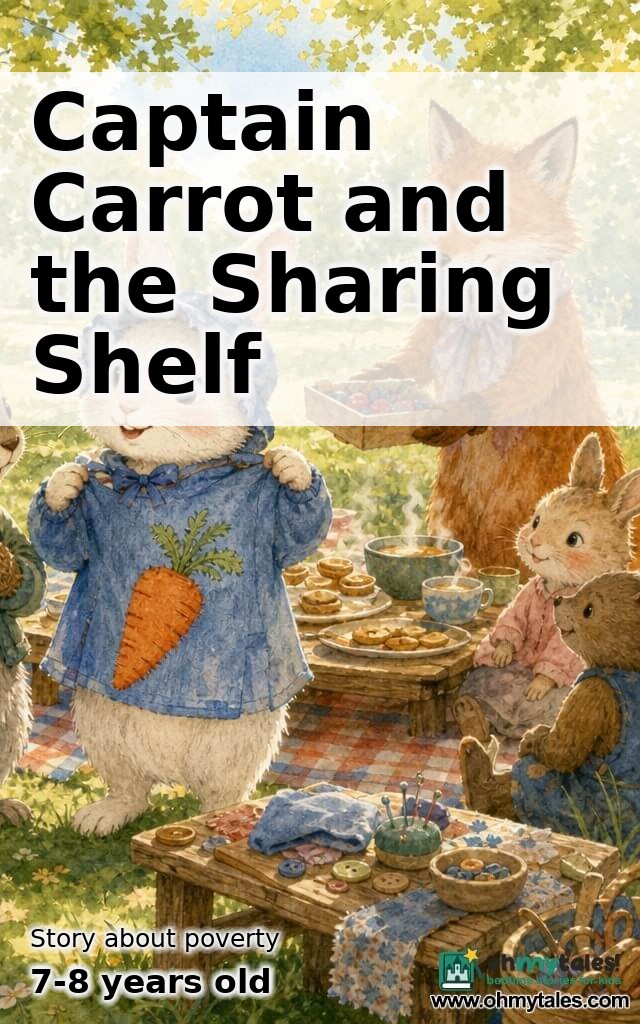
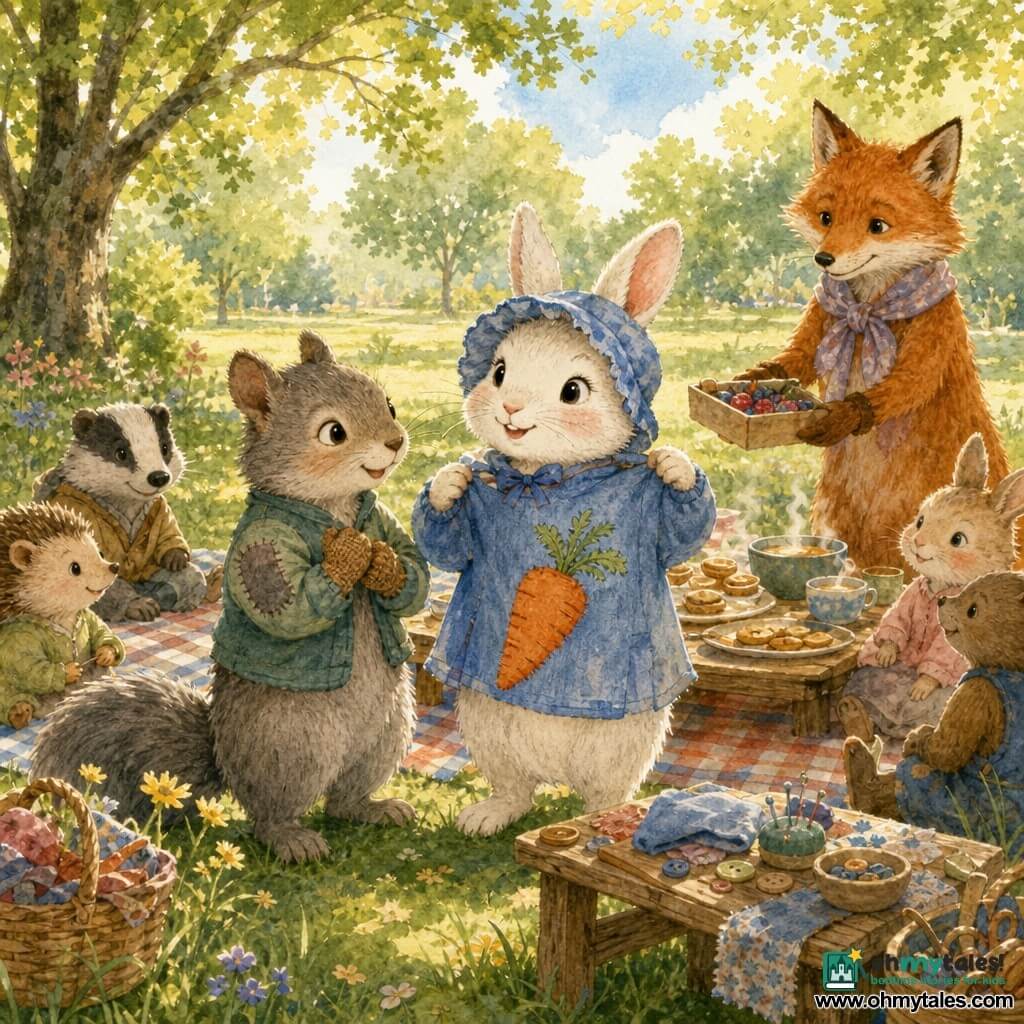
She held up her jacket by the shoulders so everyone could see the carrot patch. The patch was not perfect. The stitches were a bit uneven. One corner puckered slightly. But the carrot smiled.
“This jacket is secondhand,” Lila said clearly. “That means someone else wore it first, and then it came to my family. We didn't buy it new. We don't always have money for new clothes. But we do have hands. We do have ideas. We do have time to fix.”
She paused, then continued, keeping her words simple, the way Mrs. Owl liked. “Some animals have lots of things. Some animals have fewer things. That can feel unfair. But we can help each other. We can share. We can make things last. We can take care of what we have. And we can still feel proud.”
A tiny laugh rose from the crowd when she tapped the carrot patch. “This carrot makes me smile,” she added. “When I wear it, I remember I can make something plain into something special.”
She stepped back. Her cheeks were warm, but in a good way.
Theo went next. He held up his sleeve with the repaired cuff. The stitches were small and neat now.
“I fixed it,” he said. “Lila showed me how. Now I can fix other things too.”
He reached into his pocket and pulled out the knitted mittens. “And I took these from the sharing shelf,” he said, voice stronger. “My paws are warmer. I used to feel embarrassed. Now I feel… thankful.”
His grandmother squeezed his shoulder.
Pippa stepped forward after him. She held up the scarf with knotted fringe—the one she had donated.
“I learned that new isn't the same as better,” she said. Her voice wobbled for a second, then steadied. “Sometimes better is… kinder. And sometimes better is sharing.”
Mrs. Owl nodded, eyes bright. “Well said.”
The picnic continued. Animals ate stew and cookies and berries. They traded recipes and told gentle jokes. Someone started a simple game of catch with a soft pinecone.
At one point, a little hedgehog named Mina stared at Lila's jacket and asked, “Does the carrot have a name?”
Lila looked down at the patch, as if listening. “Yes,” she said. “It's Captain Carrot.”
Mina giggled. “Captain Carrot!”
Soon, three younger kids were marching around with pretend patches on their shirts, calling themselves the Carrot Crew. One had a leaf stuck to their head like a hat. Another used a napkin as a cape. They were very serious about their mission, which seemed to be “finding snacks and sharing them.”
Lila laughed until her belly felt warm. She didn't need shiny new things to feel happy. She needed friends, and stories, and a place where everyone tried.
As the sun lowered, families began packing up. Leftover food was divided into small containers to take home. No one acted like leftovers were sad. Leftovers were a plan for tomorrow.
Before leaving, Mrs. Owl gathered the class for one last message. “Remember,” she said, “sobriety can be joyful. That means we can live simply and still live well. We can enjoy what we have. We can repair what breaks. We can share what is extra. And we can always, always treat each other with respect.”
On the walk home, Lila's jacket rustled in the breeze. Theo walked beside her, wearing his mittens even though it wasn't very cold, just because he could.
“I like Community Week,” Theo said.
“Me too,” Lila replied. “It makes our school feel like a big nest.”
Theo nodded. “And your jacket really is brave.”
Lila touched the carrot patch gently. “It's not just the jacket,” she said. “It's what it reminds us to do.”
Theo looked up at the sky, where the clouds were soft and pink. “Care, share, repair,” he said, counting on his mittened paws.
Lila smiled. “And be proud,” she added.
They hopped and padded along the path, not rushing, not worrying. Just two kids in a world of animals, carrying something simple and strong: the quiet hope that grows when a community takes care of its own.