Chapter 1: Cracks in the Calm
The morning sunlight streamed through the curtains, casting golden patterns onto the pale blue walls of Mia's room. She lay in bed, eyes tracing the familiar shapes on the ceiling, fighting the urge to pull the covers over her head and disappear. Downstairs, the muffled clatter of dishes and the low hum of voices signaled that her parents were awake. Mia listened, heart thumping, for the tone of those voices—were they arguing again, or was today going to be different?
She stretched, slid out of bed, and reached for her navy-blue hoodie. On her way to the bathroom, she passed her younger brother Leo's room. His door was ajar, as usual, and she could see him curled up with his tablet, headphones clamped over his ears. He was good at escaping, she thought. Sometimes, she wished she could do the same.
In the kitchen, the air was thick with the scent of toast and tension. Her father, in his neatly pressed shirt, sat at the table reading emails on his phone. Her mother, hair hastily pinned back, busied herself at the stove. They barely looked at each other.
“Morning, Mia,” her father said, not glancing up.
“Morning,” Mia replied, sliding onto a chair. She watched her mother pour coffee, her hands trembling just a little. Leo shuffled in, still glued to his screen.
“Would you put that thing away at the table, please?” their mother said, voice tight.
Leo grunted and set his tablet down, eyes rolling. Silence settled, heavy and awkward.
Mia's appetite vanished. She toyed with the corner of her toast, wishing someone would say something to break the ice. But no one did. The only sound was the clock ticking, counting down the minutes until she could escape to school.
Chapter 2: Whispers and Worries
At school, Mia drifted through the halls, backpack slung over one shoulder. Her best friend Layla caught up with her at her locker, grinning as she recounted a silly story from the bus. Mia tried to smile, but her mind was elsewhere.
“Hey, Earth to Mia!” Layla nudged her. “You okay? You've been super quiet lately.”
Mia hesitated. “Just... tired, I guess.”
Layla frowned. “Is it your family stuff again?”
Mia nodded, and Layla squeezed her arm. “You know you can talk to me, right?”
Mia opened her mouth, but the bell rang, and the moment slipped away. In math class, she found it impossible to focus. The numbers blurred, replaced by memories of raised voices and slamming doors. She wondered if her classmates ever worried about things like this, or if their homes were calm, like in the movies.
After lunch, during free period, Mia ducked into the library and found an empty corner. She pulled out her journal and scribbled a few lines:
Why do they keep fighting? Is it my fault? I wish I could make it stop.
She stared at her words and felt a lump rise in her throat. She wanted things to go back to the way they used to be, when family game nights were fun and laughter filled the house. But she didn't know how to fix it.
Chapter 3: The Storm Breaks
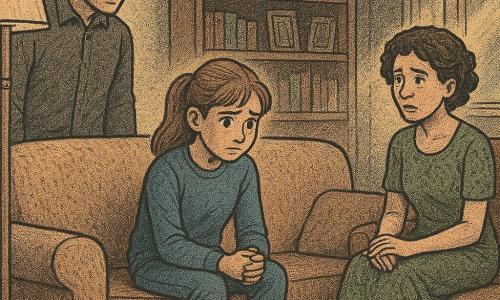
That evening, the storm Mia felt inside matched the one raging outside. Rain lashed against the windows as thunder rumbled in the distance. After dinner, her parents' voices started to rise—first in the living room, then echoing through the hallway.
“You never listen to me!” her mother shouted.
“I do listen, but you always twist my words!” her father retorted.
Leo retreated to his room, but Mia hovered at the top of the stairs, hands clenched, listening. The words stung, even if they weren't meant for her.
Suddenly, her mother's voice broke. “I just want us to be a family again. Is that so much to ask?”
Her father's reply was softer, but Mia couldn't make out the words. She wanted to rush downstairs, shout at them to stop, to remind them that she and Leo were there, caught in the middle.
Instead, she crept into her own room, closed the door, and sat on the floor, knees drawn to her chest. She stared at the rain streaking down the window, wondering if her family would ever feel whole again.
Chapter 4: Seeking Help
The next morning, Mia's teacher, Ms. Carter, announced that the school counselor, Mr. Jenkins, would be visiting classrooms to talk about family and feelings. Mia's stomach twisted. She hated the idea of sharing personal stuff in front of everyone.
When Mr. Jenkins entered, he smiled kindly and spoke gently. “Families aren't always perfect,” he said. “Sometimes, people in a family disagree or fight. That's normal. But it's important to talk about our feelings and find ways to solve problems together.”
He handed out a worksheet with questions about home life, feelings, and ways to ask for help. Mia stared at the page, unsure what to write. After class, she lingered by the door.
“Mr. Jenkins?” she said quietly.
He turned, his expression warm. “Yes, Mia?”
“Um... if someone's parents argue a lot, what can they do? I mean, what if talking doesn't help?”
Mr. Jenkins nodded, as if he'd heard the question many times before. “Sometimes, families need a little extra help. There are people—mediators—who can help families talk to each other, listen, and understand. If you ever want to talk more, my door's always open.”
Mia nodded, biting her lip. The idea of telling an adult about her family's troubles felt scary, but maybe, just maybe, it was what they needed.
Chapter 5: A Difficult Conversation
That evening, Mia watched her parents move around the kitchen, avoiding each other's eyes. She took a deep breath, heart pounding, and spoke up.
“Can we talk? All of us?”
Her parents exchanged a surprised look, but nodded. Leo wandered in, sensing something important was happening.
Mia's voice trembled. “I know things have been hard. I hear you fighting. It makes me feel... scared. And sad. I want us to be a family, like before.”
Her parents' faces softened. For a moment, no one spoke. Then her mother knelt beside her.
“I'm so sorry, honey,” she whispered. “We didn't mean for you and Leo to feel this way.”
Her father nodded. “We love you both. We're just... having trouble getting along right now.”
Mia swallowed hard. “Maybe we could get help? Like, talk to someone together? My school counselor said there are people who help families.”
Her parents looked at each other, uncertainty flickering between them. But then, to Mia's relief, her father spoke.
“If you think it would help, we can try.”
Her mother nodded, wiping her eyes. “Yes. Let's try.”
Mia felt a weight lift from her chest. For the first time in weeks, she allowed herself a small, hopeful smile.
Chapter 6: The First Step
A week later, the family sat in a cozy office with a mediator named Ms. Patel. She had kind eyes and a calming voice that made Mia feel safe.
“Everyone in a family has feelings,” Ms. Patel began. “Sometimes, those feelings get tangled up, and it's hard to understand each other. My job is to help you listen and talk, so you can untangle those knots.”
Mia listened as her parents explained how work stress and worries had made them impatient and distant. Leo admitted that he'd been hiding in his room because he hated hearing them fight.
When it was Mia's turn, she spoke quietly. “I just want us to stop fighting. I miss when we had fun together. I want to feel safe at home.”
Ms. Patel nodded. “That's very brave, Mia. Thank you for sharing.”
They practiced listening exercises—taking turns speaking without interrupting, repeating back what the other said to show they understood. It felt awkward at first, but soon, Mia noticed her parents really listening to each other, not just waiting to talk.
After the session, Ms. Patel gave them a simple challenge: eat dinner together, no screens, and share something good about their day.
Chapter 7: Building Bridges
At dinner that night, the family sat together, a little unsure at first. Mia glanced at her brother, who shrugged, then announced, “I got a B+ on my science quiz.”
“That's great, Leo!” their father said, smiling for the first time in days.
Mia shared a funny story from school, and her mother laughed—a real, warm laugh that filled the kitchen. Gradually, the tension began to fade. They talked, listened, and even joked a little.
Afterward, Mia felt lighter. She knew things weren't magically fixed, but something had shifted. She caught Leo's eye, and he grinned. For the first time in a long while, they both felt hopeful.
Over the next few weeks, the family kept meeting with Ms. Patel. They learned about “I” statements—saying “I feel upset when...” instead of blaming. They practiced taking “cool-down” breaks when arguments got too heated. Sometimes, they still slipped up, but each time, they tried again.
Mia noticed that her parents argued less and listened more. Leo spent less time hiding in his room. On Saturday mornings, they started a new tradition: making pancakes together. There were still messy moments—burnt pancakes, spilled syrup, a joke gone wrong—but now, laughter always found its way back.
Chapter 8: Facing Setbacks
One evening, Mia came home to find her parents arguing again—voices louder than she'd heard in weeks.
“I can't believe you forgot about the meeting!” her mother snapped.
Her father sighed. “I said I was sorry. Work's been crazy.”
Mia's heart sank. For a moment, she worried all their progress had vanished. She retreated to her room, fighting tears.
A few minutes later, there was a soft knock on her door. Her mother entered, looking tired.
“I'm sorry you had to hear that, sweetheart,” she said. “We're still learning. Sometimes, we mess up.”
Mia nodded. “I was scared it would go back to how it was.”
Her mother hugged her. “We'll keep working on it. Remember what Ms. Patel said—progress, not perfection.”
Later, at dinner, her father apologized to everyone. They talked about what happened and how they could do better next time.
Mia realized that setbacks didn't mean failure. It just meant they were still learning, together.
Chapter 9: Growing Together
Spring arrived, and with it, new routines. Mia joined the school's drama club, and her parents made time to attend her performances. Leo signed up for soccer, and the family cheered him on from the sidelines. There were still disagreements, but now, Mia noticed her parents catching themselves—taking deep breaths, listening, and apologizing when needed.
One evening, as the family gathered for a movie night, Mia reflected on how far they'd come. She remembered the silent breakfasts and stormy arguments, how lost she'd felt. Now, their home felt warmer, even if things weren't perfect.
After the movie, Mia's mother turned to her. “Thank you, Mia. You were brave enough to ask for help, and you brought us together.”
Mia blushed. “I just wanted us to be happy again.”
Her father smiled. “You reminded us what matters most.”
Mia grinned, snuggling into the couch between her parents and Leo. She knew there would still be tough days, but now, they had tools to get through them—together.
Chapter 10: Lessons Learned
On the last day of school, Mia stopped by Mr. Jenkins' office. She wanted to thank him, but also share what she'd learned.
“Things at home are better,” she said. “Not perfect, but better. We talk more, and we have help when we need it. I used to think it was my fault when my parents fought, but now I know it wasn't.”
Mr. Jenkins smiled. “I'm proud of you, Mia. Family conflict is hard, but you faced it with courage and honesty. Remember, every family has challenges. What matters is how you work through them.”
Mia left his office feeling lighter than she had in months. She knew there would still be ups and downs, but she felt ready to face whatever came next.
That night, as she watched the sunset from her bedroom window, Mia thought about everything she'd learned: that families aren't perfect, but they can grow and heal; that asking for help is brave, not weak; and that love, even when tangled in arguments, can always find its way back.
As the last light faded, Mia smiled, knowing she wasn't alone—and that together, her family could weather any storm.