Chapter 1: The Chime Above the Rooftops
Fog liked to curl around the city in the 1930s, as if the streets were a cup of warm tea and the mist was the steam. Tram bells pinged in the distance. Neon signs hummed softly, trying their best to shine through the grey.
In the Green Quarter—an eco-neighborhood tucked between brick warehouses and rooftop gardens—old trees stood like patient guardians. Their roots held the sidewalks gently, lifting them in friendly bumps, and their leaves whispered secrets to the wind.
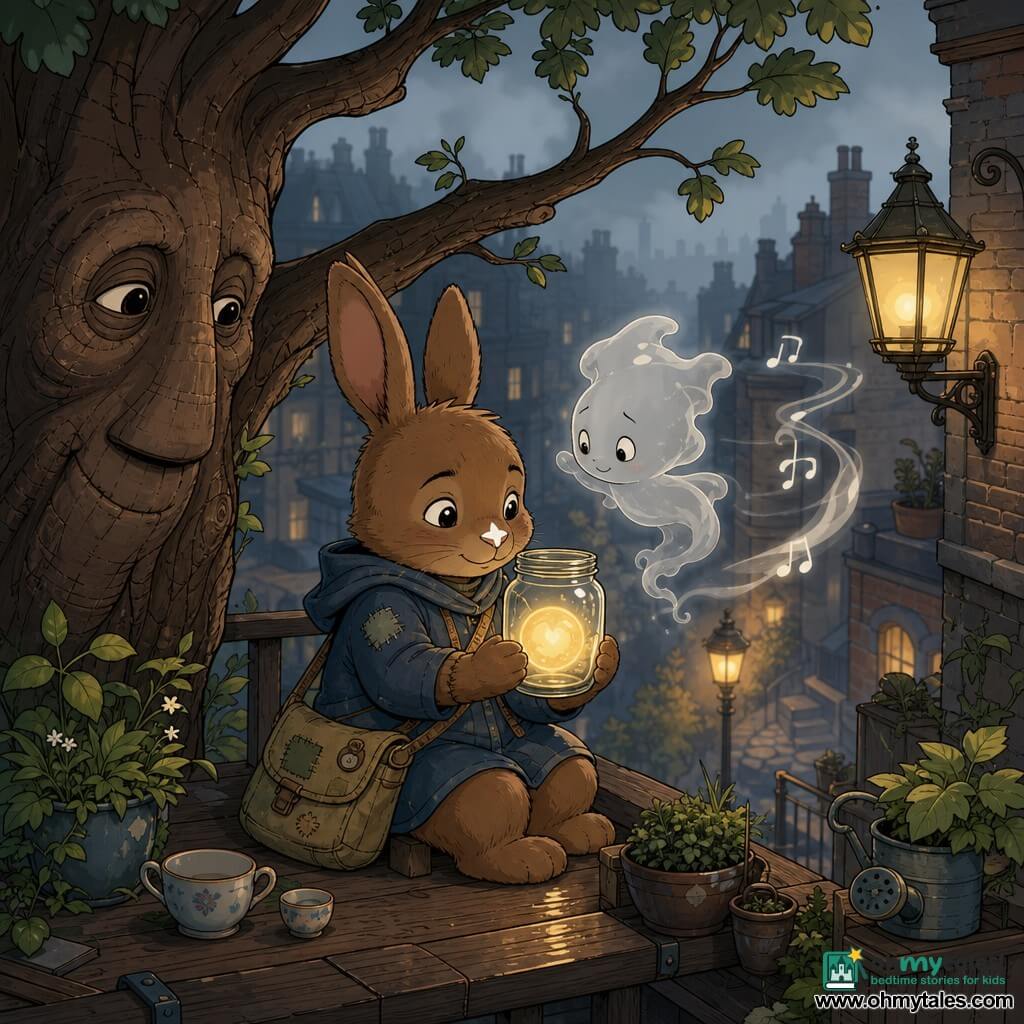
On a small balcony above a bookshop that sold only blank notebooks, a rabbit named Bramble kept watch.
Bramble was a calm rabbit with velvet-brown fur and a white star on his nose. He wore a tiny satchel made from recycled cloth and a key on a string around his neck. The key did not open doors.
It opened listening.
Hanging beside him was the Night-Chime: a silver wind chime shaped like moons, raindrops, and little streetlamps. When it sang, nightmares forgot where to land. They drifted away like soot brushed off a window.
Bramble leaned forward and tapped one of the small bells. It rang with a sound like a clean spoon in a cup.
“Good evening,” he told it.
The chime answered with a cheerful tinkle, as if to say, “Still here. Still working.”
Below, the city glowed in tiny pieces: lamplight on wet stones, the orange eyes of a passing bus, the blue blink of a distant radio tower. Magic lived here the way music lived in a street—sometimes loud, sometimes quiet, always nearby.
Bramble's main job was to keep the Night-Chime safe. His other job, the one only he knew about, was to grow a glow.
It was not a lamp or a candle. It was a lueur—a little living light no bigger than a grape, resting in a glass jar lined with moss. It pulsed softly, like a sleeping heart.
Bramble held the jar up to the fog. “You're getting brighter,” he whispered. “A tiny bit. I saw it.”
The lueur shimmered, pleased, and made the inside of the jar look like dawn had taken a nap there.
A soft rustle came from the nearest tree. The oldest one in the Green Quarter was called Grandroot, and his bark had the color of warm cocoa.
Grandroot's branches creaked in a slow, kindly way. “Bramble,” he rumbled, voice deep as a cellar. “The city is dreaming heavily tonight.”
“I know,” Bramble said. He listened. Even with no humans nearby, the city still dreamed: cats on windowsills, pigeons on ledges, foxes in alleys, and all the small creatures tucked into the cracks of brick and stone.
From the far street, a strange sound floated up—like someone trying to play a lullaby on a teapot.
The Night-Chime tinkled once by itself.
Bramble blinked. “That wasn't me.”
The lueur flickered as if it had heard a joke.
Grandroot's leaves shivered. “Someone is playing with sleep.”
Bramble's ears rose. “Then I should check.”
He slipped the jar into his satchel, gave the Night-Chime a gentle pat, and hopped to the fire escape. The fog welcomed him, cool and soft.
“Stay bright,” he told the lueur.
It pulsed twice, brave as a button.
Chapter 2: Foggy Streets and Friendly Magic
Bramble hopped along a narrow rooftop path where herbs grew in old teacups. The city below was full of angles and echoes. A billboard showed a smiling soda bottle; beside it, a small spell-sticker kept pigeons from landing on the letters. Urban magic liked practical jokes and tidy solutions.
At the edge of the Green Quarter, a lamppost bowed politely. Its light was golden and steady.
“Evening, Keeper Rabbit,” said the lamppost, because in this city even lampposts enjoyed a chat.
“Evening,” Bramble replied. “Have you seen anything odd?”
“A tune that doesn't belong,” the lamppost said. “It drifted by like a ribbon. Not mean. Just lost.”
Bramble nodded. Lost things were common here: lost buttons, lost thoughts, lost umbrellas, even lost songs.
He followed the sound down to a side street where old shops leaned close together, as if they were sharing gossip. A bakery sign swung gently, though there was no wind. The smell of cinnamon floated out, warm and comforting.
A cat sat on a doorstep, washing one paw with great seriousness. The cat's eyes were the color of green glass.
“Hello, Bramble,” the cat said, without stopping the washing. “You're out late.”
“I heard a strange tune,” Bramble said. “Did you hear it too?”
The cat flicked an ear. “Mm. It sounds like a dream trying to whistle. Harmless, but messy. Messy dreams can trip over themselves.”
Bramble's nose twitched. “That's what I worry about. The Night-Chime keeps nightmares away, but if dreams get tangled…”
“They might turn into grumpy little clouds,” the cat finished, and yawned. “Not dangerous. Just annoying. Like a sock full of crumbs.”
Bramble smiled. That wasn't too scary. Socks full of crumbs were mostly funny.
He hopped onward until he reached a small plaza where the fog pooled like milk. In the middle stood an old fountain that no longer held water. Instead, it held coins, acorns, and a few shiny marbles.
Above the fountain hovered a faint swirl of sound—thin, twisting notes, wobbling in the air.
Bramble stood very still and listened with the key on his string. The key warmed, as if it approved of careful hearing.
The tune hiccuped and then sighed.
“Oh,” said a small voice, “I can't do it right.”
Bramble looked up. A tiny creature hung in the air like a paper kite. It was made of streetlight glow and fog, with a face drawn in faint lines. It looked embarrassed.
“What are you?” Bramble asked gently.
“A Draft,” it said. “A Dream Draft. I'm supposed to carry sweet dreams from one rooftop to another. But I got… scribbled.”
“Scribbled?” Bramble repeated.
The Draft nodded and wobbled. “Someone left an idea unfinished. It stuck to me. Now my tune is all wrong, and the dreams I carry bump into each other. They get tangled like string.”
Bramble thought of the lueur in his satchel, growing slowly. Light liked stories. Stories liked ideas. Ideas liked being finished.
“Where did the unfinished idea come from?” Bramble asked.
The Draft pointed with a foggy finger toward a tall building with a clock face. “Up there. The Radio Tower. The air around it is full of words and music. Tonight, someone sent a story into the air and forgot the ending.”
Bramble's ears perked. “A story without an ending can get restless.”
The Draft drooped. “I didn't mean to make a mess.”
“I don't think you did,” Bramble said. “Let's fix it. No scolding. Just… creativity.”
The Draft brightened a little at that word, as if it was hungry for it.
Bramble opened his satchel and took out the jar. The lueur glowed softly, making the fog look like it had stars inside.
The Draft gasped. “That's beautiful.”
“It's learning,” Bramble said. “And so are we.”
Chapter 3: The Tower of Unfinished Tunes
The Radio Tower rose above the city like a long finger pointing at the moon. Its metal bones were damp with fog, and thin wires hummed with distant songs. Around its base, old posters clung to walls, advertising jazz nights and bicycle races from years ago.
No humans walked here, but the place was not empty. A flock of pigeons perched on a ledge, all facing the same direction like an audience. A pair of foxes played cards on an overturned crate, using bottle caps as chips.
Bramble approached the tower door. There was no lock, only a small round slot with a shape like… a listening ear.
He held up his key. The key tingled.
“May I?” Bramble asked the door politely.
The slot glowed, and the door clicked open, pleased by manners.
Inside, the tower was full of echoes. Steps spiraled upward, and each step made a quiet note, like walking on a xylophone.
The Draft floated behind Bramble, trying to hum properly. “I'm sorry,” it whispered.
“Shh,” Bramble said kindly. “We're not here to be sorry. We're here to be smart.”
Halfway up, they found the problem.
It was a knot of sound, hanging in the air like a tangled scarf. Bits of melody looped around it, and scraps of words flickered inside: “and then… and then… and then…”
Bramble frowned. “That's a story stuck in the middle.”
The knot wiggled, as if it didn't like being noticed.
The lueur in the jar pulsed faster. It seemed to lean toward the knot, curious.
The Draft squeaked. “That's what scribbled me!”
Bramble sat on a step and thought. He did not rush. Calm was one of his gifts.
“How do you untangle a story?” he murmured. “You don't pull. You… imagine.”
He looked at the knot and spoke to it the way you speak to a shy animal.
“Hello, unfinished ending,” Bramble said. “You can stop spinning. No one is chasing you.”
The knot slowed a little, surprised.
Bramble continued, voice soft. “You're not bad. You're just incomplete. You need a shape that fits.”
The foxes below laughed at a joke and the sound drifted up. The pigeons outside cooed like slow drums. The city itself offered little pieces of music.
Bramble took a breath and began to create.
He pictured the Green Quarter's ancient trees, their leaves catching fog like lace. He pictured the Night-Chime, silver and steady. He pictured the lueur, wanting to grow, wanting to become more than a dot.
Then he spoke an ending out loud, simple and bright.
“And then,” Bramble said, “the small light didn't try to be the whole sunrise. It only tried to be a brave glow in one window. And that was enough to help the night feel kind.”
The knot trembled.
Bramble added, “And then the dreams found their way again, because someone cared enough to listen.”
The key on his string warmed like a tiny handclap.
The knot loosened. The looping bits of melody slid into place. The scraps of words settled down like birds landing.
With a gentle pop—like a bubble in bathwater—the tangled story became a smooth ribbon of tune.
The Draft inhaled, as if it could breathe for the first time. Its foggy edges sharpened into a neat little shape.
“Oh!” it cried. “That's the ending! I can carry that!”
Bramble smiled. “Go on, then. Take it where it belongs.”
The Draft spun once, delighted, and the tune it made was sweet and steady now—no teapot wobble, no string-tangle.
But one more thing happened.
The lueur flared warmly in its jar, bright enough to paint gold on Bramble's whiskers.
Bramble blinked. “Did you like that?”
The lueur pulsed, proud. It had grown—not by force, but by story.
Chapter 4: A Glow That Learns to Shine
Back in the Green Quarter, the fog had thinned. The ancient trees stood quietly, their branches calmer, as if the whole neighborhood had taken a deep breath.
Bramble returned to his balcony. The Night-Chime swayed gently, waiting.
He hung it properly, checked each little moon and raindrop, and then tapped it once.
The sound spilled into the air—clear, silver, comforting.
From the nearby windowsills and alley corners, sleepy animals sighed in relief. A squirrel curled tighter in its nest. A dog behind a gate stopped grumbling and settled down. Even the foxes, now done with their game, yawned and wandered off.
Grandroot's voice rolled up from the street. “Better?”
“Better,” Bramble called back. “It was a story that needed an ending.”
Grandroot chuckled, a sound like leaves brushing. “The city is made of endings and beginnings. Keep listening, little keeper.”
Bramble set the jar on the small table by his chair. The lueur glowed like a tiny lantern, no longer grape-sized. Now it was closer to a plum, round and steady, with soft colors moving inside it—gold, pale blue, the faint pink of sunrise hiding in a pocket.
Bramble leaned close. “You grew,” he whispered.
The lueur shimmered, and for a moment Bramble thought he saw shapes in it: a ribbon of music, a staircase of notes, an ending that fit like a puzzle piece.
From above, the Draft drifted by, now confident and neat, trailing sweet dreams like paper boats on a calm river.
“Thank you, Bramble!” it called.
Bramble waved. “Remember—if you get tangled, don't yank. Pause and imagine.”
“I will!” the Draft sang, and its tune sprinkled the street with gentle peace.
Bramble settled into his chair. The city's lights blinked like sleepy eyes. Somewhere a tram bell rang, friendly and far away.
He tapped the Night-Chime again, softer this time.
“Good night,” he told the chime.
Tinkle.
He looked at the lueur. “Good night,” he told the glow.
Pulse.
And as the fog folded itself around the buildings like a blanket, the Green Quarter stayed bright in its own quiet way—protected by ancient trees, watched over by a calm rabbit, and warmed by a growing light that learned, story by story, how to shine.