Chapter 1: The Notice on the Board
Maya tugged her braid and read the notice pinned to the classroom board. "School Skills Fair — Next Friday. Share something you love to do." Her heart did a small flip. She loved to fix things: a loose zipper, a wobbly chair, even her little brother's toy robot that blinked the wrong way. But something else buzzed in her ears — she had once heard boys in older classes say, "Fixing stuff is for boys." It made her throat tighten.
Ms. Alvarez smiled as she handed out colored flyers. "This fair is about showing skills. Everyone's welcome, and every skill is important," she said. Her voice was steady like warm honey. Maya glanced at her classmates. Leo, who loved to bake, grinned and waved a sticky-gloved hand. Amina doodled machines in the margin of her notebook. Sam practiced balancing a soccer ball on his knee while whispering the steps to tie a double knot.
"Okay, partners," Ms. Alvarez called. "Work in groups of four. Think of a booth that shows teamwork." Maya felt a hope spark. She raised her hand and joined Leo, Amina, and Priya. They liked different things, which suddenly felt exciting instead of scary.
"What's our booth?" Priya asked. Her hair was tied up in a high ponytail that bounced when she laughed.
"Maybe a baking demo?" Leo said.
"Or a mini repair workshop?" Maya offered. The others looked at her with puzzled faces.
"Repairs?" Amina tilted her head. "Like tools?"
"Like fixing things and showing how anyone can learn," Maya explained. She imagined a booth where boys and girls could both learn to use a screwdriver and follow instructions. Priya's eyes lit up. "We could teach simple repairs and show how recipes and repairs are both steps to follow." Leo rubbed his chin thoughtfully. "And we could have cupcakes for visitors!"
Ms. Alvarez walked by and nodded. "Sounds like a plan. Remember, make space for everyone's ideas." Her words wrapped around Maya like a warm blanket.
Chapter 2: The Argument Over Roles
The group met after school in the art room. They drew a poster and made a list of materials. Maya had brought a small screwdriver set wrapped in bright tape. Leo brought his recipe cards, slightly sticky with flour. Amina sketched diagrams for "screwdriver safety" while Priya wrote slogans: "Fix It Together" and "A Skill for Every Voice."
But when it came to dividing jobs, the air got prickly. "I'll handle the cupcakes. Baking is my thing," Leo said. "Then Maya can set up the tools, and Priya and Amina can make posters," he added, as if that arrangement was perfectly natural.
Maya's fingers tightened around a pencil. "I can do the poster, too," she said quietly. "I've been practicing lettering."
Priya frowned. "But you said you like repairs. I can help with tools."
Amina looked worried. "We should choose what everyone wants to do."
Leo scratched his head. "I just thought—" He stopped when he saw Maya's face. He hadn't meant to assume. "Sorry, Maya. I didn't mean to decide for you."
Maya thought of the boys who had said fixing was for them. Her cheeks warmed, but she breathed out and smiled. "It's okay. I don't like being told what to do because I'm a girl. I want to try both. We can share tasks and switch during the fair."
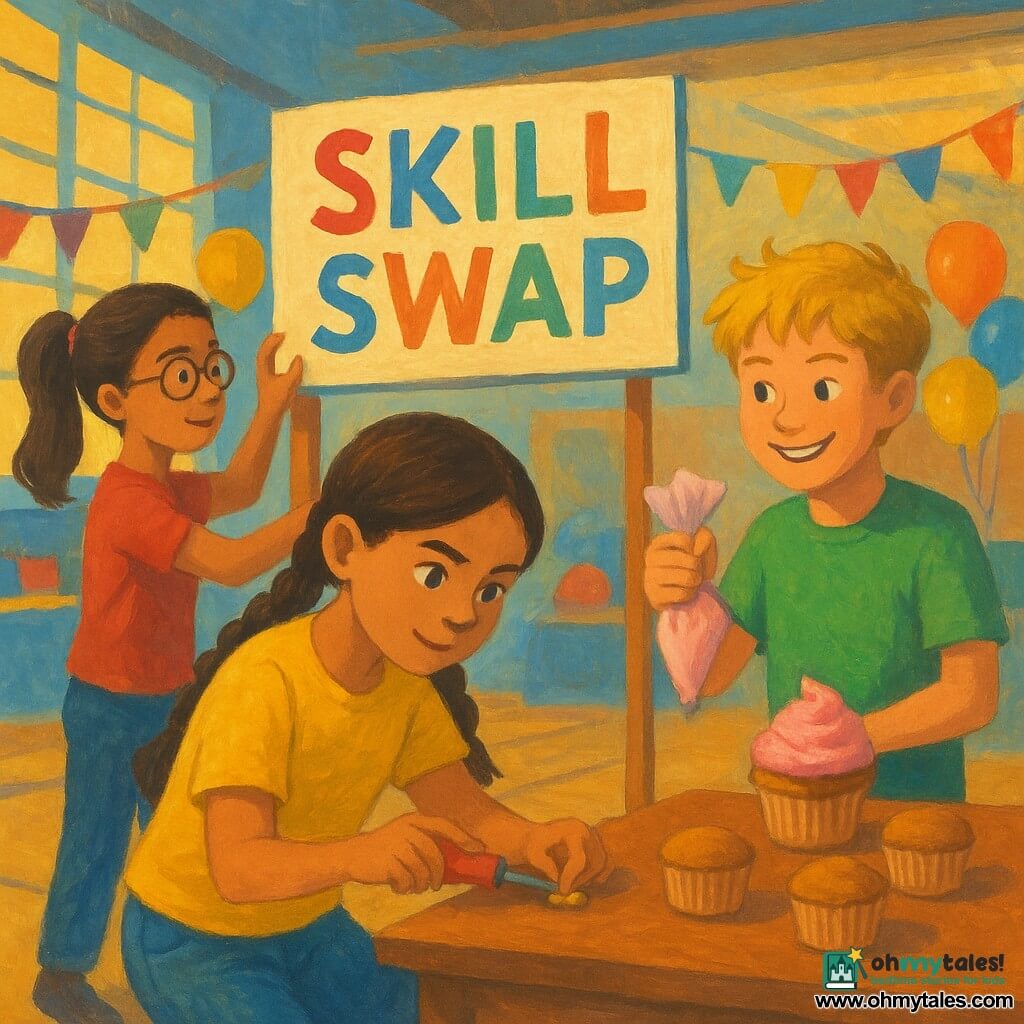
They made a new rule: everyone would teach and learn something new. For the first half of the fair, two people would run the repair table while the others baked and explained recipes. Then they'd switch. Priya suggested a "skill swap" sign so visitors would know.
"Deal," Amina said, and they shook on it like pirates sealing a pact.
Chapter 3: Practice and Surprise
Practice day arrived. Lucy from Mr. Harper's class stopped by. She had short hair and a ready smile. "Can I try the screwdriver?" she asked.
"Of course," Maya said, handing it over. Maya showed Lucy how to hold the handle and press gently so the screw would turn without stripping. Lucy's hands were careful, and she beamed when the loose hinge clicked into place.
"Cool!" Lucy said. "You're really good at explaining, Maya."
Meanwhile Leo rolled out a tray of small cupcakes. He taught Sam how to pipe frosting in a swirl. Sam's swirls looked like tiny mountains, and he laughed when frosting landed on his nose.
As they practiced, some older students wandered by. Two boys from Grade 7 raised an eyebrow at the repair table. "Isn't that for the metal club?" one of them said in a teasing voice. Maya felt a tiny pinch, but then Priya marched up and said, "We're showing how anyone can learn to fix things, not just one club. Want to try?"
The boys hesitated, surprised. "Um… maybe later," one mumbled and walked away. Maya realized the teasing didn't sting as much when her friends stood beside her. Small acts of support were like tiny shields.
On the day before the fair, the group set up their booth in the gym. They labeled their stations: "Repair Corner," "Bake-Off," and "Skill Swap." They practiced a little skit where they mixed up roles, showing a boy and a girl learning from each other. Maya played herself — a girl who loved tools — and Leo played a boy learning to sew on a button during the swap. When he fumbled the needle, the class erupted with laughter and then applause when he got it right.
Ms. Alvarez watched from the doorway and said softly, "This is exactly what I hoped for. You're teaching respect by doing it."
Chapter 4: The Fair and the Bell
The morning of the fair buzzed with voices. Parents, teachers, and students moved from booth to booth. A young boy hesitated at the repair table, eyes wide at the screwdriver set. Maya knelt beside him and handed him a pair of safety goggles.
"Everyone gets goggles," she said, smiling. "We all deserve to feel safe to try."
He grinned and tightened the goggles, then turned a screw carefully. Nearby, a girl taught her father how to measure baking powder by tapping the spoon like Leo had shown her. When the Skill Swap sign was up, many visitors stayed longer than expected, swapping talents like coins in a jar.
Midway through the fair, Ms. Alvarez rang a small brass bell that hung above the gym door. "A bell for every voice!" she called. It was a line from their class pledge: to listen, to share, to make space. The bell's sound was bright and friendly, and it fluttered across the room.
Something small and perfect happened. A Grade 6 student named Jamal, who usually played video games at recess, walked up to the booth. He watched Maya teach a girl how to use a wrench. Then he asked, quietly, "Can I… try the piping? I never baked with anyone."
Maya's face opened like a window. "Yes! We'll switch in ten minutes. You can teach me how to decorate the cupcakes then."
When Jamal returned, his frosting swirls were surprisingly neat. He laughed at himself and said, "I thought baking was only for girls." The words came out like a question. Maya shook her head kindly. "Skills are for everyone."
By the end of the fair their booth had a steady line. Parents thanked the children for showing patience and cooperation. Ms. Alvarez gave each student a small sticker shaped like a bell. "You listened to each other. You shared tasks. You made it fair," she said.
On the way home, Leo munched on a cupcake and said, "I liked learning to use that glue gun. My hands are sticky, but I fixed my shoelace this morning." Priya added, "I liked showing people how to make space for each other's ideas."
Maya looked out the window as clouds slid by like slow cotton. Her heart felt full and steady, like a rhythm. She remembered the boys who had once teased about tools. She didn't feel angry anymore. She felt hopeful.
That night, before bed, Maya placed her sticker on the inside of her closet door where sunlight peeked through. The bell decal looked ordinary, but when she touched it she remembered all the small choices that made the fair work: asking questions, offering help, switching roles, saying sorry, saying yes.
"If everyone gets a bell," she whispered to the room, "then every voice gets heard."
She slept thinking of tiny victories: a fixed hinge, a perfectly frosted cupcake, a boy who tried piping for the first time. The world felt like a place where practice could change a habit, where a single classroom could show fairness was ordinary and possible.
And in the morning, she woke ready to fix, to teach, and to listen — because the bell's sound had become part of her, gentle and bright.