Morning Light and Quiet Keys
Mr. Milo woke with a soft hum in his chest. The sun slipped like honey through the curtains. He padded to the piano in bare feet. The piano was a friend with black and white teeth. He brushed its keys with his fingers, gentle as rain. He liked to be careful and precise. Each note had a little lamp inside it, he thought, and he knew how to make them glow.
He was a pianist. He wore a blue sweater with tiny music notes stitched on the elbow. Today he was making a surprise. He folded the music like a letter in his mind. He would play for the village and for his neighbor, little Rosa, who liked to hum while she watered her flowers. He wanted everyone to feel warm like a blanket wrapped around a song.
Milo packed his bag with a small metronome that ticked like a tiny bird, a soft handkerchief for the keys, and a peppermint for after the concert. He hummed as he walked. People in the town waved. A boy on a bench tapped a rhythm on his knee. A cat stretched like a slow chord across a fence. Milo listened. Musicians are listeners, he knew. Singers too. They listen with their heart.
The Marimba Garden
On the way to the square, Milo walked past the marimba garden. The marimba was like a wooden rainbow on legs. It sat in the middle of a patch of sunflowers. The wooden bars looked like a staircase for sound. Milo loved the marimba because it sounded like sunlight on water. Today, a tall man named Mr. Jun was there, polishing the marimba with a soft cloth. He smiled when he saw Milo.
“You're playing later?” Mr. Jun asked. His voice had the bright ring of a bell. He was both a player and a maker of instruments. Sometimes he sang too, low and warm like a ripe plum.
“Yes,” Milo said. “I made a surprise. I hope it brings smiles.”
Mr. Jun tapped the marimba gently. The bar rang a warm note. “A marimba likes to help,” he said. “It loves to join hands with piano and voice.” He gave Milo a small wooden mallet. “For the surprise,” he whispered.
Milo practiced a few gentle scales with the mallet. The marimba replied with a cascade of golden notes. The sound felt like stepping on soft leaves. A few children nearby stopped to watch. They clapped quietly, careful not to wake the notes.
Milo learned something then. A musician is not only the one who plays. A musician listens to other sounds. He learns where the marimba lives among the piano notes and the singer's breath. He learned to leave space, like empty bowls ready to be filled with color.
Preparing the Surprise
Back home, Milo set the piano lid like a soft cover over a sleeping book. He wrote out his program on a card. He chose songs that were like stories he wanted to tell: a bright one that hopped like a rabbit, a soft one that smelled like mint, and a lullaby that smelled like dusted sugar. He folded the songs so each could be a surprise for a different ear.
He also thought about singers. Singers make words into birds and feelings into color. He wrote a simple duet that could be sung softly, like a secret told under a blanket. The words were about a boat that sails on moonlight. He left spaces in the music where a voice could bloom, where a singer could lift a tiny note high like a kite.
Milo practiced each piece very slowly. He counted with the metronome that ticked steady as heartbeats. He tapped his foot like a small drum. Precision was his friend. He liked to know where each note would fall, like placing stars one by one in a night sky.
Then he packed the marimba mallet into his pocket. He tied a ribbon around the metronome. He smelled peppermint and felt ready. Surprises, he thought, are like gifts for ears.
The Little Square
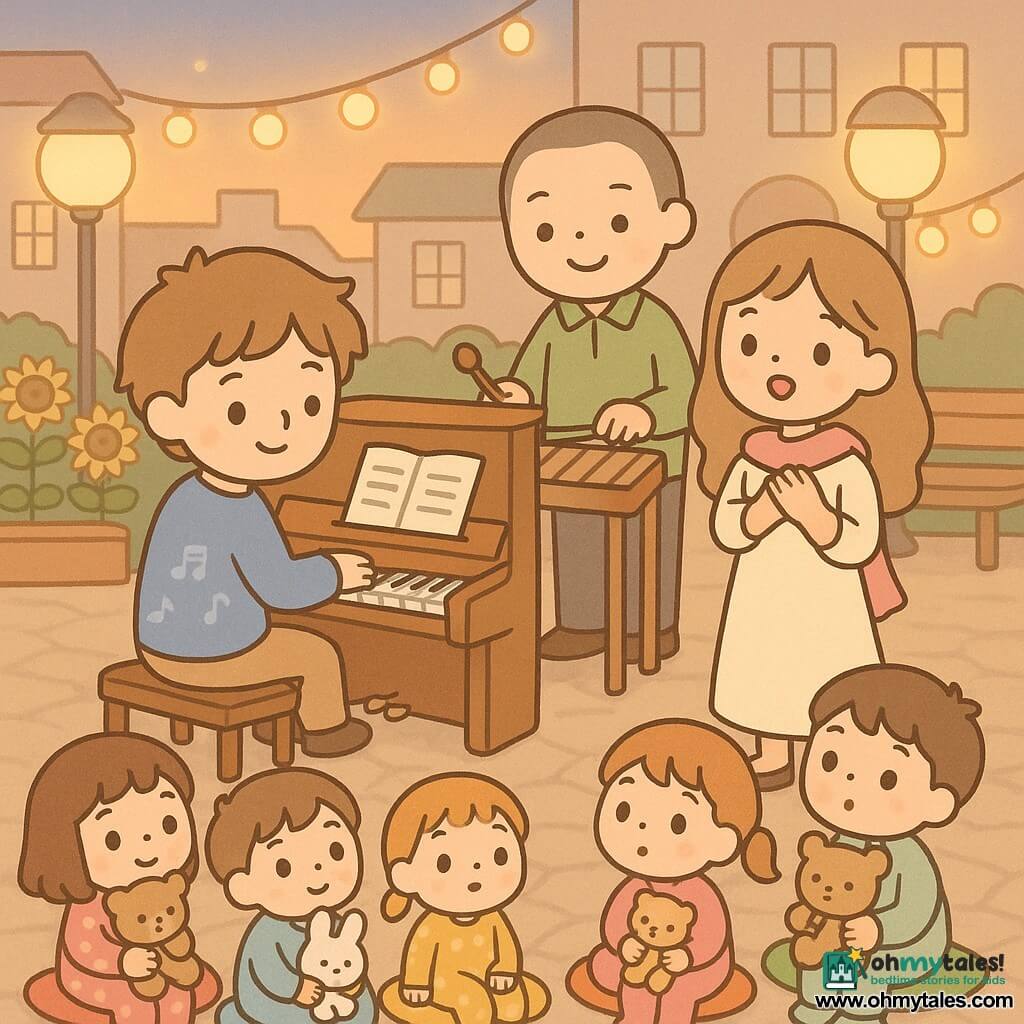
The square filled with people as the sun leaned low. Lamps winked on like sleepy eyes. Children held stuffed animals. Some wore pajamas over their shoes. The village band carried delicate instruments—flutes like silver threads, a small drum, and a singer named Lila. Lila had a voice that smelled of warm bread and summer. She smiled at Milo. She wore a scarf that fluttered like a soft chorus.
Milo sat at the piano. The lid lifted like an open mouth. The first note was a pebble dropped into a pond. Ripples of sound moved across the square. He played the bright rabbit song. Feet tapped. The marimba answered with wooden bells. Mr. Jun tapped his mallet where Milo left a space, and the marimba sounded like a ladder of sunshine.
A man in the crowd clapped. A little girl hummed and swayed, her eyes closed. Milo played the song with care. He thought of how singers hold words like tiny birds. He watched Lila stand by the edge of the light. When Milo left space, she lifted her voice and placed it gently into the music. Her voice threaded through the piano like silk. The crowd breathed with the notes.
Milo noticed faces. He saw someone remembering a birthday. He saw someone else smiling like they had found a lost button. Music can make those small things big and warm. He learned that day that a musician makes paths for feelings to walk on, and a singer is a guide who leads feelings up and down those paths.
Rain of Notes
Halfway through, a soft breeze turned into a tiny rain of petals from the trees. The leaves tapped the marimba like tiny fingers. The marimba sang with the rain. Milo's hands were steady. He felt the pulse of the town, the breathing of the people, the rhythm like tiny feet walking home. A dog barked in time, then stopped, as if remembering it had a song to keep.
Suddenly, the smallest boy in the crowd started to cry. He had lost his mitten. The sound prickled like a small thorn in Milo's music. The boy's mother shushed and looked worried. Milo slowed down. He changed the song into a soft lookout, like a boat searching the shoreline for a missing star. The marimba made gentle bell notes. Lila sang quietly, turning the music into a warm blanket that covered the boy. He sniffled, then smiled. The mittens were found under the bench, warm from the sun. The boy's laughter bubbled like a stream. Music had helped him breathe through the trouble.
Milo learned then that music can fix tight hearts. A singer can wrap words around someone who needs holding. A player can make the space where a story heals.
Night Lullaby
As the sky turned from orange to a deep blueberry, Milo played the lullaby. The notes fell slow like feathers. The marimba tapped like tiny toes on a wooden floor. Lila's voice was a silver thread that stitched the sky to the earth. The village's lights blinked in time, a choir of lamps saying goodnight.
Milo's hands danced softly. He remembered his own first lesson with a teacher who had called him “gentle hands.” He remembered nights when his mother hummed and folded his worries into pockets. The lullaby was for all of those pockets. Children leaned on parents. Parents looked like islands of calm. Even the cat curled like a comma on a warm lap.
When the last note was almost gone, Milo invited everyone to hum along. Singing is brave and small. Children took a breath and sang a tiny thread. Their voices were small bells, a safe kind of loud. The town hummed. The sound felt like a wool sweater pulled over the square. Milo felt it in his chest, a warm fullness like a bowl of soup.
A Thank You to the Music
After the concert, people whispered “thank you.” Rosa came with a bouquet of blue flowers, and she hugged Milo like a sheet wrapped around his shoulders. Mr. Jun gave a soft bow and a new mallet carved with little stars. Lila pressed a paper heart into Milo's palm. “You made room for us,” she said. “You listened.”
Milo smiled. His surprise had worked. He saw little ears glow and small hands clap. He had made a place where piano, marimba, and voice could talk together. He thought about how singers tell stories with breath, how musicians build paths with notes, and how both gather people like warm blankets.
He walked home holding the metronome, now quiet, like a sleeping bird. The moon hung like a pale cymbal in the sky. Milo hummed his favorite chord. He whispered a little prayer of thanks to the sound that had helped so many hearts.
At his window, he set the marimba mallet on the sill. He opened the piano lid once more and lifted his hands above the black and white teeth. He did not play a big tune. He played a single, soft chord. It sat in the air like a gentle friend.
He thought of every singer and player he knew. He thought of the marimba like a wooden rainbow, of Lila's warm voice, of Mr. Jun smiling. He breathed out slowly, like letting go of a balloon. He closed his eyes and said, in the hush of the night, a small, bright thanks.
“Thank you to the music,” he whispered, and the sound of the words folded into the dark like a lullaby. He climbed into bed with the quiet echo of the chord in his head. Outside, the village kept a tiny note alive until morning. Inside, Milo's heart kept time with the metronome of his breath.
He slept, and the song slept too, cozy as a kitten, waiting for another day when hands would make light with sound and voices would paint the air.