Morning Shoes and a Brave Backpack
Leo was five years old, and his new school shoes felt very shiny. They squeaked a little on the kitchen floor. Squeak, squeak. Leo tried to walk quietly, but the shoes sounded like tiny mice having a party.
“Good morning, shoes,” Leo whispered, as if they were helping him be brave.
His backpack waited by the door. It was blue, with a bright yellow zipper that looked like a smile. Inside were a lunchbox, a small water bottle, and a pencil case with crayons lined up like sleepy caterpillars.
Leo's tummy felt jumpy, like popcorn that had not popped yet.
Mom knelt and helped him zip his coat. “First day back,” she said. “You can feel nervous and excited at the same time.”
Leo nodded. He liked that. It made his feelings feel normal.
On the walk to school, Leo noticed new things. A chalk drawing of a sun on the sidewalk. A dog with a purple collar. A tall tree that dropped one leaf right in front of his toe, as if it were saying, “Hello.”
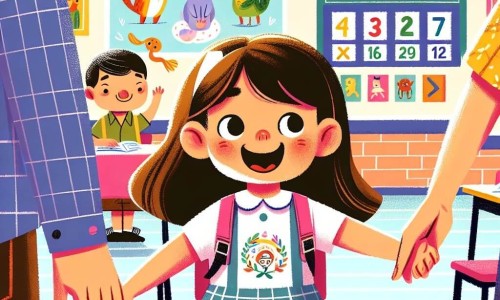
When they reached the school gate, Leo saw other children. Some held hands with grown-ups. Some bounced on their toes. Some were already running in small circles, like busy bees.
A teacher stood near the door with a kind face and a name tag. It said: Ms. Carter. She waved slowly, like a flag that meant, “You are welcome here.”
Leo took a deep breath, the way Mom had shown him. In… and out… like blowing a bubble.
Inside the classroom, the tables had tubs of crayons. The walls had pictures of letters and animals. There was a corner with pillows and books, and a rug with big, bright shapes.
Ms. Carter showed everyone where to put their bags. Leo found a hook with his name. Seeing “LEO” in thick black letters made his chest feel warm, like a small lamp had turned on.
They began with simple things. A hello song. A story about a bear who liked to share. A tour of the room.
Leo tried to be extra helpful. If someone dropped a pencil, he picked it up. If someone looked lost, he pointed to the cubbies. Being helpful made him feel steady, like standing with both feet on the ground.
Then Ms. Carter said the word Leo had been waiting for.
“Recess.”
The Playground and the Very Popular Swing
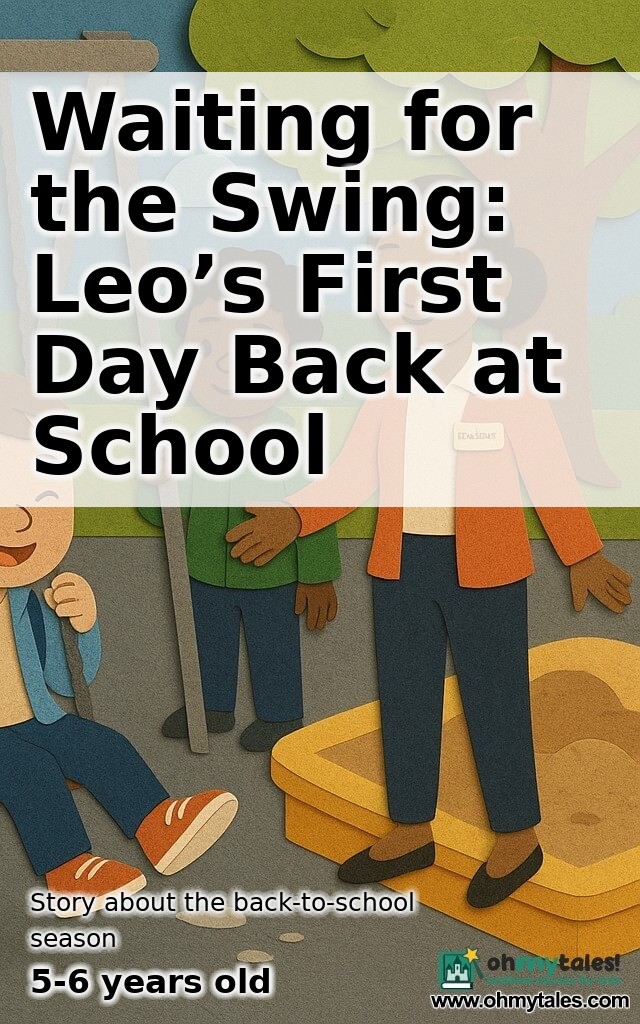
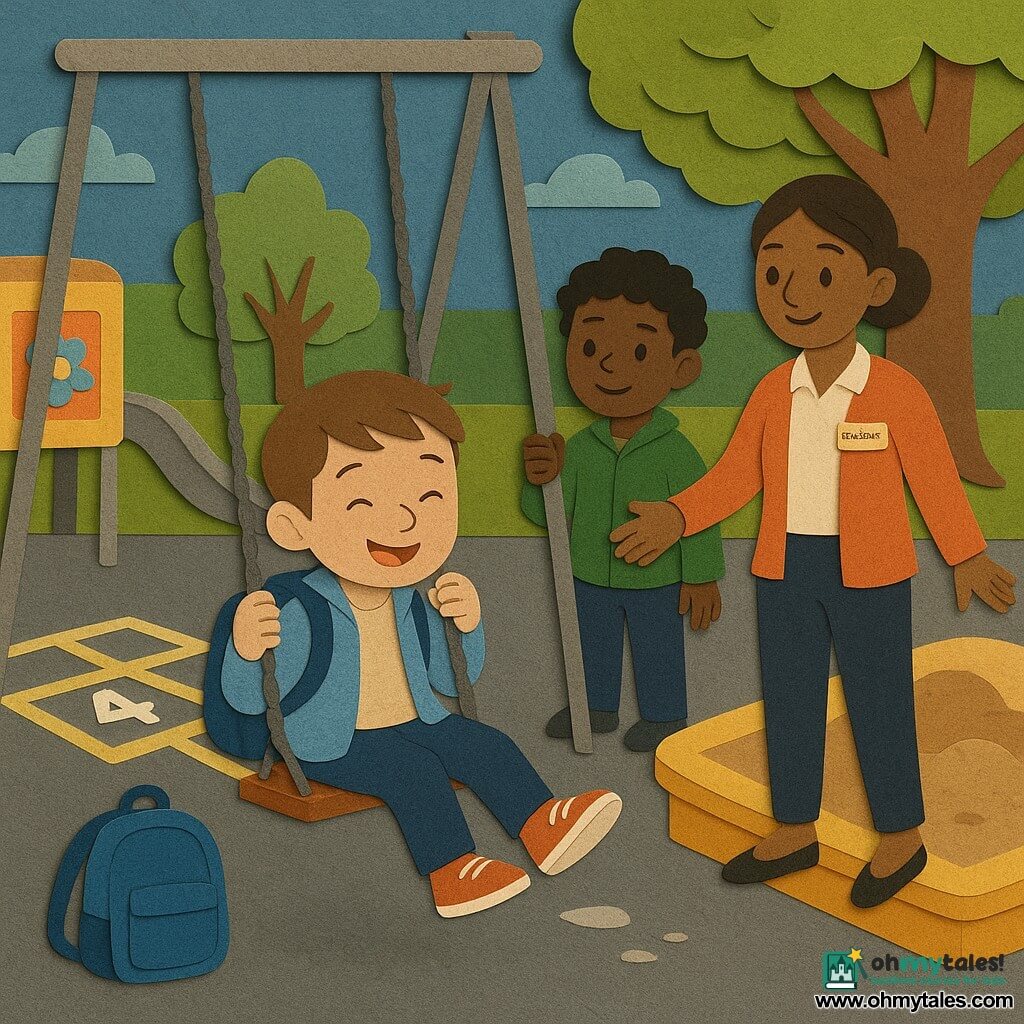
Outside, the playground looked like a small town made for children. There was a slide like a shiny silver river. There was a climbing frame like a jungle. There were painted lines for hopscotch, and a sandbox full of tiny mountains.
And there were swings.
Two swings. Just two.
They hung from a metal frame and moved back and forth with the wind, as if they were practicing.
Leo loved swings. Swings made his belly tickle in a good way. Swings made the sky feel closer.
He ran toward them—then stopped.
A small group of children was already there. One child was swinging high. Another child stood nearby, holding the chain and looking ready to jump on next. Two more children waited behind, feet shuffling.
Leo felt that popcorn feeling again. He wanted to be on the swing right now. His hands even reached forward, as if they could pull a swing toward him like a rope.
A boy with curly hair glanced at Leo and said, “We're waiting.”
Leo looked at the line. It was not very long, but it felt long to his impatient legs.
He took one step closer. Then another. He tried to see if there was a way to squeeze in, like sliding a book into a tight shelf.
He thought, If I just stand right here, maybe it will be my turn faster.
But when the swinging child slowed down and hopped off, Leo stepped forward at the same time as the curly-haired boy.
Their shoes almost bumped.
The curly-haired boy frowned. Not a big frown, but a small one, like a wrinkled sock.
Leo froze. His cheeks got hot.
Ms. Carter was walking across the yard, watching, not like a hawk, but like a calm lighthouse. She came closer.
“What's happening?” she asked gently.
Leo wanted to say, “I need the swing!” but the words felt too loud in his head. Instead he said, “I… I just want a turn.”
“So do we,” the curly-haired boy said. His voice was not mean. It sounded more tired than angry.
Ms. Carter nodded. “Swings are popular,” she said. “That's why we use a simple plan. We make a line, and we wait our turn.”
Leo stared at the swing. The empty seat rocked a little, like it was waving at him.
“But waiting is hard,” he admitted.
Ms. Carter smiled as if she already knew that. “Yes, it can be. Let's try something that helps.”
She pointed to a small sign near the swings. It had a picture of a child on a swing, then a picture of a child standing behind with one finger up, and then a picture of children smiling.
“This sign means: one turn, then switch,” Ms. Carter said. “And we can count to twenty. That way everyone knows when a turn is done.”
The curly-haired boy said, “I can count!”
A girl in a pink jacket said, “I can count, too!”
Leo swallowed. Counting to twenty sounded like a lot when you wanted to fly right away. But it also sounded like a map. And maps helped.
Ms. Carter looked at Leo. “Would you like to join the line at the end?”
Leo nodded and stepped back. He stood behind the girl in the pink jacket. His hands squeezed together. He stared so hard at the swing that he almost forgot to blink.
The child on the swing began to swing again, and the waiting children counted out loud.
“One… two… three…”
The counting was bumpy at first. Someone said “five” twice. Someone said “ten” very early. It was a little silly.
Leo's mouth wanted to laugh, but his worry tried to hold it in.
“Eleven… twelve… thirteen…”
Leo noticed the girl in the pink jacket was bouncing a little, like her legs had springs. She looked at Leo and whispered, “I really like swings.”
Leo whispered back, “Me too.”
It felt good to say it. Like sharing a secret that was not really a secret.
“Fourteen… fifteen… sixteen…”
Leo's feet started to itch with impatience. So he tried the trick Mom had taught him. He looked for things.
He found: a cloud shaped like a duck. A ladybug on the fence. A leaf stuck to the bottom of his shoe.
“Seventeen… eighteen… nineteen… twenty!”
The child jumped off. The next child sat down. The chain clinked. The seat creaked.
Leo waited again.
The popcorn in his tummy began to calm down. It still bounced, but it was not trying to explode. The counting helped, like a gentle drum.
When it was finally the girl's turn, she swung for twenty counts, smiling wide. Then she hopped off quickly.
The curly-haired boy took his turn. He pumped his legs and laughed. At “twenty,” he slowed and jumped off.
Now Leo was at the front.
His heart beat fast, but in a happy way.
He sat on the swing. The seat felt cool under his shorts. He held the chains. He pushed off with his toes.
The world moved.
The ground went back. The sky came forward. The air brushed his face like soft hands.
He wanted to swing forever. He really, really did.
But the counting began.
“One… two… three…”
Leo listened. He swung. He smiled. He felt like a bird who had borrowed the playground for a moment.
“Seventeen… eighteen… nineteen…”
At “twenty,” Leo dragged his feet gently, slowing down. He could have pretended not to hear. He could have swung higher and higher, like a rocket.
But he remembered the small frown on the boy's face. He remembered Ms. Carter's calm voice. He remembered how the line felt fair.
So Leo stopped.
He hopped off. His shoes squeaked again. Squeak, squeak.
He stepped to the side and said, “Your turn,” to the next child.
The next child smiled at him, and that smile felt almost as good as swinging.
A Small Team with a Big Idea
Later, Leo saw the curly-haired boy near the hopscotch squares. The boy's shoe lace was untied, and he looked down at it like it was a tricky snake.
Leo walked over. “Do you want help?” he asked.
The boy looked up. His frown was gone. “Yes, please.”
Leo crouched and tried to remember how to make the loops. His fingers were still learning.
The girl in the pink jacket came over too. “I can do bunny ears!” she said.
Together, they made two loops and crossed them. They pulled gently. The lace became neat and safe again.
The boy beamed. “Thanks,” he said. “I'm Ben.”
“I'm Leo,” Leo said. “And I waited my turn.”
Ben nodded. “I saw. That was good.”
Leo felt taller inside.
At the end of recess, Ms. Carter blew a whistle. It was not a scary sound. It was a clear sound, like a doorbell.
Back in class, they drew pictures of their morning. Leo drew the swings. He drew a line of children. He drew a little sign with the number twenty. He even drew a duck-shaped cloud.
Ms. Carter walked by and stopped at Leo's picture. “Tell me about it,” she said.
Leo pointed. “We made a line,” he explained. “We counted to twenty. Then we switched. It was fair.”
Ms. Carter nodded. “That is a great recess rule,” she said. “And you helped make it work.”
After school, Mom met Leo at the gate. Leo's backpack looked heavier, but his face looked lighter.
On the walk home, Leo said, “The swings were hard.”
Mom squeezed his hand. “Hard can be good,” she said. “What did you do?”
“I waited,” Leo said. “I wanted to go first. But I waited. And then I got a turn. And then I stopped at twenty.”
Mom smiled. “That sounds like growing.”
At home, while Mom packed away the lunchbox, Leo lined up his crayons on the table. He made them into a little line, like the swing line.
“Red is first,” he told his crayons. “Then orange. Then yellow.”
He giggled at himself. Even his crayons had to wait their turn.
That night, in bed, Leo thought about the first day back. The new classroom. Ms. Carter's friendly eyes. Ben's untied lace. The counting voices rising together.
He whispered a simple rule into the dark, just to make sure he remembered.
“At the swings,” he said softly, “I wait in line, I count to twenty, and then I switch.”
His tummy felt calm now, like popcorn after it has popped—warm, light, and ready to rest.
And in his mind, the swing moved gently, back and forth, sharing the sky with everyone.