Morning at the Edge of the Village
The rooster's call slid through the open window like a bright ribbon. Tom sat up fast, rubbing his eyes. He was a young farmer, and his farm sat right at the edge of the village, where the last houses ended and the fields began.
Outside, the air smelled of wet grass and warm earth. Tom pulled on his boots and stepped into the yard. Chickens pecked near the fence. A brown dog named Moss wagged his tail so hard his whole body wiggled.
“Good morning, Moss,” Tom said. “Big day.”
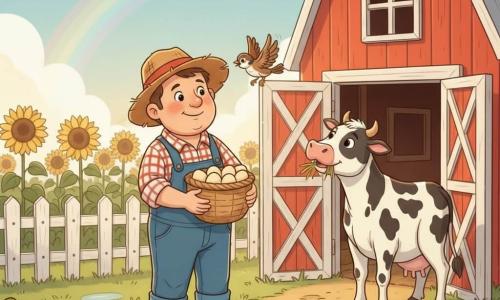
He walked to the barn. The wooden doors were cool under his hands. Inside, the cows breathed slowly, like sleepy music. Tom filled their water trough, then carried fresh hay in his arms. The hay felt scratchy and soft at the same time.
“Breakfast for you,” he told the cows.
One cow, Daisy, lifted her head and blinked at him. “Moo,” she said, as if she agreed.
Tom smiled. “I'm glad you're cheerful. I need some cheer today.”
He had a plan. He wanted to check his fields and decide what to plant next. Farming was not just doing one thing. It was many small jobs, done with care, every day.
Tom stepped outside again. The sun was climbing, but the wind felt cool. He looked across his land. Near the village road, the soil stayed a bit damp because a little stream ran by. Farther away, the field was higher and dried out faster.
“Different spots, different needs,” Tom whispered, like a secret.
Moss trotted beside him as Tom walked to the vegetable patch. The leaves of the lettuce looked shiny, and the carrots' green tops poked up like little flags.
Then Tom heard a voice. “Tom! Are you there?”
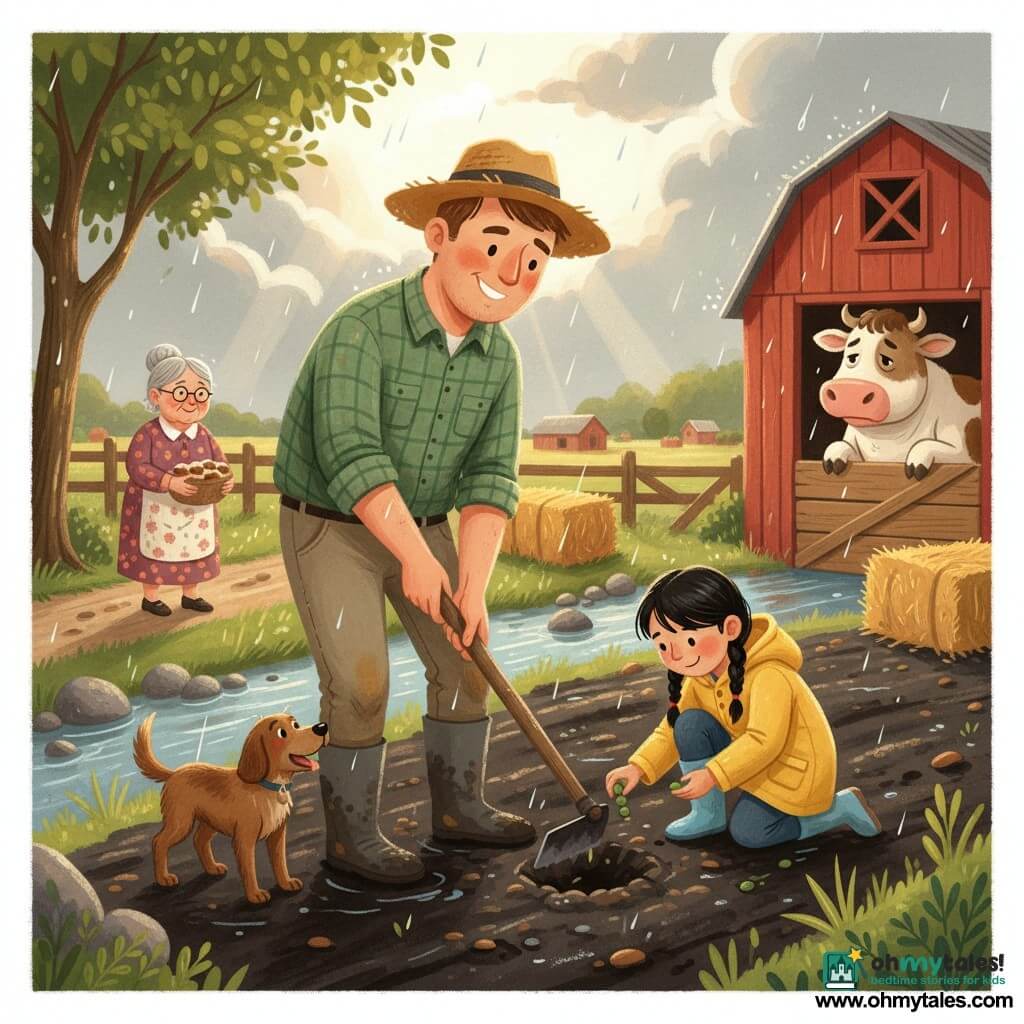
It was Mrs. Bell from the village, holding a basket.
“I brought you some muffins,” she called. “You work hard.”
Tom's ears turned warm. “Thank you, Mrs. Bell. I'll share with my helpers.” He patted Moss, who looked proud.
Mrs. Bell pointed at the sky. “They say it might rain later.”
Tom looked up. Clouds were gathering, thin and gray. “Rain can help,” he said, “but too much can hurt.”
Mrs. Bell nodded. “Farming is tricky, isn't it?”
“It is,” Tom said, “but I love it. I like feeding people. I like caring for this place.”
The Weather Puzzle
After the muffins, Tom visited the tool shed. He checked his shovel, his rake, and his seed bags. Each bag had a picture: corn, wheat, beans, and sunflowers.
Moss sniffed the bags and sneezed.
Tom laughed. “Not for you.”
He took out a little notebook. Inside, he drew simple lines: one for sunny days, one for rainy days. It helped him remember the weather.
Tom had learned that farmers must watch the sky like a storybook. The sky gave clues.
He spoke aloud, because it helped him think. “Here, near the stream, the soil holds water. Beans like that. But up on the dry hill, corn does better because it can stretch its roots.”
Then he remembered his cousin Lina, who lived far away in a hot, dry place. She farmed under bright sun almost every day.
Tom had visited her once. Her farm had sandy soil, and the wind felt like a warm hair dryer. Lina grew olives and tomatoes. She saved water in big barrels and used drip hoses that gave tiny sips to each plant.
Tom looked at his own field again. Here, the summers were gentler. Spring could be wet. Autumn could be chilly. In this climate, wheat liked the cool mornings, and potatoes liked the rich, damp soil.
“Different climates, different crops,” Tom said.
Moss barked once, as if he understood.
A small twist arrived right then. A gust of wind pushed the clouds, and the first raindrops tapped Tom's hat.
Tap. Tap. Tap.
“Oh!” Tom said. “It's earlier than I thought.”
He hurried to the chicken coop. If rain poured hard, the bedding could get soggy. He grabbed a dry bale of straw and tucked it inside. The hens clucked and shuffled.
“Don't worry,” Tom told them. “I've got you.”
Next, he ran to the open seed bags. Rain could ruin them. Tom scooped them up and carried them to the shed, breathing fast.
When he returned outside, the rain grew heavier. The yard turned shiny. The stream made a louder, happier sound.
Tom stood under the porch roof with Moss. They watched the rain fall in silver lines.
Moss whined softly.
“It's okay,” Tom said gently, scratching behind Moss's ears. “Rain is part of the job. We just adjust.”
Helping Hands and Muddy Boots
When the rain slowed, Tom stepped into the soft ground. Mud clung to his boots like thick chocolate. He walked carefully toward the higher field to check the furrows he had made yesterday.
“Oh no,” he murmured.
A small line of soil had slid, filling in a shallow trench. If he planted seeds there now, they might wash away.
Tom took a deep breath. His shoulders drooped for a moment. Then he straightened up.
“Farming is not quitting,” he said. “It's trying again.”
He fetched his hoe and began to reshape the trench. The tool made a steady scrape-scrape sound. The earth smelled strong and alive.
A child's voice called from the lane. “Tom! Need help?”
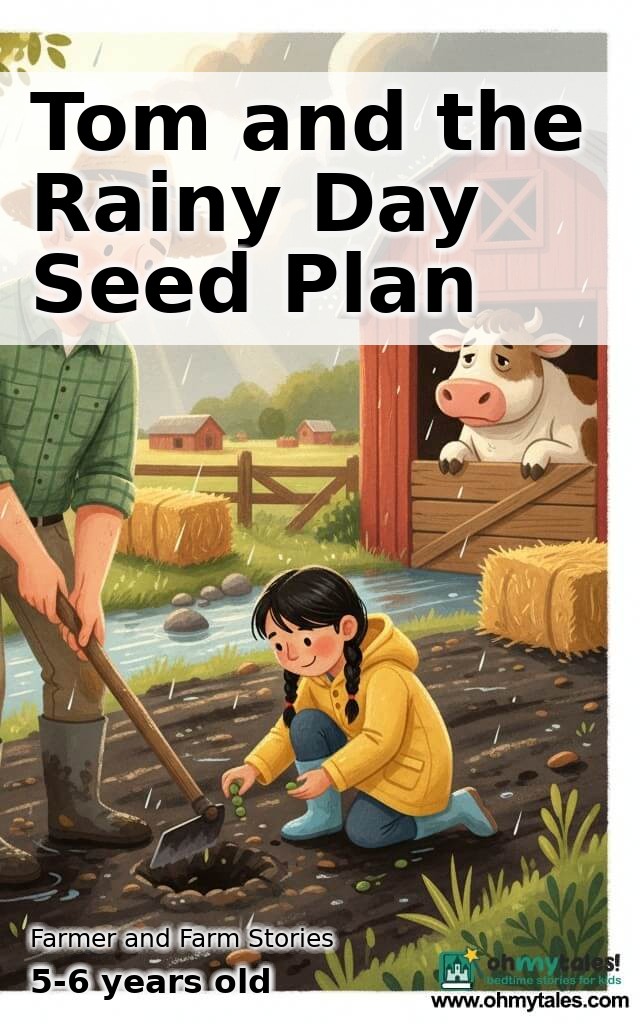
It was Nia, who lived in the last house of the village. She wore a yellow raincoat and held a small bucket.
Tom smiled. “Hello, Nia. I could use an extra pair of eyes.”
Nia stepped closer, careful not to slip. “My teacher said farms feed everyone. Is that true?”
Tom nodded. “Yes. Farmers grow food, care for animals, and keep the soil healthy. It's a big job, but it matters.”
Nia looked at the muddy trench. “What are you doing?”
“I'm making a safe bed for seeds,” Tom explained. “Seeds need the right depth. Not too deep, not too shallow. And they need soil that isn't packed like a rock.”
Nia squatted and touched the ground with one finger. “It's cold.”
“It is,” Tom said. “That's why I won't plant warm-weather crops today. Corn likes warmer soil. But peas can handle cool days, so I'll plant peas near the stream.”
Nia giggled. “Peas are brave!”
“They are,” Tom agreed.
Together they walked to the lower field by the stream. The water moved past smooth stones. The soil there felt darker and softer. Tom showed Nia how to make little holes with his finger.
“Drop one seed,” he said, “then cover it gently. Like tucking it into bed.”
Nia whispered, “Good night, seed,” and covered it with a pinch of soil.
Tom chuckled. “Perfect.”
When they finished, Nia pointed to the hill. “What will you plant up there?”
“Sunflowers,” Tom said. “They love sun, and their roots help hold the soil. And later, the birds will enjoy the seeds.”
Nia's eyes went wide. “So you feed birds too?”
Tom shrugged in a friendly way. “The farm shares. We grow for people, and we make space for nature.”
They heard a bleat from the barn. A goat had noticed them.
Tom called back, “I'm coming soon!”
Nia waved. “I should go. My mom will worry.”
“Thank you for helping,” Tom said. “You were careful and kind.”
Nia beamed. “I want to be a farmer for a day!”
“You already were,” Tom told her.
Evening Calm, Tomorrow's Plan
By late afternoon, the clouds broke apart. The sun returned, soft and golden. Tom finished his rounds: he checked the goats' fence, filled the water again, and brushed Daisy's back. Daisy leaned into the brush, calm and heavy.
In the kitchen, Tom made soup with carrots and potatoes from last season's storage. The steam smelled cozy. Moss lay near the door, tired from watching everything.
Tom sat at the table with his notebook. He wrote in careful letters:
- Rain came early.
- Trenches needed fixing.
- Planted peas near the stream.
- Sunflowers tomorrow on the hill.
He thought of Lina in her hot, dry climate, saving water drop by drop. He thought of his own cool, changeable weather, where rain could be a helper or a surprise. He thought of Mrs. Bell's basket and Nia's small hands tucking seeds into soil.
Tom looked out the window. The fields were quiet now. The village lights twinkled like tiny stars near the road.
He felt tired in his muscles, but warm in his heart.
“This work is hard,” he said softly to Moss, “but it's good. The land listens when we take care of it.”
Moss lifted his head and thumped his tail once.
Tom washed his bowl, set his boots by the door, and stretched his arms. Outside, the night air smelled clean after the rain.
“Tomorrow,” Tom whispered, “we'll start again with energy.”
He turned off the light, and the farm rested, ready for morning.