Chapter 1
Maya woke before the sun. She tied her hair in a loose knot and put on her paint-stained sweater. The studio smelled like coffee and paper. Light slipped in through the tall window. Outside, the street was quiet. Inside, a small bell on the shelf chimed like a little bird when the breeze moved it.
Maya was an artist. She drew with soft pencils and painted with bright colors. She also listened. That was part of her work. Sometimes the artists she listened to were people. Sometimes they were invisible — like the memory of a song, or the sound of footsteps on wet pavement. She felt connected to them. They helped her think of new ideas.
Today she would do something different. The neighbourhood had asked her to help make a big mural on the wall by the playground. "We want colors that hug us," Mrs. Alvarez had said with a laugh. "We want something that makes the children run faster and the grandparents smile slower."
Maya packed her brushes. She packed spare paints. She thought about the invisible artists too — the ones who lived in the stories of the houses and in the whispers of the trees. She whispered, "Come with me." She felt brave and a little nervous. The knot in her stomach was small, like a pebble.
Chapter 2
At the playground, a group had already gathered. Children pointed to the big blank wall. Some held tiny drawings. Others brought jars of old buttons. A man with a wide hat carried a ladder. A girl named Noor waved a paper cutout shaped like a bird.
"Hello, Maya!" called Tomas, the baker. "We baked extra rolls. Paint makes me hungry."
Maya smiled. She set up a long table. She laid out canvases and paper and glue. "Let's make this together," she said. "We will listen to the wall. We will listen to each other."
First, she asked everyone to close their eyes. The street grew quiet. Maya hugged her elbows. She asked, "What color is your happy today?" A boy said, "Blue, because the sky is my cape." An older woman said, "Cream, like my tea." A teenager said, "Rainbow, because I can be many things." Maya wrote each answer in her little notebook.
Then she showed how to mix colors. She dipped a flat brush in yellow and gently tapped it against blue. "Watch," she said softly, "blue and yellow sing together and make green." The children clapped. Hands reached for the tube of paint. Someone smeared green on a paper airplane and laughed.
Maya taught simple gestures. "When you move the hand in big circles, the paint breathes. When you press light, the color stays shy. When you press hard, it shouts." She demonstrated. Her hands were steady. The sunlight warmed her skin. Each movement was like a small, safe secret.
People who had never painted before tried. A man with rough fingers painted a small, careful flower. A little girl, who whispered to her sneakers, painted a loud sun with orange spikes. Maya walked along the wall, guiding a child's hand or straightening a crooked patch of tape. She spoke kindly. "Try again," she would say. "Try a little softer." She showed mistakes too. "See? Sometimes my line went wobbly. That is part of the picture now."
The invisible artists seemed pleased. The wind hummed and a stray leaf stuck to a smear of paint like a tiny airplane.
Chapter 3
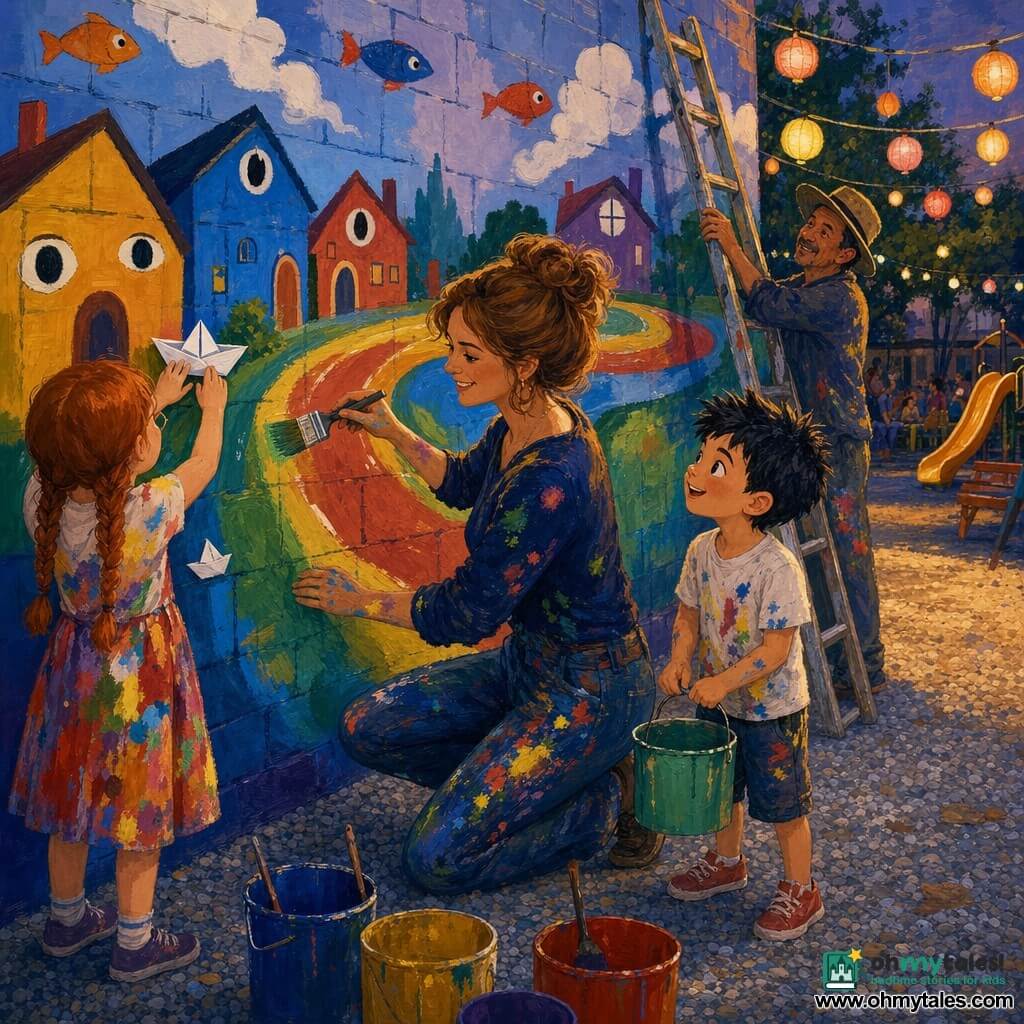
By midday, the mural grew. It had houses with windows that looked like friendly eyes. It had fish that swam in clouds. It had a long ribbon of colors that looked like a road for dreams. People added things that mattered to them. A child glued a paper boat. An old man painted a small bird and wrote his mother's name beneath it. Maya learned how each stroke told a story.
Sometimes she doubted her choices. She wondered if the colors were too loud or the shapes too odd. Her chest tightened. A little boy noticed and tugged her sleeve. "Are you sad?" he asked.
Maya crouched down and held his small hand. "I am thinking," she said. "Artists think a lot. We try things. Sometimes they work. Sometimes they do not. That is okay."
The boy nodded as if this was important advice. He handed her a small blue marble. "Keep this," he said. "It helps."
Maya kept the marble and kept going. She told the group about times she had painted a picture that everyone loved and times when she had to paint over it the next day. She shared the small failures like tiny pebbles in a pocket. People listened. They shared their own pebbles too — like the woman who had once burned a batch of cookies or the teenager who had missed a goal in a game. Everyone smiled at the honesty. It made the air lighter.
At the edge of the mural, Maya painted a doorway. "This is for doubts," she said later, laughing. "You can step through and try something new." A child leapt over the painted doorway on tiptoes, shouting, "New!"
Chapter 4
As dusk came, lanterns were hung. The mural glowed in the soft light. Neighbours brought blankets and sat on the grass. Mrs. Alvarez played a quiet tune on a small flute. Maya stood back. Her hands were smudged with color. Her sweater had dots of paint like tiny stars.
"Look at how much we did," Tomas said, his voice full of pride. "You brought us together, Maya."
She felt warm. She also felt tired and unsure. "I was scared," she said, honest and small. "I worried my ideas would not matter."
A little girl tucked her drawing under Maya's arm. "Your ideas make us brave," she said. "You taught me to try."
Maya thought about the invisible artists again. She thought about the songs and footsteps and the marble in her pocket. She thought about the hands that had helped and the stories people had painted. She decided right then she would be honest about her work. She would tell others about the times she failed and about the times she glowed. "I will speak of both," she whispered to the mural, and to the night.
They shared snacks and laughter. People left small notes on the windowsill. One said, "Thank you for your time." Another said, "You made the wall sing." A child drew a crayon moon and pinned it to a lamppost.
Before everyone went home, Maya stood before the mural. She touched a cool patch of blue. "This is our wall," she said. "It shows that making is not perfect. It is a path. We respect each other's work. We respect that everyone tries."
The neighbourhood clapped softly, like rain. Maya looked at the faces around her. She felt seen. She felt part of something gentle and big.
That night, at home, she washed her brushes. She found the blue marble in her pocket and put it on her shelf where she kept notes and small keepsakes. She wrote in her notebook: Today we painted together. I will tell the truth about my doubts and my successes. People need both.
She turned off the lamp. The moon looked like a thin paintbrush in the sky. Maya smiled and fell asleep listening to the quiet sounds of the street. The mural waited for the morning, ready to greet the day and to remind everyone that art grows when people share, respect, and try together.