Chapter 1: The Clay Seal That Wouldn't Break
In the city of Uruk, where the walls rose like baked bread against the sky, dawn came in bands of copper and rose. Market sellers called out prices, goats argued with each other, and the river whispered its old, muddy songs.
Naram, a potter with strong hands and a laugh that could chase away nervous thoughts, carried a basket of bowls to the temple storehouse. He was an adult, tall and broad-shouldered, with clay under his nails most days and kindness in his eyes always.
He had promised his neighbor, little Suri, that he would bring her mother a jar of oil. Suri's mother had been coughing for days, and Naram couldn't stand the sound. He moved through the crowd, weaving between linen robes and baskets of dates.
Then he saw the door.
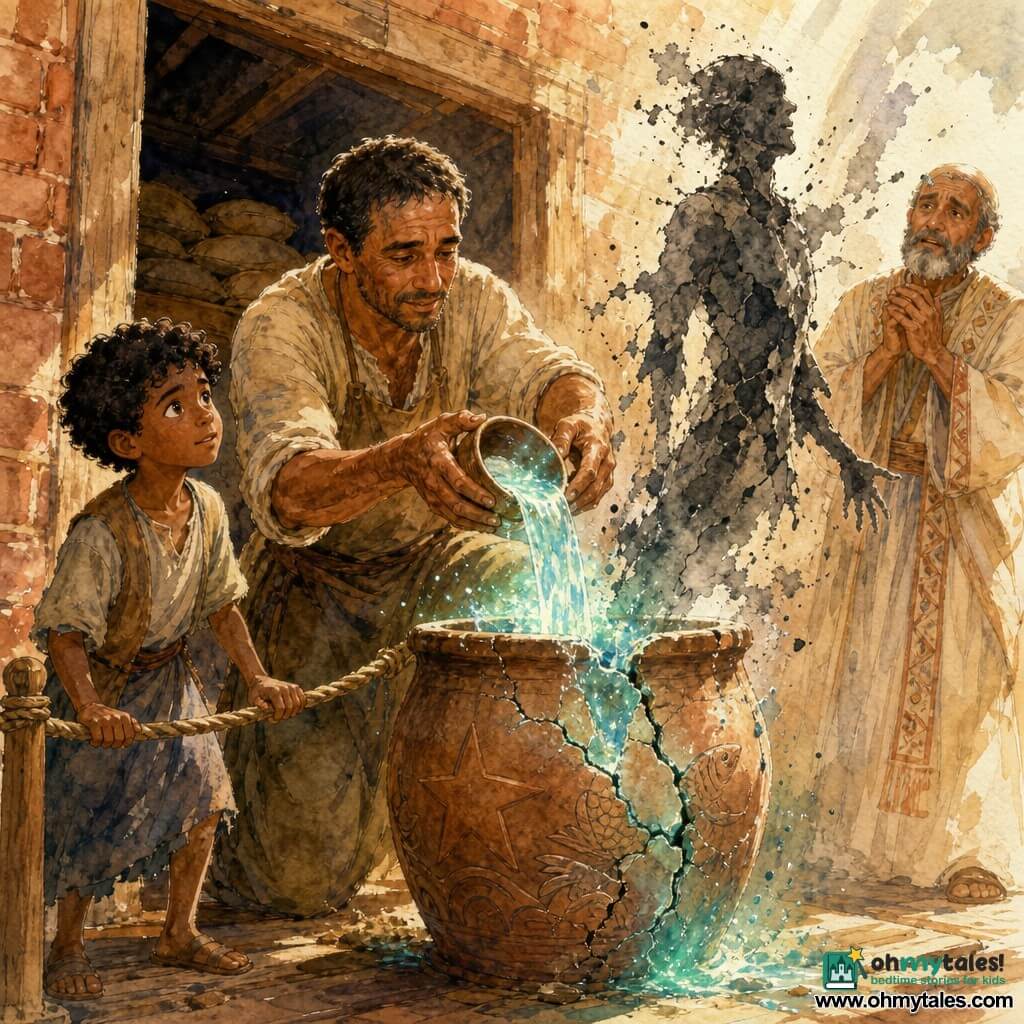
It was the back door of the storehouse—plain wood, iron latch—except for the seal. A lump of river clay was pressed over the join, stamped with a sign: a star over a fish. Everyone in Uruk knew that mark. It belonged to the shrine of Enki, Lord of Deep Waters and Clever Plans.
The seal should have been easy. A twist, a crack, a clean break.
But it didn't break.
Naram tried again, gentle, then firmer. The clay stayed whole, as if it had turned to stone. And as he watched, a thin, dark line seeped from the seal like ink from a wound.
His stomach tightened. “That's not right.”
The line crawled down the door, down the threshold, and into the dust. Wherever it touched, the dust turned gray, and tiny insects fell still, as if someone had taken away their little sparks of life.
A priest hurried past, then stopped short, eyes widening. “By the Seven Winds,” he breathed. “The curse has woken.”
“What curse?” Naram asked.
The priest swallowed, as if his throat had suddenly filled with sand. “A simple one, but stubborn. Long ago, a thief tried to steal sacred grain from this storehouse. Enki's guardians caught him, but the anger didn't leave. It slept in the seal. If the seal hardens, the city's stores spoil. Bread becomes bitter. Water tastes of metal. And people…” His voice dropped. “People lose their warmth.”
Naram looked around. A woman nearby rubbed her arms, shivering though the sun was already bright. A child's laughter sounded strange—thin, like a reed flute with a crack.
“Can you fix it?” Naram asked.
The priest shook his head. “The high priest has gone to Nippur. The temple scribes argue. The guards blame each other. Meanwhile, the curse spreads like spilled dye.”
Naram set down his basket. He thought of Suri's mother, of the cough, of the way sickness creeps. He thought of the city's ovens, of warm loaves. He thought of the river, which could be generous or cruel depending on the day.
He took a breath, and the breath felt like a promise. “Tell me how to unbind it.”
The priest stared. “You? You're a potter.”
“I'm a potter,” Naram agreed. “And I'm here.”
The priest hesitated, then leaned closer. “They say the seal was made from clay taken from the Abzu spring—Enki's hidden water under the world. To soften it again, you must bring it a gift from the deep: water that remembers its own name. And you must speak the thief's forgiveness.”
Naram blinked. “Water that remembers its own name?”
The priest gave a helpless shrug. “Myths are like that. Clear as a bell, until you try to hold them.”
Naram looked at the dark line in the dust. It was reaching toward the alley like a slow, patient snake.
He picked up his basket again, but lighter now, as if his old errands had slipped away. “Where do I find the Abzu spring?”
The priest pointed east, toward the reed marshes where fog clung in the mornings. “Follow the canal past the date groves. Beyond the last watch post, there's a cracked statue of a bull. Under it, they say, the world has a seam.”
Naram nodded. A seam. He understood seams. You could mend a pot, but only if you found the crack.
He started walking.
Behind him, the seal stayed unbroken, stubborn as a clenched fist.
Chapter 2: The Reed Boat and the Laughing Wind
Outside Uruk, the air smelled of wet plants and sun-warmed mud. The canal ran beside him, slow and greenish, with dragonflies skimming the surface like tiny jeweled arrows.
Naram met a boatman at the edge of the marsh, a boy about Suri's age with hair like a nest of dark curls. The boy was pushing a reed boat into the water, pretending it was a mighty ship.
“Where's your captain?” Naram asked.
The boy lifted his chin. “I'm the captain.”
“I need a ride,” Naram said. “Past the date groves. Past the last watch post.”
The boy squinted at him, dramatic as a temple actor. “That's far. That's… legendary.”
“I'll pay,” Naram offered, reaching for the small pouch at his belt.
The boy waved away the idea as if it were a fly. “Keep your silver. Bring me a story instead. Something good. Something that makes my mother stop worrying.”
Naram paused. He didn't have a polished story ready, not like the singers in the market. But he had something better: truth shaped with care.
He climbed into the boat, and the reeds creaked pleasantly under his weight. “All right,” he said. “Here's a story about a city that forgot how to be warm, and the people who remembered each other.”
The boy's eyes lit. “That's already interesting.”
They pushed off. The marsh opened around them, tall reeds swaying like a crowd whispering secrets. The wind chased ripples over the water, and it almost sounded like laughter.
Halfway through the groves, the sky dimmed. Not with storm clouds—no, the light simply thinned, as if someone had stretched a veil across the sun. Naram felt the curse's cold touch even out here.
The boy shivered and pulled his cloak tighter. “Do you feel that?”
“I do,” Naram said. “What's your name, Captain?”
“Bel,” the boy said, and then, quieter, “My mother says that name means ‘lord.' But I'm not a lord. I'm just… me.”
“Being you is plenty,” Naram said. “And today, Captain Bel, you're helping your city.”
Bel straightened a little. “Good. Because the watch post guards have been acting strange. They don't smile anymore.”
Sure enough, when the boat glided near the last watch post, the guards stood like carved stones. One of them raised a hand slowly, as if his arm were heavy.
“No travel beyond,” the guard said, voice flat.
Naram met his eyes. They were dull, like coins left too long in dirty water. “We need to reach the cracked bull statue.”
The guard's gaze drifted to the water, unfocused. “No travel beyond.”
Bel leaned forward, whispering, “He's like my uncle when he forgets his words.”
Naram thought fast. A simple curse, the priest had said. Simple, but stubborn. Like a knot that won't loosen because no one tugs the right strand.
Naram lifted his basket and pulled out a small clay cup, one he'd made himself, smooth and reddish. He filled it with canal water and held it up.
“Guard,” Naram said gently, “do you remember the taste of cool water after a long day?”
The guard blinked once. A tiny movement, but real.
Naram stepped closer, careful not to sound like a command. “Take this. Not as an order. As a gift.”
The guard hesitated, then took the cup with stiff fingers. He sipped.
For a moment nothing changed. Then the guard's shoulders dropped, just a fraction. His mouth twitched, trying to recall how a smile worked.
“Thank you,” he said, and the words sounded more like a person and less like an echo.
Naram nodded. “We'll be quick.”
The guard lifted the barrier rope. “Be careful,” he added, and the warning had warmth in it.
Bel exhaled like he'd been holding his breath for days. “How did you do that?”
“I didn't do much,” Naram said. “I remembered he was hungry for kindness.”
They slipped past into quieter water. The reeds grew thicker. The air smelled older, like stories told a thousand times. The laughing wind returned, tugging at Bel's curls and Naram's sleeves, as if it wanted them to hurry.
Ahead, on a low mound of cracked earth, stood the statue: a bull with broken horns, its stone face worn smooth by rain and years. A seam ran down the base, dark as a shadow.
Bel guided the boat to the bank. “That's it,” he whispered.
Naram stepped out, boots sinking into soft mud. He placed a steadying hand on the bull's flank.
The stone felt cold.
“Captain Bel,” Naram said, “I might not come back up right away.”
Bel swallowed. “Are you going under the world?”
“Just a little,” Naram said, aiming for lightness. “I'll be back before your story ends.”
Bel tried to grin. “Then make it a long story.”
Naram found the seam. His fingers traced it until they reached a narrow opening hidden by moss. From inside came a sound like distant water, deep and patient.
He took one more breath.
And climbed down.
Chapter 3: The Abzu's Doorway and the Fish of Names
The passage sloped sharply, and the air changed with every step. It grew cooler, damp, and it smelled of wet stone and secrets. Naram's sandals scraped against rock, and little droplets tapped his hair like careful fingers.
At the bottom, darkness opened like a mouth—except it wasn't hungry. It was waiting.
A faint glow rose from below, bluish and soft, like moonlight caught in a jar. Naram followed it into a cavern where water spread wide and still. The surface reflected the ceiling, which glittered with crystals like frozen stars.
This had to be it: the Abzu, the deep fresh water under the world, the place Enki's cleverness slept.
Naram knelt at the shore. The water looked calm, but it felt watchful. He dipped a finger in.
Cold surged up his arm, not painful, but powerful—like touching a memory that wasn't his.
A ripple formed. Then another.
A fish rose from the depths, large as Naram's forearm, scales silver-green. Around its head floated a thin ring of light, like a halo made of water.
The fish spoke.
Not with a mouth, but with meaning that landed in Naram's mind like a pebble in a pond.
WHO KNOCKS AT THE DEEP?
Naram's heart hammered. He forced his voice to stay steady. “My name is Naram. I'm from Uruk. A curse has woken in the temple storehouse. I was told to bring water that remembers its own name.”
The fish circled once. The halo shimmered.
ALL WATER REMEMBERS. MOST PEOPLE FORGET TO LISTEN.
Naram almost laughed, partly from relief and partly because that sounded exactly like a god's riddle. “Then teach me to listen.”
The fish drifted closer. In its scales, Naram saw flickers—children splashing, farmers praying for rain, women drawing water at dawn, old men staring into wells as if looking for lost years.
The fish's thought-voice softened, oddly gentle.
THE CURSE IS A KNOT. NOT OF POWER, BUT OF FEELINGS LEFT TOO LONG IN THE DARK.
Naram pictured the dark line creeping through dust. “How do I undo it?”
BRING THREE THINGS, the fish answered. A CUP THAT HAS HELD KINDNESS. A WORD THAT HAS HELD FORGIVENESS. AND WATER THAT KNOWS ITS OWN NAME—CALLED BY SOMEONE WHO MEANS IT.
Naram looked down at his hands. A cup that has held kindness… he had given water to the guard. His clay cup had been a gift, not a tool. Maybe that counted.
A word that has held forgiveness… that was harder. He hadn't been the one stolen from. He wasn't the god, or the priest, or the long-dead guardian. How could he forgive in someone else's place?
The fish seemed to sense the worry.
FORGIVENESS IS NOT OWNED, it said. IT IS OFFERED. IT DOES NOT ERASE WHAT HAPPENED. IT UNCLENCHES THE FUTURE.
Naram's chest eased a little. He thought of Suri's mother again. He thought of Bel, waiting above. He thought of the guard who had remembered warmth.
“I'll try,” he said.
The fish dipped, and a small current lifted from the Abzu, rising like a ribbon. It poured into Naram's cup—his clay cup, which he still carried—without spilling a drop.
The water inside glowed faintly, as if it held a trapped dawn.
WHAT IS ITS NAME? the fish asked.
Naram hesitated. Water's name? In Uruk, they called it “water,” “river,” “canal,” “life,” “danger,” depending on the day.
But this water felt older than those words. It felt like the first sip after thirst, the first rain after dust, the first lullaby after fear.
Naram closed his eyes. He listened—not with ears, but with something quieter.
He whispered, “Abzu.”
The water in the cup brightened, as if pleased to be recognized.
The fish's halo flared once.
GO. THE SEAL WILL LISTEN IF YOU SPEAK AS YOU HAVE LISTENED.
Naram stood, cradling the cup carefully. “Thank you,” he said, and meant it.
The fish sank back into the deep. As it vanished, Naram caught one last thought, like a farewell pressed into his palm:
REMEMBER: A SIMPLE CURSE CAN BE UNDONE BY A SIMPLE HEART.
The climb back up was harder with the cup in hand. The passage seemed steeper now, like the world wanted to test how much he cared.
But Naram didn't spill a single drop.
When he emerged into daylight, Bel nearly toppled into him.
“You're alive!” Bel said, half laughing, half scolding.
Naram held up the cup. “And I brought a little piece of the deep.”
Bel stared at the glowing water. “That's… that's definitely not canal water.”
“No,” Naram agreed. “It knows its own name.”
Bel's eyes shone with excitement and fear mixed together, the way they did when someone told a good myth. “Then let's hurry. The air feels colder.”
Naram glanced back toward Uruk's distant walls, hazy in the heat. “Yes,” he said. “Let's hurry.”
Chapter 4: The Thief's Shadow and the Word Like a Key
They traveled fast. The reed boat skimmed the canal, and the laughing wind pushed at their backs as if it had decided to be helpful for once.
Yet as Uruk grew nearer, the city looked wrong. The colors seemed drained. Even the banners on the temple poles hung limp, like tired tongues.
At the storehouse, the dark line had become several lines, branching through the dust like cracks in dried mud. People stepped around them as if afraid the lines could bite.
The priest from earlier stood nearby, rubbing his hands together. “You returned,” he said, voice hopeful but shaky. “Did you—”
Naram lifted the cup. The glow drew a gasp from the priest and a murmur from the crowd.
“It's Abzu water,” Naram said. “Now I need the thief's forgiveness.”
The priest's face pinched. “We don't know his name. Records are broken. Stories changed.”
Bel tugged Naram's sleeve. “If you don't know his name, how do you forgive him?”
Naram stared at the seal. It looked like ordinary clay, but the surface had a cruel shine, like frozen anger. He could almost feel the old moment sealed inside: a hand reaching, grain spilling, a shout, a chase, shame burning in the throat.
A simple curse, but stubborn.
He thought of the fish's words: Forgiveness is offered.
Naram turned to the crowd. “Does anyone here remember a hungry season?” he asked.
A woman raised her hand slowly. “When I was small,” she said, “the river ran low. My father traded his belt for barley.”
An old man nodded. “I remember children chewing reeds.”
Another voice, quieter: “I remember stealing a fig once,” a teenager admitted, cheeks red. “I was starving. I still feel bad.”
Naram let their words settle. Hunger. Need. Mistakes.
He looked at the seal again and spoke to it as if it were a person crouched behind a door.
“Whoever you were,” Naram said, “you did wrong. You tried to take what wasn't yours. That matters.”
The crowd went still.
“But I can imagine you were frightened,” Naram continued, voice warm, steady. “Maybe you were hungry. Maybe you thought no one would help. Maybe you thought the gods had forgotten you.”
The priest's eyes glistened.
Naram lifted his free hand, palm open, the way you offer bread. “I can't change your choice. But I can choose what happens next.”
He drew a breath that felt like light.
“I forgive you,” he said.
The words didn't boom like thunder. They weren't fancy. They weren't carved in gold.
But they were real.
For a heartbeat, nothing happened. Then a thin shadow peeled away from the seal—like smoke tugged by a breeze. It shaped itself into a hunched figure, featureless, trembling.
Bel grabbed Naram's arm. “Do you see that?”
“I do,” Naram whispered.
The shadow-thief didn't move toward them. It simply hovered, as if waiting to be chased away. Naram didn't chase it.
He stepped closer instead.
“You don't have to keep stealing warmth,” he told it. “Go. Rest.”
The shadow wavered. It seemed smaller, less sharp. Then it drifted upward, unraveling into the air like a scarf released from a tight knot. It vanished without a sound.
The priest exhaled. “By Enki… you spoke it loose.”
Naram's hands shook slightly. “Now the water.”
He knelt, set the cup against the seal, and whispered the name again: “Abzu.”
The water in the cup glowed brighter. He poured it carefully over the clay.
At first it beaded on the surface. Then the seal sighed—an actual sigh, like a door that had been held shut too long. The clay softened under the Abzu water, dark line receding as if pulled back by an unseen hand.
A crack formed down the seal's center.
Naram pressed gently.
The seal broke.
Warmth rushed out, not as fire, but as comfort. The air in the storehouse doorway smelled suddenly of grain and sun. Somewhere in the crowd, a baby started giggling, and this time it sounded full and round.
The priest's shoulders sagged with relief. “It's done.”
Bel grinned, triumphant. “Your story is getting good!”
Naram stood, wiping his hands on his tunic. “Not finished yet,” he said softly.
Because the cold had lifted from the storehouse, yes—but the city had been touched. People looked tired. The day was slipping toward evening. And Naram realized something else:
He and Bel were still outside, and the wind had shifted. A dry wind now, smelling of dust. The kind of wind that meant a desert night could be sharp.
The priest touched Naram's arm. “You should come to the temple. We have guest rooms.”
Naram looked toward the temple steps. Already, pilgrims were crowding in, grateful and loud, and the priest was being pulled away by questions.
Bel tugged his sleeve again, quieter now. “My mother will be waiting. Our house is small, but…”
Naram remembered Suri, remembered the oil he'd meant to bring. Remembered that warmth was meant to be shared.
He nodded. “Lead the way, Captain.”
Chapter 5: A Door Opened, A Shelter Found
Bel's home sat in a narrow lane where the bricks held the day's heat. A little clay lamp burned near the doorway, its flame steady and brave.
Bel knocked and called, “Mother! I'm back!”
The door opened at once. Bel's mother stood there, her hair wrapped in a scarf the color of pomegranates. Worry had drawn lines around her eyes—until she saw her son safe. Then the lines loosened.
She pulled Bel into a fierce hug. “You vanished like a mischievous spirit,” she scolded, voice shaking. “I was ready to march to the temple and yell at the gods.”
Bel leaned back, proud. “I helped unbind a curse.”
His mother blinked. “You—what?”
Naram cleared his throat gently. “He did,” he said. “He brought me to the Abzu seam.”
Bel's mother looked Naram up and down, taking in his dusty clothes, his steady posture, and the empty cup in his hands that still smelled faintly of deep water.
“You're Naram the potter,” she said, recognizing him. “Suri talks about your bowls like they're heroes.”
Naram smiled. “They mostly hold stew.”
Bel's mother's expression softened. “Come in. Both of you. The air is strange tonight. Too sharp.”
Inside, the house was indeed small, but it was bright with ordinary treasures: a woven mat, a shelf of cups, a little clay figurine of a lion with chipped ears. A pot simmered over coals, sending up a smell of lentils and garlic that felt like a blanket.
Bel flopped onto the mat. “Tell her the story,” he demanded. “The whole thing. With the fish that talks.”
Bel's mother raised an eyebrow. “A talking fish?”
Naram sat carefully, as if his bones had finally remembered they were tired. “It's a long story,” he said.
“Good,” she replied, ladling stew into bowls. “Long stories make the night shorter.”
As they ate, Naram told it all: the unbreakable seal, the creeping dark line, the marsh wind that laughed, the guard who remembered the taste of kindness, the bull statue with the hidden seam, the glittering cavern, the fish of names, the three things needed, and the word of forgiveness that unclenched the future.
Bel kept interrupting to add sound effects. “And then—whoosh!—the shadow peeled off like burnt paper!”
His mother listened with a hand over her mouth, half in awe, half in disbelief, until Naram described the warmth returning to the storehouse.
When he finished, a quiet settled in the room. Not the cold quiet of the curse, but the gentle quiet of people who feel safe enough to be still.
Bel's mother spoke first. “You could have walked away,” she said to Naram. “Many would have. They would say, ‘It's for priests.' Or, ‘It's not my trouble.'”
Naram looked at his bowl. “I thought of people coughing,” he admitted. “And bread turning bitter. And children growing quiet. Trouble spreads. So does help.”
Bel's mother reached out and squeezed his wrist, a simple, grateful gesture. “Then our door is yours tonight.”
Outside, the wind hissed down the lane, but it couldn't reach through the thick brick. The lamp flame in the doorway stayed steady.
Bel yawned, huge and theatrical. “So… we found shelter at the end. That means the story is ending, right?”
Naram chuckled. “For tonight.”
Bel's mother tucked a blanket around her son. “Tomorrow you can brag to everyone,” she said. “But tonight you sleep.”
Bel mumbled, already drifting off. “Captain Bel… savior of… the marsh…”
Naram lay down on the mat they offered him, the house's warmth settling into his shoulders like a kind hand. He listened to the ordinary sounds: the crackle of coals, the distant call of a night bird, Bel's soft breathing.
In his mind, he heard the fish again: A simple curse can be undone by a simple heart.
Naram didn't feel like a hero. He felt like a person who had carried water, spoken a word, and chosen to care. That seemed small.
But small things, he thought, can be mighty. A cup. A name. A door.
And as the night deepened, Uruk held its warmth again, and Naram—at last—had found an easy, safe shelter, where the wind could not bite and the darkness could not cling.