Chapter 1: The Two-Backpack Problem
Milo kept lining up his pencils on the edge of the kitchen table, point to eraser, point to eraser, like the neat little row could keep everything else from wobbling.
Across from him, Jay balanced a spoon on his nose for exactly two seconds before it clattered into his cereal bowl.
“Ten points,” Jay announced, as if he had landed a skateboard trick instead of losing a spoon fight.
Milo tried to smile. It came out small.
The kitchen smelled like toast and dish soap. Morning light made squares on the floor. Milo's mom moved around those squares with a quiet kind of speed—mug, keys, papers, phone—checking, rechecking. His dad stood by the counter stirring his coffee even though it was already mixed.
They weren't shouting. That almost made it harder.
Jay leaned closer. “You sure you're coming to practice after school? Coach says if you miss another one, you'll owe the team twenty push-ups.”
Milo slid a pencil a millimeter to the left. “I'm coming. I think. Depends.”
“Depends on what?”
Milo opened his mouth and then closed it again. There were so many “depends” lately: depends on which house, depends on which day, depends on whose turn it was to drive. His life was turning into a calendar with legs.
Mom cleared her throat. “Milo, honey, after school today you'll go with Dad. Your bag is by the door.”
Dad nodded, not looking at Mom, not looking at Milo. “And tomorrow night you'll be with Mom. We'll switch after dinner.”
Jay blinked. “So… like a relay race?”
Milo let out a short laugh that surprised him. “Yeah. Except nobody trained for it.”
Mom came over and squeezed Milo's shoulder, warm and careful. “We're working on a plan,” she said. “A plan you can count on.”
Dad's voice was gentle but tight, like he was holding a balloon string too hard. “We're going to sign some paperwork today to make it official. It's about schedules and school stuff. Nothing you did caused it.”
Milo stared at the pencils. He wanted to say, I didn't even think I caused it. Then a different thought pushed in: What if I did, a little?
He didn't say either.
Jay scraped his bowl noisily. “Paperwork sounds boring. But if it makes the schedule less… mushy, that's good.”
Milo finally looked up. Jay's eyebrows were lifted, like he was trying to hold the whole room up with his face. Jay was almost eleven—two weeks away—and he treated serious things like they were heavy boxes: you didn't pretend they weren't there; you just tried not to drop them on your toes.
Milo's mom checked the clock. “We have to leave in five.”
Milo stood, grabbed his backpack, then stopped. Two backpacks sat by the door—one blue, one black. One for Dad's place, one for Mom's.
The Two-Backpack Problem.
He could feel it in his stomach, like he'd swallowed a small, nervous hamster.
Jay pointed. “Why do you have two? That's unfair.”
Milo shrugged. “It's… a system.”
Jay tilted his head. “Systems can be improved.”
Milo huffed. “If you can improve my whole life before first period, be my guest.”
Jay grinned, quick and brave. “Challenge accepted.”
Chapter 2: A Map Made of Sticky Notes
At school, the hallway sounded like a shoebox full of marbles. Lockers slammed, sneakers squeaked, someone laughed too loud. Milo liked the noise usually. Today it felt like everyone else had a simple, straight hallway, and he had to walk through a maze.
In homeroom, Jay tore a page from his notebook and drew two squares. In one square he wrote “MOM HOUSE.” In the other: “DAD HOUSE.”
Then he drew Milo in the middle as a stick figure with wild hair and wrote “MIL0” because he always spelled Milo's name with a zero to be annoying.
“What is that?” Milo whispered.
“A map,” Jay whispered back. “If you're going to do the relay race thing, you need a baton.”
“I don't have a baton.”
Jay tapped his pencil. “Your stuff is the baton. Socks. Homework. Charger. Toothbrush. The legendary gym shorts that smell like regret.”
Milo snorted. “Don't talk about the gym shorts.”
Jay drew tiny lines from Milo to both houses. “You don't have to carry everything. You can have two sets of some things. Like—” He paused dramatically. “Chargers.”
Milo's eyes widened. “Two chargers?”
Jay nodded. “Your mom and dad might be willing to buy a second one. It's cheaper than listening to you complain.”
Milo almost laughed for real this time. Almost.
During math, Milo kept thinking about his parents and the word “agreement.” It sounded like a handshake, like a promise. But what if it also sounded like a door clicking shut?
At lunch, Milo poked at his pasta while Jay ate like he was paid per bite.
Jay said, “When are they signing the thing?”
“Today,” Milo answered. “After school. They said… I can come. If I want.”
Jay stopped chewing. “Do you want to?”
Milo's fork hovered. “I don't know. It feels… weird. Like watching people decide where you belong.”
Jay's mouth twisted thoughtfully. “Maybe it's also watching them decide how to take care of you.”
Milo stared at him. Jay could be ridiculous, but sometimes he said things that landed softly, like a blanket.
Jay wiped sauce off his lip with his sleeve. “If you go, you should bring a snack. Serious adult meetings have the energy of dry toast.”
Milo said, “I think there will be water.”
“Water is not a snack.”
“I know.”
Jay reached into his lunch bag and slid a granola bar across the table like it was a secret message. “Emergency baton fuel.”
Milo picked it up and turned it over in his hands. “Thanks.”
Jay shrugged, pretending it wasn't a big deal. “Loyal teammates. That's us.”
Milo tucked the granola bar into his pocket. The Two-Backpack Problem still existed, but now it had a tiny solution-shaped corner.
After lunch, in the library, Milo and Jay worked on their science project: building a small model bridge out of sticks and glue. Jay insisted the bridge needed “character,” so he added a tiny flag made from a sticky note.
“What's it stand for?” Milo asked.
Jay wrote on it carefully: FLEX.
“Flex?” Milo repeated.
Jay nodded. “Like flexibility. Bridges need it. They can't be stiff or they crack. Same with… you know. Life stuff.”
Milo swallowed. The word felt strange and useful.
“Okay,” Milo said softly. “Flex.”
Chapter 3: The Office With the Quiet Clock
After school, Milo's dad picked him up. Jay waved from the curb and called, “Remember: snack!” like Milo was going on a mountain hike instead of to an office.
In the car, Dad kept both hands on the steering wheel. The radio was off, which made the turn signals sound extra loud.
Dad cleared his throat. “You don't have to come in, Milo. You can wait in the lobby. Or in the car. Whatever feels better.”
Milo looked out the window at houses sliding by—someone's dog in a yard, a kid bouncing a basketball, a woman carrying groceries. Normal life, busy with normal things, as if the world didn't notice Milo's stomach doing cartwheels.
“I'll come in,” Milo decided. “I want to know what's happening.”
Dad's shoulders loosened a little. “Okay. Thanks for telling me.”
The office building was plain and beige, like it was trying not to be remembered. Inside, the lobby smelled faintly like carpet and peppermint. A clock ticked loudly, slow and patient.
Mom was already there, sitting in a chair with her bag on her lap. She smiled when she saw Milo, but her eyes looked tired, like she'd been reading tiny print all night.
“Hey, kiddo,” she said.
“Hey,” Milo answered, and he meant it to both of them.
A woman in a navy blazer introduced herself as Ms. Carter. She spoke to Milo too, not just over his head, which made him feel less like luggage.
“Your parents are here to sign a custody agreement,” Ms. Carter explained in a calm voice. “That means you'll have a schedule that everyone follows, so you can plan your weeks. It also includes rules about school decisions, medical stuff, and making sure you have what you need in both homes.”
Milo's mouth was dry. “So it's… like a rulebook?”
Ms. Carter nodded. “A guide. It's meant to reduce surprises.”
Milo thought about how surprises used to be fun—surprise birthday cupcakes, surprise snow days. Now surprises were things like finding boxes in the hallway.
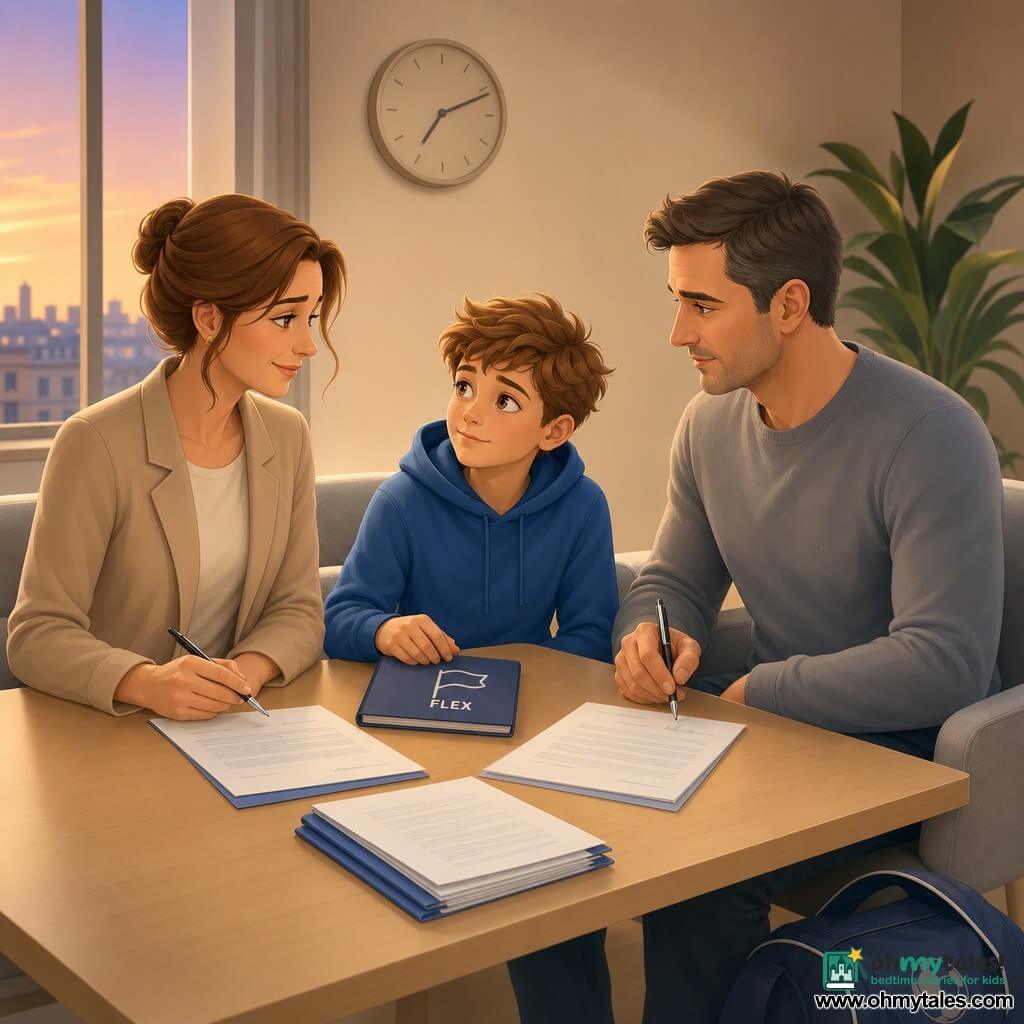
They went into a small meeting room. The table was shiny and too big for the number of people. Papers were stacked neatly. Two pens sat on top like they were waiting for a race to start.
Mom and Dad sat across from each other. Milo sat near the corner where he could see both their faces without turning his head too much.
Ms. Carter read through the main points. Her voice was steady, like she was laying stones across a stream.
“Weekdays,” she said. “Alternating weekends. Pickups at school. Holidays split. A plan for birthdays. A way to handle changes if someone is sick or traveling.”
Milo listened hard. Some parts sounded fair. Some parts sounded like someone had cut his life with scissors and tried to tape it back together in a new shape.
Dad asked, “Can we add that Milo can call either of us anytime?”
Mom nodded quickly. “Yes. Absolutely.”
Milo's chest felt warm for a second.
Ms. Carter looked at Milo. “How does the schedule feel to you? Anything you want to say?”
Milo's tongue stuck to the roof of his mouth. He wanted to say, I want you to live in the same house again. He wanted to say, I want this to be a bad dream. He wanted to say, I'm afraid I'll forget something important and then everything will fall apart.
Instead he said, “I… don't want to be the messenger. Like, I don't want to carry messages between you two.”
Mom's face softened. “That's a good point.”
Dad nodded. “You shouldn't have to.”
Ms. Carter wrote something down. “We can add a communication plan. Parents communicate directly, not through the child.”
Milo let out a breath he didn't know he was holding. It felt like someone had taken a heavy book off his backpack.
Then came the signing.
Mom picked up a pen. Her hand shook a little. Dad picked up the other pen. He paused, staring at the paper like it might bite.
Milo watched them sign their names. Ink on paper. Simple lines that meant a big change.
When they finished, Ms. Carter stacked the pages and clipped them together. “All right,” she said. “This agreement is about stability. It's not about choosing one parent over the other. Milo gets to love you both.”
Milo's eyes stung. He blinked fast.
Mom reached across the table, not to Dad, but toward Milo. “We're still your team,” she said.
Dad's voice was rough around the edges. “Always.”
Milo nodded. “Okay.”
He didn't feel magically better. But he felt… held. Like the floor was still under him.
Chapter 4: The Flex Kit
That evening, Milo went to Dad's apartment. It was smaller than their old house, but Dad had tried to make it familiar. Milo's favorite cereal sat on the counter. A framed photo of Milo and Dad at the beach leaned on the shelf, slightly crooked like it had been placed in a hurry.
Milo dropped his backpack on the floor and sat on his bed. The room smelled like clean sheets and new paint.
Dad stood in the doorway. “How are you doing, really?”
Milo's honest answer was: like I'm a rope being pulled from both ends. But he didn't want Dad to look more tired.
So he said, “I'm… okay-ish.”
Dad nodded like he understood the secret language of “okay-ish.” “That makes sense.”
They ate dinner—tacos that fell apart, because Dad always overfilled them. Milo actually liked that. The mess felt normal.
After dinner, Dad opened a drawer and pulled out a small plastic bin. “I made something,” he said, looking a little embarrassed. “It's your ‘Flex Kit.'”
Milo raised an eyebrow. “Please tell me it's not full of yoga videos.”
Dad snorted. “No. It's practical.”
Inside were duplicates: a toothbrush, deodorant, a phone charger, an extra pair of socks, a small notebook, and a list on top written in Dad's neat handwriting.
FLEX KIT CHECKLIST:
- Homework folder
- Sports gear
- Favorite hoodie
- Keys
- Phone
- Something fun
Milo touched the list. The paper was thick, like Dad had printed it on purpose, not scribbled it on a napkin.
Dad said, “I know you've been worried about forgetting things. So this is… to make it easier.”
Milo's throat tightened. “You did this?”
“Your mom and I talked,” Dad said. “She's making one at her place too. Same list.”
Milo stared at him. “You talked?”
Dad's mouth tilted. “We can talk about you. We're learning.”
Milo picked up the notebook from the bin. It was plain, but on the front Dad had drawn a tiny bridge with a flag. The flag said FLEX in block letters.
Milo laughed, startled. “Did Jay tell you about the bridge?”
Dad looked confused. “Who's Jay?”
Milo grinned wider. “Never mind. It's just… funny.”
Dad leaned on the doorframe. “If the schedule ever needs to change, we'll tell you ahead of time whenever we can. And if it changes last minute, it doesn't mean anyone forgot you. It just means life got messy.”
Milo nodded slowly. “And if I feel mad or sad… I can say it?”
Dad answered without hesitation. “Yes. You can say it to me, and you can say it to Mom. Feelings are allowed.”
Milo looked down at the Flex Kit again. Practical things. Concrete things. A little bit of control in a situation that felt huge.
He opened the notebook and wrote one sentence on the first page:
I can be loyal without being stuck.
He wasn't sure where the sentence came from, but it felt true, like a door unlocking.
Later, Milo texted Jay: Went to the signing. Weird but okay. Also: Flex Kit exists.
Jay replied almost immediately: YES. Welcome to the Order of the Double Charger.
Milo smiled into his pillow. It was the first time that day he felt close to peaceful.
Chapter 5: The Switch Day Experiment
The next afternoon, it was switch day.
At school, Milo's friends argued about a video game update. Someone complained about cafeteria pizza. The world continued being the world, which was comforting.
After the last bell, Milo stood by the front steps with his backpack. Dad would pick him up today and bring him to Mom's after dinner.
Jay joined him, chewing gum loudly. “How's the Order of the Double Charger treating you?”
Milo said, “Powerful. I feel like I could run a small country.”
Jay nodded solemnly. “Electricity is leadership.”
Milo laughed. Then his smile faded, just a little. “Switch days are still… strange.”
Jay leaned against the railing. “Okay, so. Experiment time.”
Milo narrowed his eyes. “Why do I feel like you're about to make me do something embarrassing?”
Jay pulled out two sticky notes and a pen. On one he wrote “HOME A.” On the other he wrote “HOME B.”
“You're not a package,” Jay said, sticking the notes to Milo's notebook like labels. “But your brain might feel like you're being shipped around. So you need a reminder that you're the same Milo in both places.”
Milo rolled his eyes, but he didn't peel them off. “And how does a sticky note do that?”
Jay tapped the notebook. “You write one good thing from each place. Every time you switch. So your brain stops treating it like losing something and starts treating it like carrying something.”
Milo considered it. It sounded simple enough to actually work.
“What if the good thing is… ‘I didn't cry in front of anyone'?” Milo asked, half joking.
Jay shrugged. “That counts. But also, you can cry in front of people. That's just your face doing weather.”
Milo barked a laugh. “My face doing weather?”
“Yep. Sunny. Stormy. Mostly cloudy with a chance of sarcasm.”
Dad's car pulled up. Dad waved. Jay waved back like a cheerful traffic officer.
Milo climbed in. As they drove, Dad asked about school, and Milo answered honestly: “Fine. Math was annoying. Jay tried to label my notebook like it's luggage.”
Dad chuckled. “Jay sounds creative.”
At Dad's place, they ate dinner. Afterward, Dad helped Milo pack the things on the checklist. No rushing, no sharp voices. Just: hoodie, keys, homework, sports gear.
Then they drove to Mom's house.
Mom stood on the porch when they arrived. The porch light made a soft yellow circle around her, like a safe spot in a game. She waved, and Milo felt that warm chest feeling again.
Dad carried Milo's sports bag to the step. “Here you go.”
Mom said, “Thanks.”
It was a small exchange. Two words. But it wasn't icy. It wasn't sharp. It was… normal.
Milo stepped between them, heart thumping. He didn't know if he should hug Mom right away or say goodbye to Dad first. The moment felt like a doorway with two handles.
Dad spoke first. “See you Friday, buddy.”
Milo nodded. “Yeah. Friday.”
Mom opened her arms. Milo hugged her. Then, surprising himself, he turned and hugged Dad too.
Dad froze for half a second, then hugged back, firm and careful. “Love you,” Dad murmured.
“Love you,” Milo said.
Mom's hand rested on Milo's shoulder. “Love you,” she added, like she was stitching the moment together.
After Dad left, Mom brought Milo inside. On the kitchen counter sat a bin like Dad's. Another Flex Kit. Another checklist. Same handwriting style—Mom's was loopier, but the words matched.
Milo pointed. “You really did it.”
Mom nodded. “We both did.”
Milo pulled out his notebook with the sticky notes and wrote under HOME A:
Dad: tacos that fall apart. He made a checklist.
Under HOME B:
Mom: porch light. She made a checklist too.
The words looked small, but they felt solid.
That night, as Milo brushed his teeth, he caught his own eyes in the mirror. They looked like his eyes—same person, same Milo—no matter what house he was in.
He whispered, “Flex,” just to test the sound.
It sounded like something you could grow.
Chapter 6: The Complicity Wink
A week later, the schedule began to feel less like a storm and more like a routine. Still windy sometimes, but not knocking everything over.
On Friday, Dad picked Milo up, and they went to soccer practice. Jay ran over the second Milo stepped onto the field.
“Report,” Jay demanded. “How's the experimental sticky-note method?”
Milo pretended to check an invisible clipboard. “Results: my brain is slightly less dramatic.”
Jay nodded seriously. “Excellent. Science wins again.”
Coach blew the whistle, and they ran drills until Milo's legs felt like noodles. The good kind of tired settled in his bones, the kind that made sleep easier.
After practice, Milo checked his phone. A message from Mom:
Proud of you. Call if you want to say goodnight.
Another from Dad:
Pizza tonight. Extra cheese. Your choice of movie.
Milo stared at the screen, feeling something gentle spread through him. Not happiness exactly. More like safety.
At home—Dad's home for the weekend—Milo opened his notebook. He added two new lines.
HOME A:
Dad: pizza + movie. He let me pick.
HOME B:
Mom: goodnight text. Her voice sounded soft.
Later, while the pizza cooled, Dad sat on the couch and patted the cushion beside him. Milo sat down, pulling a blanket over his legs.
Dad asked, “Anything you want to change about the schedule? We can talk with Mom. Agreements can be adjusted.”
Milo thought about it. The word “adjusted” sounded like turning a backpack strap until it fit. Not perfect, but better.
“I like knowing the plan,” Milo said. “And I like that I can call Mom. And… I like that you two don't make me carry messages.”
Dad nodded. “Good. We'll keep that.”
Milo hesitated, then said, “Sometimes I still feel guilty. Like if I'm having fun here, Mom might be sad. Or if I'm okay with Mom, you might think I don't miss you.”
Dad's eyes softened. “Your fun isn't a betrayal. You're allowed to be happy in both places. Missing someone and enjoying where you are can happen at the same time.”
Milo let those words settle. They fit, like the last piece of a puzzle.
When the movie started, it was a silly comedy about a dog who accidentally became mayor. Jay would have loved it. Milo giggled in the quiet parts and laughed out loud in the loud parts. Dad laughed too, wiping his eyes like the movie was funnier than it probably was.
Halfway through, Milo's phone buzzed again. Mom had sent a picture: the family cat sprawled across Milo's bed at her house like it owned the blankets.
Caption: He's stealing your spot. Should I charge him rent?
Milo snorted. He typed back: Tell him I'm coming for my throne Sunday.
Dad glanced over. “Mom?”
“Yeah,” Milo said. “Cat drama.”
Dad chuckled. “The most serious kind.”
Milo leaned back, blanket tucked under his chin. His life still had two backpacks, two houses, two sets of rules. It was still different. Some nights would still feel heavy.
But there were also checklists, porch lights, pizza, and the steady knowledge that love could live in more than one place without splitting into pieces.
The dog-mayor movie reached a ridiculous scene where the dog wore a tiny suit. Milo laughed, then looked at Dad.
Dad raised an eyebrow. “What?”
Milo said, “Nothing. Just… this is okay.”
Dad's mouth curved into a small, relieved smile. “Yeah,” he whispered. “It is.”
Milo's phone buzzed one more time—Jay, of course:
Did you survive switch week?
Milo typed: Yep. Flex level: advanced.
A second later: Jay replied: Proud. Also, your face doing weather better be sunny tomorrow at practice.
Milo looked up from the screen. Dad was watching him with that quiet, careful attention, like Milo mattered more than the movie.
Milo held Dad's gaze for a second, then gave a tiny wink—half joke, half secret handshake for the new normal.
Dad blinked, surprised, and then winked back, clumsy but earnest.
Milo sank into the couch, smiling to himself as the movie kept playing, the room warm and steady, like a good place to fall asleep.