Chapter One: The Thread of Dawn
There was once a young man named Samir who wove friendships like bright threads. He lived in a small town where narrow streets curled like question marks and warm lamps hummed at night. Samir's hands were clever and kind. He mended nets, sewed shoes, and tied ribbons. People said he could tie a knot that would hold the moon if the moon ever slipped down to the earth.
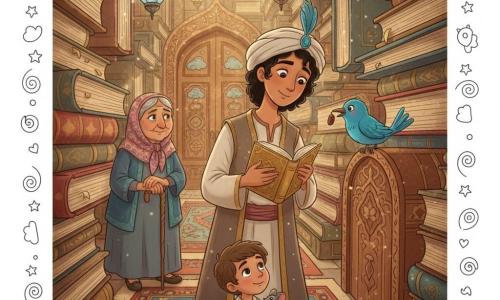
One cool morning, a messenger arrived at Samir's door carrying a bundle wrapped in blue cloth. Inside was a thin manuscript full of tiny drawings and neat notes — a book of curious ideas from the school across the garden gate. It was called a scientific manuscript, and it belonged to the school's wise teacher. The messenger explained, bowing, that the teacher had left for a long journey and the manuscript must be returned to the school before the festival of lanterns. Without it, the children could not finish their simple experiments nor learn the clever ways the teacher wrote about.
Samir felt the manuscript thrum like a caged bird. He was not a runner or a rider; his craft was to join people with threads. Yet threads and books were cousins of a kind: both told stories and kept things together. Samir tucked the manuscript under his arm and promised to return it. The path to the school wound through markets that smelled of spices, across a courtyard where statues pretended to sleep, over a wooden bridge that creaked like an old friend. It should have been a short walk, but the town loved to surprise.
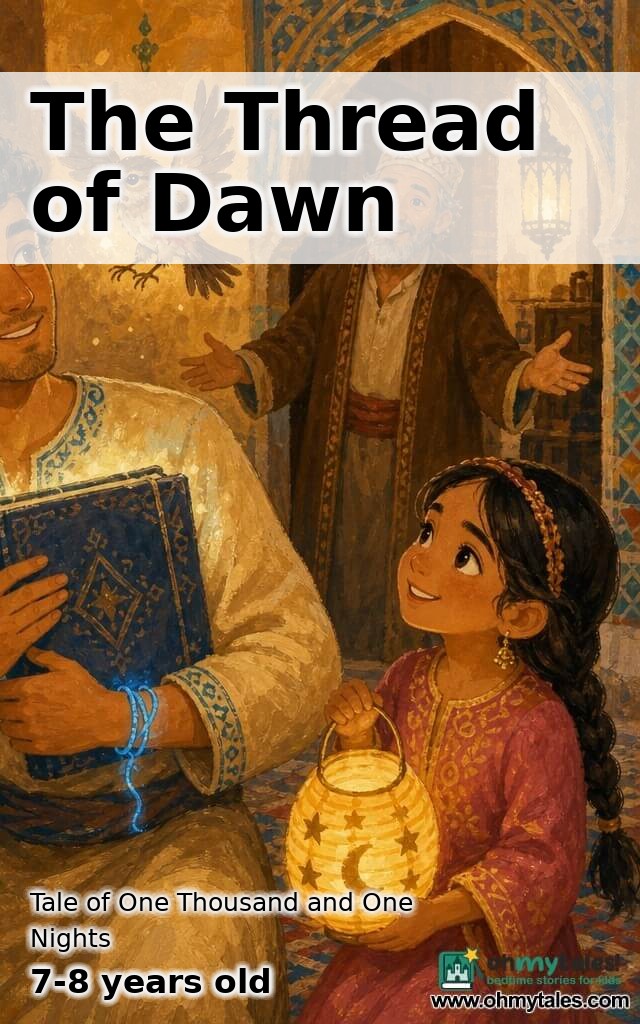
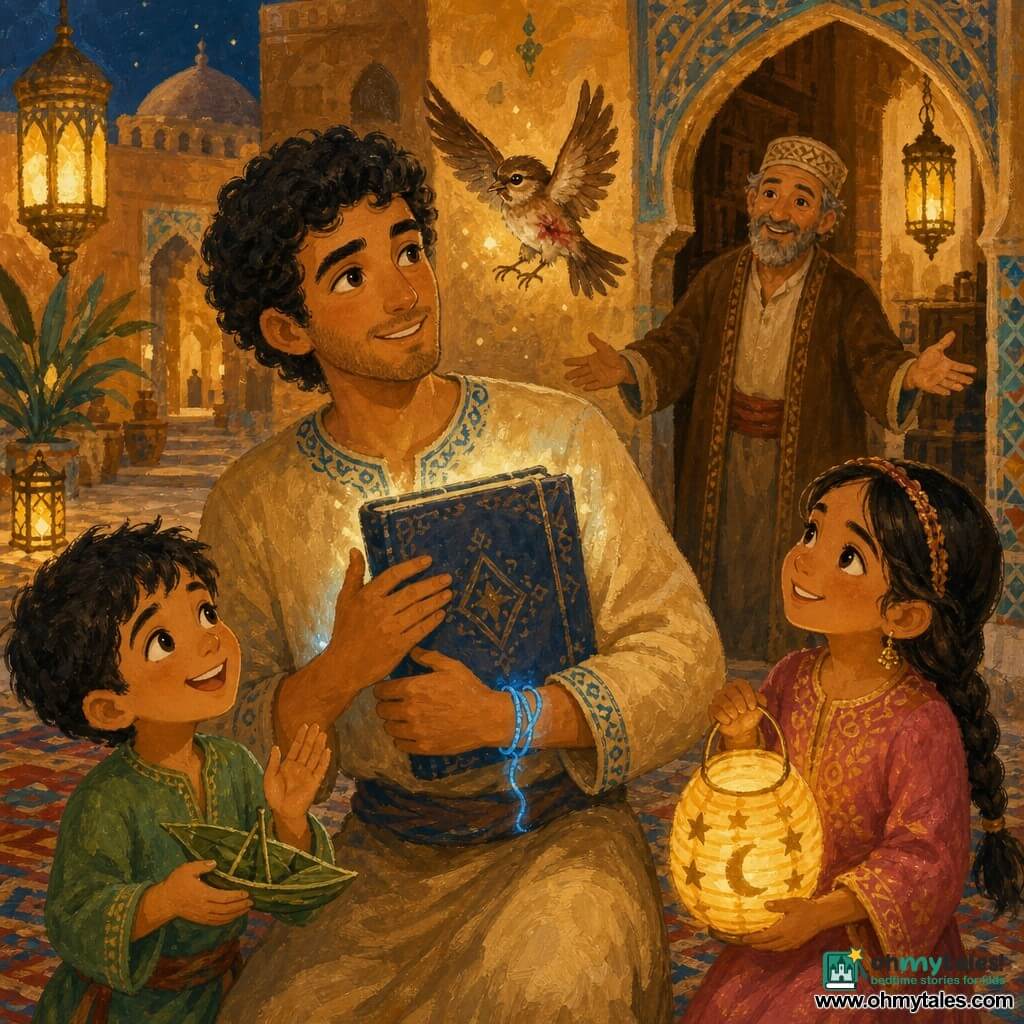
Before he left, his grandmother wrapped his wrist with a small bracelet of knotted blue string. "This is the Thread of Dawn," she whispered. "It remembers your promises. If you are lost, it will show the way. If your heart grows heavy, it will lighten your step." Samir smiled and kissed her wrinkled hand. The bracelet felt warm, as if the sun had slipped inside it.
Chapter Two: The Three Gentle Tests
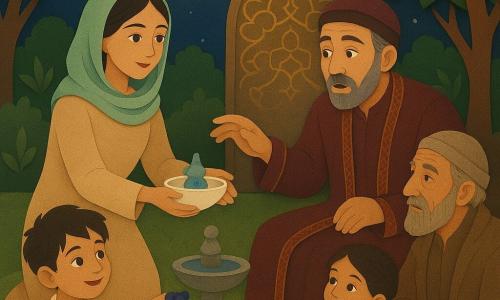
Samir put one foot in front of the other. The manuscript hummed softly against his chest like a sleeping cat. He crossed the spice market where a carpet seller told riddles and a child sold paper stars. He met a woman whose basket had tipped and whose oranges had rolled like tiny suns. Samir stopped and gathered them, stacking orange on orange until the woman could smile again. She thanked him and handed him a folded leaf. "For you," she said, "when the road grows thorny." Samir took it, not knowing how a leaf could help, and set it into his pocket.
Near the fountain, a merchant argued with a baker over a loaf that had been shaped like a crescent moon. The baker's eyes were red with worry; the loaf had been meant for the school feast. Samir listened to both with the patience of a willow tree. He braided a small cord from flour-stiffened cloth and used it to carry the loaf carefully to the baker. He said to them in a soft, steady voice, "If we hold things gently, they stay whole." The cord kept the loaf safe, and both merchant and baker laughed, surprised by how simple mending could be.
As Samir left the market the sky grew a little strange. A thin mist rose that smelled of old stories. It curled around the bridge and beneath it, a voice like silk said, "Only those who answer with kindness may pass." A gate made of woven light appeared before him, and three shapes stepped forward, each a test.
The first was a sparrow, small and bright-eyed. It had a thorn in its wing. Many would have hopped over it or said, "Not my business." Samir thought of the bracelet and the leaflet, of his grandmother's steady hand. He sat and hummed a lullaby he had learned as a child, then eased the thorn out with careful fingers. He wrapped the wing in a scrap of cloth and watched the sparrow fly in joyful loops. The woven gate sighed and opened a little.
The second was an old man who carried a heavy bundle and blinked with tiredness. He had walked far and his shoes were thin as paper. Samir offered him the loaf that had been saved and the merchant's little pouch of coin. The old man smiled like a sunrise and blessed Samir. "A full heart makes the path lighter," he said, and the gate folded another braid of light toward opening.
The third test was the finest. A mirror mist shimmered and from it stepped a child made of shadows. The child had no name and its hands were empty. It looked at Samir with the sort of wide question children ask when they trust the world to answer. Samir understood that this test was not of strength but of cleverness. He reached into his pocket and pulled out the green leaf the woman had given him. He smoothed it and folded it into a tiny boat. Gently he placed the boat on a puddle and blew, making the boat sail. The shadow-child clapped and reached into the puddle to feel the cool water. In that small game, Samir showed that small kindnesses become adventures. The woven gate opened wide enough for him to pass.
With each test passed, the manuscript glowed a little warmer beneath his arm. The world seemed to hum approval. The Thread of Dawn on his wrist thrummed like a kind friend.
Chapter Three: The Night of the Lanterns
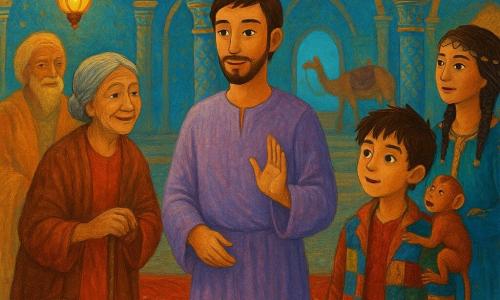
Samir arrived at the school as the sun tipped its hat and the town began to light lanterns. The festival had already begun: children practiced songs, and the air was full of the sweet sound of bowls being tapped and the soft stamping of feet. But at the school, a gentle worry had planted itself like a stubborn seed. The teacher's seat was empty, and the blackboard shimmered with unfinished chalk drawings. The manuscript, meant to reach the teacher before dusk, was now late. The children looked to Samir with hopeful eyes, as if he were a bridge that could be stretched across the sky.
Inside the courtyard, a locked gate stood between Samir and the teacher's study. A sign read, in fine letters, "The door opens for the one who shows patience and truth." Samir pressed his hand to the gate. The Thread of Dawn warmed. He remembered the sparrow and the leaf-boat and how the old man's smile had been like a lantern in fog. He thought of the manuscript's neat drawings — diagrams of stars and the gentle curl of leaves — and how the children would hold them the way children hold a discovered toy.
Samir sat on the stone step and opened the manuscript. It smelled of dust and sunlight. As he turned the pages, he read simple, curious facts written in careful ink. There was a page about moonbeams and how they could be caught in jars if you asked very politely; another about how two drops of water can dance together and become a tiny river. The words and pictures felt like little doors.
A shadow passed. A whisper of wind lifted a lantern and sent it wobbling. The locked gate did not stir. Samir tried the handle; it did not yield. He knocked politely. No one answered. Some might have left then, but Samir's heart was the slow, steady kind that keeps promises. He would not be hurried by doubt.
He thought of the tests he had met and the way each small kindness had loosened a knot somewhere else. Perhaps, he thought, the gate needed not force but a tale. He began to tell the manuscript a story, a quiet tale about the day he rescued the sparrow, about the old man's light laugh, about the child of shadow who loved a folded leaf-boat. His voice was soft and warm like bread. Little by little, the ink on the pages seemed to wake and shimmer. The manuscript hummed like a cage opening.
When he finished, a gentle tapping came from the lock. The gate sighed and slowly swung open. Beyond it, the teacher's study was bathed in lantern light. The teacher stood by the window, having returned earlier than expected. He had been delayed by helping a neighbor whose roof had leaked. He smiled when he saw Samir holding the manuscript. "You have brought more than a book," he said. "You have brought the way of kindness that the book teaches."
Samir felt tired but happy. Outside, lanterns bobbed like friendly moons. The children crowded around, cradling the manuscript as if it were a sleeping bird. The teacher taught them the simplest experiment on the spot: how to catch moonlight on a silver spoon and how to make two drops of water dance. The children's faces were filled with wide, gentle wonder.
Chapter Four: The Return of Light
As the festival warmed into night and the sky stitched itself with stars, the teacher asked Samir to sit. He took a small box from a shelf and opened it. Inside lay a thin spool of golden thread and a small, plain coin. "The spool is a gift for one who binds the town with care," the teacher said. "And the coin will buy you bread when your pockets are light." Samir bowed, but he felt the little bracelet on his wrist buzz like a friendly insect. He slipped the golden thread into his bag and promised himself he would use it well.
That night, Samir walked home by a new route where children carried paper stars on sticks and older neighbors nodded as they passed. He thought of how every test he had met had been a small thing: picking up oranges, holding a loaf safe, folding a leaf into a boat. Each act had opened a door. He understood then that perseverance was like a slow sun: it did not always dazzle, but it warmed whatever it touched until the shadows stepped aside.
In the days that followed, Samir used the golden thread to mend more than shoes. He sewed torn pockets and tied a new swing for the schoolyard. He stitched a patch on a kite and mended the community map that had been torn by wind. He taught the children how to fold leaves into tiny boats and how to listen for the music of two drops meeting. The spool seemed endless because each stitch led to another kind heart, and kindness, such as Samir found, is a chain that can grow very long.
One afternoon, a small door at the bottom of the teacher's study opened just enough for the manuscript to slide out like a shy cat. The children clapped. The teacher lifted Samir's hand and said, "You have learned something the book cannot teach alone. You have learned to keep walking when the road becomes a riddle. That is the best kind of learning."
Samir's bracelet glowed faintly at sunrise. He kept the green leaf in his pocket as a reminder that even things that seem small can sail a long way. He thought of the sparrow's wing and the old man's laugh and the child of shadow who had found joy in a puddle. The town felt warmer, not because the sun had grown stronger, but because many small lights were burning. Lanterns were brighter when more hands lit them.
When asked how he had managed to carry the manuscript safely, Samir would only smile and hold up his hand to show his knotted bracelet. He never boasted. Instead, he would say quietly, "A promise is a kind of map. Keep walking."
And so the town learned to hold promises like paper boats, gentle and brave. The manuscript taught the children clever ideas about stars and water, but Samir taught them the patient art of trying again. He showed them that a promise kept is like a bridge made of light—sometimes thin, sometimes flickering, but strong enough for hearts to cross.
At the next festival, the teacher placed a small plaque on the school gate that read in plain letters, "Here lives a town that remembers." People who passed would touch it and feel a soft warmth, as if someone had just handed them a cup of tea. Samir continued to mend, to listen, to braid friends together. He never sought a crown; his crown was the steady, soft sound of people calling for help and knowing someone would come.
The Thread of Dawn never stopped pulsing on his wrist. It reminded him of all the little ways to be brave: to sit when angry, to laugh when tired, to mend when something is torn. Perseverance, he learned, was not a single great leap but a string of small steps and small stitches. And when you weave enough of these together, you can open any gate — even the ones made of moonlight.
So, in the town with winding streets and lantern songs, Samir kept his promise and taught others to keep theirs. The manuscript rested in its place at the school, and children learned how to catch moonbeams in jars and how two drops of water can dance. More than that, they learned that when the heart is clever and generous, doors that once seemed locked become places to walk through with lanterns held high. The night felt safe and full of tiny lights, and the town slept wrapped in a blanket of quiet bravery, with dreams stitched together by hands that never gave up.