Chapter 1 — The List
Maya liked lists. She liked the thin neat lines she drew with her pencil, the way a completed box felt like a secret prize. On the morning of February sixth she made a new list. Supplies. People to ask. Steps to build a wall.
Her kitchen table smelled of toast and lemon soap. Outside, frost clung to the school bus stop like powdered sugar. Inside, pink paper waited in a tidy stack. Maya smoothed a sheet with two fingers. The paper crinkled softly. It felt important.
“I want a Wall of Thank-Yous,” she said aloud, as if the idea might listen and grow. “A place where everyone can put something they're grateful for.”
Her mother poured cocoa. “Is it for Valentine's Day?” she asked, stirring marshmallows into the steam.
“Sort of,” Maya said. She thought of hearts and giggles, but she thought of other things too: the crossing guard who always waved, the lunch lady who remembered her favorite fruit, the shy boy who held doors. “Valentine's about kindness. That's what I'm aiming for.”
She added tidy ticks to her list. “Borrow a bulletin board. Ask Mr. Harris for permission. Make labels. Bring glue, tape, stickers, real pens—no glitter vault this year.”
Her little brother stuck a sticker upside down on the list. Maya smiled and circled it. Plans could bend. Just a little.
Chapter 2 — The Team
Maya knew she couldn't do the wall alone. She marched through school with a clipboard like a captain. Her first recruit was Ana, who drew wolves and wrote poems in the margins of math worksheets.
“You'll like this,” Maya said. “We'll make it so that anyone can post anything. Big or small. Heart-shaped or not.”
Ana tilted her head. “Can I write a poem about my grandmother's soup?” she asked. “She always adds extra pepper but it is the best.”
“Perfect,” Maya wrote on the list: Ana's poem. She added a smiley face.
Next was Jordan, who liked to test everything with a scientific frown. “What if people only post silly things?” he asked. “Or spam the wall with paper planes?”
“Then we'll make rules,” Maya said, happily. “Friendly rules. No peeking in other people's notes, unless they want you to. No mean words. No paper planes—unless they're labeled ‘adult supervision.'”
Jordan laughed and joined. He even offered to build a simple slot box for anonymous notes. Maya crossed that off with a neat pen stroke. She loved how the plan expanded, like a map filling with little flags.
But not everyone was quick to sign on. Samira, who kept her hair in braids and her thoughts in pockets, looked uncertain. “I don't do Valentine's,” she said. “It feels…awkward.”
“Then don't call it Valentine's,” Maya said gently. “We're doing Thank-Yous. It can be for anything—someone who helped with homework, a dog who learned how to sit.”
Samira blinked. “Okay,” she said, and added two braid-flips to her agreement. Maya put her name on the list.
Chapter 3 — The Trouble with Glue
The week before the holiday the classroom buzzed like a jar of bees. Posters were being cut into hearts, and someone had brought a box of glitter the size of a treasure chest. Maya's methodical calm wobbled when she discovered glitter footprints across the art table.
“Glitter is forever,” sighed Mr. Harris, sweeping a trail like a tired comet. “Even when you think it's gone.”
Maya launched Plan B. No glitter jars. Liquid glue sticks only. Colored string instead of sequins. But rules tangled with small rebellions. Leo folded ten identical red hearts and declared them “official thank-you shapes.” Mei wanted to tape feathers next to her note, and by noon someone had stuck three spoons to the bulletin board because, as one boy argued, “Spoons remind me of cereal and cereal is a kind of love.”
A bigger worry arrived in an email from the principal. “Safety checks,” the message said. “Please ensure all decorations are fire-safe and inclusive.” Maya read the words twice. Inclusive. She felt both proud and nervous.
At recess a group of kids argued in a flurry of voices about who should be thanked first—friends, family, teachers, pets. The voices tangled into something tense and small. A boy named Tyler crossed his arms and said no one ever thanked him; he felt invisible.
Maya unclipped her pencil and walked over. She thought of lists and boxes and little labels that could be sorted. “What if we make room for everyone?” she suggested. “We can have a corner for ‘small thanks'—things like a smile—and a corner for ‘big thanks'—like someone who helped you move.”
Tyler's scowl softened. “Even for someone who moved away?” he asked.
“Especially for them,” Maya said. “Especially.”
Chapter 4 — Different Languages, Same Heart
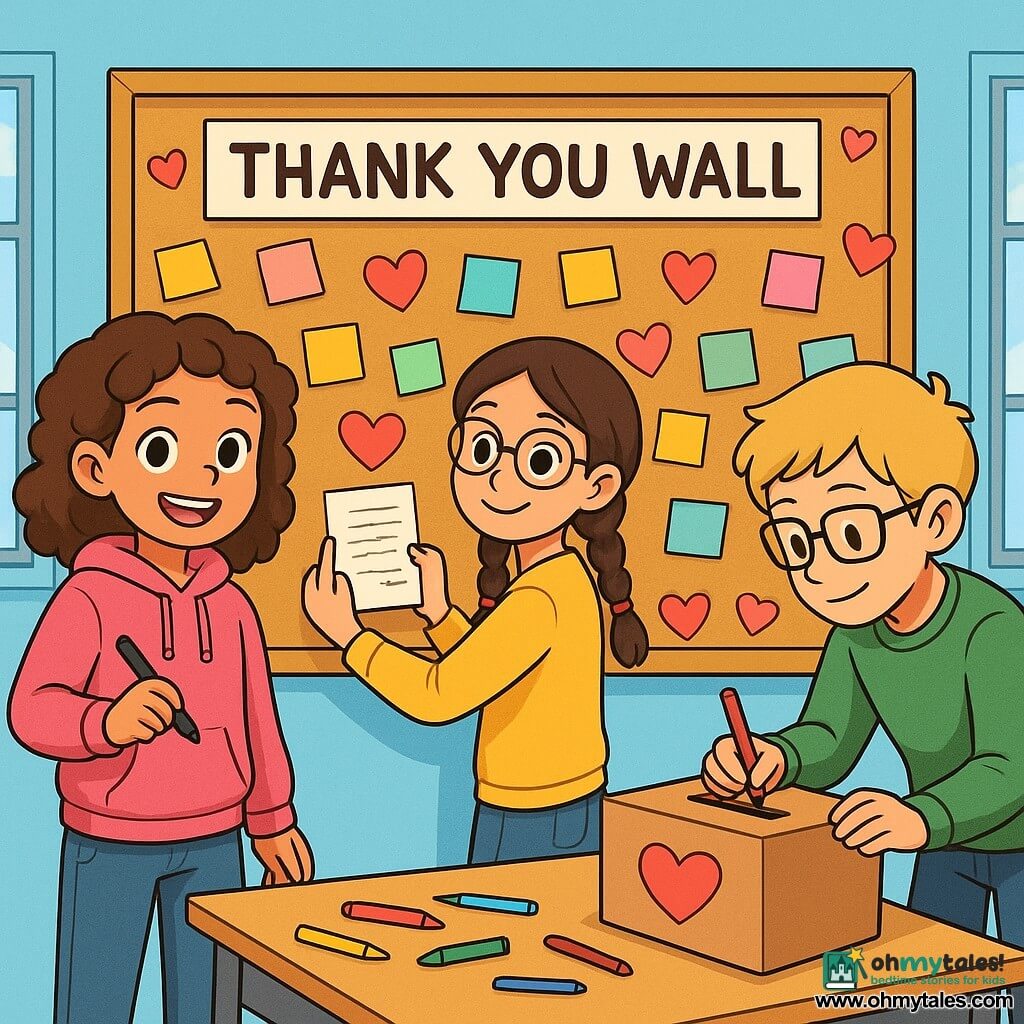
The day the wall went up felt like opening a present. Mr. Harris lent a large bulletin board, and Maya assigned spaces with tidy sticky notes. She hired—or rather, persuaded—two younger students to be “poster guardians,” which meant they handed out pens and scolded over-exuberant sparkles.
People came with all kinds of thank-yous. Mei taped a feathered note that fluttered in the draft and wrote, “Thank you for lending me your umbrella.” Ana posted her poem, ink smudged at the edges, about soup and winter hills. Jordan engineered a tiny, elegant slot where anonymous notes slid in like secrets.
A surprise came from the ESL corner. Mrs. Alvarez brought a collection of thank-yous in many languages—“grazie,” “shukran,” “dziękuję,” “ありがとう.” The letters looked like different kinds of music. Maya pinned them in a bright arc.
Samira placed a folded note that read, in careful handwriting, “Thank you for making space.” There was no heart on it. There didn't need to be.
Some students wrote about people. Others thanked things: “Thank you, library, for quiet corners” and “Thank you, bus driver, for the jokes.” A boy wrote, “Thank you to my sister who taught me to braid shoelaces,” and left a small knot of shoelace beside it.
The wall smelled faintly of paper and cocoa and the lemon cleaner from the janitor's cart. It sounded like whispers and laughter and the occasional hum of the heater. The wall began to sparkle—not with glitter, but with attention.
Chapter 5 — A Little Trouble, A Big Fix
On the morning of the big reveal, someone had left a sticky note with words that weren't kind. Maya discovered it when she was straightening labels. Her stomach did a small drop. She held the paper between two fingers and read: “This is dumb.”
Maya set the paper down and closed her eyes. Her list-making brain started to rearrange. Step one: keep calm. Step two: find witness. Step three: respond with something that won't make it worse.
She asked Jordan to help. They built a small “response corner” next to the mean note and invited students to write why they appreciated the person who had written it—an invitation, not a confrontation. People added notes that were gentle and specific: “I like how you tell jokes at lunch,” and “You throw the best paper planes.”
The mean note stayed, but it was smaller amidst the others. A day later, the writer slipped a note into the anonymous slot. It said, simply, “Sorry. I was having a bad morning.” The wall accepted it like a wide doorway. Maya felt relief like sunshine through a crack.
That afternoon, a parent came in who didn't speak much English. She touched the paper at the edge, shook her head in a soft, delighted way, and traced the word “thank” with a finger. It was a tiny act. Maya stepped closer and offered a cup of cocoa. The woman smiled and pressed her hand to her heart. No words were needed.
Chapter 6 — Smiles Across Windows
Valentine's Day arrived clean and bright. The Wall of Thank-Yous brimmed with folded confessions, comic drawings, careful lists, and hurried scrawls. Children read each other's notes and sometimes blushed or laughed out loud. Mr. Harris read a long note that said, “Thank you for making math less scary,” and pretended to faint in a very dramatic way. It was the perfect kind of performance—equal parts silly and tender.
Not everyone could come to school that day. A few students were sick. One family had to stay home for a relative's surgery. To make room for them, Maya had set up a small tablet near the board. People could video-call and show their messages from wherever they were.
Later, a chime sounded. The tablet screen brightened. On it was Maya's friend Elif, who had moved to another town last month. Her hair was in two quick braids and she was wearing a blue sweater with tiny silver stars. She waved, and the room got a little quieter.
“Look!” Ana called. “Elif's here!”
Elif pointed at the wall, mouth forming the words slowly. “Thank…you,” she mouthed, and then she read a note that Jordan had stuck to the board for her. Jordan's face turned the color of a ripe apple.
Maya pressed her palm to the glass of the tablet. Elif pressed her hand to her own screen. For a second, it looked like their palms would match across the glass. Everyone around them held their breath as if they could lean into the connection.
From the opposite side of the school playground came another small light. Across the street, Mrs. Baker, the retired teacher who sat at her window with a patchwork quilt, saw the crowd and stepped outside. She could not come closer—her knee made long walks difficult—but she came to the window and watched. When she saw the tablet and Elif smiling, she raised a hand and then, carefully, she smiled.
It was not a grand parade smile. It was a soft curve, lived with years. Her eyes crinkled like folded paper. Maya caught the smile and felt something warm and exact in her chest. She raised her hand too, and so did Elif. The gestures were small. They were enough.
Maya thought of her list, of sticky notes, of rules and wings. The Wall of Thank-Yous reached out farther than she'd planned. It made space for voices and apologies, for different languages, for people who preferred not to be hugged but liked to be noticed. It held kindness in many shapes.
When the bell rang, Maya walked home with a folded note in her pocket. She kept her hand in her coat. The street was quiet and the sky was a pale pink. Across from her window, Mrs. Baker's light winked on and off as if sending Morse code of warmth.
Maya pressed the little note to her heart. It said, “Thank you for making a place.” She smiled and looked at the tablet again, where Elif's last face lingered like a stamp. They waved until the screen dimmed.
From inside the house, her brother called, “Did you get everything done, captain?”
“Mostly,” Maya said. She turned and leaned against the cool glass of the window. The city hummed softly beyond the yard. Somewhere, someone was tucking in a child. Someone else was closing a book. Across the street, through a thin pane and a little distance, a light blinked and a kindly face smiled.
Maya raised her free hand and sent it back. Across the space, in a simple, shared moment, the world returned a smile at a distance.