Chapter 1: The Quiet Corner of the Kitchen
Maya was nine, and she could always tell what kind of day it was by the sounds in her kitchen. On good days, the kettle sang and someone hummed. On busy days, cupboards banged like drums.
Today, everything sounded soft.
Her mum moved slowly, making toast but forgetting to eat it. The butter knife rested on the plate like it was tired too. Maya sat at the table and traced tiny circles on the wood with her finger. The house smelled like tea and rain.
“Are we still going to see Grandpa's garden?” Maya asked. Her voice came out smaller than she meant it to.
Mum's eyes looked shiny, like when sunlight hits a puddle. “Not today,” she said gently. “Grandpa won't be there.”
Maya knew Grandpa had been very sick. She had seen the extra pillows, the medicine bottles lined up like little soldiers, and the way grown-ups whispered in hallways. Still, her mind kept trying to fix the sentence, like turning a puzzle piece around and around.
“Where is he, then?” she asked.
Mum sat beside her and put a warm hand over Maya's fingers, stopping the circles. “Grandpa died last night,” she said. “That means his body stopped working. He doesn't feel pain now.”
Maya blinked hard. She didn't cry right away. First she felt empty, like when you open the fridge expecting juice and it's not there. Then a slow heaviness arrived, settling on her shoulders.
“But… he was going to teach me how to prune roses,” Maya said. It sounded unfair when she said it out loud.
Mum nodded. “I know. We can still learn. We'll learn in a different way.”
Maya didn't understand how you could learn something from someone who wasn't there. But she nodded anyway, because Mum's hand was steady, and steady felt important.
That afternoon, Mum showed Maya a small wooden box from the top shelf. Inside were Grandpa's things: a faded photo of him holding Maya on his shoulders, his old penknife, and a notebook with neat writing. Maya touched the notebook like it might be warm.
“Do you want to help me remember him?” Mum asked.
Maya took a breath. “Yes,” she whispered. “I don't want to forget.”
Chapter 2: The List of Thank-Yous
The next day, rain tapped on the windows like polite knocking. Maya sat on her bed with Grandpa's notebook open on her knees. The pages smelled a little like soil and peppermint.
Grandpa's handwriting filled the paper with ordinary things: “Water tomatoes,” “Buy birdseed,” “Maya likes strawberry jam.” That last one made Maya smile and then, in the very next second, made her throat sting.
Maya carried the notebook to the living room. Mum was folding laundry, but her hands kept stopping mid-fold, like her thoughts were somewhere else.
Maya cleared her throat. “Can we make a list?” she asked. “Like… a list of things Grandpa did. So we can say thank you.”
Mum's face softened. “That's a lovely idea.”
So they found a big piece of paper and a marker that squeaked on the first line. Maya wrote at the top: THANK-YOU LIST.
They filled it slowly.
“Thank you for fixing my bike chain,” Maya said, and wrote it down.
“Thank you for telling stories about when you were a boy,” Mum added.
Maya remembered how Grandpa made pancakes shaped like lopsided hearts. “Thank you for funny pancakes,” she said.
Mum laughed once, a small laugh that sounded surprised to be allowed in the room. “He was terrible at making them even.”
Maya wrote: THANK YOU FOR TERRIBLE PANCAKES.
They kept going until the paper was crowded with ink. Maya read the list and felt something gentle under the sadness, like a blanket tucked around her feet. The sad part was still there, but the warm part was there too.
Later, Mum said they would go to the cemetery in two days, after the funeral. Maya had heard the word cemetery before, but it felt different now—like a place she had to learn, the way you learn a new school corridor.
That night, Maya stared at the ceiling and tried to imagine Grandpa. She tried to picture him in the garden, his hands dirty, his hat tilted. Then she tried to imagine “not feeling pain.” It was hard to think about nothing.
Mum came in to say goodnight. Maya tugged at her sleeve. “Is it okay if I still feel… mad?” she asked.
Mum sat on the edge of the bed. “Yes,” she said. “And sad. And confused. Grief is like weather. It changes, and it comes in waves. You don't have to be one feeling only.”
Maya nodded, holding on to the words like a railing.
Chapter 3: The Day of the Cemetery
The funeral was full of grown-up voices and careful footsteps. People hugged Maya and said, “He loved you very much,” and Maya believed them, but the words felt like they were floating above her head.
Afterwards, Mum asked if Maya wanted to go to Grandpa's grave with just the two of them. Maya said yes, even though her stomach did a nervous flip.
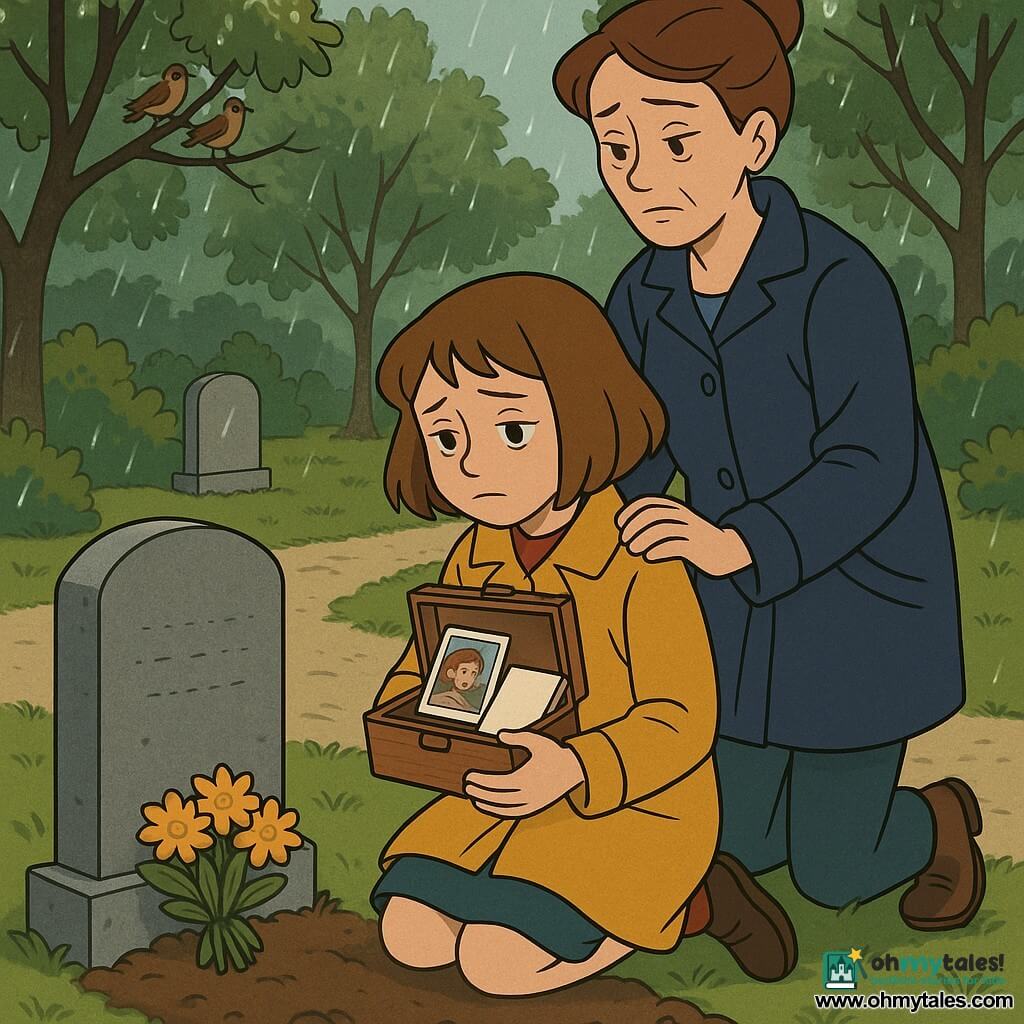
The cemetery was quieter than Maya expected. There were trees with wet leaves and paths made of small stones that crunched under their shoes. Birds hopped between the grass, as if they had errands.
They found Grandpa's grave. The soil looked new and darker than the ground around it. A simple stone stood there with his name. Maya stared at the letters. They were real. Too real.
Mum placed a bunch of yellow flowers down carefully. “He liked cheerful colors,” she said.
Maya swallowed. The air felt cool in her nose. She wanted to talk, but the words got stuck, like they were shy.
Mum stepped back a little, giving Maya space. “You can say something if you want,” she murmured.
Maya leaned closer to the stone. She didn't want other people to hear. It felt like a private moment, like reading a secret note.
So she whispered at the cemetery.
“Hi, Grandpa,” she said softly. “It's Maya. I don't know if you can hear me, but I'm saying it anyway.”
Her voice wobbled. She pressed her hands together, not like a prayer exactly, but like holding herself.
“I'm mad you left,” she whispered. “I know you didn't choose it. Mum says your body stopped working. I keep thinking you'll walk up behind me and say, ‘Hello, pickle,' because you always called me that.”
Maya let out a tiny breath that sounded like a squeak.
“I made a thank-you list,” she continued, very quietly. “Thank you for the bike chain. Thank you for the peppermint candies in your pocket. Thank you for teaching me how to be patient when seeds take forever.”
She paused. The cemetery stayed calm, like it was listening in its own way.
“I'm going to miss you every day,” she whispered. “And I'm going to try to notice the good things you noticed.”
When she stood up, her eyes were wet, but her chest felt a little less tight. Mum put an arm around her, and they stayed there for a moment, just breathing.
On the way back, Maya asked, “Do people always feel this sad when someone dies?”
Mum thought for a while. “People feel it in different ways,” she said. “But love makes grief. If you didn't love him, you wouldn't miss him like this.”
Maya looked down at the crunchy stones. “So… it hurts because it mattered.”
“Yes,” Mum said. “Exactly.”
Chapter 4: A Small Job in the Garden
The next weekend, the rain stopped. The garden behind their house looked bright and a little wild, as if it had been waiting for someone to pay attention again.
Mum brought out Grandpa's notebook and set it on the patio table. “He wrote some garden notes,” she said. “Do you want to help me with one?”
Maya hesitated. Part of her wanted to run away from anything that reminded her of him. Another part wanted to run toward it. Grief, she was learning, could pull you in two directions at once.
She nodded. “Okay. Just one.”
They flipped through the notebook until they found a page titled ROSES. There was a drawing of a stem, and next to it, Grandpa had written: “Trim dead blooms so new ones can grow.”
Maya stared at the sentence. It was about flowers, but it sounded like advice for people, too.
Mum handed her a pair of small gardening scissors. “We'll be careful,” she said. “We'll take our time.”
They knelt by the rose bush. Some flowers were still pink and proud. Others had browned edges and drooped like tired hats.
Maya snipped one dead bloom and held it in her palm. It felt papery. She didn't like throwing it away, as if it had feelings.
“Is it wrong to cut it?” she asked.
Mum shook her head. “No. It's part of caring for it. We're helping the plant use its energy for new growth.”
Maya thought of Grandpa's body stopping. She thought of how Mum said he didn't feel pain now. The idea of “stopping” still scared her, but the garden gave her a picture she could hold: things ended, and other things continued.
When they finished, Maya washed her hands at the outdoor tap. The water was cold and sparkly. She looked at the rose bush again. It didn't look sad. It looked ready.
That evening, Mum made pancakes. They were slightly uneven, and the first one was a strange shape that looked like a boot.
Maya giggled, surprising herself. “Grandpa would approve,” she said.
Mum smiled, and her eyes shone again, but this time it wasn't only sadness. “He absolutely would,” she said.
Maya carried her plate to the table and whispered, almost without noticing, “Thank you.”
Chapter 5: The Glowing Star
A few days later, Mum brought home a small packet from the shop. Inside was a glow-in-the-dark star sticker, the kind you could put on a ceiling.
Maya held it up to the lamp. It looked pale in the daylight, like a little piece of moon.
Mum sat beside her on the bed. “I thought we could choose a place for it,” she said. “Something small you can see at night.”
Maya turned the star over in her fingers. “For Grandpa?”
“For remembering,” Mum said. “And for gratitude. When you see it, you can think of one thing you're thankful for—about him, or about your day.”
Maya considered her ceiling. It was plain white, with a tiny crack in the corner. She had always meant to put posters up, but never got around to it. The crack looked like a thin lightning bolt.
“I want it there,” Maya said, pointing to a spot near the crack. “So it's like a bright friend next to a messy part.”
Mum nodded. “Perfect.”
They cleaned the spot and pressed the sticker carefully. Maya held it for a few seconds, as if it might float away. When she let go, it stayed.
That night, Mum turned off the light, and the room became soft and dark. At first, Maya couldn't see the star. Then, slowly, it began to glow—a quiet greenish light, like a firefly that decided to stay.
Maya lay back and watched it.
Her sadness was still in her, but it wasn't shouting now. It was more like a tired animal curled up, needing care.
Mum stood in the doorway. “Goodnight,” she said.
“Goodnight,” Maya answered. Then, in a voice meant for the glowing star and the memory behind it, she added, “Thank you for loving me, Grandpa. Thank you for the garden. Thank you for the terrible pancakes.”
She closed her eyes. The star kept glowing, steady and patient, and Maya felt that even when something ends, love can leave a light you can still find in the dark.