Chapter 1: Morning Light
The sun woke the garden like a warm blanket. Sam sat on the low stone wall and watched the light move across the leaves. He was seven. He spoke softly to himself. "Good morning, little world."
His house smelled like toast and jam. His mother called, "Sam, come eat!" He padded inside with bare feet. Breakfast was calm. They talked about plans for the day. His mother smiled and tucked a curl behind his ear. "We might visit the museum of traditions," she said. Sam blinked. Museums felt quiet to him. He liked trees and the sound of the brook better. But his mother sounded excited.
After breakfast, Sam put on his cap. He packed a small notebook, a pencil, and a cloth bag for snacks. Before they left, his father handed him a wicker basket. "For picking fruit," his father said. Sam's fingers closed around the handle. The basket felt steady and patient.
Outside, the garden hummed. Bees moved through light like tiny boats. The strawberry plants held red strawberries like secret smiles. Sam knelt and reached gently. The first berry was soft and warm. He tasted it. Sweet juice ran down his chin. He laughed, small and surprised. "It's ripe," he said, and put the berry in the basket.
His parents watched him pick. The quiet made him feel brave. He moved from plant to plant. He learned to look for the right kind of red. He learned to lift the leaf and check underneath. "Not all fruit is ready yet," his mother said. "We wait for the best moment." Sam nodded. Waiting felt like a small, important game.
Chapter 2: The Small Adventures
The path to the town was dusty and warm. Sam held the basket close. He noticed how the light fell through the trees. It made patterns on his shoes. He liked patterns. His father pointed out a bird building a nest. "Look," he said. Sam squinted. The bird moved like a tiny carpenter. He felt happy to see the small work of life.
At the museum, the doors were heavy and painted blue. The museum smelled of wood and old paper. Sam's shoulders rose a little. He feared that museums might be too quiet for his thoughts. Inside, a woman in a linen dress greeted them. "Welcome," she said with bright eyes. Her voice was kind.
They walked slowly through rooms of tools and toys. Sam touched nothing at first. Then he saw a basket like his. It sat under a window with light on it. He thought of the one he carried. The guide told them about old summer days when families picked fruit together and made jam. Sam listened. The words painted pictures in his head. He imagined his grandparents standing by a stove, stirring thick jam until it shone.
In one corner, there was a small display about the town's market. There were wooden scales and painted signs and a jar of buttons. Sam liked the jar. He leaned closer and read the little notes. "See how people saved small things," his mother whispered. Sam thought about saving small moments, like the taste of a strawberry or the sound of a bird.
A child in the group shouted and ran ahead. Sam almost followed. He chose to stay near the basket display. He liked looking slowly. The guide showed them an old map with dotted paths and tiny drawings. Sam traced a finger over a path that led to an orchard. His heart gave a tiny thump. "We had orchards here," the guide said. "People learned how to care for trees from their parents and grandparents."
"You can learn too," the guide added softly, noticing Sam. Sam felt a nudge of comfort. He liked knowing that learning could be gentle, like picking fruit.
Chapter 3: Hands and Stories
After the tour, the guide invited visitors to try making paper jam labels. Sam dipped his fingers in glue and stamps. He pressed a little strawberry onto paper. The stamp left a bright red circle. He smiled. The simple act of pressing felt like a promise.
Outside, the town square had a small fair. There were voices and a soft bell from an ice cream cart. Sam's parents bought him a scoop of lemon sorbet. It was cool and made his tongue tingle. He walked slowly, feeling summer on his face.
They returned to the garden in the late afternoon. The sun was lower now. Shadows grew long and soft. Sam's basket was nearly full. He set it on the table and sat beside it. A gentle breeze moved the leaves. Sam closed his eyes and breathed in the smell of warm fruit and late sun. It felt like a quiet hug.
His mother brought out jars and an old wooden spoon. "Shall we make jam?" she asked. Sam nodded. He loved stirring. He loved the way the fruit broke down and the spoon moved through sticky sweetness. He learned to stir from his father, who showed him how to turn his wrist slowly so the jam wouldn't splatter.
"Remember to taste," his father said with a wink. Sam did. The jam was warm and full. He thought of the museum stories. He thought of the people who had learned these same small tasks years ago. He felt a connection, as if some warm, steady line tied his hands to theirs.
Sam wiped his hands on a towel. He took the basket to the shed and planted the remaining seeds with care. Planting felt like a promise to tomorrow. "We'll see new sprouts," he whispered to the soil.
Chapter 4: Evening Thanks
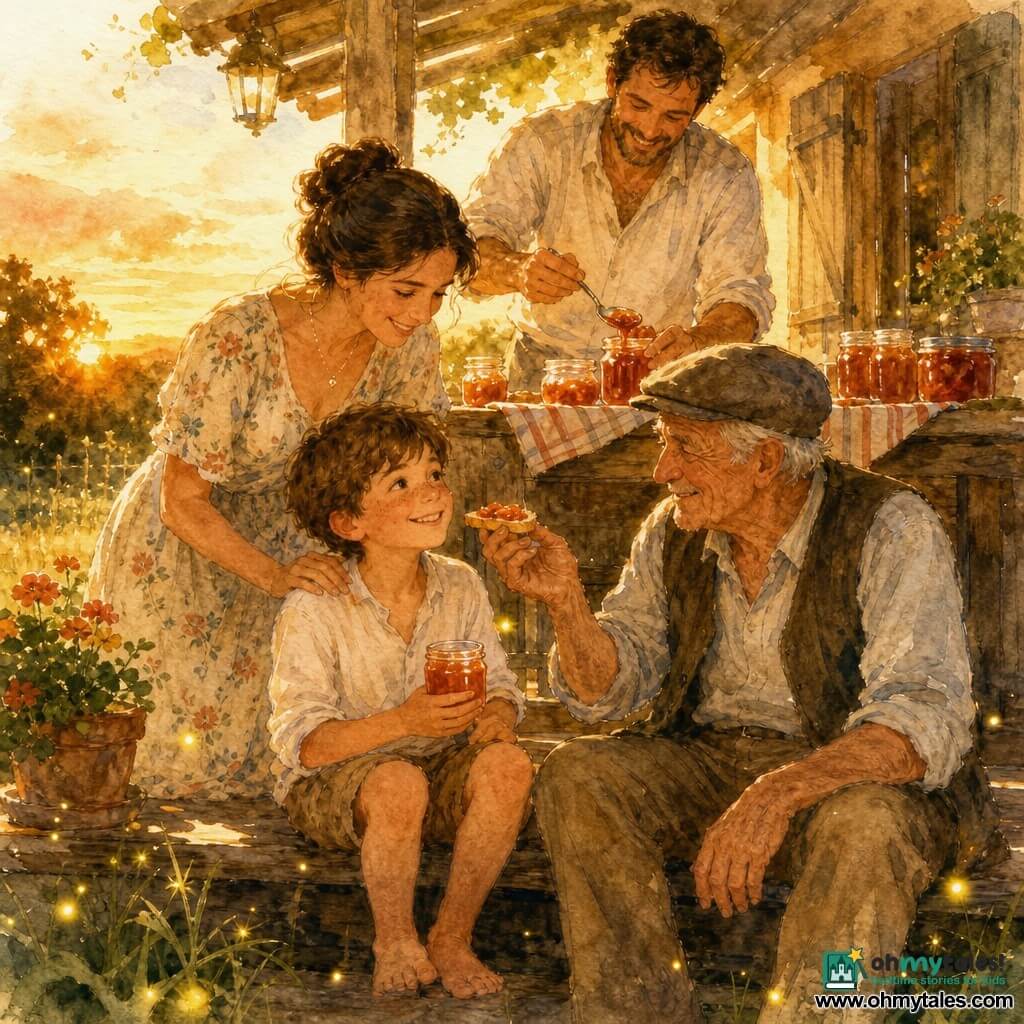
Night arrived with a slow hush. Fireflies began to blink in the grass like tiny lanterns. The family sat on the porch with jars of jam lined up like little suns. Sam held one jar. It was his favorite because he had helped make it.
His grandfather visited for dinner. He had walked across the lane and wore a soft hat. He smelled like the apple trees in autumn. He opened the jar. He spread jam on warm toast and handed a slice to Sam. "To the picker," he said. Sam felt his cheeks warm.
They talked about small things. Sam listened more than he spoke. He told a story about the museum. "They had an old map and a jar of buttons," he said. His grandfather smiled. "We grew up here," his grandfather said. "We picked fruit together and told stories while we worked." Sam felt proud. He realized that his small choices—picking only ripe fruit, learning to stir slowly, making labels—were part of a larger story.
Before bedtime, Sam sat on the porch step with a blanket. The sky softened into lavender. He felt the day's warm sounds settle into a gentle hum. His mother tucked his blanket around his knees. "Thank you for today," she said.
Sam looked at the jar of jam, then at his parents, then at his grandfather. He felt a quiet, steady love like the one that holds a kite string when the wind pulls. He thought of the garden, the museum, the fair, and the small things he had learned. He understood something gentle: every small task can knit people together.
He found words that felt right. "Thank you," he said, looking at each of them. He thanked the sun for the warm morning. He thanked the guide for showing stories. He thanked the garden for its fruit. His voice was soft but sure.
His parents hugged him. His grandfather ruffled his hair. The world seemed kinder when it had names of thanks. Sam put the jar on the windowsill. He liked the way the light made it glow.
That night, Sam dreamed of rows of trees and quiet museums filled with stories. He dreamed of jars lined like friendly stars. He woke the next morning feeling small and brave. He knew he would pick fruit again. He knew he would visit the museum another summer. He knew he would say thank you each time.
The days would pass and the little lessons would stack up like jars on a shelf. Sam felt ready. He had learned that summer holds small gifts and that gratitude makes them shine brighter.