Chapter 1: The Queen Who Listened to Snow
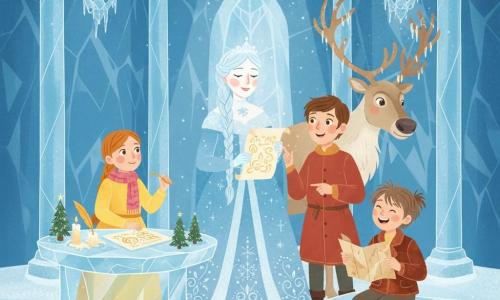
In a palace made of ice that shone like a thousand mirrors, the Snow Queen sat very still. She was not lonely—no, the halls were full of glittering quiet, and quiet can be a friend. Still, the Snow Queen had a secret tucked beneath her white cloak like a warm pebble in a pocket.
She dreamed of translating an ancient language.
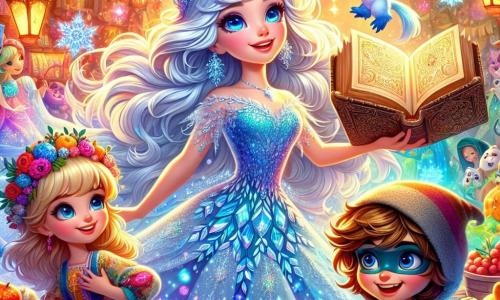
Not just any old words, but the oldest ones—the ones the world whispered before people learned to shout. The letters were carved on pale stones and broken tablets, and the Snow Queen kept them in a silver chest. When she opened it, the symbols looked like tiny snowflakes that had decided to become puzzles.
She traced one with her fingertip.
“What do you say?” she murmured. “Are you a song? A warning? A recipe for hot chocolate?”
The ice around her seemed to giggle. A thin icicle chimed as if it were a laughing bell.
At that moment, the North Wind knocked at the window. He did not knock politely, because winds are like that. He swirled in and bowed, turning into a tall, see-through gentleman in a coat made of mist.
“Your Majesty,” he said, “travelers are near.”
The Snow Queen lifted an eyebrow as sharp as a crescent moon. In the old days, she might have turned cold at once. In some stories, she did. People sometimes remembered only her frost and forgot her listening.
“Travelers?” she repeated.
“Strangers,” the North Wind said. “From far beyond the pine forests. They carry a sled, a small lamp, and a bundle of words.”
“A bundle of words?” the Snow Queen asked, suddenly interested.
The North Wind nodded. “They speak a language I cannot understand. It sounds like pebbles skipping on water.”
The Snow Queen closed her silver chest and stood. Her dress whispered like snowfall. She looked out across her kingdom: frozen lakes like sleeping eyes, snowdrifts like gentle pillows, and the aurora curling above like a ribbon someone had lost in the sky.
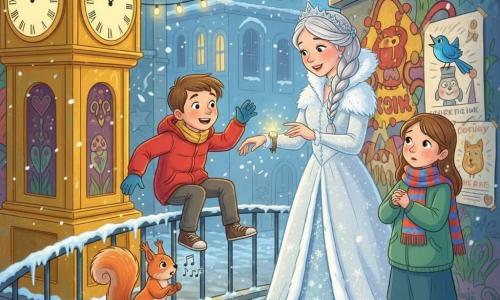
In the courtyard below, a cluster of travelers approached. Their cheeks were red, their boots were thick, and their scarves were bright—little flags of courage.
One small boy at the front lifted his mittened hand. He waved as if waving could warm the air.
The Snow Queen surprised even herself: she waved back.
Then she did something that, in old tales, no one expected.
She went down to greet them.
Chapter 2: The Door That Opened Both Ways
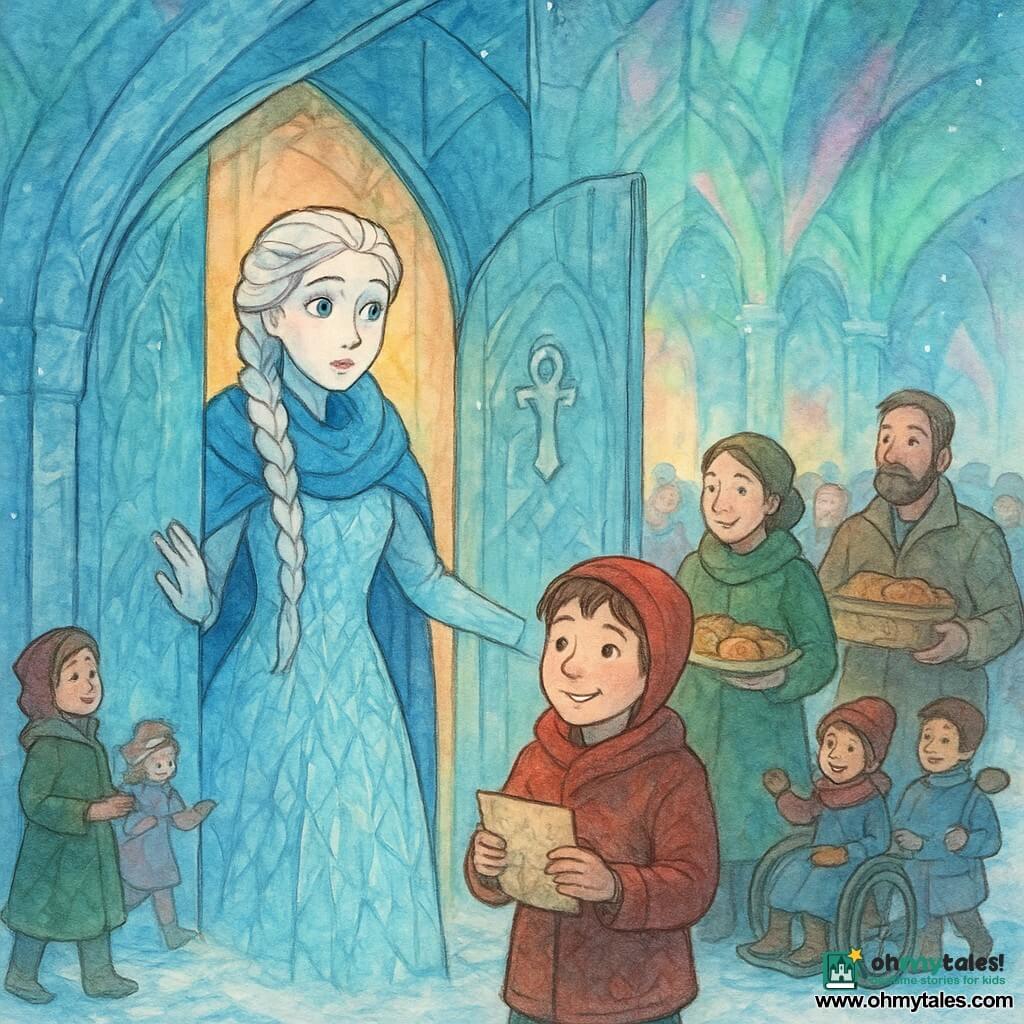
The great palace doors were carved with snowflowers and stars. They usually opened with a solemn groan, as if they were too important to be cheerful. Today, they opened with a lighter sound, like two pages turning in a book.
The travelers stopped. Their eyes grew wide.
The Snow Queen stepped forward. Her crown shone, not with sharpness, but with a calm, clear light, like the moon on fresh snow.
“Welcome,” she said. Her voice was cool, yes, but cool like a clean stream, not like a cruel storm. “You are far from home.”
A woman with kind eyes bowed. “Thank you, Snow Queen. We mean no harm. We are… guests.”
Behind her, a man held a small wooden box, wrapped with string. The little boy clutched a folded paper so tightly it looked as if he feared it might fly away.
The North Wind hovered nearby, trying very hard to look polite.
The Snow Queen noticed the boy's paper. “Is that your bundle of words?”
The boy nodded. “It's… it's my grandpa's. He said it's old. Older than our village.”
The woman added, “We found it in a chest in the attic. We cannot read it. But it felt important, like a letter that never got delivered.”
The Snow Queen's eyes sparkled. Letters that never got delivered were the saddest kind.
“May I see?” she asked.
The boy hesitated. He looked up at her as if she might turn the paper into a snowball.
The Snow Queen knelt, bringing her gaze closer to his. Her cloak pooled on the ice like spilled milk.
“I will be careful,” she promised. “Paper is brave, but it is also shy.”
The boy slowly held it out.
The Snow Queen took it as gently as if it were a sleeping bird. The paper was rough and brown, and the ink was faded. The symbols danced across it in lines that curved like winter rivers.
Her heart made a small, surprising leap. These marks… they were like the ones in her silver chest.
“I have seen this shape,” she whispered, pointing to a sign like a looped hook. “And this one—like a tiny ladder.”
The travelers leaned in. Their breath made little clouds.
“You can read it?” the man asked.
“Not yet,” the Snow Queen admitted. “But I can listen to it. Every language has a music. This one hums like ice under the sun.”
The boy blinked. “Ice can hum?”
“Oh yes,” the Snow Queen said. “It hums when it is happy not to be alone.”
She stood and opened her arms toward the palace. “Come inside. You must be warm. And you must be fed. Even ancient letters cannot be read on an empty stomach.”
The North Wind gasped. “Warm?”
The Snow Queen shot him a look that could have frozen a wink. “Not too warm,” she said. “Just… friendly.”
Inside, the palace was bright, not gloomy. The ice walls held colors like candies trapped in crystal. The travelers walked carefully, afraid to break something.
The Snow Queen clapped her hands once. At once, chairs grew from the floor like polite mushrooms, and a table unfolded like a snowflake opening its arms. A teapot appeared, puffing steam.
The boy's eyes shone. “Magic!”
The Snow Queen smiled—a small smile, but real. “Magic is simply kindness moving quickly.”
They drank hot berry tea that tasted like summer remembering winter. The Snow Queen laid the paper beside her, and she asked the travelers their names and where they came from. She listened as if each word were a bead she might string into a necklace.
When the woman said, “Some people told us not to come. They said the Snow Queen does not welcome strangers,” the room grew quiet.
The Snow Queen looked at the paper again. Then she looked at their tired faces.
“Some stories are old coats,” she said softly. “They keep you warm, but sometimes they do not fit anymore.”
The boy grinned. “My coat is too small already.”
The Snow Queen laughed, and it sounded like tiny bells in snow.
“We will make a new story,” she said. “One with open doors.”
Chapter 3: The Alphabet of Ice and Sun
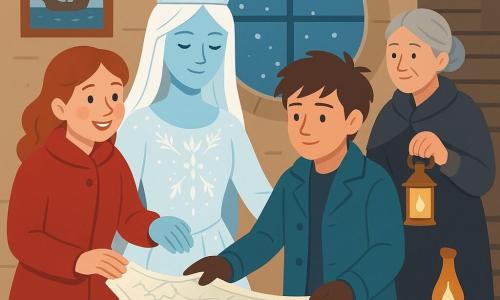
That night, the Snow Queen brought out her silver chest. The travelers gathered around, their curiosity as bright as lanterns.
Inside lay smooth stones and thin tablets, each marked with strange signs. The boy leaned closer, nose wrinkled.
“It's like… secret doodles,” he whispered.
“Secret doodles,” the Snow Queen agreed. “But doodles with long memories.”
She placed the boy's paper beside a tablet. Two symbols matched like cousins meeting at a family party.
The man whistled softly. “So it really is the same language.”
“Yes,” the Snow Queen said. “An ancient tongue. Older than my palace. Older than many fears.”
They worked together. The Snow Queen had sharp eyes, and the travelers had patient hands. The woman was good at noticing patterns. The man was good at making careful copies. The boy was good at asking questions that adults forgot to ask.
“Why does this symbol show up so much?” the boy asked, pointing to a mark shaped like a little open door.
The Snow Queen traced it. “I think it means ‘welcome.' Or ‘come in.' Or perhaps ‘share.'”
The North Wind drifted by the window, peeking in like a nosy cat. “It might mean ‘beware,'” he suggested.
The Snow Queen shook her head. “No. Beware has corners. This has curves.”
The boy giggled. “Beware has pointy elbows!”
They compared signs the way children compare shells. Some letters looked like snowflakes. Some looked like fishbones. Some looked like tiny suns, which made the Snow Queen pause.
“A sun,” she said, surprised. “Why would a winter language have suns?”
The woman shrugged. “Maybe winter people missed the sun.”
The Snow Queen's fingers hovered over the sun symbol. She remembered something, faint as a dream: a time before she had built her palace, when she had stood among people and listened to their laughter. She had not always lived apart. Perhaps she had simply… forgotten how to return.
They found words.
Not many at first. But each one was a candle in a dark hallway.
A line on the tablet became: WE TRAVEL TOGETHER.
Another became: SHARE THE FIRE, SHARE THE STORY.
The boy bounced on his chair. “It's like the language is… hugging.”
The Snow Queen felt warmth in her chest, and it startled her because she was used to feeling warmth only in her hands when she held snow.
Then they reached the longest message, written on the boy's paper. The symbols flowed like a river that had decided to become a sentence.
The Snow Queen spoke slowly, translating as if stepping on new ice.
“TO THE ONE WHO LIVES IN WINTER,” she read, “DO NOT LOCK YOUR HEART. A DOOR THAT NEVER OPENS FOR OTHERS ALSO NEVER OPENS FOR JOY.”
The room fell silent. Even the teapot seemed to stop breathing.
The boy whispered, “Is it… for you?”
The Snow Queen swallowed. Her throat felt tight, as if a scarf had wrapped itself there.
“It might be,” she said. “Or it might be for anyone who feels safer alone.”
The woman reached across the table. She did not touch the Snow Queen—she waited, letting permission be part of the kindness.
“We are glad you opened the door,” she said.
The Snow Queen looked at the open-door symbol again. It no longer seemed like a puzzle. It seemed like a promise.
Outside, the aurora danced. It looked like a green curtain being pulled aside.
The Snow Queen stood. “Tomorrow,” she said, “we will do something new.”
The boy's eyes widened. “More translating?”
“Yes,” the Snow Queen said, “and more welcoming.”
Chapter 4: The Festival of Open Doors
By morning, snow fell in soft flakes, not as an army, but as a choir. The Snow Queen sent the North Wind with a message. This time, he did not slam into windows. He carried her words like a careful messenger.
The message was simple:
ALL ARE WELCOME TO SHARE TEA, STORIES, AND SONGS.
Some people blinked when they heard it. Some frowned. Some whispered, “Is it a trick?”
But curiosity is a strong mitten—it pulls you outside even when the air is cold.
Soon, visitors arrived: a baker from a nearby village with cinnamon rolls wrapped in cloth, a fisherman with a basket of shiny dried fish, children with sleds, and elders with thick books. A family from far away came speaking a different language, their words tumbling like marbles. A traveler with dark skin and bright eyes came with a drum. A girl with a wheelchair arrived, her wheels leaving neat lines in the snow like careful handwriting.
The courtyard filled with voices and laughter that rose into the sky like birds.
The Snow Queen stood at the palace doors. She wore her crown, but she also wore something else: a long scarf in bright blue, a gift from the boy. It looked like a river around her shoulders.
The boy stood beside her like a tiny guard of honor. He announced, very seriously, “The Queen says you can come in. But please wipe your boots. Ice is slippery.”
People chuckled and did as they were told.
Inside, the palace changed. The ice walls held not only colors but reflections of smiling faces. The halls echoed with music and the clatter of cups. The Snow Queen used her magic to make warm rugs of woven frost—soft as clouds, not cold at all.
At a long table, the ancient tablets lay protected under clear ice-glass. Next to them were blank papers and charcoal sticks.
“Today,” the Snow Queen declared, “we share languages. Old and new. Yours and mine.”
The fisherman scratched his head. “I only know a few words from my grandfather.”
“Those are precious,” the Snow Queen said. “A few words can be a bridge.”
The traveler with the drum tapped a rhythm. “In my home,” he said, “we say ‘welcome' like this,” and he spoke a word that sounded like sunshine landing.
The Snow Queen repeated it carefully. The sound felt strange and lovely in her mouth.
The girl with the wheelchair rolled closer. “In my class,” she said, “we learned that some people talk with hands.”
She lifted her hands and signed a greeting. The movement was like birds in flight.
The Snow Queen watched, fascinated. “Your hands speak,” she said softly. “How beautiful.”
The girl taught her a simple sign for WELCOME. The Snow Queen practiced until her fingers made the gesture smoothly, like a ribbon tying itself.
Then, to everyone's surprise, the Snow Queen placed the ancient open-door symbol on a large banner of snowcloth. She carved it with a fingertip, and the mark shone silver.
“This symbol,” she told them, “is from a very old language. It means ‘welcome.'”
The boy pumped his fist. “I knew it!”
People cheered. Someone started a song, and others joined in, even if they did not know the words. They hummed instead, and humming is a language too.
Later, when the festival was at its happiest, a small hush fell as two shy strangers stepped forward. They were bundled in patched coats. Their eyes darted around as if expecting a storm.
The Snow Queen walked to them at once.
“You are welcome,” she said, and she signed it with her hands as well. Her scarf fluttered like a friendly flag.
One of the strangers let out a breath and smiled. “We were afraid,” he admitted.
“Fear is a snowbank,” the Snow Queen said gently. “It looks big until you step over it.”
The stranger laughed, a little. “I like that.”
At the end of the day, the Snow Queen stood again by her silver chest. She did not close it.
Instead, she left it open on the table, beside the tea cups.
The boy yawned and leaned against her cloak. “So… what's the moral?” he asked sleepily, because children sometimes ask the important questions when they are almost dreaming.
The Snow Queen looked around her palace, now full of warm noise and shared crumbs. She thought of the ancient message: A door that never opens for others also never opens for joy.
She answered softly, so the words could settle like gentle snow.
“When you welcome others,” she said, “you welcome new light into your own life. And when you listen to different words, you learn your own heart has more rooms than you knew.”
The boy smiled, eyes closing. “That's a good moral.”
The Snow Queen gazed at the open-door symbol shining on the banner. In it she saw something modern and old at once: a simple shape that said, in every language, You belong here.
Outside, winter still ruled the land—but now it wore laughter like a crown.
And in the Snow Queen's palace, the door stayed open.