Departure from Blue Harbor
Dr. Mira Hale kissed the picture on the wall—a photo of her little niece blowing dandelion seeds—and packed her notebook. She was an exoplanetary biologist, which meant she studied life on other worlds. Today she was heading to the Aurora Ice Refinery, a floating station that turned comet ice into clean water and fuel.
The shuttle hummed like a friendly bee. It wore smooth silver skin and had windows that looked like big eyes. Mira buckled in and checked the small screen. "How are we feeling?" she asked the ship.
"Ready and steady," chirped the ship in a tiny, cheerful voice. Mira smiled. Talking to machines was polite and helped her focus. She loved asking questions, and machines liked giving answers.
Outside, space stretched dark and speckled. The stars were quiet but brilliant. Mira thought about the tiny microbes she studied—if life could live in a puddle on a rock, maybe it could live in the cold water that forms in comet ice. Her job at the refinery would be to study the ice and make sure it was safe. She also wanted to listen for any signals from far away.
"Curiosity," Mira said aloud, "is the best tool." The shuttle tilted, engines whispered, and they sailed past a ribbon of blue gas toward the bright dot where the refinery floated.
The Ice Refinery
The Aurora Ice Refinery was a calm place. It looked like a village of glass and metal, with solar wings that shone like feathers. Robots rolled gently between the modules, carrying jars of sparkling ice. People chatted in soft voices; they drank warm tea that tasted like cinnamon and talked about tiny discoveries.
Mira met her team: Lina, a gentle engineer with ink-stained fingers, and Sam, a pilot who loved telling funny space puns. "Welcome, Dr. Hale," Lina said, handing Mira a soft jacket. "We kept a lab bench warm for you."
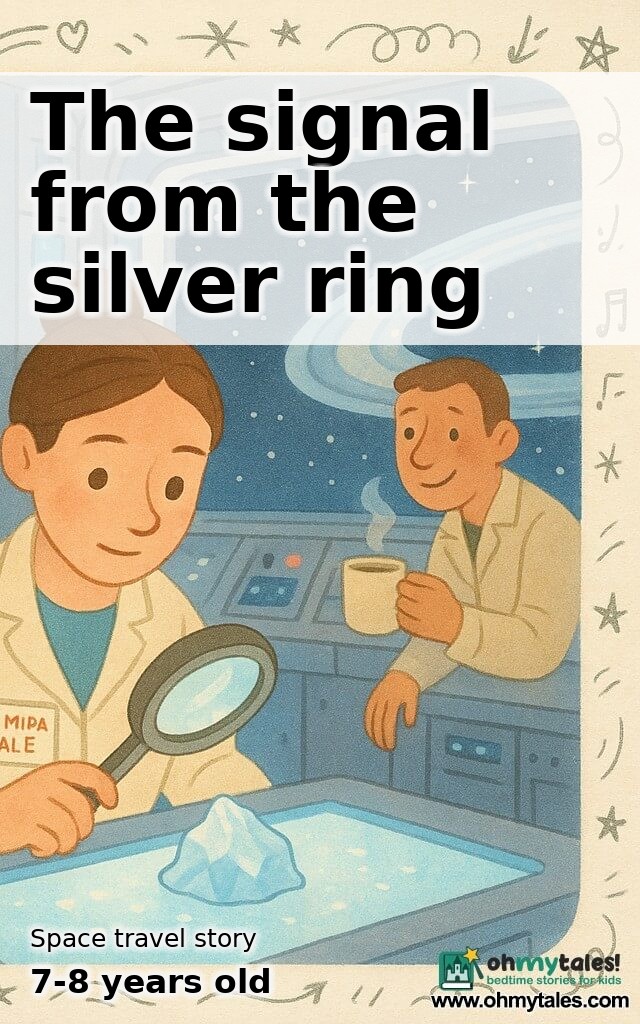
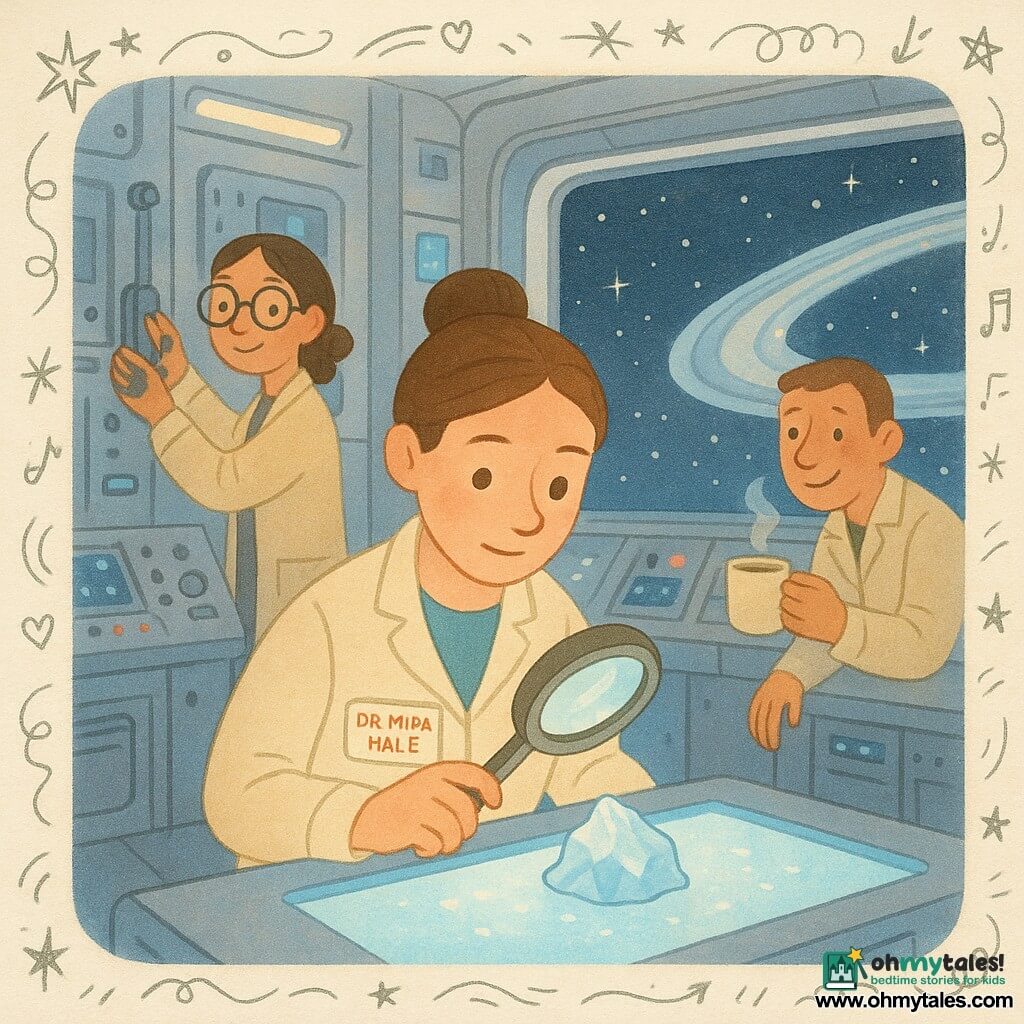
Mira's lab was neat. There were microscopes that hummed quietly and trays of ice samples that glinted like little moons. She opened a sample and breathed in the cold air. The ice smelled clean and faintly metallic. Under the microscope, crystals looked like tiny forests.
As she worked, her instruments blinked. A small green light pulsed and then steadied. A faraway signal—very faint—had been picked up by the refinery's listening array. "Could be a radio blink, or cosmic noise," Sam said. "Sometimes space sings strange songs."
Mira's heart tapped like a bird. She adjusted her tool and smiled. "Let's listen carefully," she said. "Listening is how we learn."
The Signal
They followed the sound. The array turned like a sunflower tracking the sun. The signal was a simple rhythm: ping... ping... pause... ping. It was too regular to be random. The team gathered, eyes wide.
"It's a pattern," Mira said softly. "Not words. But it might be made by something trying to be heard."
Lina checked the ice. "There are tiny bubbles trapped in this core sample," she said. "Maybe the ice can store old signals, like a sea keeps echoes."
Mira thought of a lesson she liked to tell kids: "Patterns are friends. They tell stories." She wrote down the rhythm and tapped it gently on her desk, making it into a little tune. Sam whistled along and laughed. The mood stayed bright—curiosity, not fear, led them.
They tried simple tests. They sent a friendly ping back—single, slow, like a wave—and waited. The reply came, slightly delayed, from a direction beyond the stars. It was not speech, but a steady, repeating echo. Mira used her instruments to map it. The signal's source seemed to be near a dusty ring of ice further out.
"We won't jump to wonder," Mira said. "We'll gather facts. Then we'll imagine carefully."
They learned the signal's pattern matched the frequency that ice crystals make when warmed by thin sunlight. "Maybe it's the comet's own heartbeat being shaped by something," Lina suggested. "Or maybe it's an old beacon."
Sam made a joke: "Maybe space whales sing when they brush their teeth." They all giggled. The laughter helped them keep calm and kind.
Mira recorded everything. She wrote clear notes about time, direction, and sound. Her pen made small, neat loops. Each note was a step toward knowing more.
Evening Light
The team decided not to chase the signal that night. The array module could wait, and the refinery hummed on. Mira put her jacket back on and walked outside. The sky above the station was a soft indigo. Far away, the ring of ice glowed like a silver necklace.
A crew member handed her a steaming cup. "Tea," he said. "For the thinker."
Mira watched the light change. At first it was bright and white, then it grew gentle and warm, and the ice wings of the refinery turned orange-pink. The shadows lengthened. Sam pointed and said, "Look—the refinery is blushing."
They stood quietly. The signal's rhythm still hummed in their notes and instruments, now a friendly companion. It did not need to be solved that evening. Sometimes learning waits and grows like seeds in soil.
Mira thought of the photo she had kissed before leaving—a small face smiling at dandelion seeds. She imagined telling her niece a bedtime story about listening stars and patient scientists. She liked to show how curiosity is brave and kind.
As the sun—distant and soft—slid down behind a ribbon of frozen dust, the light painted the ice in gold. Mira felt calm, full of questions and gentle joy. "Tomorrow," she said, and the word felt like a promise. The refinery lights glimmered; the signal pulsed in a steady way, like a lullaby.
The night arrived like a friendly blanket. Mira closed her notebook and whispered, "Good night," to the listening array. Outside, the stars kept their bright watch. Inside, the team prepared for rest, knowing they would wake ready to learn more.
And as the sun set, the Aurora Ice Refinery shone softly—an island of light on a sea of dark—while the distant signal sang on, patient and small, and Mira listened with a heart full of wonder.